Portable Hydrogen Powered Generator Market Size, Share & Demand Report By Power Output (1–5 kW, 5–10 kW, Above 10 kW), By Application (Construction, Telecommunications, Events & Outdoor Activities, Emergency Backup), By End-Use Industry (Industrial, Commercial, Telecommunications, Government & Defense), By Region & Segment Forecasts, 2025–2034
USD 3950
Market Overview
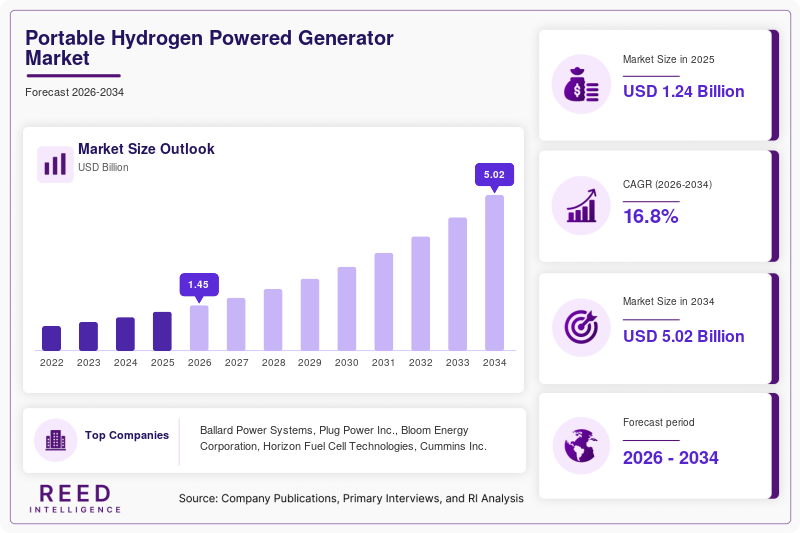
The Portable Hydrogen Powered Generator Market size was valued at USD 1.24 billion in 2025 and is projected to reach USD 4.86 billion by 2033, expanding at a compound annual growth rate (CAGR) of 16.8% during the forecast period (2025–2034). The market size expansion reflects growing adoption of hydrogen-based energy systems as industries transition toward low-emission power alternatives for temporary and mobile electricity generation.
Portable hydrogen-powered generators use hydrogen fuel cells to generate electricity without combustion, producing only water vapor as a byproduct. The market growth has been supported by global decarbonization targets and increasing investments in hydrogen infrastructure, which have accelerated adoption of hydrogen-powered equipment across industrial, commercial, and emergency response applications. Governments and energy agencies have prioritized hydrogen technologies to complement renewable energy systems and replace diesel-based portable generators.
Key Highlights
- Dominant region: North America accounted for 34.2% share in 2025, while Asia Pacific is expected to grow fastest at 18.4% CAGR.
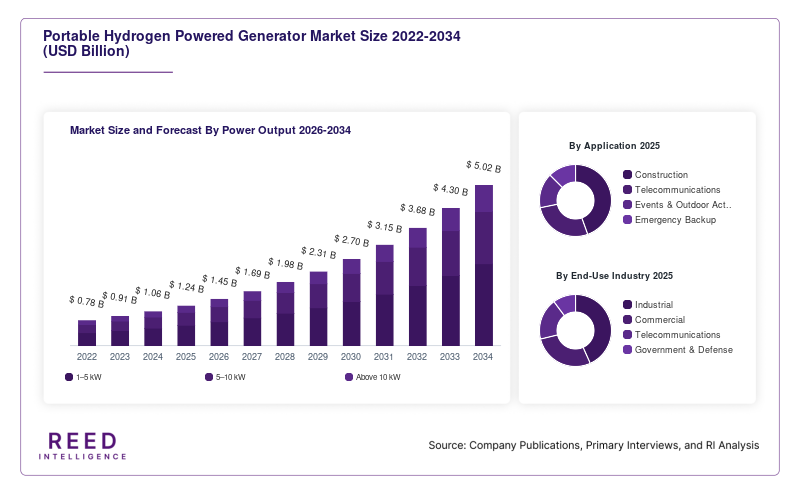
- Leading subsegments: Generators rated 1–5 kW led the power output segment with 42.7% share, while 5–10 kW units will grow fastest at 19.1% CAGR. In applications, construction activities dominated with 31.5% share, whereas telecommunications backup power will grow fastest at 18.7% CAGR.
- Dominant country: The United States recorded USD 356 million in 2025, projected to reach USD 402 million in 2026
Market Trends
Expansion of Hydrogen-Based Portable Energy Systems
A notable trend shaping the Portable Hydrogen Powered Generator Market is the growing deployment of hydrogen fuel cell systems for portable and off-grid energy applications. Companies are integrating advanced proton exchange membrane (PEM) fuel cells into compact generator units to provide stable electricity with minimal emissions. Portable hydrogen generators are increasingly used in outdoor operations, telecommunications towers, and disaster response scenarios where silent and emission-free power is essential. The shift toward hydrogen-based mobile power solutions is further supported by the rising availability of modular hydrogen storage cylinders and transport systems.
Integration with Renewable Energy Infrastructure
Another emerging trend in the Portable Hydrogen Powered Generator Market involves the integration of hydrogen generators with renewable energy systems. Hydrogen produced through renewable electrolysis is being utilized as a storage medium for intermittent solar and wind energy. Portable hydrogen generators are increasingly used as backup units for renewable installations in remote locations. This integration enables continuous power availability even during renewable energy fluctuations. As renewable energy installations expand worldwide, portable hydrogen generators are becoming a complementary technology that supports distributed energy systems and resilient energy networks.
Market Drivers
Rising Demand for Clean Mobile Power Generation
The increasing demand for emission-free and portable electricity generation is a major driver of the Portable Hydrogen Powered Generator Market. Industries that rely on temporary or remote power sources are shifting away from diesel generators due to environmental regulations and operational costs. Hydrogen-powered generators provide a cleaner alternative by eliminating carbon emissions during electricity production. As governments implement stricter air quality regulations, businesses are investing in hydrogen-based portable generators to comply with sustainability goals while maintaining operational reliability.
Expansion of Hydrogen Infrastructure
The expansion of hydrogen production and refueling infrastructure is another factor driving the Portable Hydrogen Powered Generator Market. Investments in hydrogen supply chains, including electrolyzers, storage facilities, and distribution networks, are improving fuel availability for hydrogen-powered systems. As hydrogen accessibility improves, portable generators powered by hydrogen become more practical for industrial and commercial users. Additionally, partnerships between energy providers and equipment manufacturers are enabling integrated solutions that combine hydrogen supply with generator deployment.
Market Restraint
High Initial Cost of Hydrogen Generator Systems
Despite its strong growth outlook, the Portable Hydrogen Powered Generator Market faces challenges related to the high initial cost of hydrogen-powered generator systems. Fuel cell components, hydrogen storage systems, and advanced power management units significantly increase manufacturing costs compared with conventional portable generators.
The complexity of fuel cell technology also increases maintenance and system integration costs. For small-scale users, the upfront investment required for hydrogen-powered generators may limit adoption, especially in cost-sensitive markets where diesel generators remain widely available and affordable.
Additionally, the cost of hydrogen production and transportation remains relatively high in several regions, particularly where hydrogen infrastructure is still developing. These factors may slow market penetration in developing economies. However, ongoing advancements in fuel cell manufacturing processes and scaling of hydrogen production facilities are expected to gradually reduce costs, improving the economic feasibility of portable hydrogen generator systems over the long term.
Market Opportunities
Growth in Disaster Relief and Emergency Power Applications
One emerging opportunity in the Portable Hydrogen Powered Generator Market lies in disaster relief operations. Natural disasters frequently disrupt electricity infrastructure, creating demand for reliable portable power systems. Hydrogen-powered generators can provide rapid, clean electricity without requiring diesel logistics. Emergency response agencies are increasingly exploring hydrogen generators due to their silent operation and lower emissions, which are beneficial for temporary shelters and healthcare facilities.
Adoption in Remote Telecommunications Infrastructure
The expansion of telecommunications networks in remote areas presents another opportunity for the Portable Hydrogen Powered Generator Market. Telecommunications towers often require continuous backup power to maintain network reliability. Hydrogen-powered portable generators offer extended runtimes and reduced maintenance requirements compared with battery-based systems. As global telecom operators expand 5G and rural connectivity projects, hydrogen-powered generators are expected to gain traction as dependable backup energy solutions.
Segmental Analysis
By Power Output
Generators with 1–5 kW power capacity dominated the Portable Hydrogen Powered Generator Market, accounting for 42.7% of the total share in 2025. These systems were widely used in small-scale portable power applications such as outdoor events, mobile workstations, and temporary field operations. The popularity of this capacity range was supported by its compact design and ease of transport. Additionally, these generators offered sufficient electricity output for lighting systems, communication devices, and small equipment, making them suitable for diverse mobile energy needs.
The 5–10 kW power output segment will grow at the fastest CAGR of 19.1% during the forecast period. Demand for higher power portable generators will increase as industries require more reliable energy for multiple devices and equipment simultaneously. These generators will become increasingly popular in telecommunications infrastructure and remote field operations where stable electricity output is required for extended periods. Technological improvements in fuel cell efficiency and hydrogen storage capacity will further support the adoption of generators within this power range.
By Application
The construction segment held the largest share of the Portable Hydrogen Powered Generator Market in 2025, accounting for 31.5% of total demand. Construction sites often require portable power solutions for tools, lighting systems, and temporary offices. Hydrogen-powered generators have become attractive alternatives to diesel-powered equipment due to their reduced emissions and quieter operation. These features are particularly beneficial in urban construction projects where environmental regulations limit the use of traditional combustion generators.
The telecommunications segment will expand at the highest CAGR of 18.7% during the forecast period. Telecommunications networks require continuous power to maintain network connectivity, especially in remote locations. Portable hydrogen generators will gain popularity as backup power solutions for telecommunications towers because they provide longer operational runtimes compared with battery-based systems. Additionally, telecom operators will increasingly adopt hydrogen generators to reduce maintenance requirements and ensure uninterrupted network performance.
By End-Use Industry
The industrial sector accounted for the largest share of the Portable Hydrogen Powered Generator Market in 2025, representing 38.9% of total demand. Industrial operations frequently require temporary electricity for maintenance projects, equipment testing, and remote work sites. Hydrogen-powered generators provided reliable portable power without generating noise and emissions associated with conventional diesel generators. This made them suitable for industrial environments where environmental compliance and operational efficiency are important considerations.
The telecommunications end-use segment will grow at a CAGR of 18.3% through 2034. Increasing demand for reliable network infrastructure will drive the adoption of portable hydrogen generators for backup power applications. Telecom operators will prioritize hydrogen-powered generators because they offer longer operating cycles and lower environmental impact compared with traditional portable power solutions. As telecommunications infrastructure expands globally, this segment will experience sustained growth.
Regional Analysis
North America
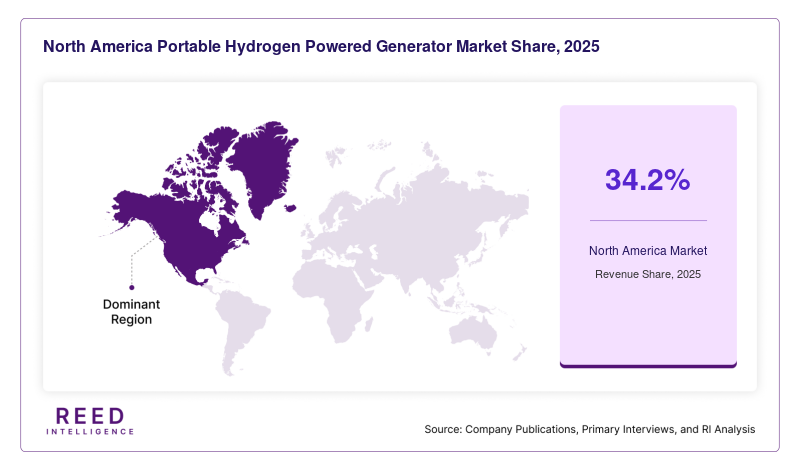
North America accounted for 34.2% of the Portable Hydrogen Powered Generator Market share in 2025, reflecting strong adoption of hydrogen fuel cell technologies in mobile power applications. The region’s market will expand at a CAGR of 15.6% through 2034, supported by investments in hydrogen infrastructure and clean energy initiatives. The increasing focus on reducing emissions from temporary power systems has encouraged industries to adopt hydrogen-powered generators instead of diesel alternatives. In addition, technological advancements in fuel cell systems have strengthened the market outlook in North America.
The United States represented the dominant country in the regional market. Government programs supporting hydrogen development have accelerated the commercialization of hydrogen-powered equipment. The country has experienced strong demand for portable hydrogen generators in emergency management, construction activities, and telecommunications infrastructure. Additionally, the presence of hydrogen technology developers and fuel cell manufacturers has enabled rapid product innovation and commercialization.
Europe
Europe held 27.5% of the Portable Hydrogen Powered Generator Market share in 2025. The region will grow at a CAGR of 16.2% during the forecast period as countries continue implementing policies supporting hydrogen energy systems. Europe’s emphasis on carbon neutrality and sustainable power technologies has encouraged industries to adopt hydrogen-based energy solutions for portable power generation.
Germany has emerged as the leading country within the regional market. The country has promoted hydrogen technology development through national hydrogen strategies and funding programs aimed at supporting clean energy innovations. Industrial users and event organizers have increasingly adopted portable hydrogen generators to comply with environmental regulations while maintaining reliable temporary power supplies.
Asia Pacific
Asia Pacific accounted for 22.8% of the Portable Hydrogen Powered Generator Market share in 2025 and is projected to register the fastest growth rate of 18.4% through 2034. The rapid expansion of construction projects, telecommunications networks, and remote infrastructure has increased demand for portable power systems across the region. In addition, governments have prioritized hydrogen technologies as part of their energy transition strategies.
Japan has remained the dominant country within the Asia Pacific region. The country has long supported hydrogen fuel cell technologies across multiple sectors, including transportation and stationary power generation. Japanese companies have developed advanced portable hydrogen generators designed for disaster preparedness and emergency response operations, which has strengthened domestic demand and technology development.
Middle East & Africa
The Middle East & Africa represented 8.6% of the Portable Hydrogen Powered Generator Market share in 2025 and will grow at a CAGR of 15.1% during the forecast period. The region has shown increasing interest in hydrogen technologies as part of broader energy diversification strategies. Portable hydrogen generators are gaining attention for their ability to provide reliable electricity in remote oil fields, mining operations, and construction sites.
Saudi Arabia has been the leading country in the regional market. The country’s investments in hydrogen production and clean energy infrastructure have created opportunities for hydrogen-powered equipment. Portable hydrogen generators are increasingly considered for temporary power supply in industrial projects and large infrastructure developments.
Latin America
Latin America accounted for 6.9% of the Portable Hydrogen Powered Generator Market share in 2025. The regional market will expand at a CAGR of 14.7% through 2034, supported by increasing demand for portable power solutions across remote industrial operations and construction sites.
Brazil has been the dominant country in the region. The country’s growing construction sector and expanding telecommunications networks have increased demand for reliable off-grid power systems. Hydrogen-powered generators are gradually being explored as alternatives to diesel generators in applications where emissions reduction and noise control are important considerations.
Competitive Landscape
The Portable Hydrogen Powered Generator Market is moderately competitive, with technology developers, fuel cell manufacturers, and energy equipment providers participating in product innovation and commercialization. Companies are focusing on improving generator efficiency, hydrogen storage capacity, and system portability to strengthen their market position.
One of the leading companies in the market is Ballard Power Systems, which has developed hydrogen fuel cell solutions used in portable and stationary power applications. The company continues to invest in advanced fuel cell technologies designed for compact power generation systems.
Other major companies are introducing modular hydrogen generators designed for telecommunications infrastructure, emergency response operations, and industrial fieldwork. Strategic partnerships between energy technology providers and hydrogen infrastructure developers are becoming increasingly common as companies seek to expand product deployment and accelerate market penetration.
Key Players
- Ballard Power Systems
- Plug Power Inc.
- Bloom Energy Corporation
- Horizon Fuel Cell Technologies
- Cummins Inc.
- Toshiba Energy Systems
- Intelligent Energy Limited
- Doosan Fuel Cell
- AFC Energy
- SFC Energy AG
- Nuvera Fuel Cells
- Panasonic Energy
- Hydrogenics Corporation
- GenCell Energy
- Nedstack Fuel Cell Technology
Recent Developments
- In 2024, a fuel cell technology company introduced a new compact hydrogen generator designed for telecommunications tower backup power systems.
- In 2023, an energy equipment manufacturer launched a modular portable hydrogen generator capable of extended runtime using interchangeable hydrogen cartridges.
- In 2024, a partnership between a hydrogen infrastructure provider and a generator manufacturer enabled integrated hydrogen supply solutions for portable generator deployment.
- In 2025, a fuel cell developer expanded production capacity for hydrogen generator systems to support growing demand from industrial and emergency power applications.
Portable Hydrogen Powered Generator Market Segments
By Power Output
- 1–5 kW
- 5–10 kW
- Above 10 kW
By Application
- Construction
- Telecommunications
- Events & Outdoor Activities
- Emergency Backup
By End-Use Industry
- Industrial
- Commercial
- Telecommunications
- Government & Defense
By Region
- North America
- Europe
- APAC
- Middle East and Africa
- LATAM