Postpartum Hemorrhage Treatment Device Market Size, Share Demand Report By Product Type (Uterine Balloon Tamponade Devices, Non-Pneumatic Anti-Shock Garments, Surgical Devices), By Application (Uterine Atony, Trauma-Related Hemorrhage, Other Postpartum Complications), By End-Use (Hospitals, Ambulatory Surgical Centers, Clinics), By Distribution Channel (Direct Sales, Distributors, Online Channels), By Region & Segment Forecasts, 2026–2034
USD 3950
Market Overview
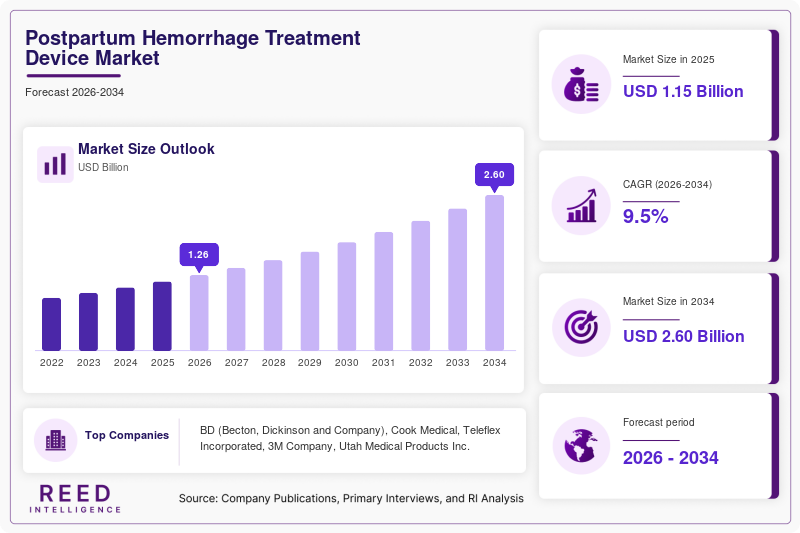
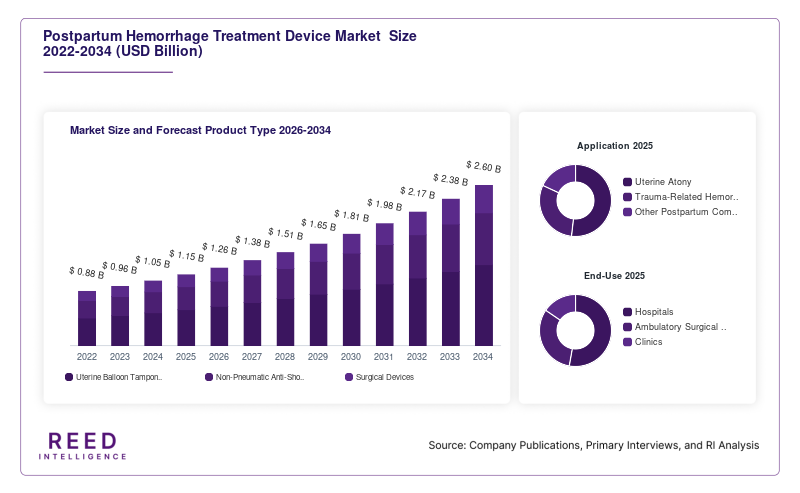
The global Postpartum Hemorrhage Treatment Device Market size was valued at USD 1.15 billion in 2026 and is projected to reach USD 2.38 billion by 2034, expanding at a CAGR of 9.5% during the forecast period (2026–2034). Postpartum hemorrhage (PPH) remains a leading cause of maternal mortality worldwide, driving demand for effective, rapid-response treatment devices across both developed and developing healthcare systems. Increasing institutional deliveries and improved maternal healthcare infrastructure have further supported market expansion.
A major global factor supporting the growth of the Postpartum Hemorrhage Treatment Device Market is the rising emphasis on maternal health programs led by international health organizations and national governments. Initiatives promoting early diagnosis, emergency preparedness, and access to advanced uterine tamponade and hemorrhage control devices have significantly improved treatment accessibility. Additionally, advancements in minimally invasive devices have enhanced clinical outcomes, reducing complications and hospital stays.
Key Highlights:
- North America dominated the market with a 34.2% share in 2025, while Asia Pacific is projected to grow at the fastest CAGR of 11.8%.
- Uterine balloon tamponade devices emerged as the leading subsegment by product with a 41.5% share, while non-pneumatic anti-shock garments are expected to grow at a CAGR of 12.3%.
- Hospitals represented the dominant end-use segment with 62.7% share, while ambulatory surgical centers are projected to grow at a CAGR of 10.9%.
- The United States recorded market values of USD 310 million in 2024 and USD 332 million in 2025.
Market Trends
Increasing Adoption of Uterine Balloon Tamponade Devices
The growing adoption of uterine balloon tamponade (UBT) devices has become a prominent trend in the Postpartum Hemorrhage Treatment Device Market. These devices offer a minimally invasive and highly effective solution for controlling uterine bleeding, especially in low-resource settings. Their ease of use, affordability, and ability to stabilize patients quickly have made them a preferred choice among healthcare professionals. Innovations such as pre-assembled kits and improved materials have enhanced reliability and reduced procedural time. This trend is expected to strengthen as healthcare systems prioritize rapid-response solutions that can be deployed in both tertiary hospitals and rural clinics.
Integration of Portable and Low-Cost Hemorrhage Control Devices
Another notable trend shaping the Postpartum Hemorrhage Treatment Device Market is the development of portable and cost-effective treatment devices tailored for emerging economies. Manufacturers are increasingly focusing on compact, easy-to-transport devices that can be used in remote or under-equipped healthcare settings. Non-pneumatic anti-shock garments (NASGs) and simplified suction-based systems are gaining traction due to their ability to stabilize patients during transportation. This trend aligns with global health initiatives aimed at reducing maternal mortality in underserved regions, thereby expanding market penetration and improving access to life-saving technologies.
Market Drivers
Rising Incidence of Postpartum Hemorrhage Cases
The increasing prevalence of postpartum hemorrhage is a key driver fueling the growth of the Postpartum Hemorrhage Treatment Device Market. Factors such as delayed pregnancies, higher cesarean section rates, and complications during labor have contributed to a growing number of PPH cases globally. This has led to a heightened demand for efficient treatment devices capable of controlling excessive bleeding promptly. Healthcare providers are increasingly adopting advanced solutions to improve patient outcomes and reduce mortality rates, thereby driving market growth.
Technological Advancements in Hemorrhage Management Devices
Continuous technological innovation in hemorrhage management devices is significantly contributing to market expansion. Modern devices are designed with enhanced safety features, improved materials, and user-friendly interfaces, enabling faster and more effective treatment. The development of disposable and single-use devices has reduced the risk of infections and improved procedural efficiency. Additionally, integration with monitoring systems allows clinicians to assess patient response in real time. These advancements are encouraging healthcare facilities to upgrade their equipment, thereby boosting the growth of the Postpartum Hemorrhage Treatment Device Market.
Market Restraint
Limited Access to Advanced Devices in Low-Income Regions
A major restraint affecting the Postpartum Hemorrhage Treatment Device Market is the limited availability and accessibility of advanced treatment devices in low-income and rural regions. Despite growing awareness, many healthcare facilities in developing countries lack the infrastructure and financial resources required to procure modern hemorrhage control devices. This results in continued reliance on traditional methods, which may not be as effective in severe cases.
Additionally, the lack of trained healthcare professionals to operate specialized devices further restricts market penetration. Inadequate supply chains and logistical challenges also hinder the distribution of these devices in remote areas. Although global health initiatives are working to address these issues, the gap between developed and developing regions remains a significant challenge for market growth.
Market Opportunities
Expansion in Emerging Healthcare Markets
Emerging economies present a substantial growth opportunity for the Postpartum Hemorrhage Treatment Device Market. Rapid improvements in healthcare infrastructure, increasing government spending, and rising awareness of maternal health are driving demand for advanced treatment solutions. Countries in Asia Pacific, Africa, and Latin America are investing in healthcare modernization, creating a favorable environment for market expansion. Manufacturers can capitalize on this opportunity by offering cost-effective and scalable solutions tailored to local needs.
Development of Multi-Functional Treatment Devices
The development of multi-functional devices capable of addressing multiple aspects of postpartum hemorrhage management represents another promising opportunity. Devices that combine hemorrhage control with monitoring or fluid management capabilities can improve treatment efficiency and reduce the need for multiple interventions. Such innovations are likely to gain traction among healthcare providers seeking comprehensive solutions. This trend is expected to enhance product differentiation and drive growth in the Postpartum Hemorrhage Treatment Device Market.
Segmental Analysis
By Product Type
Uterine balloon tamponade devices dominated the Postpartum Hemorrhage Treatment Device Market in 2025, accounting for 41.5% of the total share. Their widespread adoption is attributed to their effectiveness in controlling severe bleeding and ease of use in emergency situations. These devices are commonly used in hospitals and clinics as a first-line intervention for managing postpartum hemorrhage.
Non-pneumatic anti-shock garments are expected to be the fastest-growing subsegment, with a projected CAGR of 12.3%. Their ability to stabilize patients during transport and in low-resource settings makes them highly valuable. Increasing adoption in developing regions will drive growth.
By Application
Uterine atony treatment represented the dominant application segment, holding 46.8% of the market share in 2025. This condition is the leading cause of postpartum hemorrhage, necessitating the use of effective treatment devices. Healthcare providers prioritize rapid intervention, contributing to the segment’s dominance.
Trauma-related hemorrhage treatment is expected to grow at the fastest CAGR of 10.7%. The rising incidence of complicated deliveries and surgical interventions will drive demand for specialized devices designed to manage trauma-induced bleeding.
By End-Use
Hospitals accounted for the largest share of 62.7% in 2025, as they are equipped with advanced medical facilities and skilled healthcare professionals. The availability of emergency care units and comprehensive treatment options makes hospitals the primary setting for postpartum hemorrhage management.
Ambulatory surgical centers are projected to grow at a CAGR of 10.9%, driven by increasing preference for cost-effective and efficient healthcare services. The expansion of these facilities in emerging markets will contribute to segment growth.
By Material Type
Silicone-based devices dominated the market with a 38.9% share in 2025 due to their flexibility, durability, and biocompatibility. These materials are widely used in uterine balloon devices, ensuring patient safety and comfort.
Latex-free materials are expected to grow at a CAGR of 11.2%, driven by rising concerns regarding allergies and the need for safer alternatives. Manufacturers are increasingly focusing on developing hypoallergenic products.
By Distribution Channel
Direct sales accounted for the largest share of 54.3% in 2025, as manufacturers prefer direct engagement with healthcare institutions to ensure proper training and product utilization.
Online distribution channels are expected to grow at a CAGR of 12.6%, supported by the increasing digitization of healthcare procurement systems and the convenience of online purchasing.
Regional Analysis
North America
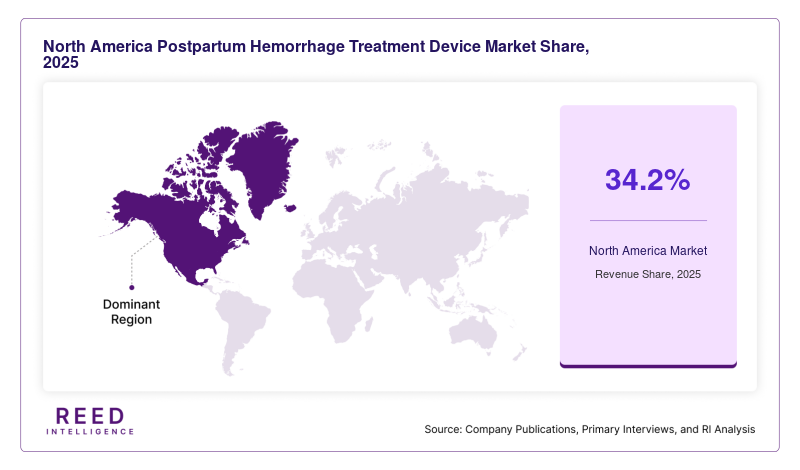
North America accounted for 34.2% of the Postpartum Hemorrhage Treatment Device Market share in 2025 and is expected to grow at a CAGR of 8.7% during the forecast period. The region’s growth is supported by well-established healthcare systems, high adoption of advanced medical technologies, and strong reimbursement frameworks.
The United States remains the dominant country in this region, driven by continuous advancements in maternal healthcare protocols. The presence of specialized maternity care centers and widespread adoption of innovative treatment devices has contributed to market expansion. Increasing awareness among healthcare professionals regarding early intervention techniques further supports growth.
Europe
Europe held a 27.6% share of the Postpartum Hemorrhage Treatment Device Market in 2025 and is projected to grow at a CAGR of 8.9%. The region benefits from robust healthcare infrastructure and strong regulatory support for medical device innovation.
Germany emerged as the leading country, supported by its advanced healthcare system and focus on improving maternal health outcomes. The integration of modern hemorrhage control devices into standard clinical practices has driven adoption. Additionally, government initiatives aimed at reducing maternal mortality rates continue to support market growth.
Asia Pacific
Asia Pacific captured 21.3% of the Postpartum Hemorrhage Treatment Device Market share in 2025 and is anticipated to grow at the fastest CAGR of 11.8%. Rapid urbanization, increasing healthcare investments, and a large patient population are key factors driving growth.
China leads the regional market due to its expanding healthcare infrastructure and rising focus on maternal health. Government programs promoting institutional deliveries and access to emergency obstetric care have significantly boosted demand for treatment devices. The growing presence of local manufacturers also contributes to market expansion.
Middle East & Africa
The Middle East & Africa region accounted for 9.1% of the Postpartum Hemorrhage Treatment Device Market share in 2025 and is expected to grow at a CAGR of 10.5%. The region is witnessing gradual improvements in healthcare infrastructure and increased investment in maternal health programs.
South Africa stands out as a key market, driven by initiatives to improve access to healthcare services in rural areas. Efforts to train healthcare professionals and expand the availability of essential medical devices have supported market growth. The adoption of cost-effective solutions is particularly significant in this region.
Latin America
Latin America held a 7.8% share of the Postpartum Hemorrhage Treatment Device Market in 2025 and is projected to grow at a CAGR of 9.8%. The region is experiencing steady growth due to increasing healthcare awareness and government initiatives focused on maternal health.
Brazil dominates the regional market, supported by its large population and expanding healthcare system. The adoption of advanced treatment devices in urban healthcare facilities has driven market growth. Efforts to improve healthcare access in rural areas are also contributing to increased demand.
Competitive Landscape
The Postpartum Hemorrhage Treatment Device Market is moderately fragmented, with several global and regional players competing based on product innovation, pricing, and distribution networks. Leading companies focus on expanding their product portfolios and strengthening their presence in emerging markets.
BD (Becton, Dickinson and Company) is recognized as a market leader, driven by its extensive range of medical devices and strong global distribution network. The company recently introduced an advanced uterine balloon tamponade system designed to improve ease of use and patient outcomes.
Other key players are actively investing in research and development to introduce innovative solutions and gain a competitive edge. Strategic collaborations, partnerships, and acquisitions are also common strategies adopted by market participants to enhance their market position.
Key Players List
- BD (Becton, Dickinson and Company)
- Cook Medical
- Teleflex Incorporated
- 3M Company
- Utah Medical Products Inc.
- GE HealthCare
- Cardinal Health Inc.
- Medline Industries
- Smiths Medical
- Bactiguard Holding AB
- Zoex Niasg
- Clinical Innovations
- HLL Lifecare Limited
- Fisher & Paykel Healthcare
- Medtronic plc
Recent Developments
- 2025: BD launched an enhanced uterine tamponade device with improved deployment mechanism.
- 2025: Cook Medical expanded its product portfolio with a new hemorrhage control system targeting emerging markets.
- 2024: Teleflex introduced a compact postpartum hemorrhage management device for ambulatory settings.
- 2024: HLL Lifecare Limited partnered with healthcare organizations to distribute low-cost devices in rural regions.
- 2023: Clinical Innovations developed a next-generation balloon tamponade system with improved pressure control features.
Postpartum Hemorrhage Treatment Device Market Segments
Product Type
- Uterine Balloon Tamponade Devices
- Non-Pneumatic Anti-Shock Garments
- Surgical Devices
Application
- Uterine Atony
- Trauma-Related Hemorrhage
- Other Postpartum Complications
End-Use
- Hospitals
- Ambulatory Surgical Centers
- Clinics
Distribution Channel
- Direct Sales
- Distributors
- Online Channels
By Region
- North America
- Europe
- APAC
- Middle East and Africa
- LATAM