Potassium Acetate Market Size, Share & Demand Report By Form (Liquid Potassium Acetate, Solid Potassium Acetate), By Grade (Industrial Grade, Food Grade, Pharmaceutical Grade, Laboratory Grade), By Application (Deicing Agents, Food Additives and Preservatives, Oil & Gas Drilling Fluids), By End-Use Industry (Food & Beverage, Chemical Industry, Oil & Gas, Pharmaceuticals, Aviation and Transportation), By Region & Segment Forecasts, 2026–2034
USD 3950
Market Overview
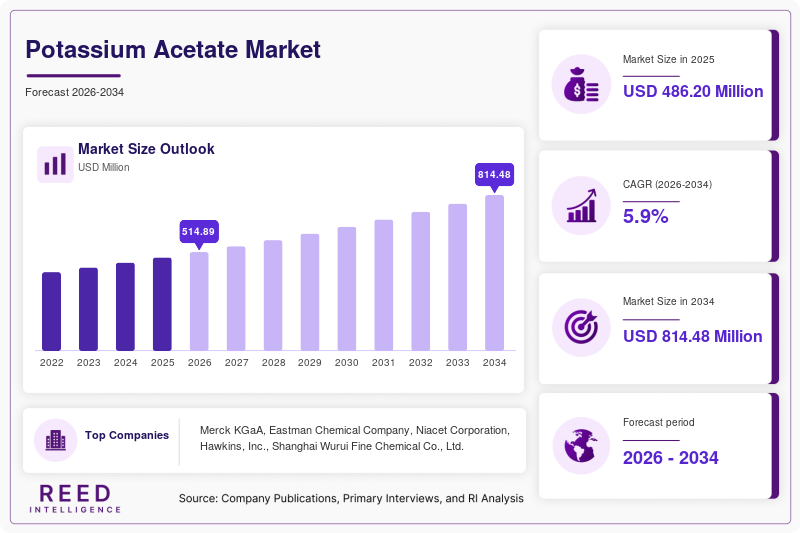
The Potassium Acetate Market size was valued at USD 486.2 million in 2026 and is projected to reach USD 768.5 million by 2034, expanding at a CAGR of 5.9% during 2026–2034. The global Potassium Acetate Market growth has been supported by the rising global emphasis on environmentally safer industrial chemicals and sustainable deicing solutions. Potassium acetate has gained wider adoption across aviation, food processing, oil & gas drilling, pharmaceuticals, and chemical manufacturing because of its low environmental toxicity, high solubility, and effective buffering properties.
The increasing demand for non-corrosive runway deicing agents has contributed significantly to the expansion of the Potassium Acetate Market. Airports and transportation authorities have increasingly replaced chloride-based deicers with potassium acetate formulations to reduce infrastructure corrosion and environmental contamination. In addition, the growing food processing industry has accelerated the use of potassium acetate as a preservative and acidity regulator in packaged food products. The compound has also seen increasing use in drilling fluids due to its compatibility with high-performance oilfield operations.
Key Highlights
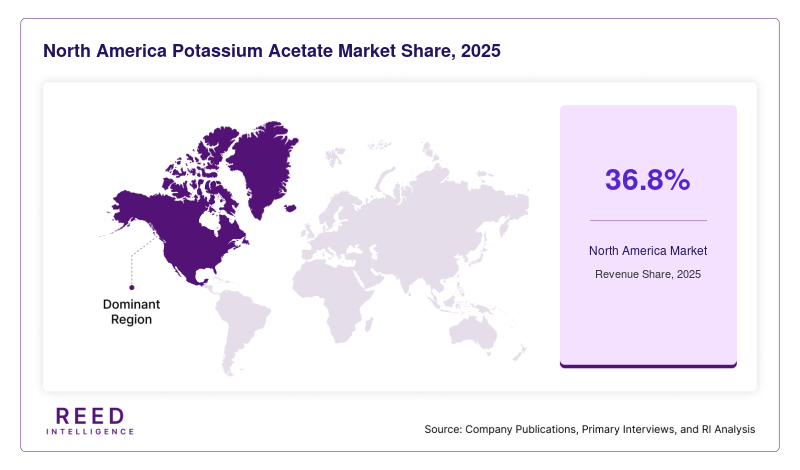
- North America accounted for 36.8% of the global Potassium Acetate Market share in 2025, while Asia Pacific is projected to register the fastest CAGR of 7.1% during 2026–2034.
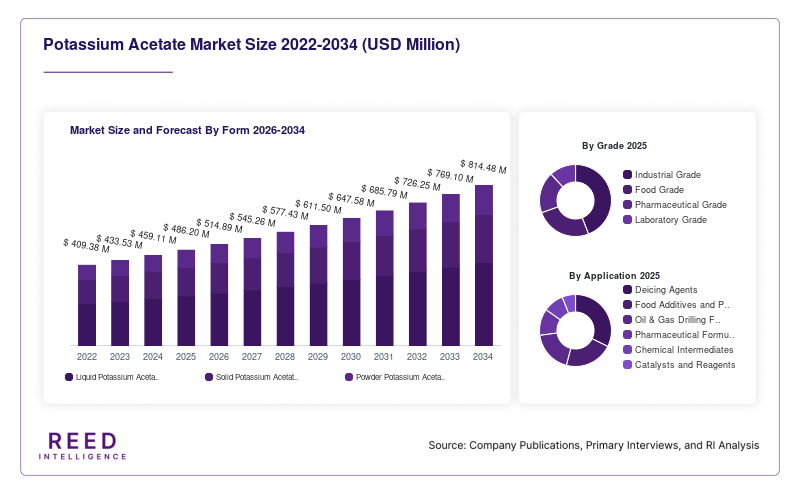
- By form, liquid potassium acetate held the dominant share of 48.5% in 2025, whereas powder potassium acetate is anticipated to witness the fastest CAGR of 6.8% through 2034.
- By grade, industrial grade accounted for the largest market share of 54.2% in 2025, while pharmaceutical grade is forecast to grow at a CAGR of 7.4%.
- By application, deicing agents dominated the market with a 33.7% share in 2025, while pharmaceutical formulations are expected to expand at a CAGR of 7.2%.
- The United States remained the dominant country market, valued at USD 128.6 million in 2024 and USD 134.9 million in 2025.
Market Trends
Increased Adoption of Eco-Friendly Deicing Solutions
The use of potassium acetate in airport runway deicing applications has increased steadily due to environmental regulations targeting chloride-based chemicals. Potassium acetate provides lower corrosiveness and improved biodegradability compared to conventional alternatives. Airports in developed economies have increased spending on sustainable maintenance chemicals, which has positively influenced the Potassium Acetate Market. The trend is expected to continue as aviation infrastructure projects expand globally.
Rising Demand for High-Purity Specialty Chemicals
Manufacturers are increasingly producing high-purity potassium acetate for pharmaceutical, laboratory, and biotechnology applications. Demand for premium-grade specialty chemicals has increased due to stricter quality standards in healthcare and research sectors. This trend has encouraged suppliers to improve purification technologies and optimize production processes to meet pharmaceutical-grade specifications.
Market Drivers
Expansion of Aviation Infrastructure and Runway Maintenance Activities
Growing investments in airport modernization and aviation infrastructure development have accelerated the demand for non-corrosive deicing chemicals. Potassium acetate is widely used for runway and taxiway deicing because it reduces structural damage caused by traditional chloride salts. The increasing number of commercial airports and rising air traffic volumes have strengthened product consumption across North America and Europe.
Increasing Utilization in Oil & Gas Drilling Operations
Potassium acetate has become an important component in drilling and completion fluids due to its compatibility with sensitive geological formations. Oilfield operators increasingly prefer acetate-based fluids because they improve operational stability and reduce environmental impact. The growth of offshore drilling and unconventional oil extraction projects has supported demand across the global Potassium Acetate Market.
Market Restraint
Fluctuating Raw Material Prices
Volatility in raw material costs, particularly acetic acid and potassium hydroxide, has created pricing challenges for manufacturers. Rising energy and transportation expenses have also affected production economics, limiting profit margins for suppliers operating in highly competitive regional markets.
Market Opportunities
Growth in Pharmaceutical and Biotechnology Applications
The pharmaceutical industry is increasingly using potassium acetate in injectable formulations, electrolyte solutions, and laboratory reagents. Rising investments in biotechnology research and healthcare infrastructure are expected to create long-term opportunities for high-purity product manufacturers.
Expansion of Sustainable Food Preservation Solutions
Food manufacturers are adopting potassium acetate as a preservative and acidity regulator in processed food products. The increasing consumer preference for safer food additives and longer shelf-life solutions is expected to support future market growth. Emerging economies are likely to provide new opportunities as packaged food consumption continues rising.
Segmental Analysis
By Form
Liquid Potassium Acetate
Liquid potassium acetate accounted for the largest share of 48.5% in 2025. The segment dominated due to its widespread use in runway deicing applications and industrial fluid formulations. Its high solubility and ease of handling supported strong adoption across aviation and chemical industries.
Powder Potassium Acetate
Powder potassium acetate is expected to witness the fastest CAGR of 6.8% during the forecast period. The segment will grow because of increasing demand from pharmaceutical and laboratory applications where stable storage conditions are required. The ease of transportation and extended shelf life are expected to strengthen product demand.
By Grade
Industrial Grade
Industrial grade potassium acetate held the largest market share of 54.2% in 2025. The segment benefited from extensive use in deicing chemicals, drilling fluids, and industrial processing operations. Large-scale infrastructure projects and aviation activities contributed to segment growth.
Pharmaceutical Grade
Pharmaceutical grade potassium acetate is projected to grow at a CAGR of 7.4% through 2034. The segment will expand due to increasing use in injectable medications, electrolyte formulations, and laboratory research. Rising healthcare investments and stricter quality requirements are expected to support growth.
By Application
Deicing Agents
Deicing agents accounted for 33.7% of the Potassium Acetate Market share in 2025. The segment dominated due to increasing adoption of environmentally safer runway maintenance chemicals. Airports and transportation agencies increasingly preferred potassium acetate because of its low corrosive properties.
Pharmaceutical Formulations
Pharmaceutical formulations are anticipated to grow at a CAGR of 7.2% during the forecast period. The segment is expected to benefit from increasing pharmaceutical manufacturing activities and rising use of specialty acetate compounds in medical products.
By End-Use Industry
Chemical Industry
The chemical industry held the dominant share of 31.4% in 2025. Potassium acetate is widely used as a catalyst, reagent, and intermediate in multiple industrial processes. Expanding specialty chemical production supported strong segment demand.
Pharmaceuticals
The pharmaceutical segment is forecast to expand at a CAGR of 7.0% through 2034. Increasing healthcare expenditures and growing biotechnology research activities are expected to accelerate demand for pharmaceutical-grade formulations.
By Distribution Channel
Direct Sales
Direct sales accounted for the largest market share of 57.8% in 2025. Large industrial buyers preferred direct procurement agreements to ensure stable product supply and pricing consistency.
Online Chemical Platforms
Online chemical platforms are projected to register the fastest CAGR of 7.5% during the forecast period. The growth is expected to be driven by increasing digital procurement practices and expanding e-commerce adoption among laboratory and specialty chemical buyers.
Regional Analysis
North America
North America held 36.8% of the global Potassium Acetate Market share in 2025 and is expected to grow at a CAGR of 5.6% during the forecast period. The region benefited from strong demand for airport runway deicing products and advanced industrial chemical manufacturing infrastructure. The United States dominated the regional market due to large-scale aviation operations and increased use of specialty chemicals in pharmaceutical production. The country’s expanding commercial airport network supported continuous product demand for winter maintenance operations.
Europe
Europe accounted for 28.4% of the global Potassium Acetate Market share in 2025 and will expand at a CAGR of 5.4% during 2026–2034. The region experienced stable demand from environmental deicing applications and food processing industries. Germany emerged as the dominant country because of its advanced chemical manufacturing sector and strong industrial research capabilities. The country also witnessed increasing utilization of potassium acetate in laboratory-grade and industrial formulations.
Asia Pacific
Asia Pacific represented 22.6% of the global market share in 2025 and is projected to record the fastest CAGR of 7.1% during the forecast period. Rapid industrialization and increasing investment in specialty chemical manufacturing contributed to regional market expansion. China led the regional market due to rising production capacity and growing demand from food processing and pharmaceutical industries. Expanding airport infrastructure and urbanization also supported higher consumption levels.
Middle East & Africa
The Middle East & Africa accounted for 6.3% of the global Potassium Acetate Market share in 2025 and is anticipated to grow at a CAGR of 5.1% through 2034. The market growth was supported by increasing oilfield drilling operations and industrial chemical demand. Saudi Arabia dominated the regional market because of ongoing investments in petrochemical production and energy sector expansion. Growing industrial diversification initiatives further supported demand for specialty acetate compounds.
Latin America
Latin America held 5.9% of the global market share in 2025 and is forecast to expand at a CAGR of 5.3% during the study period. Demand for food-grade and industrial-grade potassium acetate increased steadily across the region. Brazil remained the dominant country market due to expanding food processing industries and increasing adoption of industrial specialty chemicals. Infrastructure modernization projects also contributed to product demand growth.
Competitive Landscape
The Potassium Acetate Market remains moderately fragmented with the presence of global specialty chemical manufacturers and regional suppliers. Companies are focusing on capacity expansion, sustainable manufacturing processes, and high-purity product development to strengthen their market positions.
Merck KGaA maintained a strong position in the market due to its extensive specialty chemical portfolio and advanced research capabilities. The company recently expanded its high-purity acetate production capacity to support growing pharmaceutical demand.
Eastman Chemical Company focused on improving sustainable chemical manufacturing operations and expanding industrial-grade product distribution networks. Niacet Corporation strengthened its market presence through food-grade potassium acetate solutions targeted at preservation applications.
Hawkins, Inc. continued to expand its industrial chemical supply operations across North America, while American Elements emphasized laboratory-grade and research-focused acetate products for biotechnology applications.
Key Players List
- Merck KGaA
- Eastman Chemical Company
- Niacet Corporation
- Hawkins, Inc.
- Shanghai Wurui Fine Chemical Co., Ltd.
- Shandong Dayi Chemical Co., Ltd.
- CABB Group GmbH
- American Elements
- MP Biomedicals
- Tokyo Chemical Industry Co., Ltd.
- Avantor, Inc.
- Parchem Fine & Specialty Chemicals
- Thermo Fisher Scientific Inc.
- FBC Industries, Inc.
- Acuro Organics Limited
Recent Developments
- In February 2025, Merck KGaA expanded its specialty acetate manufacturing operations to support pharmaceutical-grade potassium acetate demand.
- In June 2024, Eastman Chemical Company introduced an upgraded sustainable industrial chemical processing initiative focused on reducing manufacturing emissions.
- In September 2024, Hawkins, Inc. expanded its North American chemical distribution network to strengthen supply chain efficiency.
- In January 2025, American Elements launched new high-purity potassium acetate formulations for biotechnology and laboratory applications.
- In August 2024, Niacet Corporation enhanced its food preservation product portfolio with advanced acetate-based ingredient solutions.
Potassium Acetate Market Segments
By Form
- Liquid Potassium Acetate
- Solid Potassium Acetate
- Powder Potassium Acetate
By Grade
- Industrial Grade
- Food Grade
- Pharmaceutical Grade
- Laboratory Grade
By Application
- Deicing Agents
- Food Additives and Preservatives
- Oil & Gas Drilling Fluids
- Pharmaceutical Formulations
- Chemical Intermediates
- Catalysts and Reagents
By End-Use Industry
- Food & Beverage
- Chemical Industry
- Oil & Gas
- Pharmaceuticals
- Aviation and Transportation
By Distribution Channel
- Direct Sales
- Distributors and Wholesalers
- Online Chemical Platforms
By Region
- North America
- Europe
- APAC
- Middle East and Africa
- LATAM