Potassium Hydrogen Sulfite Market Size, Share Demand Report By Grade (Food Grade, Technical Grade, Pharmaceutical Grade, Reagent Grade), By Application (Food Preservation, Water Treatment, Textile Processing, Pulp & Paper, Laboratory Use), By End Use (Food & Beverage Manufacturers, Chemical Processors, Pharmaceutical Companies, Research Institutes, Others), By Region & Segment Forecasts, 2026–2034
USD 3950
Market Overview
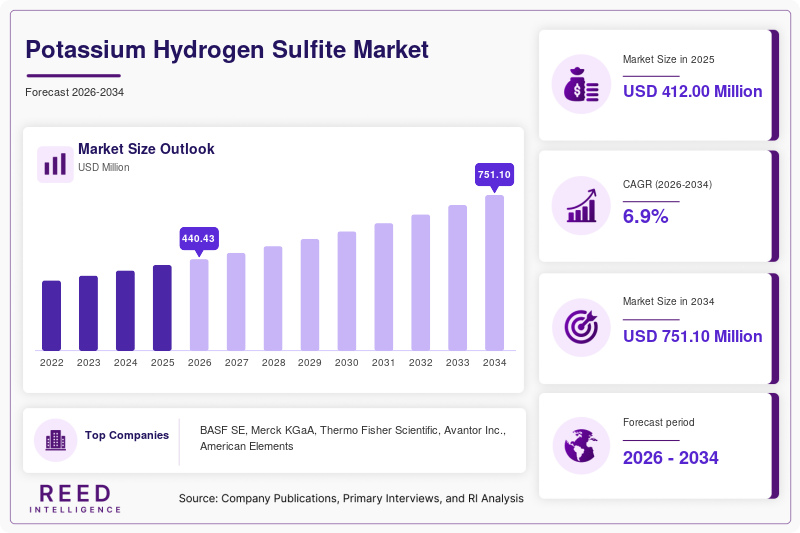
The Potassium Hydrogen Sulfite Market size was valued at USD 412 million in 2026 and is projected to reach USD 706 million by 2034, expanding at a CAGR of 6.9% from 2026 to 2034. Potassium hydrogen sulfite is widely used as a reducing agent, preservative, bleaching aid, and specialty processing chemical across food processing, water treatment, textile finishing, pulp processing, and laboratory applications. Demand remains supported by the broader shift toward efficient chemical additives that improve shelf life, stabilize formulations, and lower oxidation during industrial processing.
A major global factor supporting market growth is the continued expansion of processed food and beverage production. Manufacturers increasingly require sulfite-based compounds for preservation, color retention, and microbial control in selected applications. In parallel, industrial users are adopting cost-efficient treatment chemicals that extend equipment life and improve operational consistency. Emerging economies are also increasing imports of specialty inorganic salts for food-grade and technical-grade manufacturing.
Key Highlights
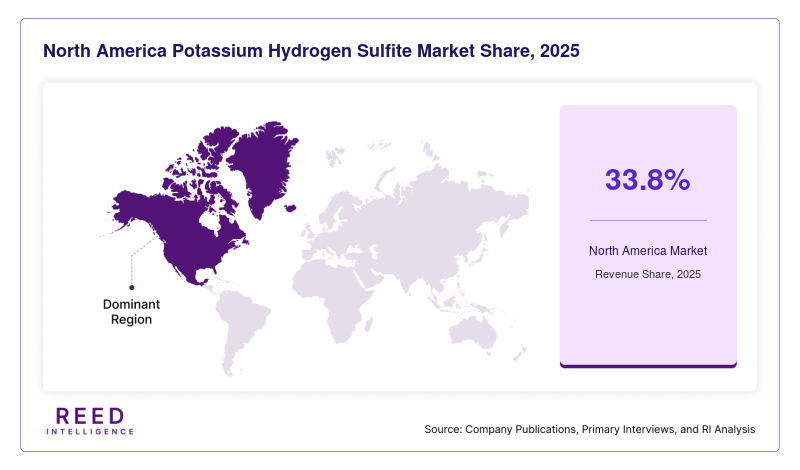
- North America dominated the market with a 33.8% share in 2025.
- Asia Pacific is expected to grow at the fastest CAGR of 8.4% during 2026–2034.
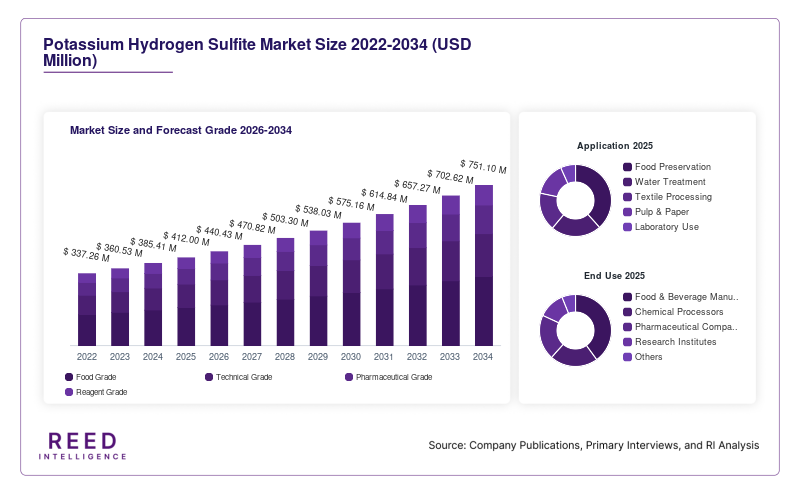
- By grade, food grade accounted for the largest share of 39.6%.
- while pharmaceutical grade is projected to grow at a CAGR of 8.8%. By application, food preservation led with a 36.4% share, whereas water treatment is expected to expand at a CAGR of 8.1%.
- By end use, food & beverage manufacturers held the largest share of 34.9%, while pharmaceutical companies are forecast to grow at 8.6% CAGR. The United States remained the dominant country, with market values of USD 118 million in 2024 and USD 126 million in 2025.
Market Trends
Rising Demand for High-Purity Specialty Grades
The market is witnessing stronger demand for higher-purity potassium hydrogen sulfite grades used in pharmaceutical processing, laboratory reagents, and sensitive food formulations. Buyers increasingly prefer consistent particle size, lower impurity levels, and controlled moisture content to improve batch performance. This trend is encouraging manufacturers to modernize crystallization, drying, and packaging lines. High-purity grades often command better margins than commodity grades, which supports investment in process upgrades. As quality standards tighten across global trade, certified specialty grades are expected to gain share in both mature and developing markets.
Regionalization of Supply Chains and Packaging Formats
Chemical distributors and end users are shifting toward regional sourcing models to reduce freight volatility and inventory risk. Producers are building local storage hubs and offering smaller packaging formats such as sealed drums, lined bags, and moisture-resistant containers. These formats reduce contamination risk and improve handling for medium-scale buyers. Regionalization also helps customers maintain steady production during transport delays. The trend is especially visible in Asia Pacific and Latin America, where industrial customers prefer shorter lead times and flexible order sizes rather than relying entirely on imported bulk shipments.
Market Drivers
Growth in Processed Food Production
Processed food output continues to expand across urban markets, driving demand for approved preservation and stabilization ingredients. Potassium hydrogen sulfite is used in selected food systems where oxidation control, color retention, and microbial stability are important. Rising consumption of packaged bakery products, dried ingredients, fruit preparations, and beverage concentrates creates recurring purchasing cycles. Mid-sized manufacturers are also upgrading ingredient systems to reduce spoilage losses during storage and export transit. As private-label food brands expand, ingredient suppliers are gaining new business from contract manufacturers seeking dependable chemical inputs.
Wider Use in Water and Industrial Treatment
Industrial plants increasingly use sulfite compounds in treatment processes to control oxidation reactions and support water conditioning systems. Potassium hydrogen sulfite offers handling and performance advantages in several controlled applications, including specialty cleaning systems and process water treatment. Manufacturing facilities are under pressure to reduce downtime caused by scaling, corrosion, and inconsistent water quality. This has increased recurring purchases of treatment chemicals. Growth in textiles, pulp, chemicals, and light manufacturing across emerging economies is further supporting industrial consumption volumes.
Market Restraint
Regulatory Limits and Handling Sensitivity
The market faces restraint from regulatory scrutiny related to sulfite use, labeling requirements, worker safety, and storage practices. Food applications are subject to strict concentration limits in many countries, which narrows product use to approved categories and controlled dosage ranges. Industrial buyers must also follow ventilation, moisture control, and safe handling procedures. Smaller manufacturers may avoid sulfite-based systems if compliance costs rise or if substitute chemistries become easier to certify. For example, exporters serving multiple regions often need separate documentation and formulation adjustments, increasing operational complexity. In addition, potassium hydrogen sulfite can degrade under poor storage conditions, leading to shorter shelf life and higher waste if inventory management is weak.
Market Opportunities
Expansion in Pharmaceutical and Laboratory Uses
Manufacturers have an opportunity to develop pharmaceutical-grade and reagent-grade offerings with tighter purity specifications. Research laboratories, diagnostic manufacturers, and pharmaceutical processors require dependable reducing agents and specialty salts for controlled reactions. These customers prioritize traceability, batch consistency, and technical support over lowest price. Producers that secure quality certifications and invest in clean-room packaging can access premium segments. As healthcare manufacturing expands in Asia and the Middle East, regional sourcing opportunities for certified specialty grades are expected to increase steadily through the forecast period.
Untapped Demand in Emerging Industrial Economies
Rapid industrialization in Southeast Asia, Africa, and parts of Latin America creates new demand for water treatment chemicals, textile auxiliaries, and processing aids. Many buyers in these regions are moving from informal sourcing channels to organized chemical distributors that provide technical guidance and compliant packaging. This shift benefits established producers. Companies that build local partnerships, multilingual labeling, and smaller pack sizes can capture first-time industrial customers. Growing food processing capacity in these regions also supports incremental demand from preservation and stabilization applications.
Segmental Analysis
By Grade
Food grade held the dominant share of 39.6% in 2024. This segment benefits from demand across dried foods, beverage concentrates, bakery mixes, and selected processed ingredients requiring oxidation control. Buyers prioritize purity, compliance labeling, and consistent solubility. Established suppliers compete through documentation support, batch traceability, and moisture-resistant packaging. Demand is strongest in regions with expanding modern retail channels and private-label food manufacturing. Food-grade sales also benefit from recurring procurement cycles because food plants often operate under scheduled production runs requiring dependable inventory planning and approved vendor lists.
Pharmaceutical grade is the fastest-growing segment and is projected to expand at a 8.8% CAGR through 2034. Growth is driven by higher quality standards, rising healthcare production, and increasing laboratory use. Customers require low impurities, validated packaging, and stable shelf life. Manufacturers are investing in refined purification systems and controlled filling lines to meet these expectations. Premium pricing in this segment attracts new entrants, although qualification periods remain longer than commodity markets. Expansion of contract drug manufacturing in Asia is expected to accelerate future demand.
By Application
Food preservation was the leading application segment with 36.4% share in 2024. Potassium hydrogen sulfite is used in selected formulations to help maintain color, freshness, and storage stability. Producers of fruit ingredients, syrups, bakery mixes, and beverage bases represent key buyers. Demand remains resilient because reducing spoilage losses often offsets ingredient costs. Suppliers increasingly offer technical guidance on dosage control and compatibility with other additives. In export-oriented food industries, preservation performance during long transport cycles further strengthens recurring demand.
Water treatment is the fastest-growing application and is estimated to rise at a 8.1% CAGR through 2034. Industrial users seek treatment chemicals that help maintain system efficiency and manage oxidation-related issues in process streams. Growing manufacturing capacity in emerging economies is creating new installations that require recurring chemical inputs. Customers value dependable supply, easy handling, and predictable performance. Suppliers that bundle testing support and treatment recommendations can secure long-term contracts, making this segment attractive for expansion.
By End Use
Food & beverage manufacturers represented the largest end-use segment with 34.9% share in 2024. Large processors purchase on contract schedules and prioritize consistent quality, audit readiness, and dependable logistics. Demand spans bakery ingredients, beverage concentrates, dried foods, and specialty preparations. As retail chains expand private-label offerings, co-packers are increasing ingredient sourcing volumes. Multi-site food producers often prefer suppliers capable of servicing several factories with standardized specifications, creating advantages for scaled chemical companies.
Pharmaceutical companies are the fastest-growing end-use segment, advancing at an estimated 8.6% CAGR through 2034. Growth stems from rising medicine output, stronger regional self-sufficiency goals, and increasing use of high-purity specialty chemicals in processing steps. Buyers require extensive quality records, controlled packaging, and technical responsiveness. Once approved, supplier relationships can be sticky and high value. Expansion of generic drug production and research activity in India, China, and the Middle East should continue to support this segment.
Regional Analysis
North America
North America accounted for 33.8% of the market in 2025 and is projected to grow at a 6.1% CAGR through 2034. Stable demand from food processing, specialty chemicals, and water treatment supports the region’s leadership position. Strong distribution networks and consistent quality standards favor established suppliers. Replacement demand from industrial users also contributes to recurring revenue across the United States and Canada.
The United States remains the dominant country in the region. A unique growth factor is the presence of large packaged food manufacturers that require dependable preservative and antioxidant ingredient systems. Continuous investment in food safety automation and ingredient traceability encourages purchases from qualified chemical suppliers with documented quality systems and domestic warehousing capacity.
Europe
Europe held 26.4% share in 2025 and is expected to register a 5.8% CAGR during the forecast period. Demand is supported by specialty food manufacturing, paper processing, and technical chemical uses. Buyers in Europe emphasize compliance, documentation, and sustainable packaging. This favors suppliers capable of providing technical-grade and food-grade variants with reliable shipment schedules.
Germany leads the European market due to its advanced manufacturing base and strong specialty chemical ecosystem. A unique growth factor is the region’s emphasis on process efficiency in industrial plants, where controlled treatment chemicals are used to reduce waste and improve production consistency. This supports repeat demand from industrial customers.
Asia Pacific
Asia Pacific represented 24.7% of the market in 2025 and is forecast to expand at the fastest 8.4% CAGR through 2034. Rising processed food output, growing pharmaceutical manufacturing, and expanding industrial water systems are major demand drivers. The region is also benefiting from new local production capacity that lowers import dependence and improves price competitiveness.
China is the dominant country in Asia Pacific. A unique growth factor is its large integrated manufacturing clusters, where chemical distributors serve food, textile, and industrial customers within concentrated zones. This structure reduces logistics costs and accelerates adoption of specialty inorganic salts across multiple end uses.
Middle East & Africa
Middle East & Africa captured 8.1% share in 2025 and is projected to grow at a 7.2% CAGR by 2034. Market expansion is supported by water scarcity challenges, rising food imports, and new industrial projects. Demand is gradually shifting from small-volume importers toward organized procurement contracts with regional distributors and storage partners.
Saudi Arabia leads the region. A unique growth factor is investment in industrial water treatment and food security initiatives, which increase demand for processing chemicals and preservation ingredients. New industrial zones and warehousing networks are also improving product availability across the Gulf region.
Latin America
Latin America accounted for 7.0% share in 2025 and is expected to grow at a 6.7% CAGR over the forecast period. Food exports, beverage processing, and textile applications support regional demand. Market growth is also aided by improving access to specialty chemicals through regional distributors that offer technical assistance and smaller shipment lots.
Brazil dominates the regional market. A unique growth factor is its large agricultural processing sector, which creates demand for preservation, ingredient stabilization, and export-oriented packaged food production. Industrial modernization in pulp and textile facilities further supports steady consumption volumes.
Competitive Landscape
The Potassium Hydrogen Sulfite Market is moderately fragmented, with global inorganic chemical manufacturers competing alongside regional specialty salt suppliers. Competition centers on purity standards, pricing, packaging reliability, and regulatory documentation. Companies are expanding warehousing footprints and building distributor partnerships to improve delivery speed.
BASF SE remains a leading participant due to its broad chemical portfolio, technical support capabilities, and global customer network. A recent development in the market includes several producers launching moisture-protected packaging lines to reduce product degradation during long-distance transport. Other active companies focus on customized grades for food and pharmaceutical buyers. Strategic priorities across the industry include capacity balancing, long-term supply contracts, and penetration into emerging industrial economies.
Key Players List
- BASF SE
- Merck KGaA
- Thermo Fisher Scientific
- Avantor Inc.
- American Elements
- Parchem Fine & Specialty Chemicals
- Noah Chemicals
- Triveni Chemicals
- Shandong Xintai Chemical
- Hebei Chengxin Group
- Aditya Chemicals
- Loba Chemie
- Otto Chemie
- GFS Chemicals
- Sisco Research Laboratories
- Airedale Chemical
- Vizag Chemical
Recent Developments
- Several Asian manufacturers expanded specialty salt packaging capacity in 2025 to support export demand.
- European suppliers introduced enhanced traceability systems for food-grade batches during 2025.
- North American distributors signed multi-year supply agreements with regional food processors in 2026.
Potassium Hydrogen Sulfite Market Segments
Grade
- Food Grade
- Technical Grade
- Pharmaceutical Grade
- Reagent Grade
Application
- Food Preservation
- Water Treatment
- Textile Processing
- Pulp & Paper
- Laboratory Use
End Use
- Food & Beverage Manufacturers
- Chemical Processors
- Pharmaceutical Companies
- Research Institutes
- Others
By Region
- North America
- Europe
- APAC
- Middle East and Africa
- LATAM