Potassium Ion Battery Market Size, Share & Demand Report By Type (Organic Potassium Ion Batteries, Inorganic Potassium Ion Batteries), By Application (Energy Storage Systems, Consumer Electronics, Others), By End-Use (Utilities, Industrial, Residential, Commercial) & Segment Forecasts, 2025–2034
USD 3950
Market Overview
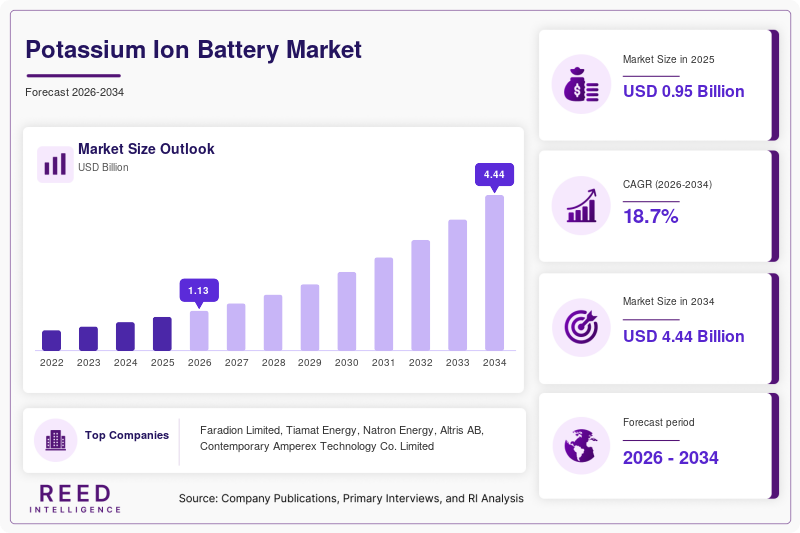
The Potassium Ion Battery Market size is estimated to reach USD 0.95 billion, followed by a steady rise to approximately USD 1.18 billion in 2026. Over the forecast period from 2025 to 2034, the market is projected to expand significantly, reaching USD 5.62 billion by 2034, registering a compound annual growth rate (CAGR) of 18.7%. This growth trajectory reflects increasing investments in next-generation battery chemistries and the growing need for scalable energy storage solutions.
Potassium ion batteries are gaining attention due to their potential advantages over lithium-ion counterparts. Potassium is more abundant and less expensive than lithium, which helps reduce overall production costs and supply chain risks. Additionally, these batteries demonstrate favorable electrochemical properties, including high ionic conductivity and compatibility with existing battery manufacturing infrastructure. This compatibility allows manufacturers to adapt existing production lines, thereby reducing capital expenditure and accelerating commercialization.
Key Highlights
- The market is expected to expand significantly, growing from USD 0.95 billion in 2025 to USD 5.62 billion by 2034.This strong upward trajectory reflects increasing adoption of alternative battery technologies across multiple industries.
- The market is projected to register a CAGR of 18.7% during the forecast period from 2025 to 2034.This growth rate indicates sustained investment and technological progress in potassium-based energy storage solutions.
- There is a growing emphasis on developing low-cost and sustainable battery technologies.Potassium ion batteries are gaining traction due to abundant raw materials and reduced environmental impact.
- Demand for grid-scale and stationary energy storage solutions is rising steadily worldwide.This is driven by renewable energy expansion and the need for reliable power management systems.
Market Trends
Increasing Research and Development in Alternative Battery Chemistries
A significant trend shaping the Potassium Ion Battery Market is the surge in research and development activities focused on alternative battery chemistries. Governments, academic institutions, and private companies are investing in developing potassium-based systems to reduce dependence on lithium resources. This trend is driven by concerns related to lithium supply constraints and price volatility. Researchers are exploring advanced cathode and anode materials, such as Prussian blue analogs and carbon-based electrodes, to improve energy density and cycle stability. These developments are gradually bridging the performance gap between potassium ion and lithium-ion batteries, enabling broader adoption across multiple industries.
Integration of Potassium Ion Batteries in Renewable Energy Systems
Another key trend is the growing integration of potassium ion batteries into renewable energy storage systems. As solar and wind energy installations increase globally, there is a rising need for cost-efficient and scalable storage technologies. Potassium ion batteries offer advantages such as lower material costs and stable performance under varied environmental conditions. Energy providers are exploring these batteries for stationary storage applications, especially in regions where cost sensitivity is high. This trend is expected to accelerate as renewable energy capacity expands and the need for reliable storage solutions becomes more critical.
Market Drivers
Abundance and Cost Advantage of Potassium Resources
One of the primary drivers of the Potassium Ion Battery Market is the abundance and affordability of potassium resources. Unlike lithium, which is geographically concentrated and subject to supply chain risks, potassium is widely available across the globe. This abundance translates into lower raw material costs, making potassium ion batteries an economically viable option for large-scale applications. The reduced cost structure is particularly beneficial for grid storage systems, where cost per kilowatt-hour is a critical factor. As industries seek to optimize energy storage expenses, the economic advantages of potassium-based systems are becoming increasingly attractive.
Growing Demand for Sustainable and Scalable Energy Storage
The rising demand for sustainable energy storage solutions is another major driver of market growth. With increasing adoption of renewable energy sources, there is a need for storage technologies that can support grid stability and energy reliability. Potassium ion batteries are being considered a sustainable alternative due to their lower environmental impact and reduced reliance on scarce materials. Additionally, their compatibility with existing battery manufacturing processes allows for scalable production. This combination of sustainability and scalability is driving their adoption across utilities, industrial sectors, and emerging energy storage applications.
Market Restraint
Limited Commercial Maturity and Performance Constraints
Despite promising potential, the Potassium Ion Battery Market faces a key restraint in the form of limited commercial maturity and performance challenges. Compared to lithium-ion batteries, potassium ion technology is still in the developmental stage, with relatively lower energy density and shorter cycle life in some configurations. These limitations restrict its immediate adoption in high-performance applications such as electric vehicles. Additionally, the lack of standardized manufacturing processes and limited large-scale production facilities pose challenges for commercialization. For instance, pilot projects in grid storage have demonstrated feasibility but require further optimization to achieve consistent performance. This restraint may slow down market penetration in the short term, although ongoing research is expected to address these issues over time.
Market Opportunities
Expansion in Grid-Scale Energy Storage Applications
A major opportunity in the Potassium Ion Battery Market lies in its potential application in grid-scale energy storage systems. As global electricity demand rises and renewable energy penetration increases, utilities are seeking cost-effective storage solutions to balance supply and demand. Potassium ion batteries, with their lower material costs and stable performance, are well-suited for stationary applications. Governments and energy providers are investing in pilot projects to evaluate their feasibility for large-scale deployment. This opportunity is expected to grow significantly as energy infrastructure modernization continues across developed and developing regions.
Emerging Applications in Low-Cost Consumer Electronics
Another promising opportunity is the use of potassium ion batteries in low-cost consumer electronics. Devices such as portable power banks, basic electronics, and backup systems do not require extremely high energy density, making them suitable for potassium-based solutions. Manufacturers are exploring these batteries as a cost-effective alternative to lithium-ion systems, particularly in price-sensitive markets. The ability to leverage existing manufacturing infrastructure further enhances this opportunity. As research improves performance metrics, the adoption of potassium ion batteries in consumer electronics is expected to expand steadily.
Segmental Analysis
By Type
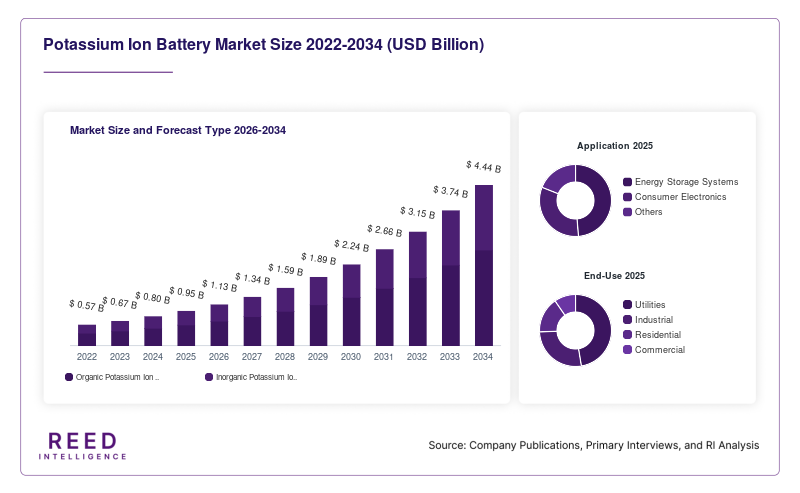
The organic potassium ion batteries segment dominated the market in 2024, accounting for approximately 58% of the total share. These batteries are preferred due to their flexibility, lightweight structure, and potential for sustainable production. Organic materials offer advantages such as reduced environmental impact and improved recyclability, making them suitable for applications where sustainability is a priority. Additionally, ongoing advancements in organic electrode materials are enhancing performance metrics, including cycle life and stability. This dominance reflects the growing preference for eco-friendly battery solutions across various industries.
The inorganic potassium ion batteries segment is projected to be the fastest-growing, with a CAGR of 20.2% during the forecast period. This growth is driven by improvements in inorganic electrode materials that offer higher energy density and better structural stability. Researchers are focusing on developing advanced cathode materials to enhance performance. The increasing demand for high-performance batteries in industrial and grid applications is further supporting the growth of this segment.
By Application
The energy storage systems segment held the largest market share in 2024, accounting for around 62%. This dominance is driven by the increasing need for reliable and cost-effective storage solutions to support renewable energy integration. Potassium ion batteries are being explored for grid-scale applications due to their lower cost and stable performance. Utilities and energy providers are investing in pilot projects to evaluate their potential, contributing to the segment’s growth.
The consumer electronics segment is expected to grow at the fastest CAGR of 19.1%. This growth is attributed to the rising demand for affordable battery solutions in low-cost devices. Potassium ion batteries offer a viable alternative for applications that do not require high energy density. As research improves performance characteristics, their adoption in consumer electronics is likely to increase significantly.
By End-Use
The utilities sector dominated the market in 2024, accounting for approximately 55% of the share. This segment benefits from the growing demand for grid stability and energy storage solutions. Potassium ion batteries are being considered for large-scale storage projects due to their cost advantages and scalability. Government initiatives supporting renewable energy integration are further driving demand in this segment.
The industrial sector is projected to grow at a CAGR of 18.9%. This growth is driven by the increasing need for backup power and energy management solutions in manufacturing facilities. Industries are adopting alternative battery technologies to reduce operational costs and improve energy efficiency. The scalability and cost-effectiveness of potassium ion batteries make them an attractive option for industrial applications.
Regional Analysis
North America
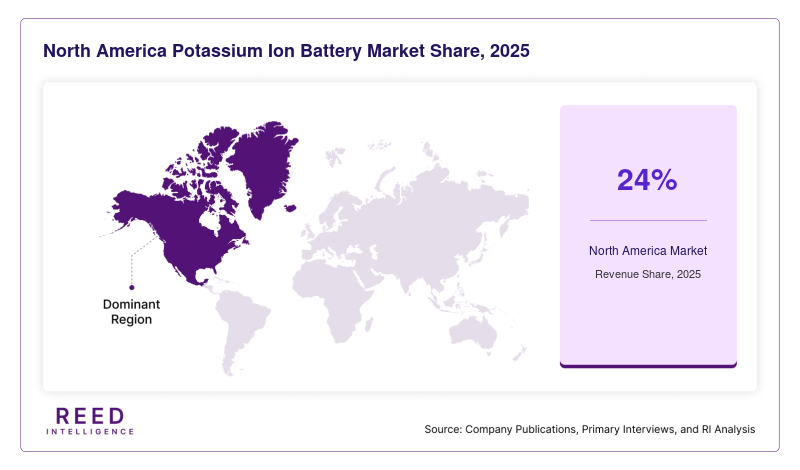
North America accounted for approximately 24% of the global Potassium Ion Battery Market share in 2025, with a projected CAGR of 17.9% through 2034. The region benefits from strong research infrastructure and early adoption of advanced energy storage technologies. Investments in renewable energy projects and grid modernization are supporting the demand for alternative battery systems. Government initiatives promoting sustainable energy solutions are also contributing to market growth.
The United States dominates the regional market, driven by significant funding for energy storage research and innovation. A key growth factor is the increasing deployment of renewable energy systems requiring efficient storage solutions. Collaborations between research institutions and private companies are accelerating the development and commercialization of potassium ion batteries.
Europe
Europe held around 22% market share in 2025, with a CAGR of 18.3% expected during the forecast period. The region’s strong focus on sustainability and carbon reduction is driving the adoption of alternative battery technologies. Policies supporting renewable energy integration and energy efficiency are creating favorable conditions for market growth.
Germany leads the European market due to its advanced manufacturing capabilities and commitment to energy transition. A unique growth factor is the country’s emphasis on reducing dependency on imported raw materials, encouraging the development of locally sourced battery technologies such as potassium ion systems.
Asia Pacific
Asia Pacific dominated the market with a 38% share in 2025 and is projected to grow at a CAGR of 19.5%. The region’s leadership is attributed to its strong electronics manufacturing base and rapid expansion of renewable energy capacity. Increasing investments in battery technology research are further supporting market growth.
China is the dominant country, driven by large-scale production capabilities and government support for alternative energy technologies. A key growth factor is the country’s focus on cost-effective energy storage solutions to support its expanding renewable energy infrastructure.
Middle East & Africa
The Middle East & Africa region accounted for 8% of the market share in 2025, with a projected CAGR of 16.8%. The region is gradually adopting advanced energy storage technologies to support renewable energy projects and reduce reliance on fossil fuels.
The United Arab Emirates leads the market, supported by investments in solar energy projects. A unique growth factor is the region’s need for reliable energy storage solutions in extreme climatic conditions, which is driving interest in durable and cost-effective battery technologies.
Latin America
Latin America held 8% market share in 2025 and is expected to grow at a CAGR of 17.2%. The region’s growing renewable energy sector and increasing electrification are driving demand for energy storage solutions.
Brazil dominates the regional market, supported by expanding renewable energy installations. A key growth factor is the government’s focus on improving energy access in remote areas, creating demand for affordable and scalable battery technologies.
Competitive Landscape
The Potassium Ion Battery Market is moderately competitive, with several emerging players and established battery manufacturers investing in research and development. Key companies are focusing on improving battery performance, reducing costs, and scaling up production capabilities. Strategic collaborations, partnerships, and funding initiatives are common as companies aim to accelerate commercialization.
One leading player in the market is Faradion Limited, which has been actively involved in developing alternative battery technologies. The company has recently announced advancements in electrode materials, enhancing the performance of potassium ion batteries. Other companies are also investing in pilot projects and partnerships to strengthen their market position. The competitive landscape is expected to evolve as more players enter the market and technological advancements continue.
Key Players
- Faradion Limited
- Tiamat Energy
- Natron Energy
- Altris AB
- Contemporary Amperex Technology Co. Limited
- Panasonic Corporation
- LG Energy Solution
- Samsung SDI
- BYD Company Limited
- Toshiba Corporation
- EVE Energy Co., Ltd.
- Svolt Energy Technology
- Envision AESC
- Amperex Technology Limited
- Hitachi Chemical Co., Ltd.
Recent Developments
- In 2025, Faradion Limited announced a new prototype potassium ion battery with improved cycle stability for grid storage applications.
- In 2026, Tiamat Energy launched a pilot project focusing on fast-charging potassium ion batteries for stationary energy systems.
- In 2025, Natron Energy expanded its research facility to accelerate the commercialization of sodium and potassium-based battery technologies.
Potassium Ion Battery Market Segments
Type
- Organic Potassium Ion Batteries
- Inorganic Potassium Ion Batteries
Application
- Energy Storage Systems
- Consumer Electronics
- Others
End-Use
- Utilities
- Industrial
- Residential
- Commercial
By Region
- North America
- Europe
- APAC
- Middle East and Africa
- LATAM