Potassium Soap Insecticide Market Size, Share & Demand Report By Type (Liquid, Concentrate), By Application (Agriculture, Greenhouse, Residential Gardening), By End-Use (Commercial Farming, Residential) By Region & Segment Forecasts, 2026–2034
USD 3950
Market Overview
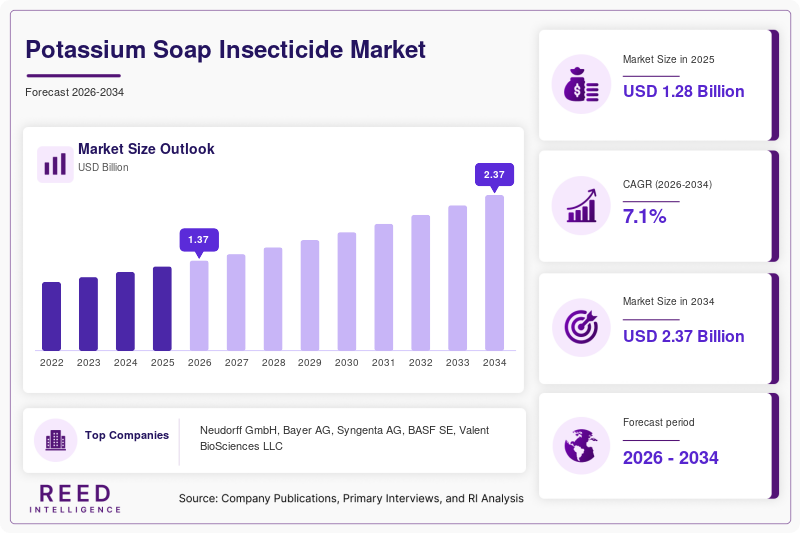
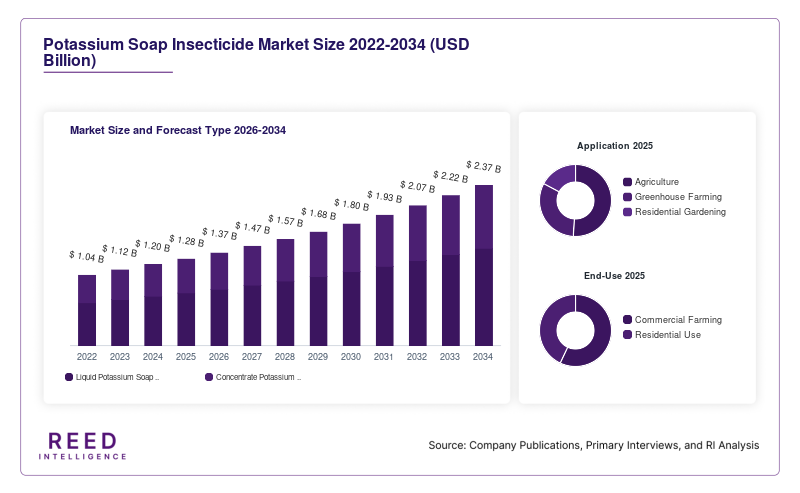
The global Potassium Soap Insecticide Market size was valued at approximately USD 1.28 billion in 2026 and is projected to reach USD 2.21 billion by 2034, expanding at a CAGR of 7.1% during the forecast period (2026–2034). The market has gained steady traction due to the increasing demand for eco-friendly pest control solutions across agricultural and residential applications. Potassium soap insecticides, derived from natural fatty acids, are widely recognized for their low toxicity and biodegradability, making them suitable for organic farming practices and integrated pest management programs.
A major global factor supporting market growth is the rising regulatory pressure on synthetic chemical pesticides. Governments and environmental agencies worldwide are tightening restrictions on harmful agrochemicals due to their impact on soil health, water contamination, and biodiversity. This shift has encouraged farmers and commercial growers to adopt safer alternatives such as potassium soap insecticides, which effectively control soft-bodied insects without leaving harmful residues. In addition, consumer awareness regarding pesticide residues in food products has further accelerated the transition toward organic and natural crop protection solutions.
Key Highlights
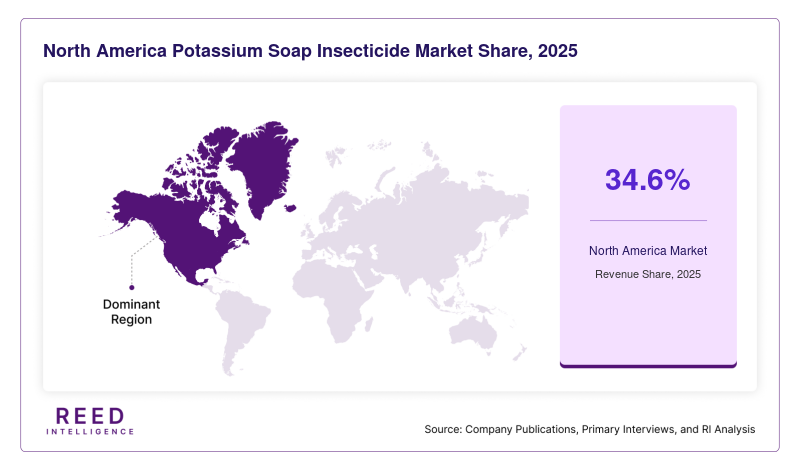
- North America held a dominant regional share of 34.6% in 2025, while Asia Pacific is expected to register the fastest growth with a CAGR of 8.3%
- In the type segment, liquid potassium soap insecticides led with a 61% share, while concentrate formulations are projected to grow at a CAGR of 7.9%
- In application, agriculture dominated with 55% share, while greenhouse farming is the fastest-growing segment with a CAGR of 8.5%
- The United States remained the dominant country, with market values of USD 312 million in 2024 and USD 329 million in 2025
Market Trends
Growing adoption of organic farming practices
The global shift toward organic farming has significantly influenced the growth trajectory of the potassium soap insecticide market. Farmers are increasingly adopting organic cultivation methods due to rising consumer demand for chemical-free produce and improved export opportunities. Potassium soap insecticides align well with organic certification standards, as they are derived from natural fatty acids and do not persist in the environment. This compatibility has made them a preferred choice among organic growers for controlling aphids, mites, and whiteflies.
In addition, organic farming associations and certification bodies are promoting the use of bio-based pesticides, which has increased awareness among farmers in both developed and developing regions. Governments are also offering subsidies and incentives to encourage sustainable agriculture practices, further boosting demand. As organic farmland continues to expand globally, the reliance on potassium soap insecticides is expected to grow steadily, reinforcing their role in eco-friendly pest management systems.
Rising use in urban gardening and residential applications
Urban gardening and home-based agriculture have emerged as notable trends contributing to market expansion. With increasing urbanization and limited access to fresh produce, consumers are turning to balcony gardening, rooftop farming, and indoor plant cultivation. Potassium soap insecticides are widely used in these settings due to their safety profile and ease of application.
Unlike conventional pesticides, these products pose minimal risk to humans, pets, and beneficial insects when used correctly. This has made them popular among home gardeners who seek effective yet safe pest control solutions. Retail distribution channels, including e-commerce platforms, have also improved accessibility to these products, enabling wider adoption. The growth of urban gardening communities and educational initiatives around sustainable living continues to support the increased use of potassium soap insecticides in non-agricultural environments.
Market Drivers
Increasing regulatory restrictions on synthetic pesticides
Stringent regulations on chemical pesticides have become a key driver for the potassium soap insecticide market. Regulatory authorities across regions are implementing strict guidelines to limit the use of harmful agrochemicals that contribute to environmental degradation and health risks. These policies have led to the gradual phase-out of several synthetic pesticides, creating a demand gap that bio-based alternatives are filling.
Potassium soap insecticides offer a viable solution due to their low toxicity and rapid biodegradability. They do not accumulate in soil or water systems, making them environmentally sustainable. As regulatory frameworks continue to evolve, farmers and agricultural enterprises are shifting toward compliant solutions to avoid penalties and ensure market access. This transition is expected to sustain long-term demand and create a favorable environment for market growth.
Rising awareness of sustainable pest management practices
Awareness regarding sustainable pest management has increased significantly among farmers, agronomists, and consumers. Educational programs, agricultural extension services, and industry campaigns have emphasized the importance of reducing chemical inputs in farming. Potassium soap insecticides are often included in integrated pest management strategies due to their selective action and compatibility with biological control methods.
Farmers are recognizing the benefits of maintaining ecological balance, such as preserving beneficial insects and improving soil health. This shift in mindset is encouraging the adoption of safer pest control options. Additionally, food retailers and supply chains are increasingly demanding residue-free produce, pushing growers to adopt natural insecticides. As sustainability becomes a core focus in agriculture, potassium soap insecticides are expected to witness consistent demand growth.
Market Restraint
Limited effectiveness against certain pest categories
One of the key challenges facing the potassium soap insecticide market is its limited effectiveness against a broad spectrum of pests. While these insecticides are highly effective against soft-bodied insects such as aphids, spider mites, and whiteflies, they are less efficient against hard-bodied insects and pests with protective exoskeletons. This limitation reduces their applicability in certain agricultural scenarios where multiple pest types coexist.
Farmers often require comprehensive pest control solutions that can address diverse infestations, and potassium soap insecticides may need to be used in combination with other products to achieve desired results. This can increase operational complexity and costs, particularly for large-scale agricultural operations. For example, in crops heavily affected by beetles or caterpillars, growers may still rely on conventional pesticides for effective control. This constraint can slow adoption rates in regions where pest diversity is high, limiting the overall market potential despite growing demand for eco-friendly alternatives.
Market Opportunities
Expansion in emerging agricultural economies
Emerging economies present significant growth opportunities for the potassium soap insecticide market. Countries in Asia Pacific, Latin America, and Africa are experiencing rapid agricultural development and increasing adoption of modern farming practices. Governments in these regions are promoting sustainable agriculture to enhance productivity and meet export standards, creating a favorable environment for bio-based pesticides.
Small and medium-scale farmers are gradually transitioning toward environmentally friendly inputs, supported by training programs and financial incentives. The expansion of organic farming and export-oriented agriculture is also driving demand for residue-free pest control solutions. As distribution networks improve and product awareness increases, potassium soap insecticides are expected to gain strong traction in these markets, contributing to overall industry growth.
Technological advancements in formulation and application
Advancements in formulation technology are creating new opportunities for market expansion. Manufacturers are investing in research and development to improve the efficacy, stability, and shelf life of potassium soap insecticides. Innovations such as enhanced emulsification techniques and combination formulations are enabling better pest control performance while maintaining environmental safety.
In addition, the integration of precision agriculture tools is improving application efficiency. Smart spraying systems and automated greenhouse technologies allow targeted application, reducing waste and improving effectiveness. These developments are making potassium soap insecticides more appealing to commercial growers who require reliable and scalable solutions. As technology continues to evolve, the market is expected to benefit from improved product performance and expanded application areas.
Segmental Analysis
By Type
Liquid potassium soap insecticides dominated the market in 2024, accounting for approximately 61% of the total share. Their widespread adoption is attributed to ease of application, uniform coverage, and immediate effectiveness against soft-bodied insects. Liquid formulations are commonly used in both agricultural and residential settings, making them versatile and user-friendly. Farmers prefer these formulations due to their compatibility with standard spraying equipment and their ability to deliver consistent results across different crop types.
Concentrate formulations are projected to be the fastest-growing subsegment, with a CAGR of 7.9% during the forecast period. These products offer cost advantages by allowing users to dilute the solution based on specific requirements. The growing demand for customizable pest control solutions and the need for efficient resource utilization are driving the adoption of concentrate formulations. Additionally, advancements in formulation technology are improving their stability and effectiveness, making them an attractive option for large-scale agricultural operations.
By Application
Agriculture remains the dominant application segment, holding a 55% share in 2024. The use of potassium soap insecticides in crop protection is driven by the need for sustainable pest control solutions that comply with organic farming standards. These insecticides are widely used in the cultivation of fruits, vegetables, and ornamental plants, where maintaining product quality and safety is essential.
Greenhouse farming is the fastest-growing application segment, with a CAGR of 8.5%. The controlled environment of greenhouses requires precise and safe pest control methods, making potassium soap insecticides an ideal choice. Their low toxicity and compatibility with biological control agents support their use in integrated pest management systems. The expansion of greenhouse farming, particularly in urban and peri-urban areas, is contributing to the rapid growth of this segment.
By End-Use
Commercial farming dominated the end-use segment in 2024, accounting for a significant share of the market. Large-scale agricultural operations require effective and sustainable pest control solutions to maintain crop yield and quality. Potassium soap insecticides are increasingly being adopted by commercial farmers as part of integrated pest management strategies, reducing reliance on chemical pesticides.
Residential use is the fastest-growing segment, with a CAGR of 7.6%. The rising popularity of home gardening and urban agriculture is driving demand for safe and easy-to-use insecticides. Consumers are seeking products that can effectively control pests without posing health risks to family members and pets. This trend is supported by increased availability through retail and online channels, making potassium soap insecticides more accessible to individual users.
Regional Analysis
North America
North America accounted for a significant share of the potassium soap insecticide market in 2025, contributing approximately 34.6% of the global revenue. The region is projected to grow at a CAGR of 6.8% during the forecast period. Strong regulatory frameworks promoting sustainable agriculture and the widespread adoption of organic farming practices have supported market growth. The presence of well-established agricultural infrastructure and advanced distribution networks further enhances product accessibility and adoption.
The United States dominates the regional market, driven by increasing demand for organic produce and stringent pesticide regulations. A unique growth factor in this region is the strong presence of certified organic farms and consumer preference for eco-labeled products. This has encouraged farmers to adopt potassium soap insecticides as part of integrated pest management programs, ensuring compliance with regulatory standards while maintaining crop quality.
Europe
Europe holds a notable share in the global market and is expected to grow at a CAGR of 6.5% through 2034. The region’s strict environmental policies and emphasis on sustainable agriculture have significantly influenced the adoption of bio-based pesticides. The European Union’s initiatives to reduce chemical pesticide usage have created a favorable environment for potassium soap insecticides.
Germany leads the regional market due to its advanced agricultural practices and strong focus on environmental sustainability. A unique growth factor in Europe is the implementation of the Green Deal policies, which aim to reduce pesticide usage and promote organic farming. This regulatory push has accelerated the adoption of potassium soap insecticides among farmers seeking compliant and effective pest control solutions.
Asia Pacific
Asia Pacific is expected to be the fastest-growing region, registering a CAGR of 8.3% during the forecast period. The region’s expanding agricultural sector, coupled with increasing awareness of sustainable farming practices, is driving market growth. Rising population and food demand are encouraging the adoption of efficient and eco-friendly pest control solutions.
China dominates the regional market due to its large agricultural base and growing emphasis on reducing chemical pesticide usage. A unique growth factor in this region is government-led initiatives promoting green agriculture and sustainable farming inputs. These programs are encouraging farmers to adopt potassium soap insecticides, particularly in high-value crop cultivation and export-oriented agriculture.
Middle East & Africa
The Middle East & Africa region is witnessing gradual growth, with a projected CAGR of 6.2%. The adoption of potassium soap insecticides is increasing due to the need for sustainable agricultural practices in water-scarce environments. Governments are focusing on improving agricultural productivity while minimizing environmental impact.
South Africa leads the regional market, supported by its relatively advanced agricultural sector. A unique growth factor in this region is the increasing use of greenhouse farming techniques, which require safe and effective pest control solutions. Potassium soap insecticides are well-suited for controlled environments, contributing to their growing adoption.
Latin America
Latin America is expected to grow at a CAGR of 7.0%, supported by expanding agricultural exports and increasing adoption of organic farming. The region’s favorable climate for crop production and growing awareness of sustainable practices are driving demand for bio-based insecticides.
Brazil dominates the regional market due to its large-scale agricultural operations and export-oriented farming. A unique growth factor in Latin America is the rising demand for residue-free produce in international markets. This has encouraged farmers to adopt potassium soap insecticides to meet stringent export standards and maintain competitiveness.
Competitive Landscape
The potassium soap insecticide market is moderately fragmented, with several key players focusing on product innovation and strategic partnerships to strengthen their market position. Leading companies are investing in research and development to enhance product efficacy and expand their application scope. The market leader, Neudorff GmbH, has established a strong presence through its wide range of eco-friendly pest control products and consistent focus on sustainability.
Recent developments in the market include the introduction of advanced formulations with improved stability and effectiveness. Companies are also expanding their distribution networks to reach emerging markets and capitalize on growing demand. Strategic collaborations with agricultural organizations and research institutions are helping players develop innovative solutions and gain a competitive edge.
Key Players
- Neudorff GmbH
- Bayer AG
- Syngenta AG
- BASF SE
- Valent BioSciences LLC
- Certis USA LLC
- Bonide Products LLC
- Safer Brand
- Garden Safe
- Scotts Miracle-Gro Company
- Koppert Biological Systems
- UPL Limited
- FMC Corporation
- Isagro S.p.A.
- Sumitomo Chemical Co., Ltd.
Recent Developments
- In 2025, Neudorff GmbH launched an enhanced potassium soap formulation with improved pest control efficiency and longer shelf life
- In 2024, Bayer AG expanded its bio-based insecticide portfolio, including potassium soap products for sustainable agriculture
- In 2025, Certis USA LLC introduced a new concentrate formulation targeting greenhouse applications, improving application efficiency and cost-effectiveness
Potassium Soap Insecticide Market Segments
Type
- Liquid Potassium Soap Insecticides
- Concentrate Potassium Soap Insecticides
Application
- Agriculture
- Greenhouse Farming
- Residential Gardening
End-Use
- Commercial Farming
- Residential Use
By Region
- North America
- Europe
- APAC
- Middle East and Africa
- LATAM