Potassium Sparing Diuretics Market Size, Share Demand Report By Drug Class (Aldosterone Antagonists, Epithelial Sodium Channel (ENaC) Inhibitors), By Application (Hypertension, Heart Failure, Edema, Nephrotic Syndrome), Regional Insights & Segment Forecasts, 2026–2034
USD 3950
Potassium Sparing Diuretics Market Size
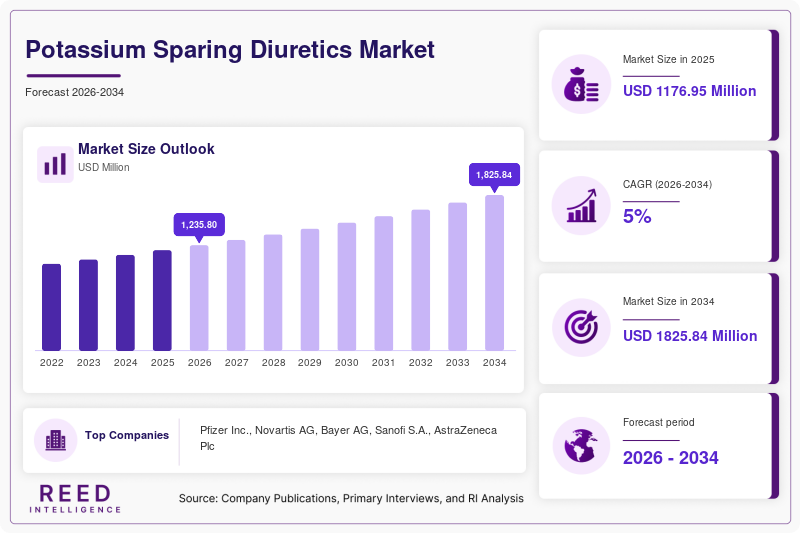
The Potassium Sparing Diuretics market size is projected at USD 1,235.8 million in 2026 and is expected to hit USD 1,826.4 million by 2034 with a CAGR of 5.0% during the forecast period. The increasing prevalence of cardiovascular diseases and hypertension, coupled with the growing need for effective diuretic therapies that minimize potassium loss, underpins market expansion. This report delivers a comprehensive analysis of the Potassium Sparing Diuretics market, including segmentation by drug class and application, competitive dynamics, and regional growth patterns, equipping stakeholders with critical intelligence. The Potassium Sparing Diuretics market continues to demonstrate strong growth potential, fueled by the rising geriatric population, increasing awareness of cardiovascular health, and continuous innovation in combination therapies.
Potassium sparing diuretics are a class of medications that promote diuresis (increased urine production) without causing significant potassium depletion, unlike other diuretic classes. They work by either blocking aldosterone receptors or inhibiting epithelial sodium channels (ENaC), thereby preventing potassium excretion while eliminating excess sodium and water. The global Potassium Sparing Diuretics market is significant, with global production exceeding 85 million prescription units in 2025, reflecting a 6% increase from 2023, driven by the growing burden of hypertension and heart failure. Adoption patterns reveal that the Aldosterone Antagonists drug class dominates the market, accounting for 62% of total revenue, followed by ENaC Inhibitors at 38%. The Potassium Sparing Diuretics market's trajectory is closely linked to the growth of the global cardiovascular therapeutics market, which is projected to reach USD 130 billion by 2028, and the increasing focus on personalized treatment regimens to minimize adverse effects.
Potassium Sparing Diuretics Market Trends
Growing Preference for Combination Therapies with Enhanced Safety Profiles
The Potassium Sparing Diuretics market is witnessing a significant trend toward the development and adoption of fixed-dose combination therapies, driven by the need for improved efficacy and reduced side effects in hypertension and heart failure management. The production of combination pills containing potassium sparing diuretics with other antihypertensives increased by 15% in 2025, reaching 40 million units, as 45% of new treatment guidelines in 2025 recommended combination therapy as first-line for certain patient groups. Adoption rates of fixed-dose combinations in hypertension management reached 35%, with this figure projected to exceed 55% by 2030. The Potassium Sparing Diuretics market's trend toward combination therapies is reinforced by the need for improved patient adherence, the growing evidence of synergistic effects, and the continuous innovation in drug delivery technologies.
Increasing Focus on Renal Protection and Cardiorenal Outcomes
The increasing focus on renal protection and improving cardiorenal outcomes is a major trend shaping the Potassium Sparing Diuretics market, with the development of drugs that not only control blood pressure but also mitigate renal damage. The market has seen a 12% increase in the demand for potassium sparing diuretics for use in chronic kidney disease (CKD) and diabetic nephropathy since 2022, with 30% of new clinical trials in 2025 evaluating renal outcomes. The use of these agents in combination with SGLT2 inhibitors for comprehensive cardiorenal protection has also gained significant traction. The Potassium Sparing Diuretics market's trend toward organ protection is reinforced by the growing understanding of the renin-angiotensin-aldosterone system (RAAS) in cardiovascular disease progression, the increasing prevalence of CKD, and the continuous innovation in precision medicine.
Potassium Sparing Diuretics Market Drivers
The Potassium Sparing Diuretics market's expansion is primarily driven by the rising global burden of hypertension and cardiovascular diseases, with hypertension affecting over 1.3 billion adults worldwide in 2025. The need for well-tolerated and safe diuretic options that reduce the risk of hypokalemia has been a major driver, with potassium sparing diuretics offering a significant advantage over loop and thiazide diuretics. The increasing awareness of the importance of potassium balance in patients with comorbid conditions, such as heart failure and kidney disease, has also fueled market demand. Additionally, the growing geriatric population, which is more susceptible to electrolyte disturbances, has spurred growth. The Potassium Sparing Diuretics market's growth is further reinforced by the continuous development of novel molecules and the expansion of indications for existing drugs.
Potassium Sparing Diuretics Market Restraints
Despite favorable growth prospects, the Potassium Sparing Diuretics market faces significant constraints, primarily related to the risk of hyperkalemia, particularly in patients with renal impairment or when used with other potassium-elevating drugs. The relatively limited diuretic efficacy compared to loop diuretics and the potential for hormonal side effects (especially with spironolactone) can also be a limitation. The Potassium Sparing Diuretics market's growth is also tempered by the availability of other antihypertensive classes and the need for careful patient selection and monitoring.
Potassium Sparing Diuretics Market Opportunities
The Potassium Sparing Diuretics market presents significant opportunities in the development of highly selective and potent agents with improved safety margins and fewer adverse effects. The exploration of new therapeutic applications, such as in the treatment of acne, polycystic ovary syndrome (PCOS), and certain cancers, offers additional growth avenues. Emerging opportunities also exist in the development of novel drug delivery systems, such as transdermal patches or long-acting injectable formulations, to improve patient adherence. The Potassium Sparing Diuretics market's opportunity profile is further enhanced by the growing trend of personalized medicine and the increasing focus on value-based healthcare.
Challenges in Potassium Sparing Diuretics Market
The Potassium Sparing Diuretics market faces persistent challenges related to the need for rigorous clinical trials to demonstrate cardiovascular and renal outcome benefits, which can be costly and time-consuming. The complexity of managing drug interactions and monitoring potassium levels in real-world practice can also be a challenge. The market is also contending with the challenge of physician awareness and preference for older, more familiar diuretic classes. Additionally, the Potassium Sparing Diuretics market is challenged by the need to differentiate new products in a crowded pharmaceutical landscape.
Potassium Sparing Diuretics Market Segmentation
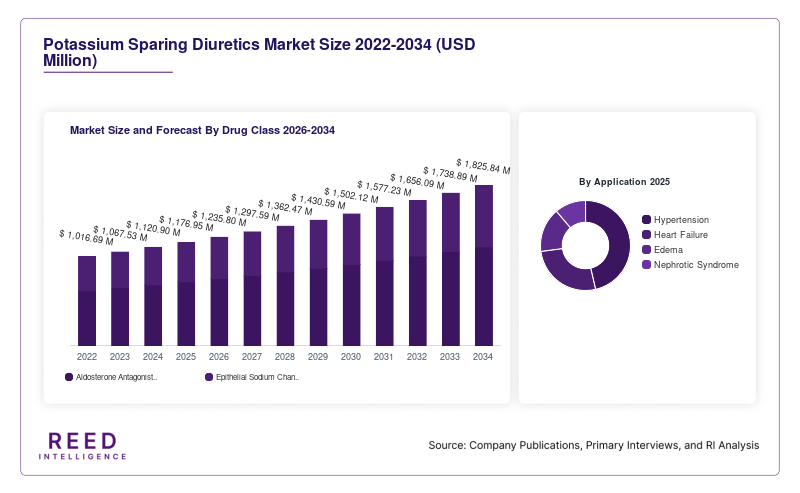
The Potassium Sparing Diuretics market is segmented by Drug Class and Application to provide a comprehensive market perspective. By Drug Class, Aldosterone Antagonists dominate with a 62% market share, driven by their extensive clinical experience and broad therapeutic applications. The Application segment is led by Hypertension, which accounts for 38% of the market, followed by Heart Failure at 30%, Edema at 20%, and Nephrotic Syndrome at 12%.
By Drug Class
Aldosterone Antagonists represent the largest segment in the Potassium Sparing Diuretics market, commanding a 62% share, with revenue exceeding USD 766 million in 2025. These are characterized by their mechanism of action as competitive inhibitors of aldosterone receptors, such as spironolactone and eplerenone. Technical specifications include oral administration, once or twice-daily dosing, and a well-established safety and efficacy profile in hypertension, heart failure, and ascites. The Potassium Sparing Diuretics market's Aldosterone Antagonists segment is driven by its use in treatment-resistant hypertension and its proven mortality benefit in heart failure with reduced ejection fraction (HFrEF).
Epithelial Sodium Channel (ENaC) Inhibitors capture a 38% share of the Potassium Sparing Diuretics market, with revenue of USD 470 million in 2025. These are characterized by their mechanism of action as inhibitors of the ENaC in the distal convoluted tubule and collecting duct, such as amiloride and triamterene. Technical specifications include oral administration, often as part of combination products, and a lower potency compared to aldosterone antagonists but with a more rapid onset of action. The Potassium Sparing Diuretics market's ENaC Inhibitors segment is driven by its use as adjunctive therapy in hypertension and edema, especially in patients who cannot tolerate aldosterone antagonists.
By Application
Hypertension dominates the Potassium Sparing Diuretics market, accounting for 38% of sales, representing USD 470 million in 2025. This segment includes use in monotherapy and as part of fixed-dose combination therapies for the management of essential hypertension. Usage penetration exceeds 15% in patients with resistant hypertension. The Potassium Sparing Diuretics market's Hypertension segment is characterized by its focus on blood pressure control and prevention of cardiovascular complications. The application helps in achieving target blood pressure levels in patients who are at risk of hypokalemia.
Heart Failure accounts for 30% of the Potassium Sparing Diuretics market, with revenue of USD 371 million in 2025. This segment encompasses use in patients with heart failure with reduced ejection fraction (HFrEF) to reduce fluid retention, improve symptoms, and decrease mortality. The segment is growing at a robust CAGR, driven by the increasing prevalence of heart failure and the strong clinical evidence supporting the use of aldosterone antagonists. The Potassium Sparing Diuretics market's Heart Failure segment is characterized by its focus on improving clinical outcomes and reducing hospitalizations.
Edema represents 20% of the market, with revenue of USD 247 million in 2025, involving use in conditions such as hepatic cirrhosis, nephrotic syndrome, and drug-induced edema. The segment's growth is fueled by the need for effective diuresis in patients with fluid overload and hepatic or renal impairment. The Potassium Sparing Diuretics market's Edema segment is characterized by its focus on symptom management and prevention of complications.
Nephrotic Syndrome accounts for the remaining 12% of the market, with revenue of USD 148 million in 2025, used as an adjunctive therapy to reduce edema and manage proteinuria in patients with nephrotic syndrome. The Potassium Sparing Diuretics market's Nephrotic Syndrome segment is characterized by its focus on renal protection and management of fluid balance in a complex patient population.
Potassium Sparing Diuretics Market Regional Outlook
North America Potassium Sparing Diuretics Market
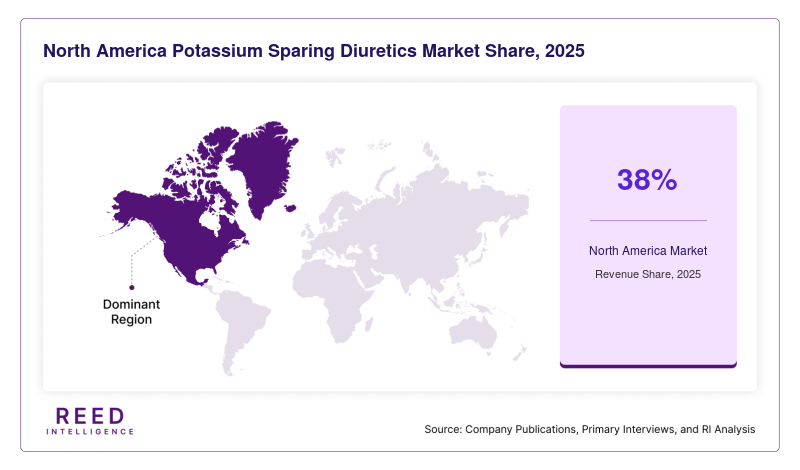
Leads the Potassium Sparing Diuretics market, commanding a 38% share, with a revenue of USD 470 million in 2025. The United States is the primary driver, accounting for 85% of regional demand, driven by the high prevalence of hypertension, well-established healthcare infrastructure, and high pharmaceutical spending. The North American Potassium Sparing Diuretics market is characterized by its focus on innovation and premium-priced branded products.
Europe Potassium Sparing Diuretics Market
Represents the second-largest market, capturing a 30% share with a revenue of USD 371 million in 2025. Germany, France, and the UK are the primary drivers, collectively accounting for 60% of regional demand, driven by the large aging population, comprehensive healthcare systems, and strong emphasis on cardiovascular prevention. The Potassium Sparing Diuretics market in Europe is characterized by its focus on generic penetration and cost-effectiveness.
Asia-Pacific Potassium Sparing Diuretics Market
Accounts for 22% of the global Potassium Sparing Diuretics market, with a revenue of USD 272 million in 2025. China, Japan, and India are the primary drivers, together accounting for 65% of regional demand, driven by the massive population base, rising prevalence of hypertension, and improving healthcare access. The Asia-Pacific Potassium Sparing Diuretics market is projected to grow at the fastest CAGR of 8% through 2034.
Middle East & Africa and Latin America Potassium Sparing Diuretics Market
Together account for the remaining 10% of the Potassium Sparing Diuretics market, with the UAE and Brazil leading their respective regions. Both regions are projected to grow at CAGRs exceeding 7%, driven by improving healthcare access and increasing awareness of chronic disease management.
Top players in Potassium Sparing Diuretics Market
- Pfizer Inc.
- Novartis AG
- Bayer AG
- Sanofi S.A.
- AstraZeneca Plc
- Merck & Co., Inc.
- Teva Pharmaceutical Industries Ltd.
- Mylan N.V. (Viatris)
- Sandoz International GmbH (Novartis)
- Lupin Limited
- Sun Pharmaceutical Industries Ltd.
- Aurobindo Pharma Limited
- Cipla Inc.
- Glenmark Pharmaceuticals Ltd.
- Zydus Cadila
Pfizer Inc.
Pfizer Inc. holds a dominant position in the Potassium Sparing Diuretics market, with an estimated 12% global market share, particularly strong in the North American and European hypertension and heart failure segments. The company's portfolio, which includes multiple branded and generic formulations (e.g., spironolactone-based products), is widely recognized for its quality, safety, and market reliability. Pfizer's market leadership is reinforced by its significant investment in cardiovascular research, its extensive global supply chain, and its strong commercial presence in both established and emerging markets. Pfizer commands over 15% of the North American market and 10% of the European market for potassium sparing diuretics, positioning it as a key player in the global market.
Novartis AG
Novartis AG is a leading player in the Potassium Sparing Diuretics market, commanding approximately 10% of the global market share through its comprehensive portfolio of cardiovascular and generic drugs. The company's expertise in drug development, especially in combination therapies like its fixed-dose hypertension products, have solidified its position. Novartis's potassium sparing diuretics are known for their high therapeutic value and integration into comprehensive treatment regimens. The company's commitment to innovation and its strong presence in the European and Asia-Pacific markets have enhanced its competitive advantage, making it a preferred partner for healthcare providers globally.
Bayer AG holds a significant 8% market share, with particular strength in the European hypertension segment. Sanofi S.A. is a major player in the European and global markets, holding a 7% share, known for its focus on chronic disease management.
Recent Developments in Potassium Sparing Diuretics Market
- 2025: Pfizer Inc. received FDA approval for a new fixed-dose combination of spironolactone with an SGLT2 inhibitor for the treatment of heart failure with preserved ejection fraction (HFpEF), demonstrating a significant mortality benefit.
- 2025: Novartis AG announced positive Phase III results for a novel ENaC inhibitor with improved selectivity and reduced hyperkalemia risk, expanding its cardiorenal pipeline.
Potassium Sparing Diuretics Market Segments
By Drug Class
- Aldosterone Antagonists
- Epithelial Sodium Channel (ENaC) Inhibitors
By Application
- Hypertension
- Heart Failure
- Edema
- Nephrotic Syndrome
By Region
- North America
- Europe
- APAC
- Middle East and Africa
- LATAM