Potassium Thiosulfate Fertilizer Market Size, Share & Demand Report By Type (Liquid Potassium Thiosulfate, Specialty Blends), By Application (Fertigation, Foliar Application, Soil Application), By End-Use (Agriculture, Horticulture, Turf & Ornamentals), By Region & Segment Forecasts, 2025–2034
USD 3950
Market Overview
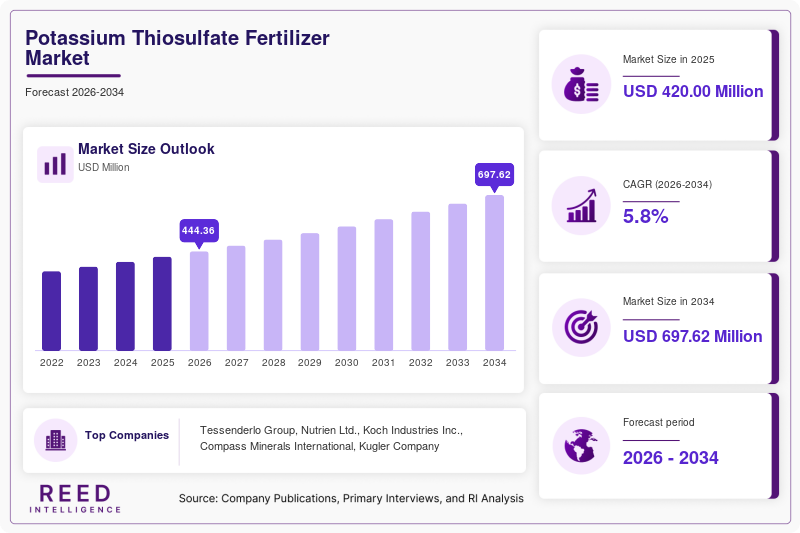
The global Potassium Thiosulfate Fertilizer Market size was estimated at approximately USD 420 million in 2025 and is projected to reach USD 455 million in 2026. With increasing adoption across high-value crop cultivation, the market is forecast to grow at a CAGR of 5.8% from 2025 to 2034, reaching nearly USD 740 million by 2034. This growth trajectory reflects a combination of agronomic efficiency, compatibility with precision agriculture practices, and increasing awareness among farmers regarding sulfur and potassium deficiencies in soil.
One of the primary growth factors is the increasing focus on crop yield optimization. Potassium thiosulfate offers both potassium and sulfur in a soluble form, making it suitable for fertigation systems. Secondly, the expansion of high-efficiency irrigation techniques such as drip irrigation is boosting the use of liquid fertilizers, including potassium thiosulfate. Thirdly, the shift toward sustainable farming practices is encouraging the adoption of fertilizers that improve nutrient uptake efficiency while minimizing environmental impact.
Key Highlights
- Market size reached USD 420 million in 2025 and is projected to grow steadily.
The growth reflects increasing adoption of advanced fertilizer solutions across global agriculture. - Expected CAGR of 5.8% from 2025 to 2034.
This steady growth rate indicates consistent demand driven by modern farming practices. - Forecast value of approximately USD 740 million by 2034.
The market expansion is supported by rising investments in high-efficiency fertilizers. - Increasing adoption in precision agriculture and fertigation systems.
Farmers are leveraging these technologies to optimize nutrient delivery and improve yields.
Market Trends
Increasing Adoption of Precision Agriculture Technologies
The adoption of precision agriculture is transforming fertilizer application practices, directly influencing the potassium thiosulfate fertilizer market. Farmers are increasingly relying on data-driven insights, soil sensors, and satellite imagery to optimize nutrient delivery. Potassium thiosulfate fits well into these systems due to its liquid form and compatibility with fertigation equipment. This allows for targeted nutrient application, reducing wastage and improving crop productivity. Additionally, digital agriculture platforms are enabling farmers to monitor soil sulfur and potassium levels in real time, encouraging the use of balanced fertilizers. As farm operations become more technology-driven, the demand for efficient and adaptable fertilizer solutions continues to rise.
Shift Toward Liquid Fertilizer Formulations
A noticeable trend in the fertilizer industry is the growing preference for liquid fertilizers over traditional granular forms. Potassium thiosulfate is gaining traction due to its ease of application and rapid nutrient availability. Liquid fertilizers can be applied through irrigation systems, ensuring uniform distribution and improved nutrient absorption. This trend is particularly evident in regions with advanced irrigation infrastructure and high-value crop production. Furthermore, liquid formulations reduce labor costs and enable flexible application schedules, making them attractive for large-scale farming operations. The increasing availability of customized liquid blends is further supporting this transition, reinforcing the role of potassium thiosulfate in modern agricultural practices.
Market Drivers
Rising Demand for High-Efficiency Fertilizers
The demand for fertilizers that enhance nutrient use efficiency is a major driver of the potassium thiosulfate fertilizer market. Traditional fertilizers often result in nutrient losses due to leaching and volatilization, leading to lower crop productivity and environmental concerns. Potassium thiosulfate provides a solution by offering readily available nutrients that are easily absorbed by plants. Its compatibility with precision irrigation systems further enhances its efficiency. Farmers are increasingly prioritizing fertilizers that deliver consistent results and reduce input costs. This shift is particularly evident in commercial farming operations, where maximizing yield per hectare is critical for profitability.
Expansion of Specialty Crop Cultivation
The growing cultivation of fruits, vegetables, and nuts is significantly contributing to market growth. These crops require precise nutrient management to achieve optimal yield and quality. Potassium thiosulfate is widely used in these applications due to its ability to supply essential nutrients without causing soil salinity issues. Additionally, the rising consumer demand for high-quality produce is encouraging farmers to adopt advanced fertilization techniques. Export-oriented agriculture in developing regions is also driving demand, as farmers aim to meet international quality standards. This trend is expected to continue as global food consumption patterns shift toward nutrient-rich and premium agricultural products.
Market Restraint
High Cost Compared to Conventional Fertilizers
One of the key challenges facing the potassium thiosulfate fertilizer market is its relatively higher cost compared to conventional fertilizers. While the product offers superior efficiency and ease of application, its pricing can be a barrier for small and medium-scale farmers, particularly in developing regions. The higher cost is attributed to production processes, raw material expenses, and distribution logistics. This limits its adoption in price-sensitive markets where farmers prioritize affordability over advanced formulations.
The impact of this restraint is evident in regions with limited access to modern irrigation systems. For example, in parts of Africa and Southeast Asia, farmers often rely on traditional fertilization methods due to cost constraints. As a result, the penetration of potassium thiosulfate remains low despite its agronomic benefits. Manufacturers are attempting to address this issue by introducing cost-effective formulations and expanding distribution networks. However, widespread adoption will depend on improved awareness and financial support mechanisms such as subsidies and credit facilities.
Market Opportunities
Growth in Sustainable Agriculture Practices
The increasing emphasis on sustainable agriculture presents a significant opportunity for the potassium thiosulfate fertilizer market. Governments and agricultural organizations are promoting environmentally friendly farming practices to reduce soil degradation and water pollution. Potassium thiosulfate aligns with these objectives by improving nutrient efficiency and minimizing losses. Its compatibility with organic and integrated farming systems further enhances its appeal. As regulatory frameworks become stricter, farmers are likely to shift toward fertilizers that meet sustainability standards, creating new growth avenues for market participants.
Expansion in Emerging Markets
Emerging economies offer substantial growth potential for the potassium thiosulfate fertilizer market. Rapid population growth and increasing food demand are driving agricultural intensification in countries across Asia, Africa, and Latin America. Governments in these regions are investing in irrigation infrastructure and promoting advanced farming techniques. This creates a favorable environment for the adoption of liquid fertilizers. Additionally, rising awareness about soil health and nutrient deficiencies is encouraging farmers to explore new fertilizer options. Market players can capitalize on this opportunity by establishing local production facilities and strengthening distribution networks.
Segmental Analysis
By Type
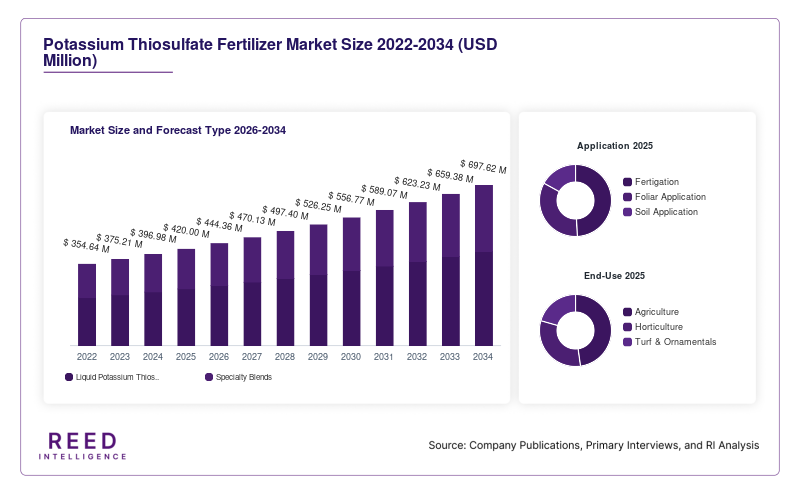
Liquid potassium thiosulfate dominated the market in 2024, accounting for approximately 68% of the total share. Its widespread use can be attributed to its compatibility with modern irrigation systems and ease of application. Liquid formulations allow for uniform nutrient distribution and rapid absorption by plants. This makes them particularly suitable for high-value crops and intensive farming practices. Additionally, liquid fertilizers reduce labor requirements and enable flexible application schedules, further supporting their adoption.
The fastest-growing subsegment is specialty blended potassium thiosulfate formulations, expected to grow at a CAGR of 6.7%. These blends are designed to meet specific crop requirements and soil conditions, offering enhanced efficiency. The growth is driven by increasing demand for customized fertilizer solutions and advancements in formulation technology. Farmers are increasingly adopting these products to achieve better crop performance and optimize input costs.
By Application
Fertigation emerged as the dominant application segment in 2024, holding a market share of around 54%. The integration of fertilizers with irrigation systems allows for precise nutrient delivery and improved water use efficiency. Potassium thiosulfate is widely used in fertigation due to its solubility and compatibility with various irrigation setups. This method is particularly popular in regions with advanced irrigation infrastructure and high-value crop production.
Foliar application is the fastest-growing subsegment, projected to grow at a CAGR of 6.3%. This method involves spraying fertilizers directly onto plant leaves, enabling rapid nutrient uptake. The growth is driven by the increasing need for quick nutrient correction and improved crop quality. Farmers are adopting foliar application to address nutrient deficiencies during critical growth stages, further boosting demand.
By End-Use
The agriculture segment dominated the market in 2024, accounting for approximately 72% of the total share. The widespread use of potassium thiosulfate in crop production is driven by its ability to improve yield and quality. Farmers are increasingly adopting this fertilizer to address soil nutrient deficiencies and enhance productivity. The segment includes various crops such as cereals, fruits, vegetables, and nuts.
The horticulture segment is the fastest-growing, with a projected CAGR of 6.9%. This growth is driven by the rising demand for high-quality fruits and vegetables. Horticultural crops require precise nutrient management, making potassium thiosulfate an ideal choice. The increasing focus on greenhouse cultivation and controlled environment agriculture is further supporting this trend.
Regional Analysis
North America
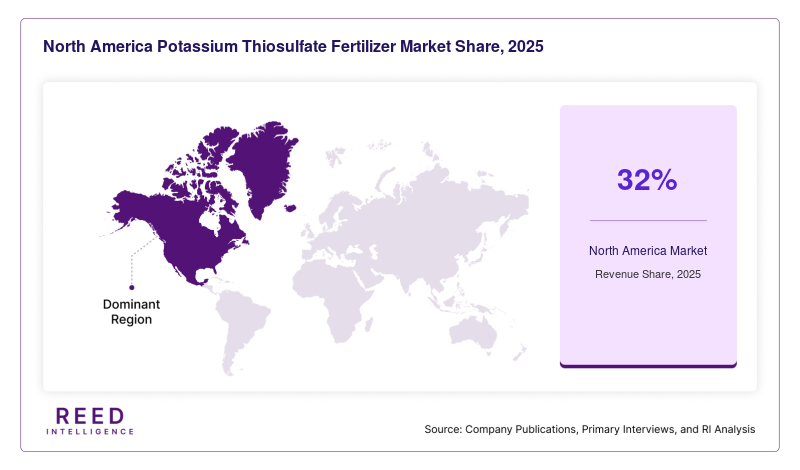
North America accounted for approximately 32% of the potassium thiosulfate fertilizer market share in 2025 and is expected to grow at a CAGR of 5.2% during the forecast period. The region’s strong adoption of advanced agricultural technologies and well-established irrigation systems are key factors supporting market growth. Farmers in the United States and Canada are increasingly utilizing liquid fertilizers to enhance crop productivity and optimize resource use.
The United States dominates the regional market due to its large-scale farming operations and focus on high-value crops. A unique growth factor is the widespread adoption of precision agriculture technologies, which enable efficient fertilizer application. Government support for sustainable farming practices is also encouraging the use of environmentally friendly fertilizers, further boosting market expansion.
Europe
Europe held a market share of around 24% in 2025 and is projected to grow at a CAGR of 5.5%. The region’s strict environmental regulations and emphasis on sustainable agriculture are driving the adoption of efficient fertilizer solutions. Countries such as Germany, France, and the Netherlands are leading the transition toward advanced nutrient management practices.
Germany emerges as the dominant country in this region, supported by its strong agricultural infrastructure and innovation capabilities. A unique growth factor is the implementation of stringent environmental policies that limit nutrient runoff. This encourages farmers to adopt fertilizers like potassium thiosulfate, which offer better nutrient efficiency and reduced environmental impact.
Asia Pacific
Asia Pacific accounted for nearly 28% of the market share in 2025 and is expected to witness the highest CAGR of 6.5% through 2034. The region’s large agricultural base and increasing food demand are key drivers of market growth. Rapid urbanization and population growth are placing pressure on agricultural productivity, leading to increased fertilizer usage.
China dominates the regional market due to its extensive agricultural activities and government initiatives to improve crop yields. A unique growth factor is the rising investment in irrigation infrastructure, which supports the adoption of liquid fertilizers. Additionally, increasing awareness about soil nutrient deficiencies is encouraging farmers to use advanced fertilizer formulations.
Middle East & Africa
The Middle East & Africa region held a market share of approximately 8% in 2025 and is projected to grow at a CAGR of 5.9%. The region’s challenging climatic conditions and limited arable land are driving the need for efficient agricultural inputs. Governments are investing in modern farming techniques to enhance food security.
South Africa is the dominant market in this region, supported by its relatively advanced agricultural sector. A unique growth factor is the increasing adoption of drip irrigation systems, which facilitate the use of liquid fertilizers. This trend is expected to drive demand for potassium thiosulfate in the coming years.
Latin America
Latin America accounted for around 8% of the market share in 2025 and is expected to grow at a CAGR of 5.7%. The region’s favorable climate and expanding agricultural activities are contributing to market growth. Countries such as Brazil and Argentina are major producers of crops that require efficient nutrient management.
Brazil leads the regional market due to its large-scale farming operations and focus on export-oriented agriculture. A unique growth factor is the increasing cultivation of high-value crops, which require precise fertilization. This is driving the adoption of potassium thiosulfate as farmers seek to improve yield and quality.
Competitive Landscape
The potassium thiosulfate fertilizer market is moderately fragmented, with several global and regional players competing for market share. Leading companies are focusing on product innovation, strategic partnerships, and geographic expansion to strengthen their position. The market is characterized by continuous investments in research and development to improve fertilizer efficiency and sustainability.
Tessenderlo Group is considered a leading player in the market, supported by its strong product portfolio and global presence. A recent development includes the expansion of its production capacity to meet growing demand for liquid fertilizers. Other major companies are also investing in distribution networks and digital platforms to enhance customer reach and improve service delivery.
Key Players List
- Tessenderlo Group
- Nutrien Ltd.
- Koch Industries Inc.
- Compass Minerals International
- Kugler Company
- Mears Fertilizer Inc.
- Hydrite Chemical Co.
- Martin Midstream Partners
- Shanxi Jiaocheng Tianlong Chemical
- Haimen Wuyang Chemical
- Sichuan Shifang Jinhai Chemical
- TIB Chemicals AG
- Omnia Holdings Limited
- Yara International ASA
- SQM S.A.
Recent Developments
- In 2024, a major fertilizer producer expanded its liquid fertilizer production facility in North America to meet rising demand.
- In 2023, a leading company introduced a new potassium thiosulfate blend designed for high-efficiency fertigation systems.
- In 2025, a strategic partnership was formed between two agricultural firms to enhance distribution networks in Asia Pacific.
Potassium Thiosulfate Fertilizer Market Segments
Type
- Liquid Potassium Thiosulfate
- Specialty Blends
Application
- Fertigation
- Foliar Application
- Soil Application
End-Use
- Agriculture
- Horticulture
- Turf & Ornamentals
By Region
- North America
- Europe
- APAC
- Middle East and Africa
- LATAM