Potting System Solar Charge Controller Market Size, Share & Demand Report By Type (MPPT, PWM), By Application (Residential, Commercial, Industrial), By End-Use (Off-Grid Systems, On-Grid Systems, Hybrid Systems), By Region & Segment Forecasts, 2025–2034
USD 3950
Market Overview
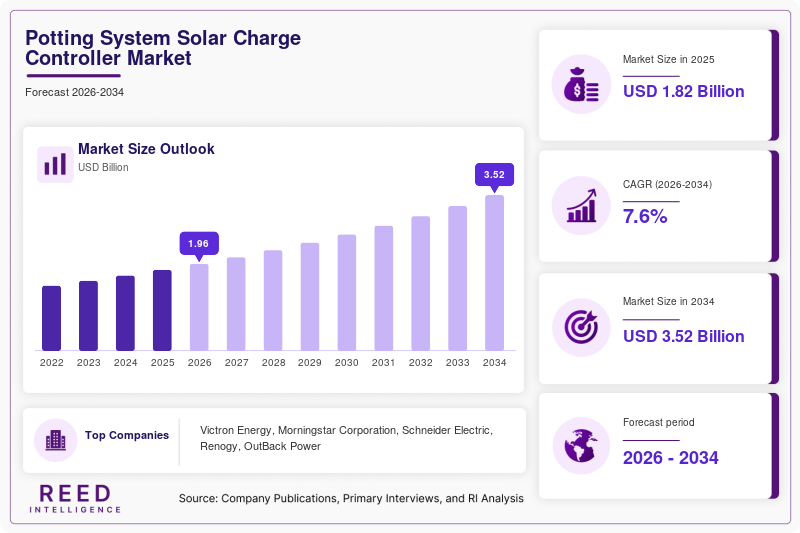
The Potting System Solar Charge Controller Market size is estimated to reach USD 1.82 billion, with growth to approximately USD 1.95 billion in 2026. Over the forecast period, the market is projected to attain USD 3.78 billion by 2034, registering a compound annual growth rate (CAGR) of 7.6% from 2025 to 2034. The increasing demand for durable and weather-resistant solar components has accelerated the adoption of potting systems in solar charge controllers, enhancing performance in harsh environments.
Potting systems involve encapsulating electronic circuits with protective compounds, which improve resistance to moisture, vibration, and thermal stress. This makes them particularly suitable for off-grid solar installations, remote monitoring systems, and industrial solar applications. As renewable energy penetration grows globally, especially in emerging economies, the demand for reliable solar charge controllers is increasing significantly.
Key Highlights
- Market size valued at USD 1.82 billion in 2025, reflecting steady demand for reliable solar infrastructure. The market is supported by increasing deployment of solar energy systems across residential and industrial applications.
- Expected to reach USD 3.78 billion by 2034, indicating strong long-term expansion. This growth is driven by rising renewable energy investments and the need for durable electronic components.
- CAGR of 7.6% during 2025–2034 highlights consistent market growth momentum. The steady pace reflects ongoing adoption of advanced charge controller technologies globally.
- Rising demand for durable and weatherproof solar systems is a key growth factor. Harsh environmental conditions are increasing the need for potted components that ensure long-term reliability.
- Growth driven by off-grid solar installations and smart controller integration. Expanding rural electrification and IoT-enabled systems are accelerating adoption across multiple end-use sectors.
Market Trends
Increasing Adoption of MPPT-Based Potting Systems
The growing preference for Maximum Power Point Tracking (MPPT) technology is a key trend in the Potting System Solar Charge Controller Market. MPPT controllers optimize the energy harvested from solar panels by adjusting electrical operating points, significantly improving efficiency compared to traditional PWM systems. When combined with potting systems, these controllers offer enhanced durability and reliability, particularly in outdoor and harsh environmental conditions. Manufacturers are increasingly incorporating potting materials to protect sensitive MPPT circuitry from moisture, dust, and mechanical damage, ensuring long-term performance and reduced maintenance requirements.
This trend is particularly evident in commercial and industrial solar installations, where system uptime and efficiency are critical. The integration of MPPT technology with advanced potting systems is also gaining traction in off-grid applications such as telecommunications towers, agricultural irrigation systems, and remote monitoring equipment. As the demand for efficient energy conversion and long-lasting components grows, the adoption of MPPT-based potted charge controllers is expected to accelerate further, contributing significantly to overall market growth.
Shift Toward Eco-Friendly and Advanced Potting Materials
Another notable trend in the market is the shift toward environmentally friendly and high-performance potting materials. Traditional potting compounds, while effective, often pose environmental concerns due to their chemical composition. As sustainability becomes a key focus, manufacturers are developing bio-based and low-toxicity potting materials that meet environmental regulations while maintaining high performance standards. These advanced materials provide improved thermal conductivity, electrical insulation, and resistance to UV radiation, making them suitable for long-term solar applications.
The adoption of such materials is being driven by stricter environmental regulations and growing awareness among end users. Additionally, advancements in material science are enabling the development of potting compounds with enhanced flexibility and durability, reducing the risk of cracking and failure under extreme temperature variations. This trend is expected to create new opportunities for innovation and differentiation among market players, further supporting the growth of the Potting System Solar Charge Controller Market.
Market Drivers
Expansion of Off-Grid Solar Installations
The rapid expansion of off-grid solar installations is a major driver of the Potting System Solar Charge Controller Market. In regions with limited access to centralized power grids, off-grid solar systems provide a reliable and cost-effective energy solution. These systems often operate in challenging environments, including remote rural areas, deserts, and mountainous regions, where exposure to extreme weather conditions is common. Potting systems play a crucial role in protecting charge controllers from environmental stress, ensuring consistent performance and durability.
The increasing demand for rural electrification, particularly in developing countries, is fueling the adoption of off-grid solar solutions. Governments and international organizations are investing in solar microgrids and standalone systems to improve energy access. This, in turn, is driving the need for robust charge controllers equipped with potting protection. As off-grid solar installations continue to grow, the demand for potted charge controllers is expected to increase significantly.
Rising Demand for Durable and Weather-Resistant Components
The need for durable and weather-resistant solar components is another key driver of market growth. Solar energy systems are often exposed to harsh environmental conditions, including high temperatures, humidity, dust, and vibrations. These factors can negatively impact the performance and lifespan of electronic components. Potting systems provide an effective solution by encapsulating the circuitry, protecting it from external damage and enhancing reliability.
Industries such as telecommunications, defense, and transportation rely heavily on solar-powered systems that require high durability. The adoption of potting systems in charge controllers ensures uninterrupted operation in these critical applications. Additionally, the increasing use of solar energy in residential and commercial sectors is driving demand for reliable components that require minimal maintenance. This growing emphasis on durability and reliability is expected to continue driving the Potting System Solar Charge Controller Market.
Market Restraint
High Initial Cost and Complexity of Potting Systems
One of the primary restraints in the Potting System Solar Charge Controller Market is the high initial cost and complexity associated with potting systems. The process of encapsulating electronic components requires specialized materials and manufacturing techniques, which can increase production costs. These costs are often passed on to end users, making potted charge controllers more expensive than non-potted alternatives. This price difference can limit adoption, particularly in cost-sensitive markets and small-scale solar installations.
In addition to cost, the complexity of potting systems can pose challenges in terms of repair and maintenance. Once a component is encapsulated, it becomes difficult to access and repair individual parts, often requiring complete replacement of the unit in case of failure. This can increase long-term operational costs and discourage some users from adopting potted solutions. For example, small residential solar system owners may prefer non-potted controllers that are easier and cheaper to maintain.
Despite these challenges, ongoing advancements in manufacturing processes and material technologies are expected to reduce costs over time. However, the current cost barrier remains a significant restraint, particularly in emerging markets where affordability is a key consideration.
Market Opportunities
Growth in Smart Solar Systems and IoT Integration
The integration of IoT and smart technologies in solar systems presents a significant opportunity for the Potting System Solar Charge Controller Market. Smart charge controllers equipped with sensors and communication capabilities enable real-time monitoring and control of solar energy systems. When combined with potting systems, these controllers offer enhanced protection and reliability, making them suitable for advanced applications.
The increasing adoption of smart homes and industrial automation is driving demand for intelligent energy management systems. IoT-enabled charge controllers allow users to monitor performance, detect faults, and optimize energy usage remotely. This trend is creating new opportunities for manufacturers to develop innovative products that combine advanced functionality with robust protection. As smart solar systems become more prevalent, the demand for potted charge controllers is expected to rise.
Increasing Investments in Renewable Energy Infrastructure
Rising investments in renewable energy infrastructure worldwide are creating substantial growth opportunities for the market. Governments and private sector players are investing heavily in solar energy projects to reduce carbon emissions and achieve sustainability goals. These investments are driving the deployment of large-scale solar installations, which require reliable and durable components, including charge controllers.
The growing focus on energy transition and climate change mitigation is expected to sustain investment levels in the renewable energy sector. This, in turn, will drive demand for advanced solar charge controllers with potting systems. Additionally, the expansion of solar energy in emerging markets offers significant growth potential, as these regions continue to develop their energy infrastructure.
Segmental Analysis
By Type
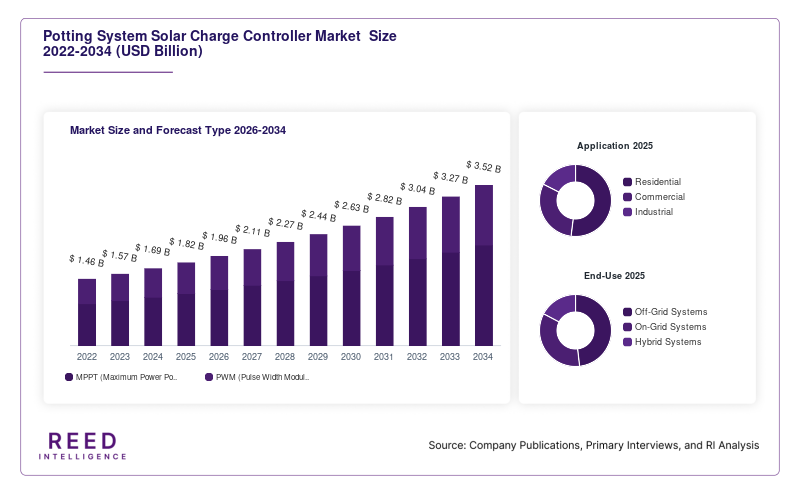
The MPPT (Maximum Power Point Tracking) segment dominated the market in 2024, accounting for approximately 62% share. MPPT controllers offer higher efficiency by optimizing the power output from solar panels, making them suitable for large-scale and high-performance applications. The integration of potting systems in MPPT controllers enhances their durability and reliability, particularly in harsh environments. This combination of efficiency and protection makes MPPT controllers the preferred choice across residential, commercial, and industrial sectors.
The PWM (Pulse Width Modulation) segment is expected to be the fastest-growing, with a CAGR of 7.2% during the forecast period. PWM controllers are more cost-effective and widely used in small-scale solar systems. The increasing adoption of potting systems in PWM controllers is driven by the need for improved durability and reduced maintenance. This trend is particularly evident in emerging markets, where affordability and reliability are key considerations.
By Application
The residential segment held the largest share in 2024, accounting for approximately 48% of the market. The growing adoption of rooftop solar systems and increasing awareness of renewable energy are driving demand in this segment. Potting systems enhance the reliability of charge controllers used in residential applications, ensuring long-term performance with minimal maintenance.
The commercial segment is expected to grow at the fastest CAGR of 7.8%. The increasing use of solar energy in commercial buildings and industrial facilities drives demand for advanced charge controllers. Potting systems provide the necessary protection for controllers used in demanding environments, making them suitable for commercial applications.
By End-Use
The off-grid segment dominated the market in 2024, with a share of 55%. Off-grid solar systems require reliable and durable components to operate in remote and challenging environments. Potting systems play a crucial role in ensuring the longevity and performance of charge controllers in these applications.
The hybrid systems segment is projected to grow at the fastest CAGR of 8.1%. Hybrid solar systems combine grid and off-grid capabilities, offering flexibility and reliability. The increasing adoption of hybrid systems in both residential and commercial sectors drives demand for advanced charge controllers with potting protection.
Regional Analysis
North America
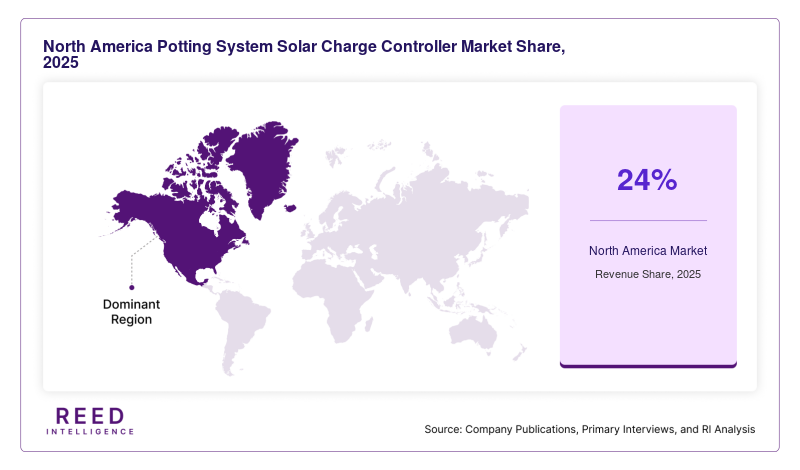
North America accounted for approximately 24% market share in 2025, with a projected CAGR of 6.8% during the forecast period. The region’s growth is driven by strong adoption of renewable energy and advanced solar technologies. The presence of established infrastructure and high awareness of energy efficiency contribute to steady demand for potting system solar charge controllers. Additionally, increasing investments in residential solar systems support market expansion.
The United States dominates the regional market due to its well-developed solar industry and supportive government policies. A unique growth factor is the increasing deployment of solar energy in remote industrial operations, such as oil and gas fields. These applications require durable and weather-resistant charge controllers, boosting the demand for potting systems.
Europe
Europe held around 21% market share in 2025 and is expected to grow at a CAGR of 7.1%. The region’s commitment to sustainability and carbon reduction targets drives the adoption of solar energy systems. Countries are increasingly investing in renewable energy infrastructure, which supports the demand for advanced solar components, including potted charge controllers.
Germany leads the European market due to its strong renewable energy policies and high solar penetration. A key growth factor is the integration of solar systems in residential and commercial buildings, supported by government incentives. This trend is driving the demand for reliable and long-lasting charge controllers with potting protection.
Asia Pacific
Asia Pacific is the largest market, accounting for 38% share in 2025, with a CAGR of 8.5%. Rapid urbanization, population growth, and increasing energy demand drive the adoption of solar energy systems in the region. The presence of major manufacturing hubs also supports market growth.
China dominates the region due to its extensive solar energy installations and manufacturing capabilities. A unique growth factor is the expansion of rural electrification programs, which rely heavily on off-grid solar systems. This drives the demand for durable potted charge controllers in remote areas.
Middle East & Africa
The Middle East & Africa region held 9% market share in 2025, with a CAGR of 7.9%. The region’s abundant solar resources and increasing investments in renewable energy projects support market growth. Governments are focusing on diversifying energy sources, which drives solar adoption.
Saudi Arabia leads the market due to large-scale solar projects and government initiatives. A key growth factor is the deployment of solar systems in desert environments, where extreme conditions require robust and weather-resistant components, boosting demand for potting systems.
Latin America
Latin America accounted for 8% market share in 2025, with a CAGR of 7.3%. The region is witnessing increasing adoption of solar energy due to favorable climatic conditions and rising energy demand. Investments in renewable energy projects support market growth.
Brazil dominates the market due to its expanding solar infrastructure. A unique growth factor is the use of solar systems in agricultural applications, such as irrigation, where durable charge controllers are essential. This drives demand for potting system solutions.
Competitive Landscape
The Potting System Solar Charge Controller Market is moderately fragmented, with several global and regional players competing based on product innovation, quality, and pricing. Leading companies are focusing on developing advanced charge controllers with enhanced durability and smart features to gain a competitive edge. Strategic partnerships, mergers, and acquisitions are common as companies seek to expand their market presence.
One of the leading players in the market is Victron Energy, known for its high-performance solar charge controllers. The company has recently introduced advanced MPPT controllers with improved potting systems, enhancing durability and efficiency. Other major players are also investing in research and development to introduce innovative products and strengthen their market position.
Key Players
- Victron Energy
- Morningstar Corporation
- Schneider Electric
- Renogy
- OutBack Power
- Phocos AG
- EPEVER
- MidNite Solar
- Blue Sky Energy
- Steca Elektronik
- Delta Electronics
- Sungrow Power Supply
- ABB Ltd.
- Huawei Technologies
- Samlex America
Recent Developments
- In 2024, Victron Energy launched a new range of MPPT solar charge controllers with enhanced potting protection for extreme environments.
- In 2023, Schneider Electric expanded its solar product portfolio by introducing smart charge controllers with integrated IoT capabilities.
- In 2024, Renogy introduced compact and cost-effective PWM controllers with improved potting systems for residential applications.
Potting System Solar Charge Controller Market Segments
Type
- MPPT (Maximum Power Point Tracking)
- PWM (Pulse Width Modulation)
Application
- Residential
- Commercial
- Industrial
End-Use
- Off-Grid Systems
- On-Grid Systems
- Hybrid Systems
By Region
- North America
- Europe
- APAC
- Middle East and Africa
- LATAM