Power Sport Vehicle Tire Market Size, Share & Demand Report By Tire Type (Radial Tires, Bias Tires, Beadlock Tires, Sand Tires), By Vehicle Type (All-Terrain Vehicles, Utility Terrain Vehicles, Snowmobiles, Dirt Bikes, Electric Utility Terrain Vehicles), By Distribution Channel (OEM, Aftermarket), By Region & Segment Forecasts, 2026–2034
USD 3950
Market Overview
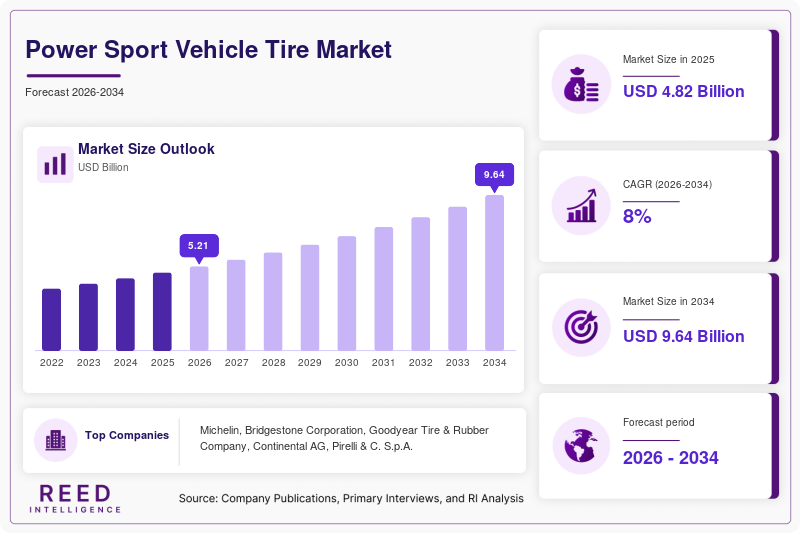
The global Power Sport Vehicle Tire Market size was valued at USD 4.82 billion in 2026 and is projected to reach USD 8.91 billion by 2034, expanding at a CAGR of 8.0% during the forecast period from 2026 to 2034. The market growth is being supported by the rising participation in recreational off-road activities, including all-terrain vehicle riding, motocross racing, snowmobiling, and utility terrain vehicle adventures across developed and emerging economies. Consumers are increasingly investing in durable and performance-oriented tires that can improve traction, stability, and vehicle handling across rough terrains, mud, snow, sand, and rocky surfaces.
The growing popularity of outdoor tourism and motorsports events has significantly increased demand for replacement tires and high-performance tire variants. Manufacturers are focusing on advanced tread compounds, puncture-resistant materials, and lightweight radial constructions to enhance product life and fuel efficiency. In addition, electric power sport vehicles are creating new opportunities for specialized tire development due to changing torque delivery patterns and weight distribution requirements. Digital tire monitoring technologies and smart pressure management systems are also gaining traction among premium vehicle users.
Key Highlights
- North America dominated the market with a 36.4% share in 2025, while Asia Pacific is expected to grow at the fastest CAGR of 10.8% during 2026–2034.
- By tire type, radial tires accounted for the largest share of 44.8%, while beadlock tires are projected to grow at a CAGR of 11.6%.
- By vehicle type, all-terrain vehicles led with a 39.7% share, whereas electric utility terrain vehicles are expected to expand at a CAGR of 12.1%.
- The United States remained the dominant country, with market values of USD 1.12 billion in 2024 and USD 1.21 billion in 2025.
Market Trends
Expansion of Electric Power Sport Vehicles
The increasing commercialization of electric all-terrain vehicles and electric side-by-side utility vehicles is influencing tire design and manufacturing trends across the Power Sport Vehicle Tire Market. Electric models generate instant torque and place different pressure loads on tires compared to traditional combustion-powered vehicles. As a result, tire manufacturers are introducing reinforced sidewalls, improved heat-resistant compounds, and optimized tread designs to support battery-powered performance systems. These developments are encouraging OEMs to collaborate with tire suppliers for application-specific product development.
Consumers are also demanding quieter tire performance and improved ride comfort for recreational electric vehicles used in forests, parks, and adventure tourism destinations. Manufacturers are responding with low-noise tread patterns and lightweight radial constructions that support extended battery range. The trend is expected to accelerate further as electric recreational mobility gains acceptance in North America, Europe, and selected Asia Pacific countries.
Growing Preference for Specialized Off-Road Tire Configurations
Demand for terrain-specific tire solutions is increasing steadily among professional racers and recreational riders. Consumers now prefer tires designed for mud trails, desert terrain, snow tracks, rocky surfaces, and mixed-condition environments instead of general-purpose variants. This trend has encouraged companies to diversify their product portfolios with highly engineered tread geometries and advanced rubber compounds that improve grip and durability under specific conditions.
Manufacturers are investing in simulation-based tread development and field-testing technologies to improve product reliability. In addition, customization trends are growing among enthusiasts who seek larger tire sizes, beadlock compatibility, and visually aggressive tread patterns for enhanced vehicle appearance. The rising influence of off-road sports communities and digital product reviews is further supporting the adoption of premium specialized tires across the global market.
Market Drivers
Increasing Participation in Recreational Adventure Activities
The growing popularity of outdoor recreational activities continues to support demand growth in the Power Sport Vehicle Tire Market. Consumers across North America, Europe, and Asia Pacific are increasingly participating in trail riding, dune racing, snow expeditions, and utility vehicle adventures. This trend has increased the sales of all-terrain vehicles, dirt bikes, snowmobiles, and side-by-side utility vehicles, directly supporting tire demand in both OEM and aftermarket channels.
Frequent exposure to rough terrains causes rapid tire wear, creating recurring replacement demand among vehicle owners. Tourism operators and adventure sports organizers are also expanding their fleets, which further contributes to higher tire consumption rates. Government investments in off-road tourism infrastructure and recreational parks are additionally encouraging vehicle adoption, particularly in rural and mountainous regions where outdoor sports activities continue to expand.
Technological Advancements in Tire Materials and Construction
Continuous advancements in tire engineering are strengthening product performance and improving consumer confidence in premium tire solutions. Manufacturers are increasingly using advanced silica compounds, reinforced synthetic rubber blends, and multi-layer carcass structures to improve traction, durability, and puncture resistance. These innovations help vehicles maintain stability under harsh riding conditions and enhance safety during high-speed off-road operations.
The integration of radial tire technology has also improved fuel efficiency, ride comfort, and heat dissipation capabilities. Furthermore, tire manufacturers are introducing smart tire monitoring systems that provide real-time pressure and temperature insights for performance optimization. The availability of technologically advanced products is encouraging consumers to replace conventional bias tires with premium radial alternatives, thereby supporting overall market expansion throughout the forecast period.
Market Restraint
High Replacement Costs and Volatility in Raw Material Prices
The high cost associated with premium power sport vehicle tires remains a major challenge for market growth, particularly in price-sensitive economies. Advanced off-road tires often require specialized rubber compounds, reinforced construction materials, and extensive durability testing, which increases manufacturing costs significantly. These expenses are ultimately transferred to end users, limiting adoption among recreational consumers with moderate spending capacity.
In addition, fluctuations in natural rubber, synthetic rubber, carbon black, and petroleum-based material prices continue to create uncertainty for manufacturers. Supply chain disruptions and transportation cost increases can further affect production efficiency and pricing stability. Smaller aftermarket distributors often struggle to maintain inventory during periods of raw material inflation, reducing product availability in regional markets. The challenge is particularly visible in developing countries where lower-cost imported products intensify pricing pressure on established brands and reduce profit margins across the industry.
Market Opportunities
Expansion of Adventure Tourism Infrastructure
The rapid expansion of adventure tourism destinations presents significant growth opportunities for the Power Sport Vehicle Tire Market. Governments and private tourism operators are investing in off-road recreational parks, desert tourism zones, mountain riding trails, and snow adventure facilities to attract domestic and international tourists. These developments are increasing the use of rental all-terrain vehicles and utility terrain vehicles, which require regular tire maintenance and replacement because of intensive operational usage.
Commercial fleet operators are increasingly demanding durable tires capable of handling continuous exposure to rough terrain conditions. Tire manufacturers can capitalize on this opportunity by offering high-wear-resistant products and long-term maintenance partnerships for tourism operators. Emerging tourism economies in Southeast Asia, the Middle East, and Latin America are expected to generate additional revenue streams for both global and regional tire manufacturers during the forecast period.
Rising Demand for Premium Aftermarket Tire Products
The growing consumer preference for performance enhancement and vehicle customization is creating opportunities within the premium aftermarket segment. Power sport vehicle owners increasingly seek tires with improved traction, aggressive tread aesthetics, and enhanced durability for racing and recreational applications. Enthusiasts are also willing to invest in larger tire sizes and specialty tire formats that improve off-road handling and overall riding experience.
Digital retail channels and online customization platforms are making premium tire products more accessible to consumers worldwide. Manufacturers are leveraging social media marketing and motorsports sponsorships to strengthen brand visibility and customer engagement. The expanding influence of enthusiast communities and recreational riding clubs is expected to accelerate demand for high-performance aftermarket tires, especially in North America and Asia Pacific.
Segmental Analysis
By Tire Type
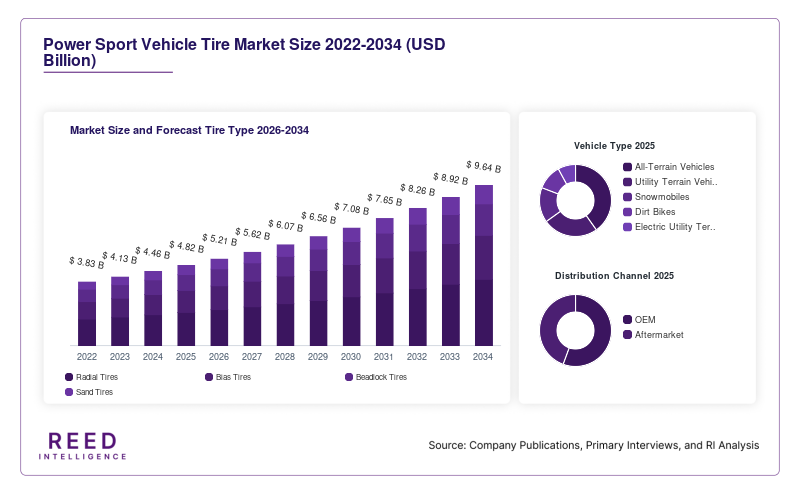
Radial tires accounted for the largest share of the Power Sport Vehicle Tire Market in 2024, representing approximately 44.8% of total revenue. Their dominance is primarily linked to superior ride comfort, improved traction, and enhanced fuel efficiency compared to traditional bias-ply alternatives. Radial tires distribute pressure more evenly across the tread surface, reducing wear and extending operational life in demanding off-road conditions. Recreational riders and commercial utility vehicle operators increasingly prefer radial variants because they offer better heat dissipation and improved handling during high-speed applications. Manufacturers are also investing heavily in reinforced radial constructions with puncture-resistant compounds to improve durability across rocky and uneven terrains. The growing adoption of premium recreational vehicles in North America and Europe continues to strengthen the demand for radial tire products across both OEM and aftermarket channels.
Beadlock tires are projected to register the fastest CAGR of 11.6% during the forecast period due to increasing demand from professional off-road enthusiasts and racing communities. These tires are designed to maintain secure wheel attachment even at low tire pressure, making them highly suitable for mud racing, rock crawling, and desert riding applications. The expanding popularity of extreme recreational sports is encouraging consumers to invest in specialized tire systems that enhance stability and traction under difficult terrain conditions. Manufacturers are introducing lightweight beadlock-compatible wheel systems and advanced sidewall reinforcements to improve overall vehicle performance. Growing customization trends and increasing participation in competitive off-road events are expected to accelerate the adoption of beadlock tires globally, particularly among younger recreational consumers and motorsports participants.
By Vehicle Type
All-terrain vehicles accounted for the dominant market share of 39.7% in 2024 due to their widespread use in recreational sports, agriculture, forestry, and utility operations. These vehicles require durable tires capable of operating across mud, gravel, snow, and rocky surfaces, creating consistent demand for high-performance tire products. Consumers prefer all-terrain vehicles because of their versatility and compact structure, which makes them suitable for both leisure and professional applications. Tire manufacturers are developing wider tread patterns, reinforced shoulder blocks, and puncture-resistant sidewalls specifically for all-terrain vehicle applications. Strong aftermarket demand is also contributing to segment growth because these vehicles frequently operate in harsh environments that accelerate tire wear. North America remains the largest contributor to segment revenue owing to its established recreational riding culture and strong utility vehicle ownership rates.
Electric utility terrain vehicles are expected to witness the fastest CAGR of 12.1% during the forecast period. The rising transition toward electric mobility solutions in recreational and commercial applications is encouraging manufacturers to design tires specifically optimized for battery-powered utility vehicles. Electric variants generate instant torque, which increases tire stress and requires improved traction capabilities. As a result, tire suppliers are focusing on low-resistance compounds, lightweight constructions, and enhanced durability features to support electric vehicle efficiency. Growing environmental awareness and stricter emission regulations are accelerating the adoption of electric utility terrain vehicles across Europe and Asia Pacific. Additionally, tourism operators and industrial users are increasingly investing in electric utility fleets for quieter operation and lower maintenance costs, supporting strong demand for specialized tire products.
By Distribution Channel
The aftermarket segment held the largest share of the Power Sport Vehicle Tire Market in 2024, accounting for nearly 58.3% of total revenue. Off-road riding environments expose tires to frequent damage, tread wear, and punctures, resulting in recurring replacement demand among recreational and commercial users. Consumers often replace factory-installed tires with upgraded aftermarket variants that provide better grip, durability, and terrain-specific performance. Online tire retail platforms and regional dealership networks have further strengthened aftermarket accessibility, allowing consumers to compare specifications and pricing more efficiently. Manufacturers are increasingly introducing premium replacement tire portfolios targeted at motorsports enthusiasts and adventure tourism operators. The strong presence of recreational riding clubs and racing communities also contributes to high replacement rates, particularly in North America and Europe where off-road vehicle usage remains extensive.
OEM distribution is expected to expand at the fastest CAGR of 10.3% during the forecast period because of increasing partnerships between tire manufacturers and recreational vehicle producers. Vehicle manufacturers are seeking advanced tire technologies that improve handling, energy efficiency, and ride comfort for newly launched models. Tire suppliers are collaborating closely with OEMs to develop application-specific solutions tailored for electric all-terrain vehicles, utility terrain vehicles, and snowmobiles. The growing production of premium recreational vehicles in Asia Pacific and Europe is supporting higher OEM tire installation volumes. In addition, consumers increasingly prefer factory-equipped premium tires that provide optimized vehicle performance and warranty assurance. These factors are expected to strengthen OEM demand across the global market over the coming years.
Regional Analysis
North America
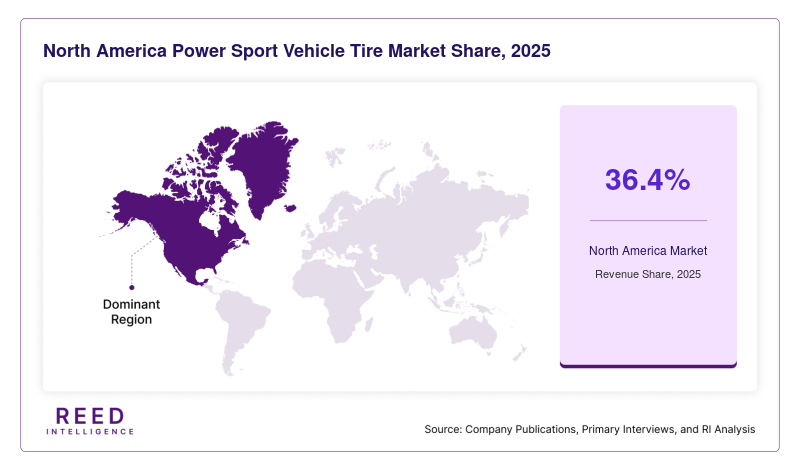
North America accounted for 36.4% of the global Power Sport Vehicle Tire Market in 2025 and is expected to maintain a stable growth trajectory with a CAGR of 7.6% during the forecast period. The region benefits from a large recreational vehicle user base, advanced motorsports culture, and strong aftermarket infrastructure. Consumers in the United States and Canada frequently participate in off-road riding activities, generating sustained demand for replacement tires. High spending on recreational mobility products and strong dealership networks further support market expansion across the region.
The United States remained the dominant country in North America due to high adoption rates of all-terrain vehicles and utility terrain vehicles. One major growth factor is the widespread presence of organized off-road racing events and recreational parks. These activities increase tire replacement frequency because vehicles are exposed to rough terrain and high-speed riding conditions. Manufacturers are also investing in advanced tire technologies tailored for snow, mud, and desert conditions across different states.
Europe
Europe represented a significant share of the Power Sport Vehicle Tire Market in 2025 and is forecast to grow at a CAGR of 7.2% through 2034. Demand growth is supported by increasing participation in recreational outdoor sports and rising consumer interest in electric utility terrain vehicles. Countries across Western Europe are witnessing growing sales of premium off-road vehicles used for leisure, forestry operations, and agricultural applications. Tire manufacturers are also benefiting from strong regulatory standards that encourage the adoption of durable and environmentally efficient tire technologies.
Germany remained the leading market within Europe due to its established automotive engineering ecosystem and high recreational vehicle ownership. A unique growth factor in the country is the increasing use of utility terrain vehicles in industrial and agricultural applications. These operational environments require heavy-duty tires with improved traction and durability. Local manufacturers are focusing on radial tire innovations and sustainable material integration to strengthen their regional market position.
Asia Pacific
Asia Pacific is projected to register the fastest CAGR of 10.8% during the forecast period due to rising disposable income and expanding recreational vehicle adoption. Countries including China, India, Japan, and Australia are witnessing increasing demand for off-road vehicles in tourism, agriculture, and sports applications. The region is also benefiting from rapid industrialization and expanding e-commerce networks that improve product accessibility. Local tire manufacturers are investing heavily in affordable yet durable product offerings to capture growing consumer demand.
China dominated the Asia Pacific market owing to its large manufacturing ecosystem and rising recreational vehicle production. One important growth factor is the expansion of domestic adventure tourism infrastructure in mountainous and desert regions. Off-road tourism operators are increasingly purchasing utility terrain vehicles and all-terrain vehicles, creating strong replacement tire demand. In addition, government support for electric mobility manufacturing is encouraging the development of specialized tires for electric recreational vehicles.
Middle East & Africa
The Middle East & Africa region is experiencing gradual growth in the Power Sport Vehicle Tire Market and is expected to expand at a CAGR of 6.8% through 2034. Rising interest in desert tourism and outdoor adventure activities is contributing to increasing adoption of off-road vehicles. Countries across the Gulf region are investing in recreational tourism facilities and motorsports events, which support demand for high-durability sand-terrain tires. The aftermarket segment is also growing steadily due to harsh environmental conditions that accelerate tire wear.
Saudi Arabia emerged as the dominant country in the region because of expanding desert recreational activities and tourism diversification initiatives. A major growth factor is the increasing popularity of organized dune racing and off-road adventure festivals. These activities require specialized tires capable of maintaining traction and stability under extreme desert conditions. Tire suppliers are introducing heat-resistant compounds and reinforced tire structures specifically designed for high-temperature environments in the region.
Latin America
Latin America accounted for a moderate share of the global Power Sport Vehicle Tire Market in 2025 and is projected to grow at a CAGR of 7.0% during the forecast period. The market is supported by increasing adoption of utility terrain vehicles in agriculture, mining, and recreational tourism sectors. Rural infrastructure expansion and improving access to outdoor recreational activities are also strengthening demand for durable off-road tires. Regional distributors are expanding their aftermarket presence to meet rising replacement requirements among recreational and commercial users.
Brazil remained the dominant country in Latin America due to its large agricultural industry and growing motorsports culture. One unique growth factor is the increasing use of all-terrain vehicles across large-scale farming operations. Farmers are investing in rugged utility vehicles for transportation and field operations, creating strong demand for puncture-resistant tires with improved load-bearing capacity. Manufacturers are also targeting regional consumers with cost-effective radial tire products designed for mixed-terrain performance.
Competitive Landscape
The Power Sport Vehicle Tire Market is moderately consolidated, with major manufacturers competing through product innovation, OEM partnerships, and regional expansion strategies. Companies are investing heavily in advanced tread technologies, puncture-resistant compounds, and lightweight tire constructions to strengthen their market presence. Premium tire brands are also focusing on motorsports sponsorships and recreational event partnerships to improve brand visibility among enthusiasts and professional riders.
Michelin remained one of the leading participants in the market due to its broad off-road tire portfolio and strong global distribution network. The company recently introduced enhanced radial tire technologies designed for electric utility terrain vehicles and high-performance all-terrain applications. Bridgestone, Goodyear, Continental, and Maxxis International are also focusing on specialized tire solutions for desert, snow, and mud-terrain operations. Several regional manufacturers are expanding production capacity in Asia Pacific to meet rising recreational vehicle demand. Competitive intensity is expected to increase further as companies invest in sustainable tire materials and smart tire monitoring technologies for next-generation power sport vehicles.
Key Players
- Michelin
- Bridgestone Corporation
- Goodyear Tire & Rubber Company
- Continental AG
- Pirelli & C. S.p.A.
- Maxxis International
- Yokohama Rubber Company
- CST Tires
- ITP Tires
- Carlisle Companies Incorporated
- Dunlop Motorcycle Tires
- Kenda Tire
- Titan International
- Trelleborg AB
- Cheng Shin Rubber Industry Co.
Recent Developments
- Michelin introduced a new reinforced radial tire series in 2025 for electric utility terrain vehicles with improved torque handling capabilities.
- Bridgestone expanded its off-road tire manufacturing capacity in Southeast Asia to strengthen regional aftermarket supply operations in 2024.
- Goodyear launched advanced mud-terrain tires featuring enhanced puncture resistance and heat management technologies for recreational riders in 2025.
- Continental partnered with recreational vehicle OEM manufacturers to develop lightweight tire solutions for electric all-terrain vehicles in 2024.
- Maxxis International expanded its premium beadlock tire portfolio to target competitive off-road racing applications across North America in 2025.
Power Sport Vehicle Tire Market Segments
Tire Type
- Radial Tires
- Bias Tires
- Beadlock Tires
- Sand Tires
Vehicle Type
- All-Terrain Vehicles
- Utility Terrain Vehicles
- Snowmobiles
- Dirt Bikes
- Electric Utility Terrain Vehicles
Distribution Channel
- OEM
- Aftermarket
By Region
- North America
- Europe
- APAC
- Middle East and Africa
- LATAM