PP Synthetic Paper Market Size, Share Demand Report By Type (Coated PP Synthetic Paper, Uncoated PP Synthetic Paper), By Application (Labels, Packaging, Tags & Tickets, Maps, Others), By End-Use Industry (Food & Beverage, Healthcare, Retail, Industrial, Logistics), By Distribution Channel (Direct Sales, Indirect Sales, Online Platforms), and Regional Forecasts, 2026–2034
USD 3950
Market Overview
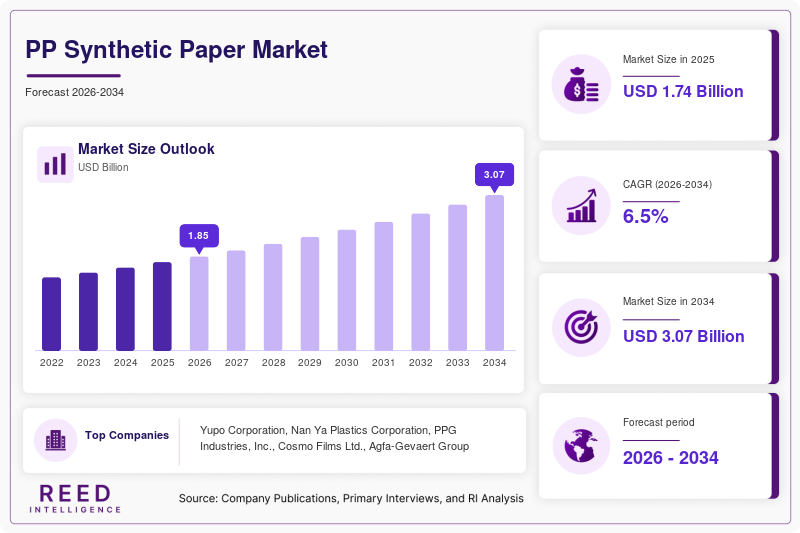
The PP Synthetic Paper Market size is estimated at USD 1.82 billion, and it is projected to reach USD 3.12 billion by 2034, registering a CAGR of 6.5% (2026–2034). Growth in digital printing, rising demand for sustainable packaging materials, and increased adoption in labeling applications have collectively strengthened market expansion.
One key global factor supporting the PP Synthetic Paper Market growth is the accelerating transition toward plastic-based recyclable alternatives in packaging and labeling industries. Polypropylene synthetic paper offers high durability, tear resistance, and water resistance while maintaining printability, making it a preferred alternative to traditional cellulose-based paper in multiple industrial applications.
Key Highlights
- Dominant Region (2025): Asia Pacific held 35% share of the global PP Synthetic Paper Market
- Fastest-Growing Region CAGR (2026–2034): Middle East & Africa expected at 7.4% CAGR
- Leading Subsegment (Type): Coated PP synthetic paper dominated with 58% share (2025)
- Fastest-Growing Subsegment: Packaging applications projected to grow at 7.8% CAGR
- Dominant Country (2024 Market Value): China – USD 0.34 billion
- Dominant Country (2025 Market Value): China – USD 0.37 billion
Market Trends
Expansion of Sustainable Synthetic Substrates
The PP Synthetic Paper Market is increasingly driven by sustainability-focused manufacturing innovations. Manufacturers are developing polypropylene-based papers that are recyclable and compatible with circular economy initiatives. This trend is particularly strong in Europe and Asia Pacific, where regulatory frameworks encourage reduced dependency on pulp-based paper products. The demand for eco-friendly packaging is pushing brands to adopt PP synthetic paper in food labels, retail tags, and industrial packaging.
Growth in Digital and UV Printing Compatibility
Another key trend in the PP Synthetic Paper Market is its rising compatibility with advanced printing technologies such as UV offset, flexographic, and digital inkjet printing. These substrates offer superior ink adhesion and image clarity, making them suitable for high-quality labeling and security printing applications. As industries adopt high-speed digital printing systems, PP synthetic paper usage continues to expand across commercial and industrial segments.
Market Drivers
Rising Demand for Durable Labeling Solutions
The growing need for water-resistant, tear-proof, and chemical-resistant labeling materials is significantly driving the PP Synthetic Paper Market. Industries such as food & beverage, pharmaceuticals, and logistics increasingly rely on synthetic paper for long-lasting labeling performance under harsh environmental conditions. This demand is further reinforced by global supply chain expansion and regulatory compliance requirements.
Increasing Adoption in Packaging Applications
Packaging industries are increasingly integrating polypropylene synthetic paper due to its strength, flexibility, and printability. The shift toward lightweight yet durable packaging solutions is accelerating the use of PP synthetic paper in premium packaging, retail packaging, and industrial wrapping applications. This driver is expected to remain strong throughout the forecast period as e-commerce continues to expand globally.
Market Restraint
High Production Cost Compared to Conventional Paper
Despite its advantages, the PP Synthetic Paper Market faces a significant restraint due to higher production costs compared to traditional cellulose-based paper. The manufacturing process of polypropylene synthetic paper involves advanced polymer processing techniques, which increases overall cost. This limits adoption in price-sensitive markets, particularly in developing economies.
Market Opportunities
Expansion in Smart Labeling and RFID Integration
The integration of smart labeling technologies such as RFID tags and QR-coded labels presents a major growth opportunity in the PP Synthetic Paper Market. Synthetic paper’s durability and resistance to moisture make it ideal for advanced tracking and identification applications in logistics, healthcare, and retail sectors.
Growth in Emerging Economies
Rapid industrialization and packaging sector growth in emerging economies such as India, Vietnam, and Brazil offer significant opportunities for the PP Synthetic Paper Market. Increasing demand for modern packaging materials and rising e-commerce penetration are expected to support long-term adoption of polypropylene synthetic paper in these regions.
Segmental Analysis
By Type
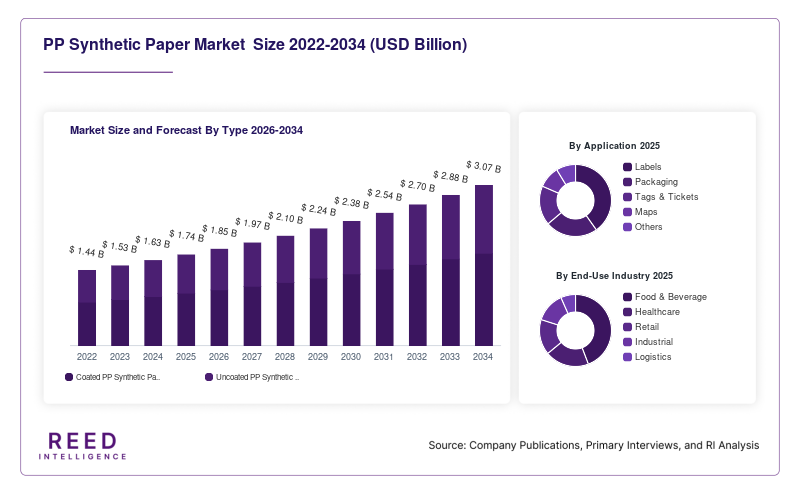
The PP Synthetic Paper Market is segmented into coated and uncoated PP synthetic paper. Coated PP synthetic paper dominated the segment with 58% share in 2025, driven by its superior printability and ink absorption capabilities. Meanwhile, uncoated PP synthetic paper is projected to grow at a 6.9% CAGR (2026–2034) due to its cost efficiency and increasing adoption in industrial applications where high-end printing is not required.
By Application
Applications include labels, packaging, tags & tickets, maps, and others. Label applications dominated with 40% share in 2025, supported by strong demand in retail and logistics industries. Packaging applications are expected to grow at a 7.8% CAGR, driven by the shift toward durable and waterproof packaging materials in food and e-commerce sectors.
By End-Use Industry
The food & beverage industry held 32% share in 2025, making it the dominant end-use segment of the PP Synthetic Paper Market due to extensive labeling and packaging requirements. The healthcare sector is projected to grow at the fastest rate of 8.2% CAGR, driven by rising demand for durable medical labels and sterilization-resistant packaging materials.
By Distribution Channel
Direct sales dominated with 60% share in 2025, as manufacturers prefer long-term contracts with industrial clients. However, online distribution channels are expected to grow at 9% CAGR, supported by the increasing digitization of procurement systems and expansion of B2B e-commerce platforms.
Regional Analysis
North America
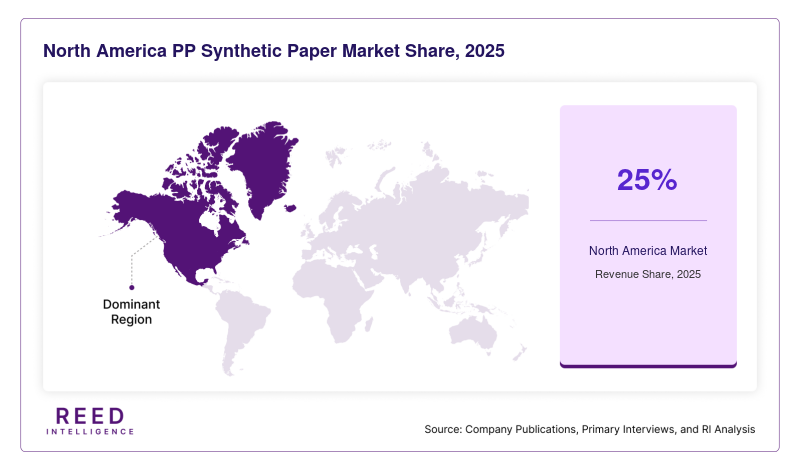
In 2025, North America accounted for 25% share of the PP Synthetic Paper Market and is projected to grow at a 6.2% CAGR (2026–2034). The region benefits from strong demand in labeling and security printing applications. The United States dominates the regional market due to advanced packaging infrastructure and high adoption of synthetic substrates in retail and healthcare labeling systems.
Europe
Europe held 22% market share in 2025, with a projected 6.0% CAGR (2026–2034). Growth is driven by stringent sustainability regulations and strong demand for recyclable packaging materials. Germany leads the European PP Synthetic Paper Market, supported by its advanced printing and packaging industry and strong environmental compliance standards.
Asia Pacific
Asia Pacific dominated the global PP Synthetic Paper Market with 35% share in 2025 and is expected to grow at a 7.1% CAGR (2026–2034). China remains the dominant country due to large-scale manufacturing capabilities and expanding packaging exports. Rising e-commerce activity and industrial expansion further accelerate regional demand.
Middle East & Africa
The Middle East & Africa region held 8% share in 2025 and is projected to expand at a 7.4% CAGR (2026–2034), the fastest among all regions. The UAE leads regional growth due to increasing investments in retail infrastructure and packaging modernization initiatives.
Latin America
Latin America accounted for 10% share in 2025, with a projected 6.3% CAGR (2026–2034). Brazil is the leading country due to rising food packaging demand and growing industrial labeling requirements. Expansion of retail and logistics sectors supports the regional PP Synthetic Paper Market.
Competitive Landscape
The PP Synthetic Paper Market is moderately consolidated with key global players focusing on capacity expansion, product innovation, and sustainability initiatives. Leading companies include Yupo Corporation, Nan Ya Plastics Corporation, PPG Industries, Cosmo Films Ltd., and Agfa-Gevaert Group. Among these, Yupo Corporation remains the market leader due to its strong global distribution network and advanced polypropylene film technologies widely used in labeling and printing applications.
Nan Ya Plastics continues to strengthen its position through vertical integration and expansion of polymer production capabilities. Cosmo Films has been focusing on enhancing specialty film offerings for packaging and labeling applications. PPG Industries is leveraging its coating technologies to improve printability and durability of synthetic paper products. Recently, Yupo Corporation introduced a new recyclable PP synthetic paper line aimed at reducing environmental impact while improving printing efficiency, reinforcing its leadership position in the PP Synthetic Paper Market.
Key Players List
- Yupo Corporation
- Nan Ya Plastics Corporation
- PPG Industries
- Cosmo Films Ltd.
- Agfa-Gevaert Group
- Arjobex (Polyart)
- Hop Industries Corporation
- Sihl GmbH
- Avery Dennison Corporation
- Tekra LLC
- Transilwrap Company Inc.
- Ritrama S.p.A.
- Toyobo Co., Ltd.
- Mitsubishi Polyester Film
- Nanya Technology Corporation
Recent Developments
- In 2025, Yupo Corporation expanded its production capacity in Asia Pacific to meet rising demand for sustainable synthetic substrates in the PP Synthetic Paper Market.
- Nan Ya Plastics introduced a new high-opacity polypropylene film designed for premium labeling applications.
- Cosmo Films announced strategic investments in recyclable packaging films to align with global sustainability targets.
- Agfa-Gevaert enhanced its synthetic paper product line with improved UV ink compatibility for digital printing applications.
- PPG Industries expanded its coating technology portfolio to improve water resistance and durability of synthetic paper materials.
PP Synthetic Paper Market Segments
By Type
- Coated PP Synthetic Paper
- Uncoated PP Synthetic Paper
By Application
- Labels
- Packaging
- Tags & Tickets
- Maps
- Others
By End-Use Industry
- Food & Beverage
- Healthcare
- Retail
- Industrial
- Logistics
By Distribution Channel
- Direct Sales
- Indirect Sales
- Online Platforms
By Region
- North America
- Europe
- APAC
- Middle East and Africa
- LATAM