Pre Pregnancy Genetic Testing Market Size, Share & Demand Report By Test Type (Carrier Screening, Expanded Carrier Screening, Single Gene Testing), By Technology (Next-Generation Sequencing, PCR-Based Testing, Microarray), By Application (Genetic Disease Screening, Infertility Testing, Family Planning), By End-Use (Hospitals, Fertility Clinics, Diagnostic Laboratories), By Region & Segment Forecasts, 2025–2034
USD 3950
Market Overview
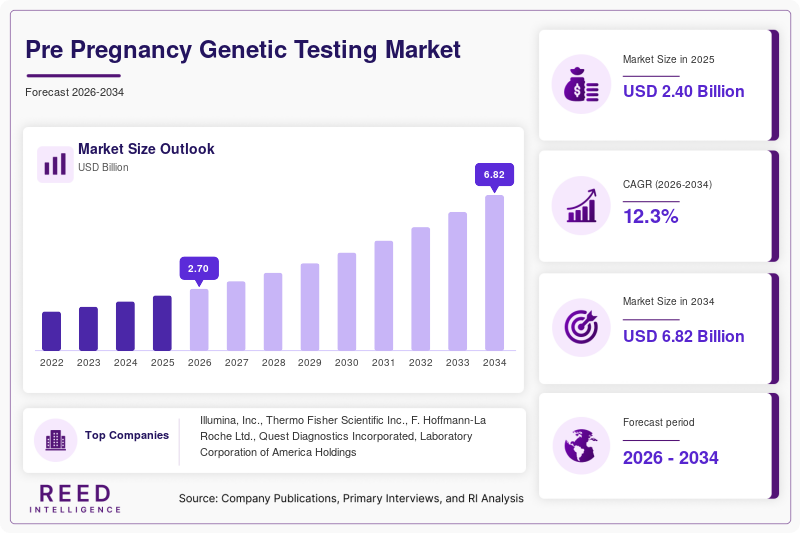
The global Pre Pregnancy Genetic Testing Market size was valued at USD 2.4 billion in 2025 and is projected to reach approximately USD 6.8 billion by 2034, expanding at a CAGR of 12.3% during 2025–2034. The market has experienced steady growth driven by rising awareness of hereditary disorders and the increasing adoption of preventive healthcare strategies among prospective parents. Advances in genomic technologies, including next-generation sequencing (NGS) and carrier screening panels, have significantly enhanced the accuracy and accessibility of preconception genetic testing services.
A major global factor supporting market growth is the increasing emphasis on preventive and personalized medicine. Governments and healthcare organizations worldwide are promoting early screening programs to reduce the burden of genetic diseases, thereby improving long-term healthcare outcomes and reducing treatment costs. This shift has encouraged couples to opt for pre pregnancy genetic testing as a proactive measure.
Key Highlights
- North America dominated the market with a 38.5% share in 2025, while Asia Pacific is projected to be the fastest-growing region with a CAGR of 14.1%.
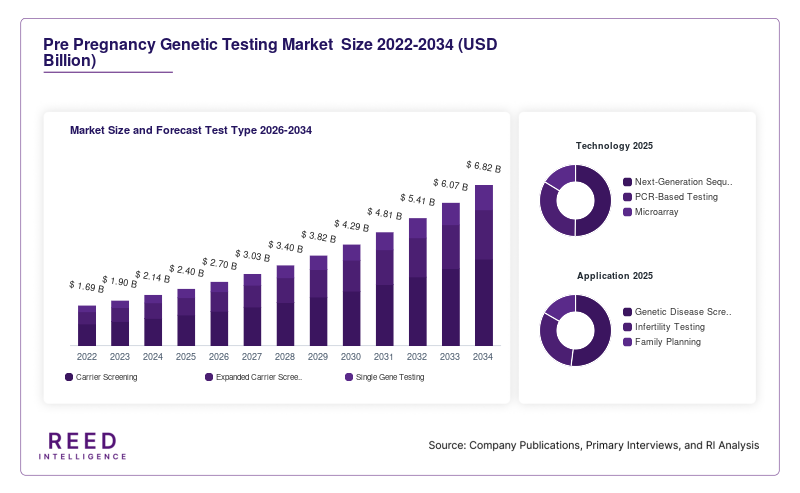
- Carrier screening accounted for the largest share among test types at 46.2%, whereas expanded carrier screening is expected to grow fastest at a CAGR of 13.8%.
- Hospitals led the end-use segment with 42.7% share, while fertility clinics are projected to expand at a CAGR of 13.5%.
- The United States remained the dominant country, with market values of USD 820 million in 2025 and an estimated USD 905 million in 2026.
Market Trends
Integration of Advanced Genomic Technologies
The Pre Pregnancy Genetic Testing Market is witnessing rapid integration of advanced genomic tools such as next-generation sequencing and microarray analysis. These technologies enable comprehensive detection of genetic abnormalities with higher precision and shorter turnaround times. Laboratories are increasingly adopting automation and AI-based interpretation tools, improving diagnostic efficiency and reducing human error. This trend is enhancing the reliability of testing services and encouraging broader adoption among healthcare providers.
Rising Demand for Expanded Carrier Screening Panels
There is a growing shift from targeted genetic tests to expanded carrier screening panels that assess multiple genetic conditions simultaneously. These panels offer a more holistic understanding of genetic risks, especially for couples without a known family history of disorders. As awareness increases, healthcare professionals are recommending broader panels as part of routine preconception care. This trend is expected to reshape the service offerings within the Pre Pregnancy Genetic Testing Market and drive higher test volumes globally.
Market Drivers
Increasing Prevalence of Genetic Disorders
The rising incidence of inherited diseases such as cystic fibrosis, thalassemia, and sickle cell anemia is a key driver of the Pre Pregnancy Genetic Testing Market. Couples are increasingly seeking early detection options to minimize the risk of passing genetic conditions to their offspring. Public health initiatives and awareness campaigns have further amplified the importance of genetic screening before conception.
Growing Adoption of Assisted Reproductive Technologies (ART)
The increasing use of assisted reproductive technologies, including in vitro fertilization (IVF), has significantly boosted demand for pre pregnancy genetic testing. Fertility clinics often recommend genetic screening as part of the treatment process to improve success rates and reduce the risk of genetic abnormalities. This integration of testing into fertility treatment protocols is driving consistent growth across developed and emerging markets.
Market Restraint
High Cost and Limited Accessibility in Developing Regions
Despite technological advancements, the high cost associated with genetic testing remains a major barrier to market expansion. Comprehensive screening panels and advanced sequencing technologies can be expensive, limiting adoption among middle- and low-income populations. In addition, inadequate healthcare infrastructure and a shortage of trained genetic counselors in developing regions restrict access to these services.
Cultural and ethical concerns also contribute to hesitancy in certain regions, where genetic testing may be perceived as intrusive or unnecessary. Furthermore, lack of standardized guidelines across countries can lead to inconsistent adoption rates. These factors collectively pose challenges to the widespread penetration of the Pre Pregnancy Genetic Testing Market, particularly in emerging economies.
Market Opportunities
Expansion in Emerging Markets
Emerging economies in Asia Pacific, Latin America, and parts of the Middle East present significant growth opportunities for the Pre Pregnancy Genetic Testing Market. Increasing healthcare investments, rising disposable incomes, and improving awareness about genetic disorders are creating a favorable environment for market expansion. Companies are focusing on cost-effective testing solutions tailored to these regions, enabling broader adoption.
Development of Direct-to-Consumer Genetic Testing
The rise of direct-to-consumer (DTC) genetic testing services offers a new avenue for market growth. These services allow individuals to access genetic insights without requiring physician referrals, increasing convenience and accessibility. As regulatory frameworks evolve and consumer trust improves, DTC testing is expected to gain traction, particularly among younger populations planning for parenthood.
Segmental Analysis
By Test Type
Carrier screening dominated the Pre Pregnancy Genetic Testing Market with a 46.2% share in 2025, owing to its widespread use in identifying inherited genetic conditions among prospective parents. Its cost-effectiveness and established clinical guidelines have made it a preferred choice.
Expanded carrier screening is expected to register the fastest growth at a CAGR of 13.8%, driven by its ability to detect a broader range of genetic disorders. The increasing demand for comprehensive risk assessment among couples will fuel its adoption.
By Technology
Next-generation sequencing (NGS) accounted for the largest share of 48.5% in 2025, as it offers high-throughput and accurate genetic analysis. Its ability to analyze multiple genes simultaneously has made it a cornerstone technology.
Polymerase chain reaction (PCR)-based testing is anticipated to grow at a CAGR of 12.7%, supported by its cost-efficiency and rapid results. Ongoing advancements in PCR techniques will enhance its applicability in emerging markets.
By Application
Genetic disease screening led the segment with a 52.3% share in 2025, driven by increasing awareness about hereditary conditions and preventive healthcare measures.
Infertility-related genetic testing is projected to grow at a CAGR of 13.2%, as more couples seek genetic insights to improve reproductive outcomes. The integration of testing into fertility treatments will accelerate growth.
By End-Use
Hospitals accounted for 42.7% share in 2025, benefiting from advanced diagnostic infrastructure and the availability of skilled professionals.
Fertility clinics are expected to grow at a CAGR of 13.5%, driven by increasing adoption of ART procedures and personalized treatment approaches. Their specialized services and patient-centric care models will support expansion.
Regional Analysis
North America
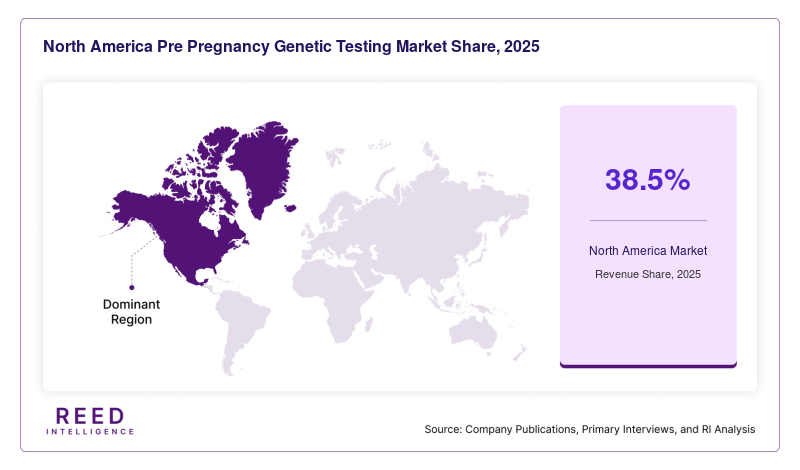
North America accounted for 38.5% of the Pre Pregnancy Genetic Testing Market share in 2025 and will expand at a CAGR of 11.6% during the forecast period. The region’s growth is supported by well-established healthcare infrastructure and widespread adoption of advanced diagnostic technologies.
The United States dominated the region due to strong reimbursement frameworks and high awareness levels. The presence of leading diagnostic companies and continuous innovation in genetic testing solutions have contributed to sustained market expansion.
Europe
Europe held 27.2% market share in 2025 and is expected to grow at a CAGR of 10.9% through 2034. Government-backed screening programs and increasing emphasis on preventive healthcare have supported market growth across the region.
Germany emerged as the dominant country, driven by robust healthcare systems and strong research initiatives in genomics. The country’s focus on early disease detection and integration of genetic testing into routine healthcare practices has boosted adoption rates.
Asia Pacific
Asia Pacific represented 21.8% of the market in 2025 and is projected to grow at the fastest CAGR of 14.1%. Rapid urbanization, rising healthcare expenditure, and increasing awareness about genetic conditions are key growth factors.
China led the region due to its large population base and expanding healthcare infrastructure. Government initiatives promoting maternal health and genetic screening programs have significantly contributed to market growth.
Middle East & Africa
The Middle East & Africa accounted for 6.5% of the market share in 2025 and will grow at a CAGR of 9.8%. Improving healthcare infrastructure and rising awareness about genetic disorders are supporting market expansion.
Saudi Arabia dominated the region, driven by increasing investments in healthcare modernization and a growing focus on preventive medicine. The country’s efforts to integrate genetic testing into national healthcare programs have enhanced accessibility.
Latin America
Latin America held 6.0% market share in 2025 and is expected to grow at a CAGR of 10.3%. The region is experiencing gradual adoption of genetic testing services due to improving healthcare systems and rising awareness.
Brazil led the market owing to its expanding private healthcare sector and increasing demand for advanced diagnostic services. The growing number of fertility clinics offering genetic testing has further supported market growth.
Competitive Landscape
The Pre Pregnancy Genetic Testing Market is moderately fragmented, with several global and regional players competing on technology innovation, pricing, and service offerings. Key companies are focusing on expanding their testing portfolios and strengthening partnerships with healthcare providers.
One of the leading players, Illumina, Inc., continues to maintain a strong market position through its advanced sequencing platforms and continuous product innovation. The company recently introduced enhanced genomic screening solutions aimed at improving test accuracy and efficiency.
Other prominent players are investing in research and development to expand their capabilities in carrier screening and genomic analysis. Strategic collaborations, mergers, and geographic expansion remain key strategies adopted by market participants to strengthen their presence.
Key Players
- Illumina, Inc.
- Thermo Fisher Scientific Inc.
- F. Hoffmann-La Roche Ltd.
- Quest Diagnostics Incorporated
- Laboratory Corporation of America Holdings
- Myriad Genetics, Inc.
- Natera, Inc.
- Invitae Corporation
- Eurofins Scientific
- BGI Genomics Co., Ltd.
- Agilent Technologies, Inc.
- PerkinElmer, Inc.
- Centogene N.V.
- GeneDx Holdings Corp.
- CooperSurgical, Inc.
Recent Developments
- 2024: A leading genomics company launched an expanded carrier screening panel covering over 500 genetic conditions.
- 2024: Strategic collaboration between diagnostic laboratories and fertility clinics increased accessibility to integrated testing services.
- 2023: Advancements in AI-based genetic data interpretation improved test accuracy and reduced turnaround times.
- 2023: Expansion of genetic testing services into emerging markets enhanced global market penetration.
Pre Pregnancy Genetic Testing Market Segments
Test Type
- Carrier Screening
- Expanded Carrier Screening
- Single Gene Testing
Technology
- Next-Generation Sequencing
- PCR-Based Testing
- Microarray
Application
- Genetic Disease Screening
- Infertility Testing
- Family Planning
End-Use
- Hospitals
- Fertility Clinics
- Diagnostic Laboratories
By Region
- North America
- Europe
- APAC
- Middle East and Africa
- LATAM