Precision Machining Market Size, Share & Trends Analysis Report By Type (Turning, Milling, Grinding, Drilling, Electrical Discharge Machining, and Other Types), By Application (Automotive, Aerospace & Defense, Medical Devices, Electronics, Industrial Machinery, and Other Applications), By End-User (Manufacturing, Healthcare, Automotive, Aerospace, and Other Industries), and By Region (North America, Europe, Asia Pacific, Latin America, Middle East & Africa) Forecasts, 2026–2034
USD 3950
Precision Machining Market Size
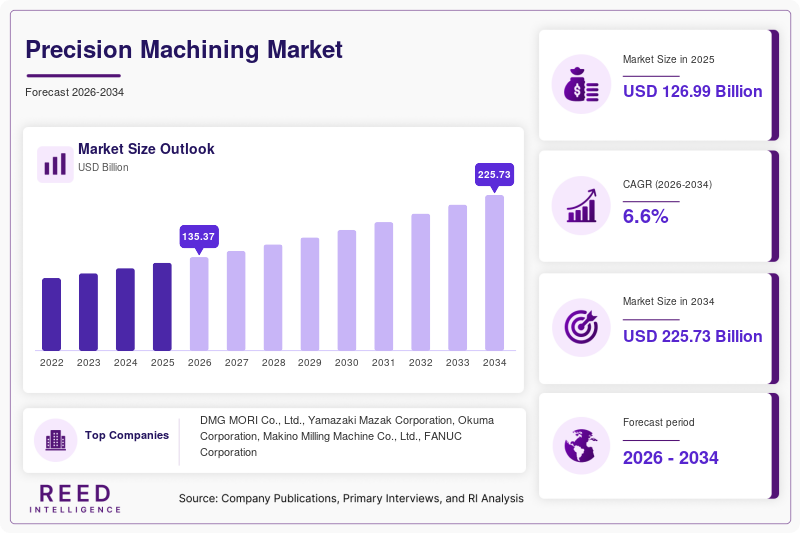
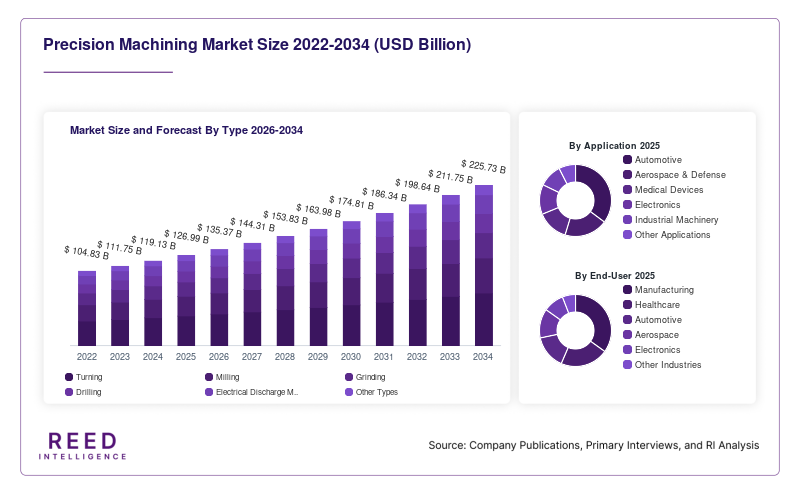
The global precision machining market size was valued at USD 126.99 billion in 2025 and is projected to grow from USD 135.37 billion in 2026 to USD 225.173 billion by 2034, registering a CAGR of 6.6% during the forecast period from 2026 to 2034.
The precision machining market comprises manufacturing processes used to produce components with tight dimensional tolerances, controlled surface finishes, and repeatable specifications. Core processes include turning, milling, grinding, drilling, boring, and electrical discharge machining (EDM). Computer numerical control (CNC) technology enables manufacturers to produce complex geometries and consistent components for applications in automotive systems, aerospace structures, medical devices, electronics, industrial machinery, and other engineered products.
Precision Machining Market Drivers
Rising Demand for High-Tolerance Components
Manufacturers across automotive, aerospace, medical devices, electronics, and industrial machinery require components that meet demanding dimensional and surface-finish specifications. Precision machining enables the production of parts with complex geometries and consistent tolerances. Increasing product complexity and performance requirements are encouraging investment in advanced CNC machines, specialized cutting tools, and precision metrology systems.
Increasing Adoption of CNC Automation
CNC machining supports repeatable production, automated tool paths, and improved control over machining parameters. Multi-axis machining centers can manufacture complex components with fewer setups, reducing handling and alignment errors. Manufacturers are also adopting robotic loading, automated tool management, and in-process inspection to improve equipment utilization and production consistency.
Expansion of Aerospace, Automotive, and Medical Manufacturing
Aerospace manufacturers require precision-machined engine, structural, and landing-system components. Automotive production relies on machined parts for powertrains, steering, braking, and electric-vehicle systems. Medical-device manufacturers use precision machining for surgical instruments, implants, and specialized equipment. Demand from these industries is supporting investment in advanced machining capabilities and quality-control infrastructure.
Precision Machining Market Restraints
High Capital Investment and Operating Costs
Precision machining requires investment in CNC equipment, cutting tools, workholding systems, metrology instruments, software, and skilled labor. Advanced multi-axis machines and specialized equipment for difficult-to-machine materials can require substantial capital expenditure. Smaller manufacturers may face challenges financing equipment upgrades while maintaining competitive pricing and acceptable utilization rates.
Shortage of Skilled Machining Professionals
Precision machining requires expertise in programming, tooling, machine setup, material behavior, process optimization, and quality inspection. A shortage of experienced machinists and CNC programmers can affect production efficiency and limit the adoption of advanced equipment. Manufacturers must invest in technical training, workforce development, and digital systems that help standardize machining processes.
Precision Machining Market Opportunities
Adoption of Smart Manufacturing and AI-Based Process Monitoring
Digital manufacturing systems create opportunities to improve machining productivity through real-time monitoring, predictive maintenance, automated inspection, and process optimization. Connected machines can provide operating data that helps manufacturers identify tool wear, equipment downtime, and deviations from expected process performance. AI-enabled systems may further support defect detection and process adjustments when integrated with reliable production data.
Growing Demand for Advanced Materials and Complex Components
The increasing use of titanium alloys, nickel-based superalloys, hardened steels, ceramics, and other advanced materials creates demand for specialized machining processes. Aerospace, semiconductor, medical, and high-performance industrial applications often require precise machining of materials that are difficult to process using conventional methods. Manufacturers with advanced tooling, process knowledge, and quality-control capabilities can address these specialized requirements.
Precision Machining Market Segmental Analysis
By Type
Milling is identified as the leading process type in published precision machining market analysis. Milling supports the production of complex geometries, pockets, slots, precision surfaces, and multi-feature components across several industries. Its versatility makes it suitable for both custom components and repeat production. Turning remains important for cylindrical parts, while grinding is used where tight tolerances and specific surface finishes are required.
Laser machining has been identified as a fast-growing process category in published market analysis, supported by its potential for processing complex geometries and specialized materials. Electrical discharge machining is relevant for conductive materials and intricate shapes that may be difficult to produce with conventional cutting methods. A consistent, independently verified share and CAGR for every process category were not established for this report.
By Application
Automotive is identified as a leading end-use application in published precision machining market analysis. The sector requires precision components for engines, transmissions, steering, braking, suspension, and electric-vehicle systems. Changes in vehicle architecture and the development of electric mobility are also creating demand for components with specific dimensional, weight, and thermal-management requirements.
Aerospace & defense is identified as a fast-growing application area in published industry analysis. Aircraft engines, structural assemblies, landing systems, and defense equipment require specialized machining processes and strict quality control. Medical devices and electronics provide additional demand through precision instruments, equipment housings, semiconductor-related components, and other high-tolerance parts. Comparable market shares and CAGRs for all application categories were not established.
By End-User
Manufacturing industries use precision machining to produce components for industrial equipment, automation systems, tooling, and specialized machinery. Healthcare-related applications include medical instruments, implants, and equipment components. Automotive and aerospace users require repeatable production and strict dimensional control for parts that contribute to product performance and reliability.
The relative demand from individual end-user groups depends on industrial output, capital investment, product complexity, outsourcing strategies, and quality requirements. A verified percentage share and comparable CAGR for each end-user category were not established for this report.
By Control Type
CNC machining is the dominant control category in published market analysis. CNC equipment allows programmed control over tool movement, spindle speed, feed rates, and machining sequences. It supports repeatable production and complex component geometries and can be integrated with automation and digital manufacturing systems.
Manual machining remains relevant for certain repair tasks, low-volume jobs, prototyping, and operations where automated equipment is not economically justified. However, a verified market-share figure for the control-type categories specifically aligned to the market estimates used in this report was not established.
Precision Machining Market Regional Analysis
Asia Pacific Precision Machining Market
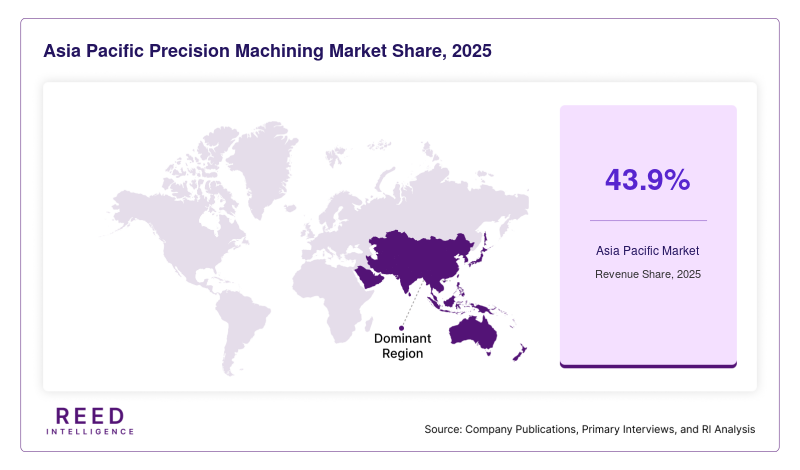
Asia Pacific was the dominant region in 2025, accounting for 43.9% of the global precision machining market, according to the market estimate that also reports the supplied global market values and 6.6% forecast CAGR. Its position is supported by a large manufacturing base, extensive supplier networks, and demand from automotive, electronics, industrial machinery, and other precision-component-consuming industries. The percentage is a 2025 estimate, not a 2026 actual share.
China, Japan, South Korea, and India contribute to regional manufacturing demand. China has a broad industrial production base, Japan has established machine-tool and precision-engineering capabilities, South Korea serves electronics and automotive industries, and India is expanding manufacturing across automotive, aerospace, medical devices, and industrial equipment. Regional demand is influenced by automation investment, manufacturing capacity, export activity, and the adoption of advanced CNC technologies.
North America Precision Machining Market
A directly comparable regional market-share percentage and forecast CAGR were not established for North America in the market dataset used for this report. Demand is associated with advanced manufacturing, aerospace and defense production, medical-device manufacturing, industrial machinery, and investment in automated production systems.
The United States is a major market for high-tolerance components used in aerospace, defense, medical technology, and advanced industrial applications. Canada and Mexico also participate in automotive and industrial supply chains. Regional growth depends on capital-equipment investment, reshoring and supply-chain decisions, workforce availability, and manufacturers’ ability to meet strict component specifications.
Europe Precision Machining Market
A verified regional market-share percentage and comparable forecast CAGR were not established for Europe under the same market definition and forecast period. Demand is supported by established automotive manufacturing, aerospace engineering, industrial equipment production, and specialized precision-engineering suppliers.
Germany, the United Kingdom, France, and Italy have important manufacturing industries that require high-precision components. Automotive engineering and aerospace production create demand for advanced machining, while industrial modernization encourages investment in automation, metrology, and connected equipment. Energy costs, labor availability, and investment cycles can influence regional manufacturing competitiveness.
Latin America Precision Machining Market
A verified market-share percentage and comparable regional CAGR were not established for Latin America. Demand is linked to automotive manufacturing, industrial equipment, aerospace-related supply chains, and modernization of manufacturing facilities. The region’s performance depends on industrial investment, access to advanced machine tools, skilled labor, and integration with global production networks.
Brazil has an established automotive and industrial manufacturing base, while Mexico participates in North American automotive and industrial supply chains. Precision machining demand can benefit from local component production and supplier development. Currency movements, capital costs, and fluctuations in industrial output can influence manufacturers’ investment decisions.
Middle East & Africa Precision Machining Market
A verified global market-share percentage and comparable forecast CAGR were not established for the Middle East & Africa. Potential demand comes from industrial diversification, energy equipment, aerospace maintenance, automotive-related production, and the development of local manufacturing capabilities. Market development varies significantly across countries and industrial sectors.
Countries in the Gulf are investing in industrial diversification and local production capabilities, while South Africa has established manufacturing activity serving automotive, mining, and industrial applications. Demand for precision machining depends on equipment availability, workforce skills, industrial investment, and the development of local supply chains.
Competitive Landscape
The precision machining market includes machine-tool manufacturers, precision-component producers, contract machining providers, and suppliers of cutting tools and manufacturing technologies. Competition is influenced by machining accuracy, throughput, automation capabilities, reliability, equipment costs, and the ability to manufacture complex components for demanding end-use industries.
Major participants include DMG MORI, Yamazaki Mazak, Okuma, Makino, FANUC, Haas Automation, Sandvik, and GF Machining Solutions. Manufacturers are developing advanced multi-axis equipment, integrated machining processes, automation systems, and digital monitoring capabilities. Suppliers serving aerospace, medical, automotive, and electronics customers must also meet stringent quality requirements and provide consistent production performance.
Key Market Players
- DMG MORI Co., Ltd.
- Yamazaki Mazak Corporation
- Okuma Corporation
- Makino Milling Machine Co., Ltd.
- FANUC Corporation
- Haas Automation, Inc.
- Sandvik AB
- GF Machining Solutions
- DN Solutions Co., Ltd.
- Hermle AG
- Oberg Industries
Precision Machining Market Recent Developments
March 2026 DMG MORI: The company announced the launch of its second-generation NMV 3000 and NMV 5000 DCG five-axis vertical machining centers. The machines incorporate design and performance updates intended to improve machining productivity and accuracy, with applications spanning aerospace, semiconductor, mobility, and die-and-mold manufacturing.
September 2026 Yamazaki Mazak Corporation: Mazak showcased the INTEGREX j-300S NEO multi-tasking machine at IMTS 2026. The machine combines twin-turning spindles with a milling spindle to support single-setup machining, reduce setup time, and improve machining accuracy for complex components.
Precision Machining Market Segments
By Type
- Turning
- Milling
- Grinding
- Drilling
- Electrical Discharge Machining (EDM)
- Other Types
By Application
- Automotive
- Aerospace & Defense
- Medical Devices
- Electronics
- Industrial Machinery
- Other Applications
By End-User
- Manufacturing
- Healthcare
- Automotive
- Aerospace
- Electronics
- Other Industries
By Control Type
- CNC Machining
- Manual Machining
By Region
- North America
- Europe
- APAC
- Middle East and Africa
- LATAM