Preclinical Respiration Inhalation Lab Equipment Market Size, Share & Demand Report By Equipment Type (Inhalation Exposure Systems, Aerosol Generators, Plethysmography Systems, Respiratory Monitoring Devices, Respiratory Analytics Software, Accessories and Consumables), By Application (Toxicology Studies, Pulmonary Drug Delivery Research, Environmental Exposure Studies, Respiratory Disease Modeling, Academic Research), By End User (Pharmaceutical and Biotechnology Companies, Contract Research Or
USD 3950
Market Overview
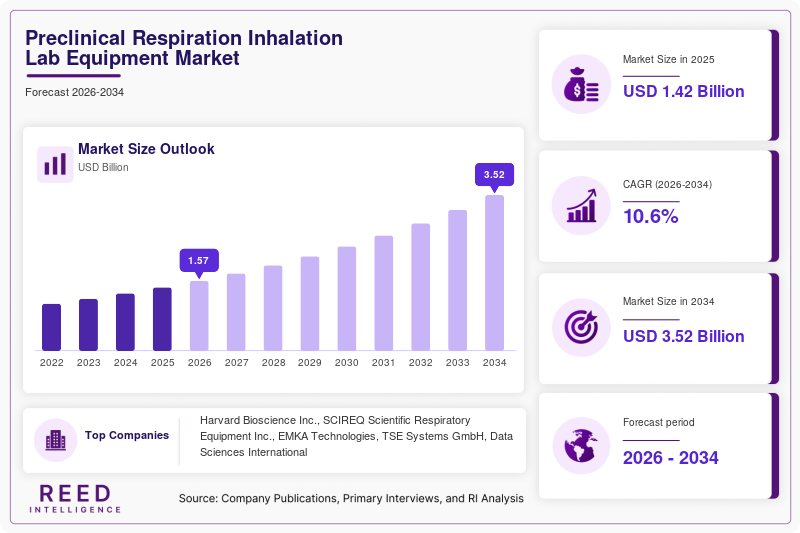
The global Preclinical Respiration Inhalation Lab Equipment Market size was valued at USD 1.42 billion in 2026 and is projected to reach USD 3.18 billion by 2034, expanding at a CAGR of 10.6% during the forecast period from 2026 to 2034. The market is experiencing stable expansion due to the increasing demand for inhalation toxicology studies, respiratory disease research, and advanced preclinical drug development programs across pharmaceutical and biotechnology companies. Growing investments in pulmonary drug delivery systems and the rising incidence of chronic respiratory disorders such as asthma, chronic obstructive pulmonary disease, and pulmonary fibrosis continue to support equipment demand across research laboratories and contract research organizations.
The increasing use of animal models in respiratory drug testing has encouraged laboratories to adopt automated inhalation exposure systems, precision aerosol generators, plethysmography systems, and respiratory monitoring software. Research institutions are also integrating digital analytics and cloud-connected monitoring platforms to improve accuracy, reproducibility, and compliance in preclinical studies. In addition, government funding for respiratory disease research and rising partnerships between pharmaceutical companies and academic institutions are supporting technological innovation within laboratory environments.
Key Highlights
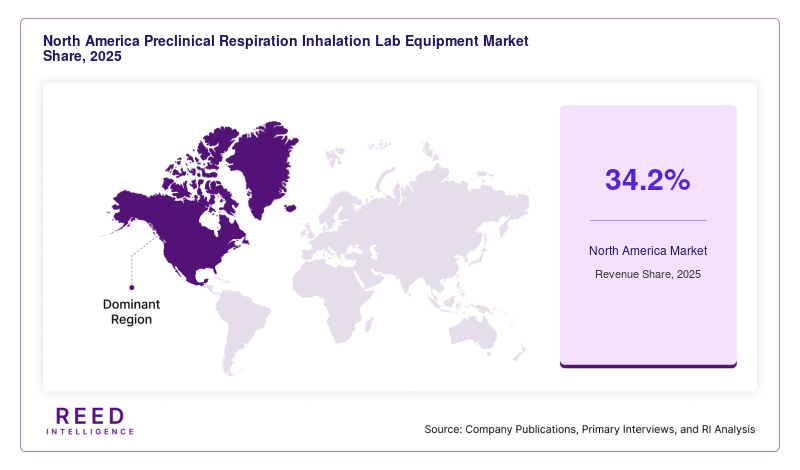
- North America dominated the market with a 34.2% share in 2025.
- Asia Pacific is expected to grow at the fastest CAGR of 11.8% during 2026–2034.
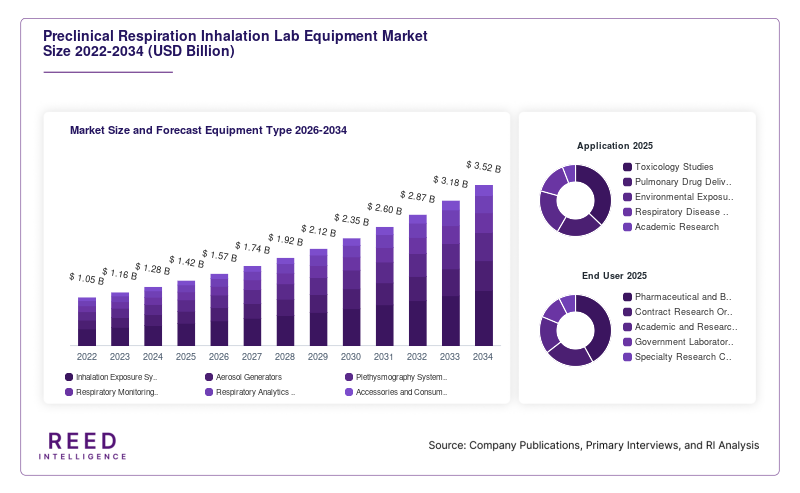
- By equipment type, inhalation exposure systems accounted for the largest share of 39.4%, while respiratory analytics software is projected to grow at a CAGR of 12.7%.
- By application, toxicology studies led with a 43.1% share, whereas pulmonary drug delivery research is expected to expand at a CAGR of 12.1%.
- The United States remained the dominant country, with market values of USD 480 million in 2024 and USD 535 million in 2025.
Market Trends
Integration of AI-Enabled Respiratory Monitoring Platforms
Laboratories involved in preclinical respiratory research are increasingly integrating artificial intelligence and automated analytics platforms into inhalation testing workflows. AI-enabled respiratory monitoring systems help researchers collect high-volume physiological data while reducing manual interpretation errors. These systems support real-time analysis of respiratory rates, airflow resistance, aerosol distribution, and pulmonary response patterns during toxicology studies. Pharmaceutical companies are adopting connected respiratory monitoring platforms because they improve reproducibility and reduce variability in preclinical experiments. The trend is particularly visible in North America and Europe, where laboratories are modernizing existing research infrastructure. Manufacturers are also integrating cloud-based reporting and predictive analytics into laboratory equipment to improve collaboration between research teams. The demand for automation is expected to increase as drug developers focus on shortening preclinical research timelines and improving regulatory documentation.
Expansion of Inhalation Toxicology Testing in Biopharmaceutical Research
Biopharmaceutical companies are increasing investments in inhalation toxicology testing to support the development of respiratory therapies, vaccines, and aerosol-based drug delivery systems. This trend has accelerated due to rising respiratory disease prevalence and the growing use of biologics in pulmonary treatments. Research organizations are deploying advanced inhalation chambers and aerosol exposure systems to evaluate particle distribution, toxicity response, and respiratory absorption rates in preclinical models. The expansion of biologics manufacturing facilities in Asia Pacific is also encouraging laboratories to upgrade inhalation testing infrastructure. Regulatory authorities are emphasizing comprehensive respiratory safety assessments before human trials, further supporting equipment demand. Contract research organizations are responding by expanding inhalation research capabilities and adopting scalable exposure systems that can support large study volumes while maintaining data consistency.
Market Drivers
Increasing Preclinical Research for Respiratory Drug Development
The growing pipeline of respiratory therapeutics is a major factor driving the Preclinical Respiration Inhalation Lab Equipment Market. Pharmaceutical companies are expanding research activities focused on asthma, cystic fibrosis, chronic obstructive pulmonary disease, and pulmonary infections. Preclinical inhalation studies are becoming essential for evaluating aerosol performance, lung deposition, and toxicity profiles before clinical testing. As respiratory diseases continue to affect aging populations and urban communities exposed to pollution, drug developers are increasing investment in pulmonary drug research. This growth has strengthened demand for inhalation exposure chambers, aerosol generators, and plethysmography systems capable of delivering precise and reproducible results. In addition, biotechnology companies are increasingly partnering with academic laboratories to accelerate respiratory therapy development, creating additional opportunities for equipment suppliers across developed and emerging economies.
Rising Demand for Regulatory-Compliant Laboratory Systems
Regulatory agencies worldwide are strengthening requirements for respiratory toxicology validation and laboratory data integrity, encouraging research facilities to adopt compliant and automated inhalation equipment. Laboratories conducting safety studies must maintain standardized testing environments and accurate respiratory measurements throughout preclinical trials. This requirement has increased demand for digitally integrated systems that provide real-time monitoring, automated reporting, and traceable study records. Companies are investing in software-enabled respiratory testing platforms that simplify compliance with international laboratory standards. The growing adoption of good laboratory practice protocols among contract research organizations is also driving replacement demand for outdated equipment. Furthermore, manufacturers are developing modular systems that can be customized for different inhalation studies, improving laboratory flexibility and increasing equipment utilization across multiple research programs.
Market Restraint
High Equipment Costs and Complex Maintenance Requirements
The high cost associated with advanced inhalation laboratory equipment remains a major challenge for market expansion, particularly among small research institutions and emerging biotechnology firms. Sophisticated inhalation exposure systems, aerosol generators, respiratory monitoring chambers, and analytics platforms require substantial capital investment and specialized maintenance procedures. Many laboratories also face additional expenses related to calibration, software upgrades, regulatory certification, and technician training. These factors can limit equipment adoption in cost-sensitive regions where research funding remains limited.
Complex maintenance requirements further increase operational burdens for research facilities. Respiratory testing systems require regular validation to ensure data accuracy and regulatory compliance, especially during long-term toxicology studies. Laboratories without dedicated technical support teams may experience workflow delays and reduced productivity due to equipment downtime. In addition, integrating advanced digital software with existing laboratory infrastructure can create compatibility challenges. Smaller contract research organizations often postpone modernization initiatives because of uncertain return on investment and lengthy procurement cycles. Although manufacturers are introducing compact and scalable systems to reduce cost barriers, affordability remains a critical concern that may slow broader market penetration during the forecast period.
Market Opportunities
Growth of Contract Research Organizations in Emerging Economies
The rapid expansion of contract research organizations in emerging economies is creating significant opportunities for the Preclinical Respiration Inhalation Lab Equipment Market. Pharmaceutical and biotechnology companies are increasingly outsourcing inhalation toxicology studies and respiratory research to specialized organizations in Asia Pacific and Latin America to reduce operational costs and accelerate product development timelines. As these organizations expand laboratory capacity, demand for inhalation chambers, aerosol delivery systems, and respiratory monitoring equipment continues to increase. Governments in countries such as China, India, and Brazil are also supporting biomedical research infrastructure through grants and innovation programs. This environment encourages contract research organizations to invest in modern inhalation testing equipment capable of supporting international regulatory standards and attracting global pharmaceutical clients.
Technological Advancements in Precision Aerosol Delivery Systems
Continuous innovation in precision aerosol delivery technologies is expected to create long-term growth opportunities across the global market. Manufacturers are developing advanced aerosol generators and inhalation exposure systems capable of delivering highly controlled particle concentrations and uniform respiratory exposure during preclinical studies. These technologies improve study reproducibility and help researchers better evaluate therapeutic efficacy and toxicological response. The increasing focus on personalized respiratory medicine and targeted pulmonary drug delivery is encouraging laboratories to adopt high-precision testing equipment. In addition, the integration of smart sensors, automated airflow control, and digital respiratory analytics is improving operational efficiency within research facilities. Companies introducing compact and energy-efficient systems are also expected to gain traction among smaller laboratories seeking cost-effective modernization solutions.
Segmental Analysis
By Equipment Type
Inhalation exposure systems represented the dominant subsegment within the equipment type category and accounted for 39.4% of the global market share in 2024. These systems are widely used in preclinical inhalation toxicology and respiratory drug development studies because they provide controlled aerosol delivery and standardized exposure conditions. Pharmaceutical companies and research institutions rely on inhalation exposure chambers to evaluate respiratory absorption, toxicity response, and pulmonary deposition in animal models. The increasing development of aerosol-based therapeutics and biologics has strengthened demand for advanced exposure systems with automated airflow control and real-time monitoring capabilities. Manufacturers are also introducing modular inhalation systems that support multiple animal study configurations, improving laboratory efficiency and reducing operational complexity. Growing emphasis on regulatory-compliant testing procedures further supports the widespread adoption of these systems across pharmaceutical research facilities.
Respiratory analytics software is projected to expand at the fastest CAGR of 12.7% during the forecast period due to rising demand for automated data management and advanced respiratory analysis capabilities. Laboratories are increasingly integrating cloud-based software platforms with inhalation testing equipment to improve study tracking, data interpretation, and reporting accuracy. These solutions help researchers analyze respiratory parameters, airflow resistance, and aerosol distribution patterns more efficiently than traditional manual methods. The growing adoption of AI-enabled analytics tools is also accelerating software demand across large pharmaceutical organizations and contract research facilities. In addition, laboratories seeking compliance with international data integrity standards are investing in digital respiratory monitoring platforms that provide traceable and centralized data management. Continuous improvements in machine learning algorithms and predictive analytics are expected to enhance software functionality and strengthen long-term market growth.
By Application
Toxicology studies accounted for the largest share of the application segment in 2024, representing 43.1% of global market revenue. Preclinical inhalation toxicology remains a critical component of respiratory drug development because it helps researchers evaluate safety profiles and identify potential pulmonary risks before human trials. Pharmaceutical companies are increasing investment in inhalation toxicology studies due to stricter regulatory requirements for respiratory therapeutics and aerosol-based formulations. Laboratories conducting toxicology research require specialized inhalation exposure systems, respiratory monitoring devices, and aerosol generators capable of delivering consistent study conditions. The rising number of environmental toxicity studies related to air pollutants and industrial chemicals has also contributed to increased demand for respiratory testing equipment. Contract research organizations continue to expand inhalation toxicology capabilities to support global pharmaceutical clients seeking faster and cost-efficient preclinical testing services.
Pulmonary drug delivery research is expected to witness the fastest growth within the application segment, registering a CAGR of 12.1% during the forecast period. The increasing adoption of inhaled therapies for chronic respiratory disorders is driving demand for advanced preclinical testing equipment capable of evaluating aerosol performance and lung deposition efficiency. Pharmaceutical companies are focusing on targeted pulmonary delivery systems that improve therapeutic effectiveness while reducing systemic side effects. This trend has encouraged research facilities to invest in high-precision aerosol generators and respiratory analysis platforms. The growing development of inhalable biologics and vaccine formulations is also contributing to market expansion. In addition, rising investments in personalized respiratory medicine are creating opportunities for innovative inhalation testing technologies that can support customized therapeutic research and advanced pulmonary drug delivery studies.
By End User
Pharmaceutical and biotechnology companies dominated the end-user segment and held 46.8% of the global market share in 2024. These organizations conduct extensive preclinical respiratory studies to support the development of inhaled drugs, biologics, and aerosol-based therapies. The growing number of respiratory disease treatment pipelines has increased investment in inhalation toxicology testing and pulmonary drug delivery research. Large pharmaceutical firms are upgrading laboratory infrastructure with automated respiratory monitoring systems and advanced inhalation chambers to improve operational efficiency and regulatory compliance. Biotechnology companies are also adopting compact inhalation testing systems that enable flexible and scalable research capabilities. The increasing collaboration between pharmaceutical firms and academic institutions further supports equipment utilization across multiple preclinical research programs. Rising pressure to accelerate drug development timelines continues to strengthen demand for technologically advanced respiratory laboratory equipment.
Contract research organizations are anticipated to emerge as the fastest-growing end-user subsegment, expanding at a CAGR of 11.9% during the forecast period. Pharmaceutical companies are increasingly outsourcing preclinical inhalation studies to specialized organizations to reduce operational costs and improve research flexibility. Contract research organizations are responding by expanding respiratory testing capabilities and investing in advanced inhalation exposure systems, respiratory analytics software, and aerosol characterization technologies. The growth of outsourcing activities in emerging markets such as India and China is creating favorable conditions for regional contract research providers. In addition, these organizations are adopting automated laboratory systems that can support large study volumes while maintaining consistent testing quality. Rising demand for integrated preclinical research services and shorter drug development timelines is expected to drive long-term expansion within this end-user category.
Regional Analysis
North America
North America accounted for the largest share of the Preclinical Respiration Inhalation Lab Equipment Market in 2025, representing 34.2% of global revenue. The region is projected to expand at a CAGR of 10.1% during the forecast period due to strong pharmaceutical research spending and advanced laboratory infrastructure. The United States and Canada continue to invest heavily in respiratory drug development, inhalation toxicology studies, and preclinical automation technologies. The presence of large pharmaceutical manufacturers and contract research organizations supports consistent demand for respiratory monitoring systems, aerosol exposure chambers, and integrated analytics platforms.
The United States remained the dominant contributor to regional revenue generation because of its extensive biotechnology ecosystem and growing pulmonary disease research activities. The country recorded market values of USD 480 million in 2024 and USD 535 million in 2025. Increased federal funding for respiratory disease studies and rising collaborations between universities and pharmaceutical firms continue to support equipment adoption. Research facilities are also prioritizing AI-enabled inhalation systems that improve study accuracy and reduce manual testing limitations across large-scale toxicology programs.
Europe
Europe held a significant share of the global Preclinical Respiration Inhalation Lab Equipment Market in 2025 and is expected to register a CAGR of 9.8% through 2034. Regional growth is supported by strict regulatory standards governing inhalation toxicology and laboratory safety testing. Countries across Western Europe are expanding investments in respiratory disease research, particularly for chronic obstructive pulmonary disease and pulmonary fibrosis. Academic institutions and biotechnology firms are increasingly deploying automated respiratory monitoring systems to improve preclinical testing efficiency and data reproducibility.
Germany emerged as the leading country within the European market due to its strong pharmaceutical manufacturing base and well-established biomedical research infrastructure. German research laboratories continue to invest in precision aerosol exposure systems and advanced plethysmography equipment to support respiratory drug development. The country also benefits from strong public-private research partnerships focused on pulmonary therapeutics and environmental toxicology. Rising demand for standardized inhalation testing platforms among contract research organizations is expected to sustain equipment upgrades across the region.
Asia Pacific
Asia Pacific is anticipated to witness the fastest growth in the Preclinical Respiration Inhalation Lab Equipment Market, expanding at a CAGR of 11.8% during the forecast period. The region accounted for a growing share of global revenue in 2025 due to increasing pharmaceutical manufacturing investments and rapid expansion of biotechnology startups. Countries including China, India, Japan, and South Korea are strengthening respiratory research capabilities to support domestic drug development initiatives. Laboratories across the region are modernizing inhalation testing facilities to align with international research standards and attract multinational pharmaceutical partnerships.
China dominated the regional market because of rising government support for biomedical innovation and the expansion of preclinical research facilities. Chinese pharmaceutical firms are increasing investment in aerosol drug delivery research and inhalation toxicology studies, driving demand for advanced respiratory testing systems. In addition, the country benefits from a large pool of contract research organizations offering cost-effective inhalation study services for international clients. Growing healthcare awareness and increasing respiratory disease prevalence are further encouraging long-term investments in pulmonary research infrastructure.
Middle East & Africa
The Middle East & Africa region represented a smaller but steadily growing share of the Preclinical Respiration Inhalation Lab Equipment Market in 2025 and is expected to expand at a CAGR of 8.9% through 2034. Market growth is supported by gradual improvements in healthcare research infrastructure and increasing investments in biotechnology initiatives. Governments in several Gulf countries are promoting medical research diversification and establishing advanced laboratory facilities to reduce dependence on imported pharmaceutical technologies. Demand for inhalation testing equipment is increasing among academic research centers and regional healthcare institutions.
Saudi Arabia emerged as the leading country within the region due to expanding healthcare modernization programs and increased funding for biomedical innovation. Research institutions in the country are strengthening respiratory disease research capabilities as part of broader healthcare transformation initiatives. Investments in laboratory digitization and partnerships with international pharmaceutical companies are also supporting equipment demand. In addition, rising awareness regarding environmental pollution and respiratory disorders is encouraging regional healthcare organizations to improve pulmonary research and toxicology testing capacity.
Latin America
Latin America accounted for a moderate share of the global Preclinical Respiration Inhalation Lab Equipment Market in 2025 and is projected to grow at a CAGR of 9.2% during the forecast period. Regional demand is driven by expanding pharmaceutical research activities and the gradual development of contract research infrastructure. Countries across the region are increasing participation in international clinical and preclinical research collaborations, encouraging laboratories to adopt advanced respiratory testing technologies. Equipment manufacturers are also targeting Latin America with cost-efficient inhalation systems designed for mid-sized research facilities.
Brazil remained the dominant country within the Latin American market because of its large pharmaceutical sector and increasing investment in biomedical research. Brazilian universities and research laboratories are focusing on pulmonary disease studies and inhalation drug development, creating demand for respiratory monitoring systems and aerosol testing equipment. Government support for local biotechnology innovation and the expansion of public healthcare research programs are also contributing to market growth. The increasing prevalence of urban respiratory disorders linked to pollution exposure is further encouraging respiratory-focused preclinical studies.
Competitive Landscape
The competitive environment within the Preclinical Respiration Inhalation Lab Equipment Market is characterized by technological innovation, strategic partnerships, and expanding product portfolios. Leading companies are focusing on automated inhalation exposure systems, AI-enabled respiratory monitoring platforms, and integrated analytics software to strengthen their market presence. Several manufacturers are also increasing investment in modular and scalable equipment designs that improve laboratory flexibility and support multiple respiratory research applications.
Harvard Bioscience remains one of the leading companies in the market due to its broad portfolio of respiratory monitoring systems and inhalation testing solutions. The company recently introduced an upgraded respiratory analytics platform with enhanced cloud-based data management features for toxicology laboratories. Other major participants are emphasizing acquisitions and regional expansion strategies to improve customer reach and strengthen distribution capabilities. Competition is expected to intensify as biotechnology startups and contract research organizations increase demand for advanced inhalation laboratory technologies. Companies are also prioritizing research collaborations with pharmaceutical manufacturers and academic institutions to accelerate product innovation and improve long-term market positioning.
Key Players
- Harvard Bioscience Inc.
- SCIREQ Scientific Respiratory Equipment Inc.
- EMKA Technologies
- Buxco Research Systems
- TSE Systems GmbH
- Data Sciences International
- In-Tox Products LLC
- LabProducts LLC
- DSI Respiratory Solutions
- Kent Scientific Corporation
- AeroLab Scientific
- HSE AG
- Sable Systems International
- Allentown LLC
- Shanghai TOW Intelligent Technology
Recent Developments
- In February 2026, Harvard Bioscience launched an upgraded inhalation exposure platform with integrated AI-based respiratory analytics for advanced toxicology studies.
- In August 2025, SCIREQ Scientific Respiratory Equipment expanded its manufacturing facility in Canada to increase production capacity for automated plethysmography systems.
- In November 2025, EMKA Technologies introduced a cloud-connected respiratory monitoring solution designed for large-scale preclinical pulmonary studies.
- In April 2026, TSE Systems GmbH partnered with a European biotechnology consortium to develop precision aerosol exposure systems for biologic respiratory therapies.
- In September 2025, Data Sciences International released a wireless respiratory telemetry platform focused on real-time inhalation monitoring in animal research laboratories.
Preclinical Respiration Inhalation Lab Equipment Market Segments
Equipment Type
- Inhalation Exposure Systems
- Aerosol Generators
- Plethysmography Systems
- Respiratory Monitoring Devices
- Respiratory Analytics Software
- Accessories and Consumables
Application
- Toxicology Studies
- Pulmonary Drug Delivery Research
- Environmental Exposure Studies
- Respiratory Disease Modeling
- Academic Research
End User
- Pharmaceutical and Biotechnology Companies
- Contract Research Organizations
- Academic and Research Institutes
- Government Laboratories
- Specialty Research Centers
By Region
- North America
- Europe
- APAC
- Middle East and Africa
- LATAM