Precocious Puberty Treatment Market Size, Share & Demand Report By Treatment Type (GnRH Agonists, Hormonal Therapy Alternatives), By Route of Administration (Injectable, Oral), By Patient Type (Central Precocious Puberty, Peripheral Precocious Puberty), By Distribution Channel (Hospital Pharmacies, Retail Pharmacies, Online Pharmacies), By Region & Segment Forecasts, 2026–2034
USD 3950
Market Overview
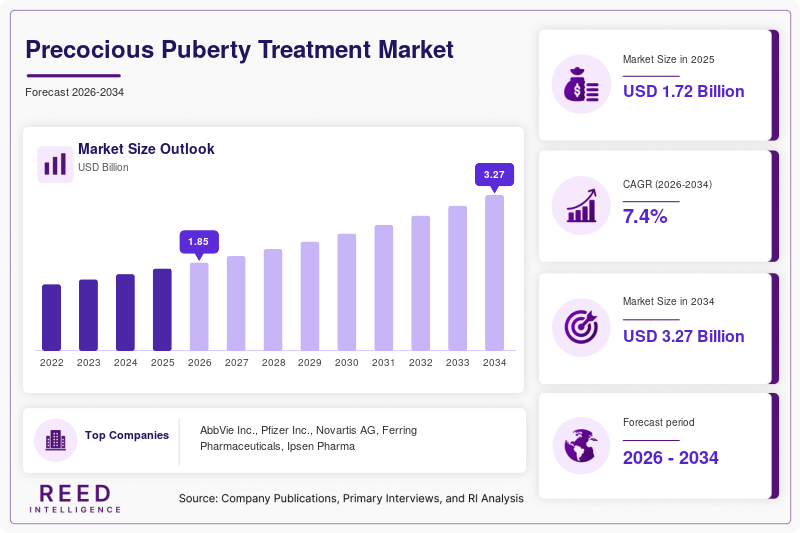
The global Precocious Puberty Treatment Market size was valued at approximately USD 1.72 billion in 2026 and is projected to reach USD 3.05 billion by 2034, expanding at a CAGR of 7.4% from 2026 to 2034. The market has experienced steady growth due to increasing awareness of early-onset puberty disorders and advancements in endocrine therapies. One of the primary global factors supporting market expansion is the rising prevalence of hormonal imbalances among children, influenced by lifestyle changes, environmental endocrine disruptors, and improved diagnostic capabilities.
Healthcare systems worldwide are focusing on early intervention to prevent long-term complications such as reduced adult height and psychological distress, which has significantly boosted treatment adoption rates. In addition, growing pediatric healthcare expenditure and increased accessibility to specialty endocrinology services are further strengthening the market outlook.
Key Highlights:
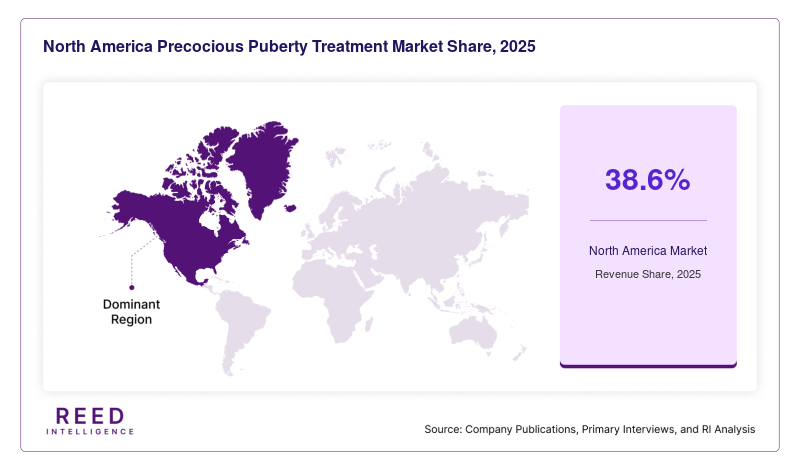
- North America dominated the market with a 38.6% share in 2025, while Asia Pacific is projected to grow at the fastest CAGR of 9.1% (2026–2034).
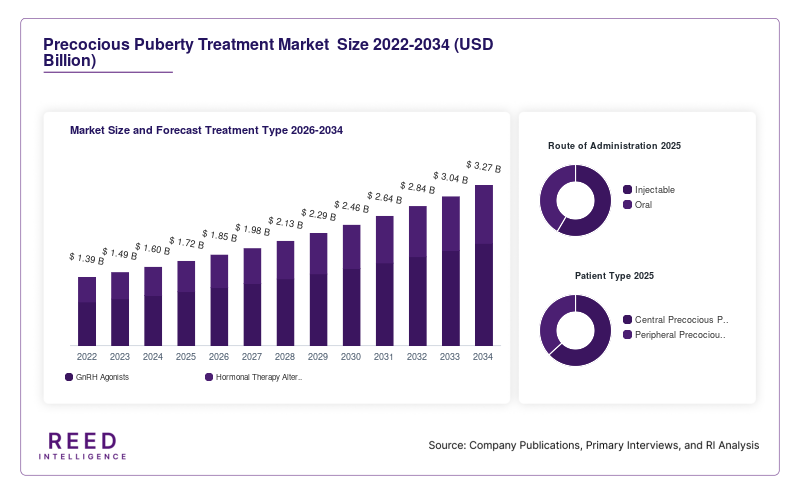
- Gonadotropin-releasing hormone (GnRH) agonists emerged as the leading treatment segment with over 64% share in 2025, while long-acting depot formulations are expected to grow at a CAGR of 8.3%.
- Hospital pharmacies accounted for the largest distribution share, whereas online pharmacies are anticipated to register the fastest growth at 10.2% CAGR.
- The United States remained the dominant country, with market values of USD 610 million in 2024 and USD 645 million in 2025.
Market Trends
Increasing Adoption of Long-Acting Therapies
A notable trend shaping the Precocious Puberty Treatment Market is the rising preference for long-acting drug formulations. These therapies reduce dosing frequency, improve patient compliance, and minimize treatment interruptions. Monthly and quarterly depot injections are gaining traction among healthcare providers due to their effectiveness in maintaining consistent hormone suppression. This shift is particularly beneficial in pediatric care, where adherence can be challenging. Pharmaceutical companies are investing in advanced drug delivery systems to further enhance convenience and therapeutic outcomes.
Integration of Early Diagnostic Technologies
The integration of advanced diagnostic tools is transforming the treatment landscape. Improved imaging techniques, hormonal assays, and genetic testing are enabling earlier and more accurate detection of precocious puberty. This trend supports timely intervention, which is critical in preventing long-term physiological and psychological effects. Additionally, digital health platforms are being increasingly used to monitor treatment progress and patient compliance. These innovations are contributing to a more proactive and personalized approach, strengthening the overall growth trajectory of the market.
Market Drivers
Rising Incidence of Precocious Puberty Cases
The increasing global incidence of precocious puberty is a key driver of market growth. Factors such as obesity, exposure to endocrine-disrupting chemicals, and genetic predisposition are contributing to earlier onset of puberty in children. This trend has prompted healthcare providers to prioritize early diagnosis and treatment, thereby expanding the patient pool. As awareness among parents and caregivers grows, the demand for effective therapeutic interventions continues to rise.
Advancements in Hormonal Therapies
Continuous innovation in hormonal therapies is another major driver for the Precocious Puberty Treatment Market. The development of highly targeted GnRH analogs with improved safety profiles has enhanced treatment outcomes. These therapies effectively delay puberty progression while minimizing adverse effects. Furthermore, ongoing research into novel formulations and delivery mechanisms is expected to improve treatment accessibility and patient experience, further fueling market expansion.
Market Restraint
High Cost of Treatment and Limited Accessibility
One of the major restraints affecting the Precocious Puberty Treatment Market is the high cost associated with hormonal therapies. Treatments often require long-term administration, making them financially burdensome for many families, particularly in low- and middle-income regions. Limited insurance coverage and reimbursement challenges further exacerbate this issue.
Additionally, access to specialized pediatric endocrinology services remains uneven across regions. Rural and underdeveloped areas often lack the infrastructure and expertise required for accurate diagnosis and effective treatment. These barriers can delay intervention, reducing treatment efficacy and hindering overall market growth. Addressing cost-related challenges and improving healthcare accessibility will be crucial for unlocking the market’s full potential.
Market Opportunities
Expansion in Emerging Markets
Emerging economies present significant growth opportunities for the Precocious Puberty Treatment Market. Rapid urbanization, improving healthcare infrastructure, and increasing awareness are driving demand for pediatric endocrine treatments in these regions. Governments are investing in healthcare reforms and expanding insurance coverage, which is expected to enhance access to treatment. Market players can leverage these developments by expanding their presence and offering cost-effective solutions tailored to local needs.
Development of Non-Invasive Treatment Alternatives
The development of non-invasive or minimally invasive treatment options offers another promising opportunity. Research into oral therapies and alternative delivery methods aims to reduce the discomfort associated with injections. Such innovations could significantly improve patient compliance and broaden treatment adoption. As pharmaceutical companies continue to invest in research and development, the introduction of these therapies is expected to create new growth avenues within the market.
Segmental Analysis
By Treatment Type
GnRH agonists dominated the Precocious Puberty Treatment Market with a 64% share in 2025, owing to their high efficacy in suppressing premature hormonal activity. These therapies have become the standard of care due to their proven clinical outcomes and safety profile.
Long-acting GnRH formulations are expected to grow at a CAGR of 8.3%, driven by their ability to reduce dosing frequency and improve adherence. Their convenience and effectiveness will continue to support adoption in the coming years.
By Route of Administration
Injectable treatments accounted for the largest share of 71% in 2025, as they are widely used for delivering hormonal therapies with consistent results. Healthcare providers prefer this route due to its reliability in maintaining therapeutic levels.
Oral therapies are projected to grow at a CAGR of 8.7%, supported by ongoing research into alternative formulations. These treatments will likely gain popularity due to improved patient comfort and ease of administration.
By Distribution Channel
Hospital pharmacies held the dominant share of 52% in 2025, as most treatments are administered under medical supervision. Hospitals remain the primary point of care for diagnosis and treatment initiation.
Online pharmacies are expected to grow at the fastest CAGR of 10.2%, driven by increasing digital adoption and convenience. Improved access to medications and rising e-commerce penetration will support this growth.
By Patient Type
Central precocious puberty (CPP) accounted for 78% of the market share in 2025, as it is the most common form of the condition. The high prevalence of CPP has led to greater demand for targeted therapies.
Peripheral precocious puberty is expected to grow at a CAGR of 7.9%, driven by improved diagnostic capabilities and increasing awareness. Early identification of rare cases will contribute to segment growth.
Regional Analysis
North America
North America accounted for 38.6% of the global Precocious Puberty Treatment Market share in 2025 and is expected to grow at a CAGR of 6.8% from 2026 to 2034. The region benefited from advanced healthcare infrastructure, high awareness levels, and early adoption of innovative therapies. Favorable reimbursement policies and strong presence of pharmaceutical companies also contributed to its dominance.
The United States remained the leading country due to widespread access to pediatric endocrinology services and strong diagnostic capabilities. The growing emphasis on early intervention and availability of specialized treatment centers significantly supported market growth in the country.
Europe
Europe held a 27.4% market share in 2025 and is projected to expand at a CAGR of 6.9% over the forecast period. The region demonstrated steady growth due to increasing awareness of hormonal disorders and strong regulatory support for pediatric healthcare. Public healthcare systems in many countries facilitated access to treatment.
Germany emerged as the dominant country, driven by its robust healthcare infrastructure and focus on research in endocrine disorders. The presence of well-established pharmaceutical companies and increasing adoption of advanced therapies contributed to sustained market growth.
Asia Pacific
Asia Pacific captured 20.8% of the market share in 2025 and is expected to register the fastest CAGR of 9.1% from 2026 to 2034. Rapid economic development, increasing healthcare investments, and rising awareness of early puberty conditions drove regional growth. Expanding pediatric healthcare services also played a key role.
China dominated the region due to its large population base and improving healthcare access. Government initiatives to enhance pediatric care and rising adoption of advanced diagnostic tools supported the country’s strong market position.
Middle East & Africa
The Middle East & Africa region accounted for 7.2% of the market share in 2025 and is projected to grow at a CAGR of 7.0% during the forecast period. Growth was supported by gradual improvements in healthcare infrastructure and increasing awareness of pediatric endocrine disorders.
Saudi Arabia emerged as the leading country, driven by government investments in healthcare modernization and rising demand for specialized treatments. Expansion of healthcare facilities and adoption of advanced therapies contributed to market growth.
Latin America
Latin America held a 6.0% share in 2025 and is anticipated to grow at a CAGR of 7.3% from 2026 to 2034. The region experienced growth due to increasing healthcare spending and improving access to pediatric treatments. Rising awareness campaigns also supported market expansion.
Brazil dominated the region, supported by its large population and expanding healthcare infrastructure. Government initiatives to improve access to specialized care and growing availability of treatment options drove market growth in the country.
Competitive Landscape
The Precocious Puberty Treatment Market is moderately consolidated, with key players focusing on product innovation and geographic expansion. Leading companies are investing in research to develop advanced hormonal therapies and improve delivery mechanisms.
The market leader, AbbVie Inc., has maintained its strong position through a robust portfolio of GnRH analogs and continuous product enhancements. The company recently introduced an improved long-acting formulation aimed at enhancing patient compliance and treatment outcomes.
Other prominent players are actively engaged in strategic collaborations, mergers, and acquisitions to strengthen their market presence. These initiatives are expected to intensify competition and drive innovation across the market.
Key Players List
- AbbVie Inc.
- Pfizer Inc.
- Novartis AG
- Ferring Pharmaceuticals
- Ipsen Pharma
- Endo International plc
- Tolmar Pharmaceuticals
- Teva Pharmaceutical Industries Ltd.
- Sun Pharmaceutical Industries Ltd.
- Dr. Reddy’s Laboratories Ltd.
- Lupin Limited
- Amneal Pharmaceuticals
- Bayer AG
- Merck KGaA
- Takeda Pharmaceutical Company Limited
Recent Developments
- 2025: Introduction of extended-release GnRH therapy improving dosing intervals.
- 2024: Strategic collaboration between pharmaceutical firms to expand pediatric endocrinology portfolios.
- 2024: Increased investment in clinical trials for oral hormone therapies.
- 2023: Expansion of manufacturing facilities in Asia Pacific to meet growing demand.
- 2023: Regulatory approvals for new formulations enhancing treatment adherence.
Precocious Puberty Treatment Market Segments
Treatment Type
- GnRH Agonists
- Hormonal Therapy Alternatives
Route of Administration
- Injectable
- Oral
Patient Type
- Central Precocious Puberty
- Peripheral Precocious Puberty
Distribution Channel
- Hospital Pharmacies
- Retail Pharmacies
- Online Pharmacies
By Region
- North America
- Europe
- APAC
- Middle East and Africa
- LATAM