Premature Rupture Membranes Testing Market Size, Share & Demand Report By Type (Immunoassay-Based Tests, Rapid Bedside Tests), By Product (Diagnostic Kits, Instruments), By Technology (Conventional Methods, Digital & Automated Methods), By End-Use (Hospitals, Diagnostic Clinics, Others), By Distribution Channel (Direct Sales, Distributors, Online Channels), By Region & Segment Forecasts, 2025–2034
USD 3950
Market Overview
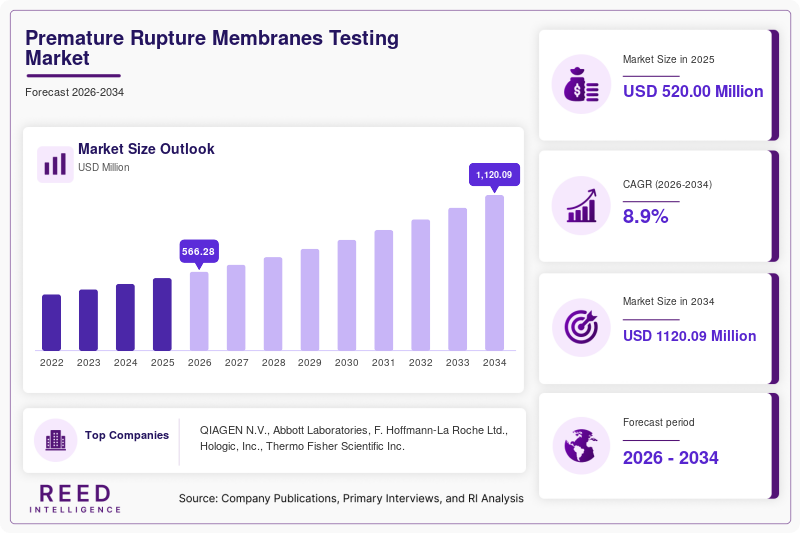
The global Premature Rupture Membranes Testing Market was valued at approximately USD 520 million in 2025 and is projected to reach USD 1.12 billion by 2034, expanding at a CAGR of 8.9% during the forecast period (2025–2034). The market has witnessed steady growth due to the rising prevalence of pregnancy-related complications and increasing emphasis on early diagnosis in maternal healthcare. Premature rupture of membranes (PROM) is a critical obstetric condition, and timely testing plays a vital role in preventing adverse maternal and neonatal outcomes.
One of the key global factors supporting market growth is the increasing awareness and adoption of point-of-care diagnostic solutions in prenatal care. Healthcare providers are prioritizing rapid and accurate diagnostic methods to reduce hospital stays and improve clinical outcomes. Additionally, technological advancements in immunoassay-based diagnostic kits and the integration of digital healthcare systems are further enhancing the accessibility and efficiency of PROM testing.
Key Highlights
- North America dominated the market with a share of 38.5% in 2025, while Asia Pacific is projected to register the fastest CAGR of 10.4% during the forecast period.
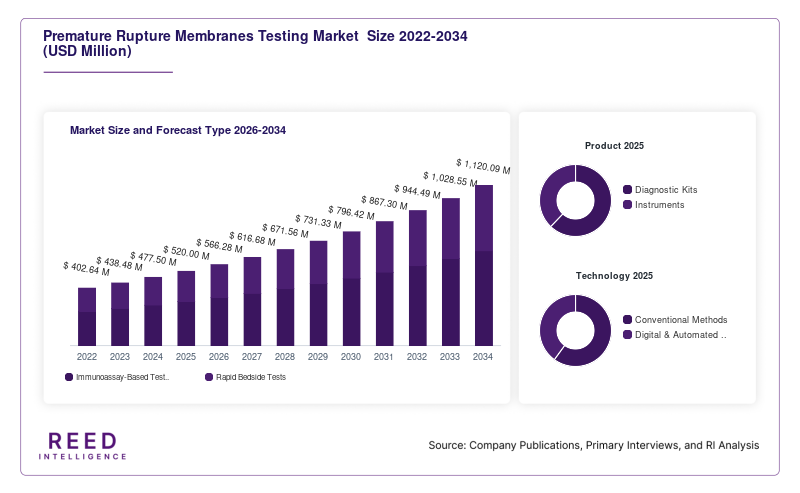
- Immunoassay-based tests led the type segment with a 61% share, while rapid bedside tests are expected to grow at a CAGR of 9.8%.
- Hospitals accounted for the largest end-use segment with a 54% share, whereas diagnostic clinics are projected to grow at a CAGR of 9.2%.
- The United States remained the dominant country, with market values of USD 182 million in 2025 and USD 195 million in 2026.
Market Trends
Increasing Adoption of Rapid Point-of-Care Testing
The Premature Rupture Membranes Testing Market is experiencing a shift toward rapid point-of-care (POC) testing solutions. Healthcare providers are increasingly adopting portable and easy-to-use diagnostic kits that deliver results within minutes. These tests reduce dependency on laboratory infrastructure and enable faster clinical decision-making, especially in emergency obstetric cases. The convenience and efficiency of POC testing are driving their integration across hospitals and outpatient care settings.
Integration of Digital Health and Diagnostic Platforms
Another notable trend shaping the market is the integration of diagnostic tools with digital healthcare systems. Electronic medical records (EMR) and connected diagnostic devices are enabling better patient monitoring and data sharing among healthcare professionals. This integration improves diagnostic accuracy and facilitates personalized care plans. Furthermore, digital platforms are supporting remote consultations, which is particularly beneficial in regions with limited access to specialized maternal healthcare services.
Market Drivers
Rising Incidence of Preterm Births and Pregnancy Complications
The increasing prevalence of preterm births globally is a primary driver for the Premature Rupture Membranes Testing Market. PROM is a leading cause of preterm delivery, necessitating early detection and management. Growing maternal age, lifestyle changes, and chronic health conditions have contributed to higher-risk pregnancies, thereby increasing the demand for reliable diagnostic solutions.
Advancements in Diagnostic Technologies
Continuous innovation in diagnostic technologies is significantly boosting market growth. The development of highly sensitive and specific immunoassay-based kits has improved diagnostic accuracy. These advancements reduce false positives and negatives, enhancing clinical confidence. Additionally, the introduction of non-invasive and user-friendly testing methods is encouraging wider adoption among healthcare providers.
Market Restraint
Limited Access to Advanced Diagnostics in Low-Income Regions
A major restraint affecting the Premature Rupture Membranes Testing Market is the limited accessibility of advanced diagnostic tools in low- and middle-income countries. Healthcare infrastructure constraints, lack of trained professionals, and high costs associated with advanced testing kits restrict widespread adoption. In many regions, traditional diagnostic methods are still preferred due to affordability, despite their lower accuracy.
This disparity in access creates a gap in early diagnosis and timely treatment, potentially leading to adverse maternal and neonatal outcomes. Furthermore, reimbursement challenges and regulatory barriers in certain countries hinder market penetration. Addressing these limitations requires investments in healthcare infrastructure and cost-effective diagnostic solutions.
Market Opportunities
Expansion in Emerging Economies
Emerging economies present significant growth opportunities for the Premature Rupture Membranes Testing Market. Rapid urbanization, improving healthcare infrastructure, and increasing government initiatives to enhance maternal health are driving demand for advanced diagnostic solutions. Market players are focusing on expanding their presence in these regions through partnerships and localized manufacturing.
Development of Cost-Effective Diagnostic Kits
The growing need for affordable healthcare solutions has created opportunities for the development of cost-effective PROM testing kits. Manufacturers are investing in research and development to produce reliable yet economical diagnostic tools. These innovations are expected to improve accessibility and adoption, particularly in resource-limited settings, thereby expanding the overall market footprint.
Segmental Analysis
By Type
Immunoassay-based tests dominated the Premature Rupture Membranes Testing Market in 2025, accounting for 61% of the total share. Their high sensitivity and specificity made them the preferred choice among healthcare professionals.
Rapid bedside tests are expected to grow at a CAGR of 9.8% during the forecast period. Their ability to deliver quick results without requiring laboratory infrastructure is driving adoption, particularly in emergency and outpatient settings.
By Product
Diagnostic kits held the largest share of 68% in 2025 due to their widespread use in hospitals and clinics. These kits offer convenience and accuracy, making them essential tools in PROM diagnosis.
Instruments are projected to grow at a CAGR of 8.6%, supported by increasing demand for advanced diagnostic equipment and integration with digital healthcare systems.
By End-Use
Hospitals accounted for 54% of the market share in 2025, driven by high patient inflow and availability of advanced diagnostic facilities.
Diagnostic clinics are anticipated to grow at a CAGR of 9.2%, as they offer specialized services and shorter waiting times, attracting a growing number of patients.
By Technology
Conventional testing methods dominated the market with a 57% share in 2025 due to their established use and familiarity among healthcare providers.
Digital and automated testing technologies are expected to grow at a CAGR of 9.5%, driven by the need for improved accuracy and efficiency in diagnostic processes.
By Distribution Channel
Direct sales accounted for 63% of the market share in 2025, supported by strong relationships between manufacturers and healthcare providers.
Online distribution channels are projected to grow at a CAGR of 10.1%, fueled by increasing digitalization and the convenience of procurement.
Regional Analysis
North America
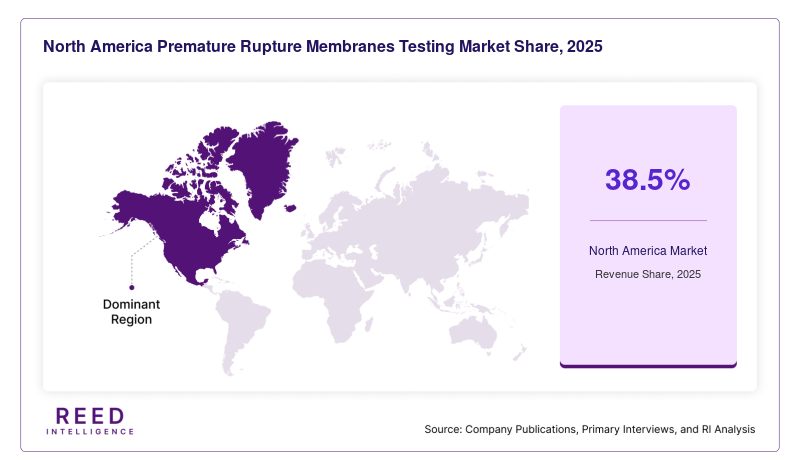
North America accounted for 38.5% of the Premature Rupture Membranes Testing Market share in 2025 and is expected to grow at a CAGR of 8.1% during the forecast period. The region’s established healthcare infrastructure and high adoption of advanced diagnostic technologies supported its dominant position.
The United States remained the leading country due to strong clinical research capabilities and widespread use of advanced prenatal diagnostic tools. The presence of well-established healthcare facilities and favorable reimbursement policies contributed to consistent market growth.
Europe
Europe held a market share of 27.3% in 2025 and is projected to grow at a CAGR of 7.8% through 2034. The region benefited from increasing awareness of maternal health and government-supported healthcare programs.
Germany emerged as the dominant country, driven by its advanced healthcare system and emphasis on early diagnosis. The country’s focus on improving maternal outcomes and integrating modern diagnostic technologies supported steady market expansion.
Asia Pacific
Asia Pacific accounted for 21.6% of the market share in 2025 and is anticipated to grow at the fastest CAGR of 10.4% during the forecast period. The region’s growth is attributed to rising healthcare investments and increasing awareness of prenatal care.
China led the regional market due to its large population base and expanding healthcare infrastructure. Government initiatives aimed at reducing maternal mortality rates and improving access to diagnostic services significantly boosted market growth.
Middle East & Africa
The Middle East & Africa region held a 7.1% share of the Premature Rupture Membranes Testing Market in 2025 and is expected to grow at a CAGR of 8.5% through 2034. Improving healthcare infrastructure and increasing focus on maternal health supported market development.
Saudi Arabia dominated the region, driven by investments in healthcare modernization and increasing adoption of advanced diagnostic technologies. Government initiatives to enhance healthcare quality played a key role in market growth.
Latin America
Latin America captured 5.5% of the market share in 2025 and is projected to grow at a CAGR of 8.7% during the forecast period. The region experienced growth due to improving healthcare access and rising awareness of prenatal care.
Brazil emerged as the leading country, supported by expanding healthcare services and increasing investments in maternal health programs. Efforts to improve diagnostic capabilities contributed to the region’s market expansion.
Competitive Landscape
The Premature Rupture Membranes Testing Market is moderately fragmented, with several global and regional players competing on product innovation and distribution reach. Key companies are focusing on research and development to enhance diagnostic accuracy and expand their product portfolios.
The market leader, QIAGEN N.V., has maintained a strong position through continuous innovation and strategic partnerships. The company recently introduced an advanced rapid testing kit designed to improve diagnostic efficiency in clinical settings.
Other prominent players are adopting strategies such as mergers, acquisitions, and geographic expansion to strengthen their market presence. Increasing competition is expected to drive innovation and improve product accessibility across regions.
Key Players List
- QIAGEN N.V.
- Abbott Laboratories
- F. Hoffmann-La Roche Ltd.
- Hologic, Inc.
- Thermo Fisher Scientific Inc.
- Siemens Healthineers AG
- BD (Becton, Dickinson and Company)
- bioMérieux SA
- PerkinElmer, Inc.
- QuidelOrtho Corporation
- Sekisui Diagnostics
- Medix Biochemica
- Biosynex SA
- EKF Diagnostics Holdings plc
- Trinity Biotech plc
Recent Developments
- 2024: QIAGEN N.V. launched a next-generation PROM rapid diagnostic kit with enhanced sensitivity.
- 2024: Abbott Laboratories expanded its maternal health diagnostics portfolio with new testing solutions.
- 2023: Roche introduced automated diagnostic systems for improved prenatal testing efficiency.
- 2023: Hologic, Inc. invested in R&D for advanced immunoassay technologies.
- 2023: Siemens Healthineers expanded its presence in emerging markets through strategic partnerships.
Premature Rupture Membranes Testing Market Segments
Type
- Immunoassay-Based Tests
- Rapid Bedside Tests
Product
- Diagnostic Kits
- Instruments
Technology
- Conventional Methods
- Digital & Automated Methods
End-Use
- Hospitals
- Diagnostic Clinics
- Others
Distribution Channel
- Direct Sales
- Distributors
- Online Channels
By Region
- North America
- Europe
- APAC
- Middle East and Africa
- LATAM