Prenatal Vitamin Ingredients Market Size, Share & Demand Report By Ingredient Type (Vitamins, Minerals, Omega-3 Fatty Acids, Amino Acids, Others), By Form (Powder, Liquid, Granules), By Application (Dietary Supplements, Functional Foods, Pharmaceuticals), By Distribution Channel (Direct Supply, Distributors, Online Channels), By Region & Segment Forecasts, 2025–2034
USD 3950
Market Overview
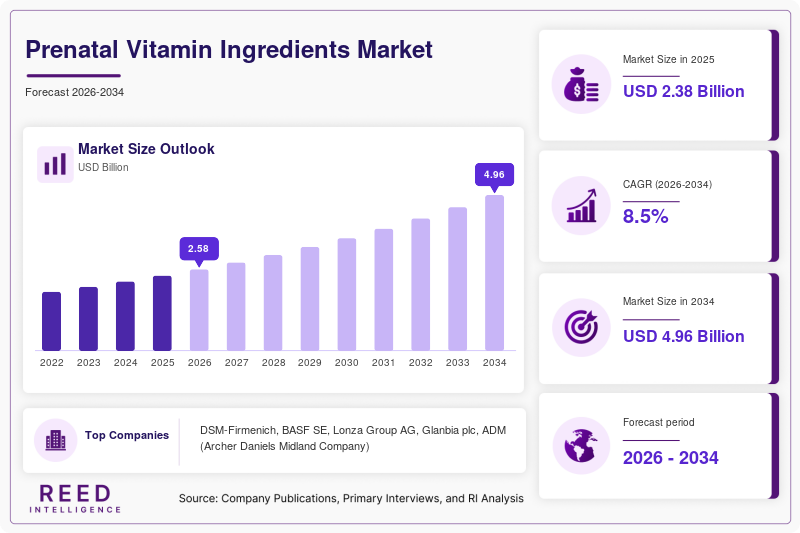
The global Prenatal Vitamin Ingredients Market size was valued at USD 2.38 billion in 2025 and is projected to reach USD 4.96 billion by 2034, expanding at a CAGR of 8.5% during the forecast period (2025–2034). The market is witnessing consistent growth due to increasing awareness of maternal health and nutrition during pregnancy. Prenatal vitamin ingredients such as folic acid, iron, calcium, omega-3 fatty acids, and vitamin D play a crucial role in supporting fetal development and reducing pregnancy-related complications.
A key global factor supporting the growth of the Prenatal Vitamin Ingredients Market is the rising focus on preventive healthcare and nutritional supplementation. Governments and healthcare organizations are actively promoting maternal nutrition programs, which has increased the demand for high-quality prenatal vitamin ingredients across pharmaceutical and nutraceutical sectors.
Key Highlights:
- North America dominated the market with a 36.8% share in 2025, while Asia Pacific is expected to grow at the fastest CAGR of 9.2% through 2034.
- By ingredient type, vitamins held the largest share (41.5%), while omega-3 fatty acids are projected to grow at a CAGR of 9.6%.
- By application, dietary supplements accounted for the leading share (52.7%), while functional foods are expected to grow at a CAGR of 9.1%.
- The United States led the market with USD 682 million in 2025, projected to reach USD 728 million in 2026.
Market Trends
Rising Demand for Plant-Based and Clean Label Ingredients
The Prenatal Vitamin Ingredients Market is experiencing a shift toward plant-based and clean label formulations. Consumers are increasingly seeking natural, non-GMO, and allergen-free ingredients. This trend is encouraging manufacturers to develop plant-derived sources of essential nutrients such as iron and omega-3.
Growth of Personalized Prenatal Nutrition
Personalized nutrition is emerging as a significant trend in the market. Companies are offering customized prenatal supplements based on individual health needs, genetic profiles, and dietary preferences. This approach is improving consumer engagement and product effectiveness.
Market Drivers
Increasing Awareness of Maternal Health
The growing awareness of maternal health and fetal development is a major driver of the Prenatal Vitamin Ingredients Market. Healthcare providers are emphasizing the importance of prenatal nutrition, leading to increased adoption of supplements.
Expansion of Nutraceutical Industry
The rapid growth of the nutraceutical industry is supporting market expansion. Prenatal vitamin ingredients are widely used in dietary supplements and functional foods, driving demand across various applications.
Market Restraint
Regulatory Challenges and Ingredient Standardization
A key restraint in the Prenatal Vitamin Ingredients Market is the complexity of regulatory requirements. Different countries have varying standards for ingredient safety and labeling, which can create challenges for manufacturers.
Additionally, ensuring consistent quality and standardization of ingredients can be difficult, impacting product development and market entry.
Market Opportunities
Development of Advanced Bioavailable Ingredients
The development of bioavailable and easily absorbable ingredients presents a significant opportunity in the Prenatal Vitamin Ingredients Market. Enhanced formulations can improve nutrient absorption and effectiveness.
Expansion in Emerging Markets
Emerging economies are witnessing increasing awareness of prenatal nutrition. Rising healthcare investments and improving access to supplements are creating growth opportunities in these regions.
Segmental Analysis
By Ingredient Type
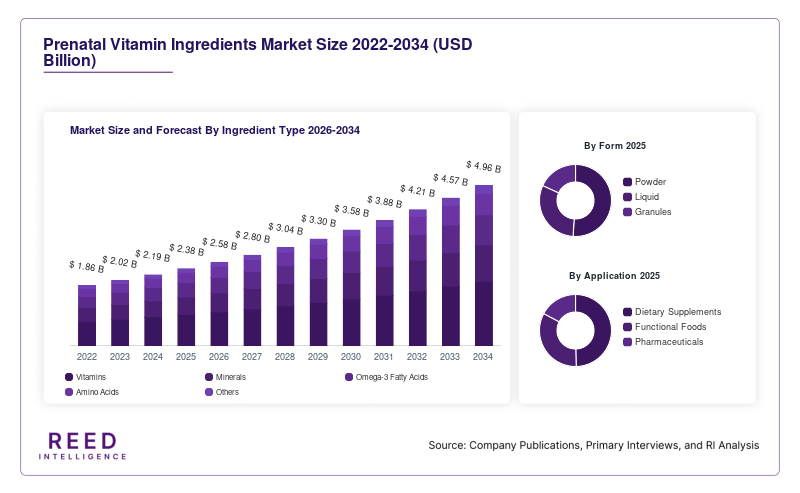
Vitamins dominated the Prenatal Vitamin Ingredients Market in 2025, accounting for 41.5% of the total share. Essential vitamins such as folic acid, vitamin D, and vitamin B-complex are widely used in prenatal formulations.
Omega-3 fatty acids are expected to grow at the fastest CAGR of 9.6% during the forecast period. These ingredients support fetal brain development, driving their demand.
By Form
Powdered ingredients held the largest share of 44.8% in 2025, supported by their ease of incorporation into various formulations.
Liquid ingredients are expected to grow at a CAGR of 9.0%, driven by their higher bioavailability and ease of consumption.
By Application
Dietary supplements accounted for 52.7% of the market in 2025, driven by high demand for prenatal capsules and tablets.
Functional foods are expected to grow at a CAGR of 9.1%, supported by increasing consumer preference for fortified foods.
By Distribution Channel
Direct supply to manufacturers held the largest share of 49.6% in 2025, as ingredient suppliers work closely with supplement producers.
Online distribution is expected to grow at a CAGR of 9.3%, driven by digitalization and e-commerce expansion.
Regional Analysis
North America
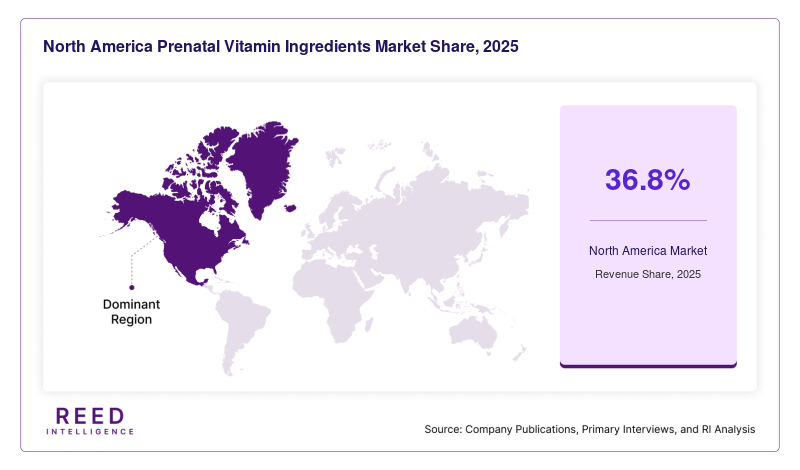
North America accounted for 36.8% of the Prenatal Vitamin Ingredients Market share in 2025 and is expected to grow at a CAGR of 8.2% during the forecast period. The region’s growth is supported by high awareness of maternal health and strong demand for dietary supplements.
The United States dominated the regional market due to its advanced healthcare system and widespread use of prenatal supplements. The presence of key manufacturers is driving growth.
Europe
Europe held a market share of 25.4% in 2025 and is projected to grow at a CAGR of 8.0% through 2034. The region’s focus on health and wellness is contributing to market expansion.
Germany emerged as the leading country, supported by strong consumer demand for high-quality nutritional products. The adoption of prenatal supplements is increasing.
Asia Pacific
Asia Pacific accounted for 24.6% of the market in 2025 and is expected to grow at the fastest CAGR of 9.2%. Increasing awareness of maternal health and rising disposable incomes are driving growth.
China dominated the regional market due to its large population and growing healthcare awareness. The demand for prenatal supplements is increasing.
Middle East & Africa
The Middle East & Africa held a market share of 6.7% in 2025 and is projected to grow at a CAGR of 8.6%. Improving healthcare infrastructure is supporting market growth.
Saudi Arabia led the regional market due to increasing healthcare investments. The adoption of nutritional supplements is rising.
Latin America
Latin America accounted for 6.5% of the market in 2025 and is expected to grow at a CAGR of 8.8%. Increasing awareness and healthcare access are driving growth.
Brazil dominated the regional market due to expanding healthcare services. The demand for prenatal nutrition products is growing.
Competitive Landscape
The Prenatal Vitamin Ingredients Market is characterized by the presence of several global and regional players focusing on innovation and product development. Companies are investing in research to develop high-quality and bioavailable ingredients.
DSM-Firmenich is a leading player in the market, known for its extensive portfolio of nutritional ingredients. The company recently introduced advanced prenatal formulations with improved bioavailability.
Other major players are focusing on expanding their product offerings and strengthening distribution networks. Strategic collaborations and innovation are key strategies adopted by market participants.
Key Players List
- DSM-Firmenich
- BASF SE
- Lonza Group AG
- Glanbia plc
- ADM (Archer Daniels Midland Company)
- Nestlé Health Science
- Kerry Group plc
- Balchem Corporation
- Naturex (Givaudan)
- Farbest Brands
- Prinova Group LLC
- Nutralliance
- Aker BioMarine
- Corbion N.V.
- Evonik Industries AG
Recent Developments
- DSM-Firmenich launched new bioavailable prenatal ingredient solutions.
- BASF SE expanded its vitamin portfolio for maternal nutrition.
- Lonza Group AG developed advanced nutrient delivery systems.
- Nestlé Health Science introduced new prenatal nutrition products.
- Aker BioMarine enhanced its omega-3 ingredient offerings.
Prenatal Vitamin Ingredients Market Segments
By Ingredient Type
- Vitamins
- Minerals
- Omega-3 Fatty Acids
- Amino Acids
- Others
By Form
- Powder
- Liquid
- Granules
By Application
- Dietary Supplements
- Functional Foods
- Pharmaceuticals
By Distribution Channel
- Direct Supply
- Distributors
- Online
By Region
- North America
- Europe
- APAC
- Middle East and Africa
- LATAM