Pressure Calibrators Market Size, Share & Demand Report By Type (Portable Pressure Calibrators, Benchtop Pressure Calibrators, Automated Pressure Calibrators), By Pressure Range (Low Pressure, Medium Pressure, High Pressure), By Application (Oil & Gas, Pharmaceuticals, Power Generation, Chemical Processing, Others), By End-Use Industry (Manufacturing, Healthcare, Energy & Utilities, Aerospace & Defense, Others), By Region & Segment Forecasts, 2025–2034
USD 3950
Market Overview
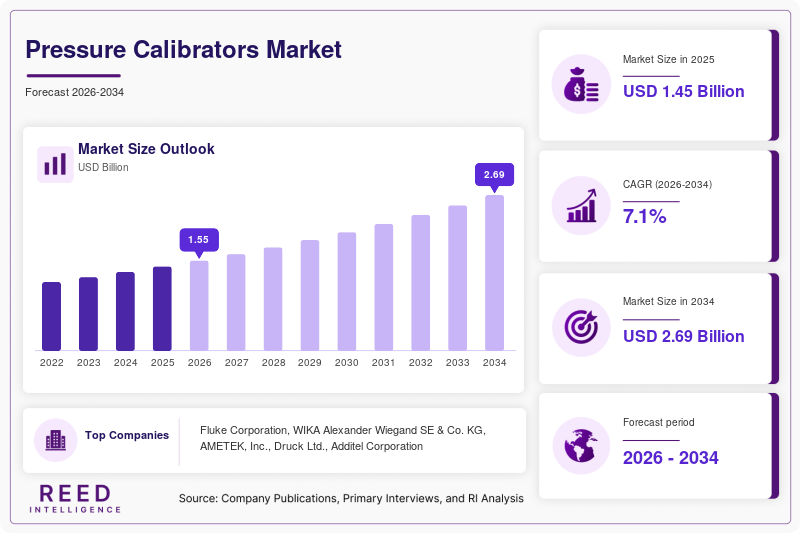
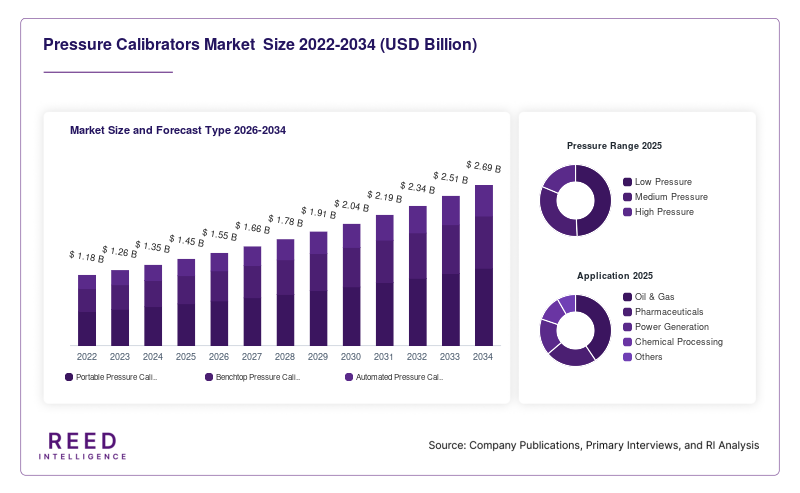
The Pressure Calibrators Market size was valued at approximately USD 1.45 billion in 2025 and is projected to reach USD 2.68 billion by 2034, expanding at a CAGR of 7.1% during the forecast period (2025–2034). The market has witnessed steady expansion due to the growing emphasis on precision measurement and regulatory compliance across industries such as oil & gas, pharmaceuticals, aerospace, and manufacturing.
A key global factor supporting market growth is the increasing adoption of industrial automation and process optimization technologies. As industries shift toward digitized operations and predictive maintenance models, the demand for highly accurate pressure calibration equipment has intensified. Pressure calibrators play a vital role in ensuring measurement accuracy, reducing downtime, and maintaining product quality, thereby supporting operational efficiency.
The integration of smart sensors and connected instrumentation has further amplified the need for periodic calibration, driving consistent demand across both developed and emerging markets. Additionally, regulatory mandates related to safety and quality standards in sectors like healthcare and energy have reinforced the necessity of reliable pressure calibration systems.
Key Highlights
- North America dominated the market with 34.2% share in 2025, while Asia Pacific is projected to register the fastest CAGR of 8.4%
- Portable pressure calibrators led the type segment with 46.5% share, while automated calibrators are expected to grow at a CAGR of 8.9%
- Oil & gas remained the leading application segment with 29.7% share, while pharmaceuticals is forecast to grow at a CAGR of 9.1%
- The U.S. market was valued at USD 410 million in 2025 and is expected to reach USD 435 million in 2026
Market Trends
Integration of Digital and Smart Calibration Systems
The Pressure Calibrators Market is undergoing a transformation driven by the integration of digital technologies. Manufacturers are increasingly introducing smart pressure calibrators equipped with wireless connectivity, cloud-based data storage, and real-time monitoring capabilities. These advanced systems enable technicians to perform remote calibrations, reduce manual errors, and streamline documentation processes. The growing use of Industrial Internet of Things (IIoT) platforms has further enhanced the adoption of digital calibrators, particularly in large-scale industrial operations. This trend is also supported by the rising demand for traceability and audit-ready calibration records across regulated industries.
Shift Toward Portable and Field-Ready Devices
Another notable trend shaping the Pressure Calibrators Market is the increasing preference for portable and handheld devices. Industries are prioritizing mobility and operational flexibility, especially in sectors such as oil & gas and utilities where on-site calibration is essential. Portable pressure calibrators offer ease of use, compact design, and faster deployment, making them suitable for field applications. Technological advancements have improved the accuracy and durability of these devices, allowing them to perform reliably in harsh environments. As a result, the adoption of portable calibrators continues to rise, particularly among maintenance teams and service providers.
Market Drivers
Growing Demand for Precision Measurement in Industrial Processes
The need for accurate pressure measurement has become increasingly critical across industrial operations. Industries such as chemical processing, power generation, and pharmaceuticals rely heavily on precise pressure readings to ensure product quality and operational safety. Pressure calibrators are essential tools for maintaining instrument accuracy, which directly impacts process efficiency. As industries continue to adopt advanced manufacturing techniques, the demand for high-performance calibration equipment is expected to grow steadily.
Expansion of Regulatory Compliance Requirements
Stringent regulatory standards across industries are significantly driving the Pressure Calibrators Market. Regulatory bodies mandate regular calibration of pressure instruments to ensure safety, reliability, and compliance with international standards. In sectors such as healthcare and food processing, adherence to quality control protocols is critical, necessitating frequent calibration activities. This has led organizations to invest in reliable calibration solutions to avoid penalties and maintain operational integrity. The increasing focus on workplace safety and environmental regulations further supports market growth.
Market Restraint
High Cost of Advanced Calibration Equipment
One of the primary challenges limiting the growth of the Pressure Calibrators Market is the high cost associated with advanced calibration systems. Automated and digital pressure calibrators often require significant initial investment, which can be a barrier for small and medium-sized enterprises. In addition to equipment costs, organizations must also invest in training personnel and maintaining calibration standards, further increasing operational expenses.
The cost factor becomes more critical in developing regions where budget constraints limit the adoption of high-end calibration technologies. While portable and manual calibrators offer relatively lower costs, they may not provide the same level of accuracy and efficiency as advanced systems. As a result, some end users continue to rely on traditional methods, slowing the overall market penetration of modern calibration solutions.
Market Opportunities
Expansion in Emerging Economies
Emerging economies present significant growth opportunities for the Pressure Calibrators Market. Rapid industrialization, infrastructure development, and increasing investments in manufacturing sectors are driving demand for calibration equipment in regions such as Asia Pacific and Latin America. Governments in these regions are also implementing policies to enhance industrial safety and quality standards, further boosting the adoption of pressure calibrators. As local industries modernize their operations, the demand for reliable calibration tools is expected to rise substantially.
Adoption of Calibration-as-a-Service Models
The growing trend of outsourcing calibration services is creating new opportunities in the market. Calibration-as-a-service models allow organizations to access professional calibration solutions without investing in expensive equipment. Service providers offer periodic calibration, maintenance, and compliance support, enabling companies to focus on core operations. This model is particularly attractive to small and medium enterprises that seek cost-effective solutions. The increasing availability of service providers and technological advancements in remote calibration are expected to drive the adoption of this model.
Segmental Analysis
By Type
Portable pressure calibrators dominated the segment with a 46.5% share in 2025. These devices were widely used due to their flexibility, ease of use, and suitability for field applications. Industries such as oil & gas and utilities relied heavily on portable calibrators for on-site maintenance and troubleshooting.
Automated pressure calibrators are expected to be the fastest-growing subsegment, with a projected CAGR of 8.9%. Their ability to perform precise and repeatable calibrations with minimal human intervention will drive their adoption. The increasing integration of digital technologies and automation in industrial processes will further support growth.
By Pressure Range
Low-pressure calibrators accounted for the largest share of 39.2% in 2025, driven by their widespread use in HVAC systems, medical devices, and laboratory applications. Their demand remained steady across industries requiring precise low-pressure measurements.
High-pressure calibrators are anticipated to grow at a CAGR of 8.2%. The expansion of heavy industries and energy sectors will increase the need for high-pressure measurement and calibration solutions.
By Application
The oil & gas segment held a dominant share of 29.7% in 2025, supported by the critical need for accurate pressure measurement in exploration and production activities. The sector’s reliance on precise instrumentation has sustained demand for calibration tools.
The pharmaceuticals segment is expected to register the fastest CAGR of 9.1%. Strict regulatory requirements and the need for high-quality production standards will drive the adoption of pressure calibrators in this sector.
By End-Use Industry
Manufacturing dominated the segment with a 31.4% share in 2025, as industries required regular calibration to maintain operational efficiency and product quality. The widespread use of pressure instruments in manufacturing processes supported segment growth.
Healthcare is projected to grow at a CAGR of 8.7%. The increasing demand for accurate medical devices and compliance with healthcare regulations will boost the adoption of calibration equipment.
Regional Analysis
North America
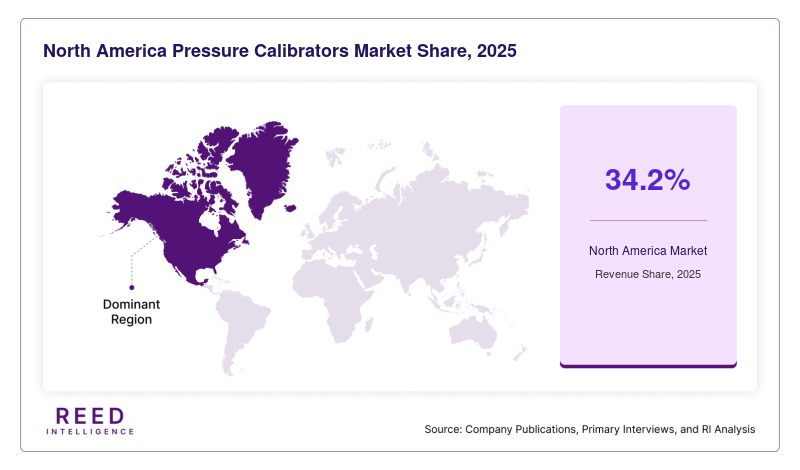
North America accounted for 34.2% of the Pressure Calibrators Market share in 2025 and is expected to grow at a CAGR of 6.5% during the forecast period. The region has a well-established industrial base and strong adoption of advanced measurement technologies. The presence of key manufacturers and high investment in automation have supported market growth.
The United States dominated the regional market due to its advanced manufacturing and energy sectors. The increasing adoption of digital calibration solutions and strong regulatory frameworks have driven demand for pressure calibrators. The country’s focus on technological innovation continues to support market expansion.
Europe
Europe held 27.8% market share in 2025 and is projected to grow at a CAGR of 6.8% through 2034. The region has a strong emphasis on quality standards and industrial safety, which has led to consistent demand for calibration equipment.
Germany emerged as the leading country in Europe, driven by its robust industrial sector and engineering excellence. The country’s focus on precision manufacturing and adoption of Industry 4.0 technologies has increased the need for accurate calibration tools.
Asia Pacific
Asia Pacific represented 22.5% of the market share in 2025 and is anticipated to grow at the fastest CAGR of 8.4%. Rapid industrialization and expanding manufacturing activities have fueled market growth in the region.
China dominated the Asia Pacific market due to its large-scale industrial operations and growing investments in automation. The country’s expanding energy and chemical sectors have increased the demand for pressure calibration solutions.
Middle East & Africa
The Middle East & Africa region accounted for 8.1% of the market share in 2025 and is expected to grow at a CAGR of 7.3%. The region’s oil & gas industry plays a significant role in driving demand for pressure calibrators.
Saudi Arabia led the regional market due to its extensive oil production activities. The need for accurate pressure measurement in upstream and downstream operations has supported market growth.
Latin America
Latin America held 7.4% market share in 2025 and is projected to grow at a CAGR of 7.0%. The region’s industrial expansion and increasing focus on quality control have contributed to market growth.
Brazil dominated the Latin American market, driven by its growing manufacturing and energy sectors. The adoption of modern calibration techniques has supported the demand for pressure calibrators.
Competitive Landscape
The Pressure Calibrators Market is moderately fragmented, with several global and regional players competing based on product innovation, accuracy, and service offerings. Companies are focusing on developing advanced digital calibrators and expanding their service portfolios to gain a competitive edge.
One of the leading players in the market is Fluke Corporation, known for its wide range of high-precision calibration instruments. The company has recently introduced advanced digital pressure calibrators with enhanced connectivity features, supporting remote calibration and data management.
Other key players are actively investing in research and development to improve product performance and expand their global presence. Strategic partnerships and acquisitions are also common as companies aim to strengthen their market position.
Key Players
- Fluke Corporation
- WIKA Alexander Wiegand SE & Co. KG
- AMETEK, Inc.
- Druck Ltd.
- Additel Corporation
- Ashcroft Inc.
- GE Measurement & Control Solutions
- Martel Electronics Corporation
- Beamex Oy Ab
- Yokogawa Electric Corporation
- Testo SE & Co. KGaA
- Omega Engineering Inc.
- Crystal Engineering Corporation
- Nagman Instruments & Electronics Pvt. Ltd.
- Tempsens Instruments Pvt. Ltd.
Recent Developments
- Fluke Corporation launched a new series of wireless-enabled pressure calibrators for industrial automation applications.
- WIKA introduced advanced high-pressure calibration systems designed for energy sector applications.
- Additel expanded its product portfolio with portable calibrators featuring enhanced accuracy and durability.
- AMETEK invested in expanding its calibration service network across Asia Pacific.
- Beamex introduced cloud-based calibration management software integrated with pressure calibrators.
Pressure Calibrators Market Segments
Type
- Portable Pressure Calibrators
- Benchtop Pressure Calibrators
- Automated Pressure Calibrators
Pressure Range
- Low Pressure
- Medium Pressure
- High Pressure
Application
- Oil & Gas
- Pharmaceuticals
- Power Generation
- Chemical Processing
- Others
End-Use Industry
- Manufacturing
- Healthcare
- Energy & Utilities
- Aerospace & Defense
- Others
By Region
- North America
- Europe
- APAC
- Middle East and Africa
- LATAM