Pressure Mapping Systems in Healthcare Market Size, Share & Demand Report By Product Type (Mat-Based Systems, Wearable Sensor Systems, Platform-Based Systems), By Application (Pressure Ulcer Prevention, Rehabilitation Assessment, Sports Medicine, Surgical Monitoring), By End-Use (Hospitals, Rehabilitation Centers, Home Care Settings, Long-Term Care Facilities), By Component (Hardware, Software, Services) & Segment Forecasts, 2025–2034
USD 3950
Market Overview
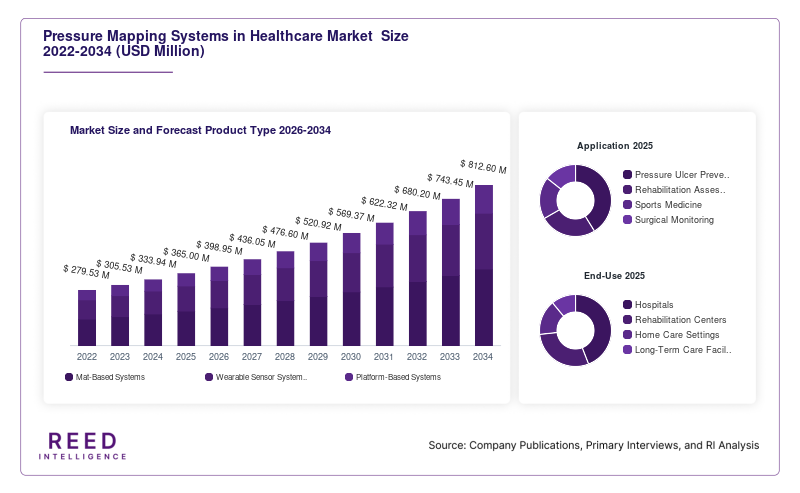
The Pressure Mapping Systems in Healthcare Market size was valued at approximately USD 365 million in 2025 and is projected to reach USD 812 million by 2034, expanding at a CAGR of 9.3% from 2025 to 2034. The market growth is primarily driven by the increasing need for patient safety monitoring and improved clinical outcomes, particularly in pressure ulcer prevention and rehabilitation assessment.
A key global factor supporting market growth is the rising prevalence of chronic conditions and mobility impairments, which has significantly increased the demand for advanced diagnostic and monitoring tools. Pressure mapping systems are widely utilized in hospitals, long-term care facilities, and rehabilitation centers to assess pressure distribution and reduce the risk of pressure injuries, thereby improving patient care quality and reducing healthcare costs.
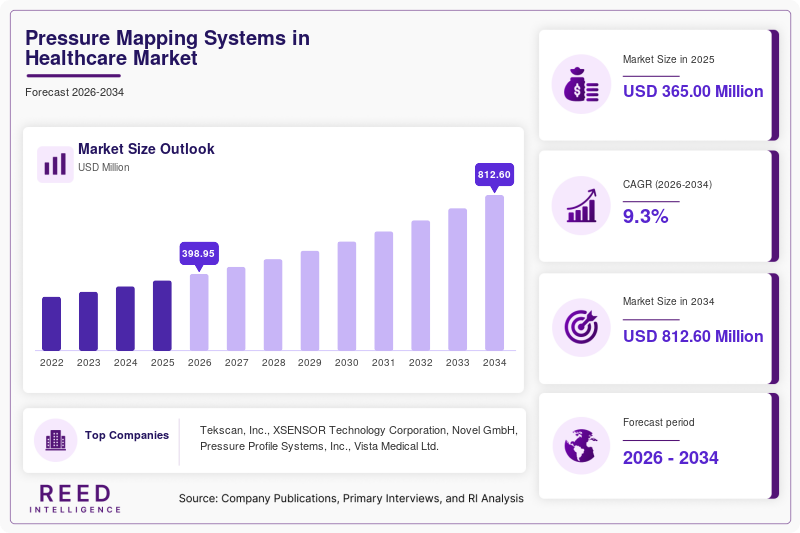
Key Highlights
- North America dominated the market with a 38.6% share in 2025, while Asia Pacific is expected to register the fastest growth at a CAGR of 11.2%.
- By product type, mat-based pressure mapping systems led with a 45.3% share, while wearable sensor systems are projected to grow fastest at a 12.5% CAGR.
- By application, pressure ulcer prevention was dominant with 41.8% share, whereas rehabilitation assessment is expected to expand at a 10.8% CAGR.
- The United States accounted for USD 128 million in 2025 and is projected to reach USD 139 million in 2026.
Market Trends
Integration of AI and Data Analytics
The Pressure Mapping Systems in Healthcare Market is witnessing increasing integration of artificial intelligence and advanced data analytics. These technologies enable predictive analysis of pressure injury risks, allowing healthcare professionals to take preventive measures proactively. AI-powered systems can identify patterns in pressure distribution and suggest real-time adjustments, enhancing patient safety and treatment efficiency. This trend is particularly relevant in critical care units and elderly care facilities where continuous monitoring is essential.
Shift Toward Portable and Wireless Systems
There is a growing shift toward portable, lightweight, and wireless pressure mapping solutions. Traditional systems required complex setups, limiting their use to specialized facilities. However, newer portable systems are designed for flexibility and ease of use across multiple healthcare settings, including home care. This trend aligns with the increasing demand for remote patient monitoring and decentralized healthcare services, contributing to broader market penetration and improved accessibility.
Market Drivers
Increasing Incidence of Pressure Ulcers
The rising incidence of pressure ulcers among hospitalized and immobile patients is a significant driver for the Pressure Mapping Systems in Healthcare Market. These systems help in early detection of high-pressure zones, enabling timely interventions and reducing complications. Hospitals are increasingly adopting these solutions to improve patient outcomes and comply with quality care standards.
Growing Geriatric Population
The expanding global geriatric population is contributing to increased demand for pressure mapping systems. Elderly individuals are more susceptible to mobility issues and chronic conditions, necessitating continuous monitoring. Healthcare providers are investing in advanced technologies to address the needs of this demographic, thereby driving market growth.
Market Restraint
High Cost of Advanced Systems
One of the major restraints in the Pressure Mapping Systems in Healthcare Market is the high cost associated with advanced systems and software integration. These systems often require significant upfront investment, including hardware, software, and training expenses. Smaller healthcare facilities and clinics may find it challenging to allocate budgets for such technologies, limiting widespread adoption.
Additionally, maintenance costs and the need for skilled personnel to interpret data further increase the total cost of ownership. In developing regions, budget constraints and lack of infrastructure hinder market penetration. Although technological advancements are expected to reduce costs over time, affordability remains a key challenge affecting market growth.
Market Opportunities
Expansion in Home Healthcare
The growing trend of home healthcare presents a significant opportunity for the Pressure Mapping Systems in Healthcare Market. With increasing preference for home-based care, especially among elderly patients, there is a rising demand for portable and easy-to-use pressure mapping devices. These systems enable caregivers to monitor patients effectively outside clinical settings, enhancing comfort and reducing hospital visits.
Emerging Markets in Asia and Latin America
Emerging economies in Asia Pacific and Latin America offer substantial growth opportunities due to improving healthcare infrastructure and increasing awareness about patient safety. Governments and private organizations are investing in advanced medical technologies, creating a favorable environment for market expansion. The rising adoption of digital healthcare solutions further supports the growth potential in these regions.
Segmental Analysis
By Product Type
Mat-based pressure mapping systems dominated the Pressure Mapping Systems in Healthcare Market with a 45.3% share in 2025. These systems were widely used due to their reliability and ease of integration into hospital beds and seating systems. Their ability to provide comprehensive pressure distribution data made them a preferred choice in clinical settings.
Wearable sensor systems are expected to grow at the fastest CAGR of 12.5% during the forecast period. Their portability and capability for continuous monitoring will drive adoption, especially in home healthcare and remote patient monitoring applications.
By Application
Pressure ulcer prevention accounted for the largest share of 41.8% in 2025. The increasing focus on reducing hospital-acquired conditions and improving patient safety contributed to the dominance of this segment.
Rehabilitation assessment is projected to grow at a CAGR of 10.8%. The growing demand for personalized rehabilitation programs and real-time feedback systems will support the expansion of this segment.
By End-Use
Hospitals represented the dominant end-use segment with a 52.6% share in 2025. The high patient volume and need for continuous monitoring made hospitals the primary adopters of pressure mapping systems.
Home care settings are anticipated to grow at a CAGR of 11.7%. Increasing preference for home-based care and advancements in portable devices will drive growth in this segment.
By Component
Hardware components held the largest share of 58.2% in 2025, as sensors and mats form the core of pressure mapping systems. Their critical role in data collection contributed to their dominance.
Software solutions are expected to grow at a CAGR of 11.3%, driven by advancements in data visualization and analytics. The increasing integration of AI and cloud-based platforms will further boost this segment.
Regional Analysis
North America
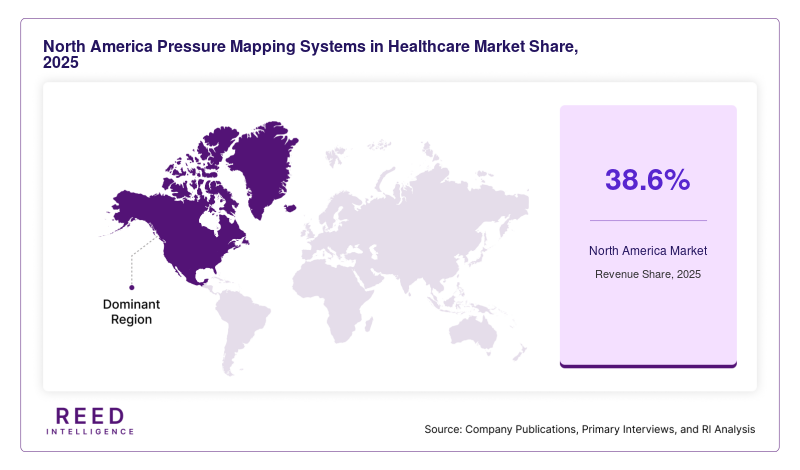
North America accounted for 38.6% of the Pressure Mapping Systems in Healthcare Market share in 2025 and is expected to grow at a CAGR of 8.7% during the forecast period. The region’s established healthcare infrastructure and strong focus on patient safety contributed to its dominant position.
The United States led the regional market due to the widespread adoption of advanced healthcare technologies. A key growth factor is the presence of well-developed reimbursement frameworks, which encourage hospitals to invest in pressure injury prevention solutions.
Europe
Europe held a 27.4% market share in 2025 and is projected to expand at a CAGR of 8.9%. The region has shown steady adoption of pressure mapping systems driven by regulatory standards emphasizing patient care quality.
Germany emerged as the dominant country, supported by its advanced medical device industry. The country’s focus on research and development has enabled the adoption of innovative pressure monitoring solutions in clinical settings.
Asia Pacific
Asia Pacific captured 18.9% of the market share in 2025 and is anticipated to grow at the fastest CAGR of 11.2%. Rapid healthcare infrastructure development and increasing awareness about pressure ulcer prevention have fueled growth in the region.
China led the regional market due to its expanding hospital network and rising healthcare investments. The country’s growing patient population and focus on digital healthcare transformation have accelerated the adoption of pressure mapping technologies.
Middle East & Africa
The Middle East & Africa region accounted for 8.1% of the market share in 2025 and is expected to grow at a CAGR of 9.5%. The market growth is driven by improving healthcare facilities and increasing government initiatives to enhance patient care standards.
Saudi Arabia dominated the region, supported by significant investments in healthcare modernization. The country’s strategic focus on adopting advanced medical technologies has contributed to market expansion.
Latin America
Latin America held a 7.0% market share in 2025 and is projected to grow at a CAGR of 9.1%. Increasing healthcare expenditure and rising awareness about patient safety have supported market growth in the region.
Brazil emerged as the leading country due to its expanding healthcare sector. The adoption of advanced diagnostic tools and increasing focus on improving clinical outcomes have driven demand for pressure mapping systems.
Competitive Landscape
The Pressure Mapping Systems in Healthcare Market is moderately competitive, with several established players focusing on product innovation and strategic partnerships. The market leader, Tekscan, Inc., has maintained a strong position through continuous advancements in sensor technology and software integration. The company recently introduced enhanced real-time analytics features to improve clinical decision-making.
Other key players are actively expanding their product portfolios and geographic presence. Companies are investing in research and development to introduce cost-effective and portable solutions. Collaborations with healthcare institutions and technology providers are also shaping the competitive dynamics of the market. The focus on improving patient outcomes and expanding application areas continues to drive competition among market participants.
Key Players
- Tekscan, Inc.
- XSENSOR Technology Corporation
- Novel GmbH
- Pressure Profile Systems, Inc.
- Vista Medical Ltd.
- Sensormedics Corporation
- Tactilus
- Body Pressure Measurement Systems
- Sensor Products Inc.
- FSA Seating System
- Medilogic
- Mobility Research
- AMI Healthcare
- Orthotimer
- BioMetrics Ltd.
Recent Developments
- Tekscan, Inc. launched an upgraded pressure mapping platform with enhanced wireless capabilities in 2024.
- XSENSOR Technology Corporation introduced a new high-resolution sensing mat for clinical applications.
- Novel GmbH expanded its presence in Asia Pacific through strategic distribution partnerships.
- Pressure Profile Systems, Inc. developed advanced wearable pressure sensors for continuous monitoring.
- Vista Medical Ltd. introduced a cloud-based analytics platform to improve data accessibility and reporting.
Pressure Mapping Systems in Healthcare Market Segments
Product Type
- Mat-Based Systems
- Wearable Sensor Systems
- Platform-Based Systems
Application
- Pressure Ulcer Prevention
- Rehabilitation Assessment
- Sports Medicine
- Surgical Monitoring
End-Use
- Hospitals
- Rehabilitation Centers
- Home Care Settings
- Long-Term Care Facilities
Component
- Hardware
- Software
- Services
By Region
- North America
- Europe
- APAC
- Middle East and Africa
- LATAM