Pressure Washer Trailers Market Size, Share & Trends Analysis Report By Trailer Type (Single-Axle Trailers, Dual-Axle Trailers, Mini Trailers), By Power Type (Hot Water, Cold Water), By Application (Commercial Cleaning, Industrial Cleaning, Construction & Equipment Cleaning, Municipal Cleaning), By End User (Pressure Washing Contractors, Construction Companies, Industrial Facilities, Municipalities, Other End Users), By Distribution Channel (Offline, Online) Forecasts, 2026–2034
USD 3950
Pressure Washer Trailers Market Size
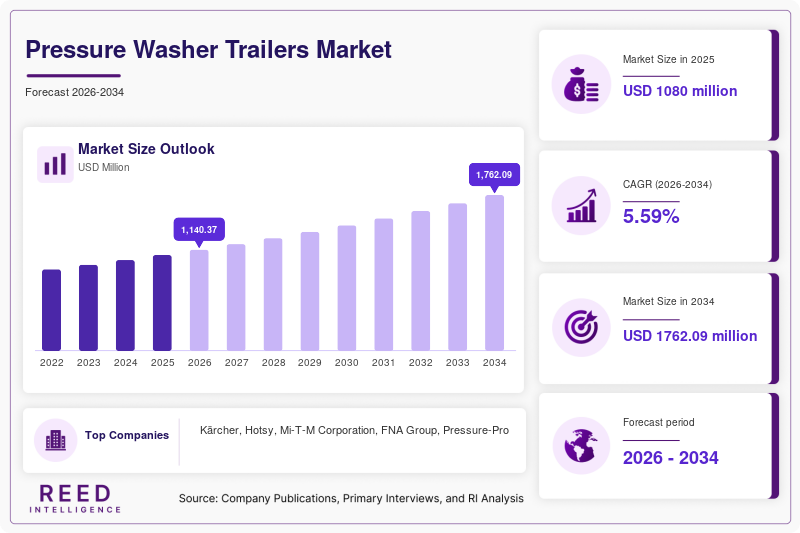
The global pressure washer trailers market size was valued at USD 1,080 million in 2025 and is projected to grow from USD 1,140 million in 2026 to USD 1,762.09 million by 2034, registering a CAGR of 5.59% during the forecast period from 2026 to 2034.
Pressure washer trailers are increasingly positioned as complete mobile cleaning systems rather than simple transport platforms. Manufacturers such as Kärcher, Hotsy and Mi-T-M combine pressure washers with water tanks, hose reels, braking systems, storage and trailer chassis to provide self-contained equipment for jobs where fixed water or power infrastructure is unavailable. Mi-T-M offers single- and dual-axle configurations, while Kärcher provides trailer packages with onboard tanks and pressure-washer skids.
Demand is connected to commercial pressure washing, construction equipment cleaning, industrial maintenance, transportation, municipal operations and property maintenance. Environmental requirements are also affecting equipment configuration because several local authorities prohibit untreated pressure-washing wastewater from entering storm drains and require containment, collection or approved disposal.
The pressure washer trailers market is developing around the need for mobile, high-output and increasingly self-contained cleaning systems. A trailer-mounted configuration allows contractors and industrial users to transport the pressure washer, water supply, hoses and accessories together, reducing setup time between job sites. Mi-T-M, for example, offers single-axle trailers with 200-gallon tanks and dual-axle configurations with two 200-gallon tanks, while Hotsy's TR-3500 uses a 200-gallon tank and a 3,500-pound-rated axle.
The customer base extends beyond dedicated pressure-washing companies. Mi-T-M identifies heavy-duty construction contractors, factories, well drillers, mines, military bases, road builders, contract cleaners, shipyards, municipalities and food-service operations as users of its dual-axle trailer systems.
Pressure Washer Trailers Market Drivers
Growth in Mobile Commercial and Industrial Cleaning
The core demand mechanism is the expansion of professional cleaning activity that must be performed at customer locations rather than inside fixed facilities. Pressure washer trailers combine the washer, water storage and hose-management equipment into a towable platform, allowing contractors to move directly between buildings, vehicles, equipment yards, construction sites and industrial facilities. Kärcher specifically markets trailer systems for mobile on-site cleaning, while Mi-T-M describes its trailer products as portable cleaning setups for heavy-duty commercial applications.
The wider building-services sector provides a recurring demand base. U.S. Bureau of Labor Statistics data show more than 2.3 million jobs in services to buildings and dwellings in late 2025, including more than 1.07 million janitorial-service jobs. BLS also projects approximately 321,800 annual openings for janitors and building cleaners over 2025–2035, reflecting continuing demand for cleaning services.
For equipment suppliers, the mechanism is direct: more mobile cleaning work increases utilization requirements, while higher job volumes encourage contractors to move from portable units toward larger, dedicated trailer systems.
Construction and Heavy-Equipment Cleaning Requirements
Construction creates a particularly suitable application because equipment, vehicles and job-site surfaces often need cleaning away from fixed facilities. Kärcher's construction-cleaning portfolio includes pressure washers and trailer packages designed for vehicles, heavy equipment and concrete forms, including applications where equipment is far from a water source.
U.S. private nonresidential construction spending remained substantial in 2026. Census Bureau data reported a seasonally adjusted annual rate of approximately USD 755.2 billion in July 2026, providing a large underlying construction activity base for equipment-cleaning applications.
The commercial mechanism extends beyond new building construction. Excavation, road building, concrete work, equipment rental and fleet operations generate repeated cleaning requirements. Trailer systems are therefore useful because the same equipment can be transported between multiple projects rather than installed permanently at one site.
Increasing Need for Wastewater Containment
Environmental compliance is creating a second equipment requirement around the cleaning process itself. Sacramento County states that wastewater from pressure washing must be contained, collected and properly disposed of rather than discharged to storm drains. Portland similarly prohibits polluted pressure-washing water from entering its stormwater system and recommends barriers, wet/dry vacuums and controlled disposal.
The impact on trailer demand is that professional operators increasingly need equipment capable of supporting controlled water use and collection. Mi-T-M already offers water trailers and systems that can be used to collect unwanted water, while municipal guidance identifies pumps, wet/dry vacuums, berms and containment systems as relevant control equipment.
This creates demand for more integrated trailer configurations, particularly in commercial markets where contractors need to demonstrate compliant wastewater handling.
Pressure Washer Trailers Market Restraints
High Initial Capital Cost and Trailer Operating Requirements
A trailer-mounted system requires more capital than a standalone portable pressure washer because the customer is purchasing the trailer chassis, water tank, pump, engine or heater, hose reels, brakes and related equipment as an integrated system. A 2025 City of San Antonio procurement, for example, specified a 325-gallon trailer-mounted hot-water pressure washer with wash-water recovery and received a quoted price of USD 31,100 per unit for the offered Hotsy configuration.
The equipment also creates towing, storage, maintenance and licensing considerations. Mi-T-M's trailers use different brake configurations and are designed for highway travel, while heavier dual-axle units are intended to carry larger water loads.
For smaller contractors, financing and utilization rates can therefore determine whether a trailer provides sufficient economic benefit compared with a portable or vehicle-mounted system.
Water, Fuel and Environmental Compliance Costs
Pressure-washing operations can consume substantial quantities of water, fuel and cleaning chemicals, particularly when hot-water systems are used for grease, oil and industrial contamination. Wastewater must also be handled according to local requirements. Portland requires commercial operators to prevent wash water from entering storm drains and states that wastewater containing hazardous chemicals may need industrial treatment.
These requirements add labor and equipment costs. Operators may need recovery pumps, berms, filtration, storage tanks or approved disposal arrangements. The constraint is particularly relevant for smaller operators working across multiple municipalities because discharge requirements can vary by jurisdiction.
Pressure Washer Trailers Market Opportunities
Integrated Water-Recovery and Compliance Systems
Pressure washer trailer manufacturers have an opportunity to move beyond cleaning power and provide integrated wash-water recovery, filtration and containment. The regulatory need is already established in several U.S. jurisdictions. Sacramento County recommends collection systems and proper disposal, while Portland specifically recommends wet/dry vacuum recovery and temporary barriers.
A trailer combining pressure washing with water recovery can reduce the number of separate machines contractors need to transport. It can also support applications where customers require documented wastewater handling. Municipal and industrial customers are particularly relevant because compliance requirements can be more stringent than for routine residential cleaning.
Compact and Specialized Trailer Platforms
Compact trailers provide another opportunity because not every cleaning job requires a heavy dual-axle platform. Kärcher offers a compact Tule Series trailer with a 1,000-pound GVWR, while Mi-T-M offers hot-water mini trailers with a 4,000-PSI belt-driven pressure washer.
Smaller systems can target landscaping contractors, property maintenance businesses, mobile detailers, fleet cleaners and smaller commercial cleaning companies. Manufacturers can also differentiate compact products through lower towing requirements, reduced setup time and modular accessory configurations.
Segmental Analysis
By Trailer Type
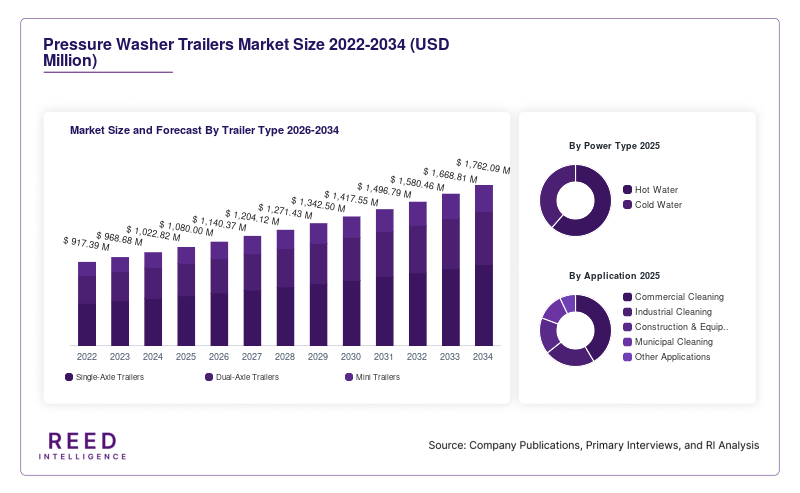
Single-Axle Trailers represent approximately 55% of the global market in 2025, making them the dominant trailer configuration. Their advantage is lower towing weight, easier maneuverability and relatively straightforward deployment for commercial contractors. Mi-T-M specifically positions single-axle trailers as lighter and more economical to tow, with 200-gallon water-tank configurations.
Dual-Axle Trailers account for approximately 32% and are used where larger water capacity, heavier equipment and greater load distribution are required. Mi-T-M's dual-axle systems can carry two 200-gallon tanks and provide additional storage beneath the tanks.
Mini Trailers represent approximately 13% and address customers seeking compact mobile systems.
Dual-Axle Trailers are the fastest-growing trailer type, with a CAGR of approximately 6.4%, supported by demand from heavy-duty industrial, construction, municipal and fleet-cleaning applications where greater water capacity and equipment payload are valuable.
By Power Type
Hot Water systems account for approximately 63% of the market in 2025. Heated water improves cleaning performance for grease, oil and other difficult contaminants and is widely used in industrial, fleet, construction and food-service applications. Hotsy's 1200 Series, for example, is designed for mobile and trailer-mounted industrial washing and reaches up to 4,000 PSI and 8 GPM depending on configuration.
Cold Water systems represent approximately 37%, supported by applications such as building exteriors, general property cleaning, concrete, equipment and other jobs where heated water is unnecessary.
Hot Water systems are also the fastest-growing power category, with a CAGR of approximately 6.1%, because commercial users increasingly require higher cleaning productivity for grease, oil and heavy soil.
By Application
Commercial Cleaning represents approximately 40% of the global market in 2025, supported by exterior building cleaning, parking lots, sidewalks, commercial properties, retail facilities and contracted property maintenance.
Industrial Cleaning accounts for approximately 25%, covering factories, warehouses, equipment yards, shipyards, mines and other industrial facilities. Mi-T-M specifically lists factories, mines, shipyards and contract cleaners among dual-axle trailer users.
Construction & Equipment Cleaning represents approximately 20% and is the fastest-growing application, with a CAGR of approximately 6.7%. Construction equipment, trucks, concrete forms and job sites require mobile cleaning, often where fixed washing infrastructure is unavailable.
Municipal Cleaning represents approximately 10%, while Other Applications account for approximately 5%.
By End User
Pressure Washing Contractors hold approximately 46% market share in 2025, making them the largest end-user group. These businesses need mobile systems because their revenue depends on moving equipment between customer locations. Trailer configurations can also increase the number of tools that can be carried to each job.
Industrial Facilities account for approximately 21%, followed by Construction Companies at approximately 18% and Municipalities at approximately 9%.
Construction Companies are the fastest-growing end-user segment, with a CAGR of approximately 6.8%, reflecting the continuing use of mobile pressure washing for heavy equipment, trucks, trailers and construction-site surfaces.
By Distribution Channel
Offline distribution accounts for approximately 68% of the market in 2025. Dealers remain important because trailer systems are configuration-intensive purchases involving pressure ratings, water capacity, heating systems, brakes, towing requirements and service support. Hotsy uses a dealer-based equipment quotation and service structure, while Mi-T-M directs customers toward local dealers.
Online distribution accounts for approximately 32% and is the fastest-growing channel, with a CAGR of approximately 7.0%. Digital channels make standardized trailers and accessories easier to compare and support lead generation for customized equipment.
Regional Analysis
North America Pressure Washer Trailers Market
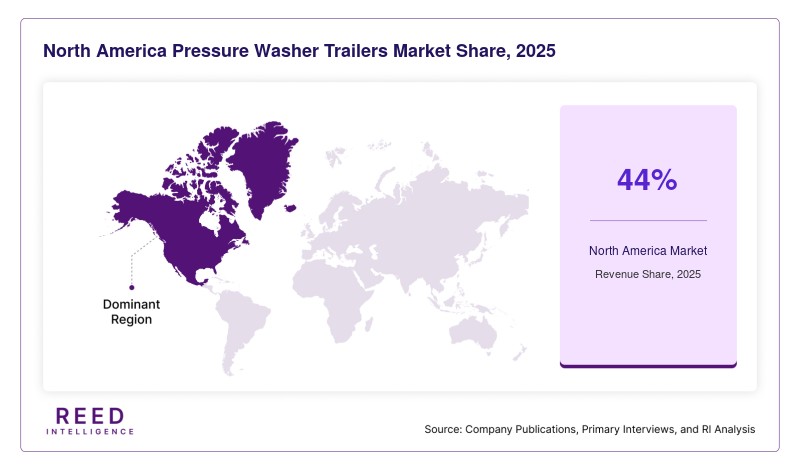
North America represents approximately 44% of the global pressure washer trailers market in 2025, making it the dominant regional market. The region has a large commercial cleaning sector, established pressure-washer manufacturers and a mature dealer network for specialized mobile equipment.
The United States provides particularly strong demand conditions because pressure washer trailers are widely used by contractors, construction companies, industrial facilities, municipalities and fleet operators. Mi-T-M, Hotsy and Kärcher all offer trailer configurations for the North American market. Mi-T-M states that its trailers are DOT approved and provides single- and dual-axle configurations, while Kärcher's trailer systems are certified by the National Association of Trailer Manufacturers.
Environmental compliance is another important regional mechanism. Sacramento County and Portland both restrict pressure-washing wastewater from entering stormwater systems, while other municipalities require containment or authorized disposal.
Construction and building-service activity provide additional demand. U.S. private nonresidential construction spending was running at a seasonally adjusted annual rate of approximately USD 755.2 billion in July 2026.
North America is projected to grow at approximately 5.2% CAGR. Market maturity and relatively high equipment penetration limit the growth rate compared with emerging regions, while replacement purchases and environmental-compliance equipment support continuing demand.
Europe Pressure Washer Trailers Market
Europe represents approximately 22% of the global market in 2025 and is supported by industrial cleaning, transportation, construction, municipal services and commercial property maintenance.
European customers tend to place strong emphasis on equipment efficiency, safety, emissions and water management. This creates a favorable environment for higher-specification trailer systems, especially where operators need to manage wastewater or comply with site-specific environmental requirements.
Kärcher's European heritage and global commercial-cleaning portfolio provide a strong regional manufacturing and distribution base. The company's trailer systems combine pressure-washer skids with water tanks and other components, demonstrating the broader movement toward complete mobile cleaning platforms.
Industrial and transportation applications are particularly relevant. Kärcher's transportation-cleaning portfolio covers fleet and trailer cleaning, while pressure washers are also used in manufacturing and industrial maintenance.
Europe is expected to register approximately 5.0% CAGR. Higher environmental standards support premium equipment demand, although higher equipment and operating costs can slow purchases among smaller contractors.
APAC Pressure Washer Trailers Market
APAC accounts for approximately 17% of the global market in 2025 and is the fastest-growing region, with an estimated CAGR of 7.4%.
The region's growth is connected to industrialization, construction activity, logistics, manufacturing facilities and the expansion of commercial cleaning services. Pressure washer trailers are particularly relevant where facilities and construction sites require mobile equipment rather than permanent washing infrastructure.
China, India, Japan, South Korea, Australia and Southeast Asian economies have different market structures. Developed markets such as Japan and Australia support professional cleaning and equipment-replacement demand, while India and Southeast Asia offer additional opportunities as construction, industrial facilities and commercial property networks expand.
The trailer format also has an advantage where customers operate across dispersed sites. A mobile water tank and pressure washer can be moved between facilities rather than installed at every location.
APAC's main constraint is uneven equipment adoption and differences in environmental regulation. However, rising industrial and construction activity creates a broader addressable base for mobile cleaning systems.
Middle East and Africa Pressure Washer Trailers Market
Middle East and Africa represents approximately 9% of the market in 2025 and is projected to grow at approximately 6.3% CAGR.
The region's demand is connected to construction, infrastructure, commercial property maintenance, transportation fleets and industrial facilities. Mobile cleaning is particularly useful on large construction sites and in locations where permanent washing infrastructure is limited.
Construction and infrastructure projects require regular cleaning of equipment, vehicles and surfaces, while fleet and logistics operations generate recurring washing requirements. Trailer-mounted systems can provide an independent water supply and high-pressure cleaning capability at dispersed locations.
The Middle East is likely to account for a substantial portion of regional premium-equipment demand because of large construction and industrial projects. Africa provides longer-term opportunities as commercial and industrial infrastructure expands.
Water availability is a key constraint. Manufacturers that reduce water consumption or integrate controlled water storage, recovery and filtration can address both operating-cost and environmental requirements.
LATAM Pressure Washer Trailers Market
LATAM accounts for approximately 8% of the global market in 2025 and is projected to grow at approximately 6.1% CAGR.
Demand is supported by construction, agriculture, transportation, industrial facilities and professional cleaning contractors. Brazil and Mexico provide significant industrial and commercial bases, while other markets contribute through construction, logistics and municipal applications.
The region's contractor-oriented market favors equipment that can be transported between multiple customer sites. Trailer systems allow businesses to carry water and cleaning equipment together, reducing dependence on customer-site infrastructure.
The main constraints include financing costs, currency fluctuations and uneven access to specialized equipment dealers. Imported pressure washers and trailer components can also face higher logistics costs.
Nevertheless, increasing professionalization of cleaning services and infrastructure development supports gradual adoption of mobile trailer systems.
Competitive Landscape
The pressure washer trailers market contains a combination of global cleaning-equipment companies, specialist pressure-washer manufacturers and regional trailer integrators. Competitive differentiation centers on pressure and flow performance, hot-water capability, tank capacity, trailer payload, towing requirements, customization, wastewater handling, service networks and equipment durability.
Kärcher offers configurable trailer systems with onboard water tanks and models such as the TRK-3500 and TRK-6000. The TRK-6000 uses a tandem axle, a 330-gallon polyethylene tank and a 6,000-pound GVWR, positioning it toward heavier mobile cleaning applications.
Mi-T-M differentiates through multiple trailer configurations. Its single-axle systems use 200-gallon tanks, while dual-axle systems can use two 200-gallon tanks. The company also offers hot-water mini trailers and water transport trailers, allowing customers to configure systems around job requirements.
Key Market Players
- Kärcher
- Hotsy
- Mi-T-M Corporation
- FNA Group
- Pressure-Pro
- Generac
- NorthStar
- Simpson Cleaning
- Alkota Cleaning Systems
- Dultmeier Sales
- BE Pressure Supply
- Aqua2Go
Recent Market Developments
July 2026 – Kärcher's current commercial portfolio includes multiple pressure-washer trailer configurations, including single-axle TRK-3500 systems, tandem-axle TRK-6000 systems and preconfigured hot-water packages. The portfolio allows customers to select trailer size, pressure-washer skid and accessory configuration according to job requirements.
2026 – Mi-T-M's current trailer portfolio spans single axle, dual axle, hot-water mini trailers and water transport trailers. The company's configurations include 200-gallon single tanks, dual 200-gallon tanks, hose reels, brakes and different hitch options, reinforcing the shift toward application-specific mobile cleaning systems.
Pressure Washer Trailers Market Segments
By Trailer Type
- Single-Axle Trailers
- Dual-Axle Trailers
- Mini Trailers
By Power Type
- Hot Water
- Cold Water
By Application
- Commercial Cleaning
- Industrial Cleaning
- Construction & Equipment Cleaning
- Municipal Cleaning
- Other Applications
By End User
- Pressure Washing Contractors
- Construction Companies
- Industrial Facilities
- Municipalities
- Other End Users
By Distribution Channel
- Offline
- Online
By Region
- North America
- Europe
- APAC
- Middle East and Africa
- LATAM