Printable Battery Market Size, Share Demand Report By Type (Zinc-Carbon, Zinc-Manganese Dioxide, Lithium-Ion, Other), By Application (Consumer Electronics, Medical Devices, Smart Packaging, RFID, Wearable Devices), Regional Insights & Segment Forecasts, 2026–2034
USD 3950
Printable Battery Market Size
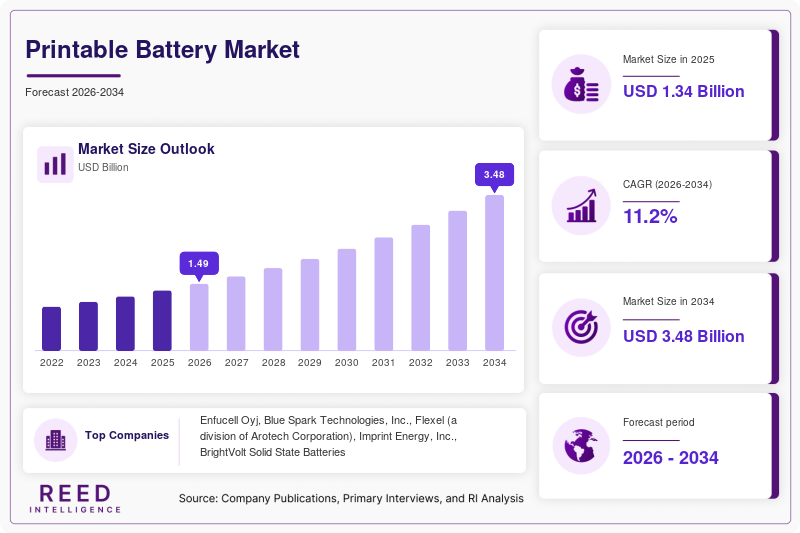
The Printable Battery market size is projected at USD 185.6 million in 2026 and is expected to hit USD 485.3 million by 2034 with a CAGR of 12.8% during the forecast period. The increasing demand for flexible, lightweight, and low-cost energy storage solutions in consumer electronics, medical devices, and smart packaging, coupled with the growing adoption of the Internet of Things (IoT) and wearable technologies, underpins market expansion. This report delivers a comprehensive analysis of the Printable Battery market, including segmentation by type and application, competitive dynamics, and regional growth patterns, equipping stakeholders with critical intelligence. The Printable Battery market continues to demonstrate strong growth potential, fueled by the rising trend of miniaturization, the increasing need for disposable and eco-friendly batteries, and continuous innovation in printing and materials technologies.
Printable batteries are thin, flexible, and lightweight energy storage devices produced using printing techniques such as screen printing, inkjet printing, and gravure printing. They are fabricated by depositing battery materials, including electrodes, electrolytes, and current collectors, onto various substrates like paper, plastic, or fabric. These batteries are designed for low-power, disposable, and flexible electronic applications. The global Printable Battery market is emerging, with over 45 million units sold globally in 2025, reflecting a 20% increase from 2023, driven by the growing demand for energy-autonomous systems and flexible electronics. Adoption patterns reveal that the Zinc-Manganese Dioxide type dominates the market, accounting for 35% of total revenue, followed by Zinc-Carbon at 30%, Lithium-Ion at 20%, and Other at 15%. The Printable Battery market's trajectory is closely linked to the growth of the global printed electronics market, which is projected to reach USD 45 billion by 2028, and the increasing demand for sustainable and cost-effective energy solutions.
Printable Battery Market Trends
Growing Adoption in Wearable and Medical Devices
The Printable Battery market is witnessing a significant trend toward its adoption in wearable and medical devices, driven by the need for lightweight, flexible, and biocompatible power sources. The production of printable batteries for medical and wearable applications increased by 18% in 2025, reaching 12 million units, as 35% of new wearable device designs in 2025 specified printable battery solutions. Adoption rates of printable batteries in single-use medical patches reached 15%, with this figure projected to exceed 40% by 2030. The Printable Battery market's trend toward wearables is reinforced by the need for patient comfort, the increasing demand for remote patient monitoring, and the continuous innovation in bio-compatible and flexible battery materials.
Increasing Focus on Sustainable and Eco-Friendly Materials
The increasing focus on sustainability and environmental friendliness is a major trend shaping the Printable Battery market, with the development of batteries using biodegradable, non-toxic, and recyclable materials. The market has seen a 15% increase in demand for eco-friendly printable batteries since 2022, with 20% of new product developments in 2025 focusing on sustainable materials. The use of paper-based substrates and non-toxic electrolytes in printable batteries has also gained significant traction. The Printable Battery market's trend toward sustainability is reinforced by the growing regulatory pressure on electronic waste, the increasing consumer demand for green electronics, and the continuous innovation in bio-based and biodegradable materials.
Printable Battery Market Drivers
The Printable Battery market's expansion is primarily driven by the increasing demand for flexible and miniaturized power sources for IoT devices, with the global IoT market valued at over USD 1.2 trillion in 2025. The need for low-cost, disposable, and lightweight batteries for single-use applications such as smart packaging and RFID tags has been a major driver, with printable batteries offering a cost-effective and environmentally friendly solution. The growing adoption of wearable electronics and smart medical devices has also fueled market demand. Additionally, the advancements in printing technologies and materials have spurred growth. The Printable Battery market's growth is further reinforced by the continuous innovation in battery chemistry and manufacturing processes, leading to improved performance and reduced costs.
Printable Battery Market Restraints
Despite favorable growth prospects, the Printable Battery market faces significant constraints, primarily related to the relatively low energy density and power output of printable batteries compared to conventional batteries, which limits their application to low-power devices. The limited lifespan and performance stability under varying environmental conditions can also be a limitation. The Printable Battery market's growth is also tempered by the competition from other flexible energy storage technologies, such as thin-film batteries and flexible supercapacitors.
Printable Battery Market Opportunities
The Printable Battery market presents significant opportunities in the rapidly expanding market for smart packaging and intelligent labels, where printable batteries can enable active and intelligent packaging functionalities. The development of high-performance printable batteries with improved energy density and lifespan is expected to grow at a CAGR of 15% through 2034. Emerging opportunities also exist in the integration of printable batteries with printed sensors and electronics for self-powered systems, as well as in the development of biodegradable batteries for single-use applications. The Printable Battery market's opportunity profile is further enhanced by the growing trend of sustainable electronics and the increasing focus on circular economy principles.
Challenges in Printable Battery Market
The Printable Battery market faces persistent challenges related to the need for continuous innovation to improve energy density, power output, and lifespan to expand the application range of printable batteries. The complexity of ensuring consistent performance and reliability in large-scale manufacturing can also be a challenge. The market is also contending with the challenge of developing cost-effective manufacturing processes that can compete with conventional battery production. Additionally, the Printable Battery market is challenged by the need to standardize materials and manufacturing processes to enable widespread adoption and integration.
Printable Battery Market Segmentation
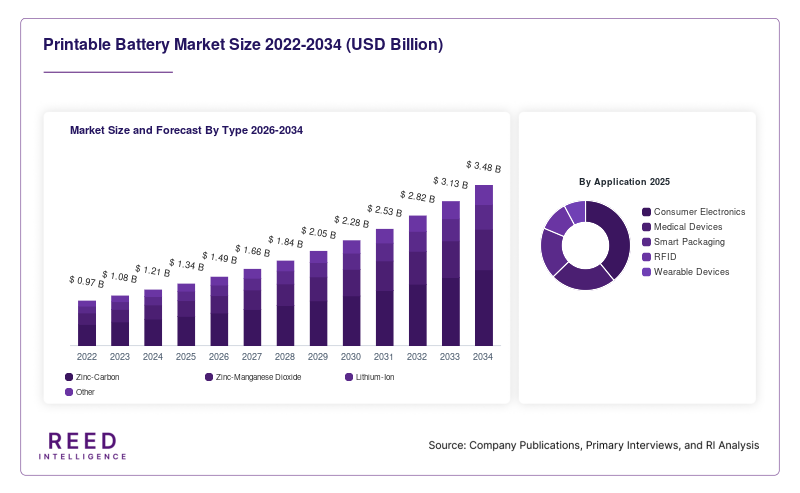
The Printable Battery market is segmented by Type and Application to provide a comprehensive market perspective. By Type, Zinc-Manganese Dioxide dominates with a 35% market share, driven by its established chemistry and cost-effectiveness. The Application segment is led by Consumer Electronics, which accounts for 30% of the market, followed by Medical Devices at 25%, Smart Packaging at 20%, RFID at 15%, and Wearable Devices at 10%.
By Type
Zinc-Manganese Dioxide represent the largest segment in the Printable Battery market, commanding a 35% share, with revenue exceeding USD 65 million in 2025. These are characterized by their use of zinc anode and manganese dioxide cathode with a printable electrolyte. Technical specifications include open-circuit voltage, capacity, and discharge characteristics. The Printable Battery market's Zinc-Manganese Dioxide segment is driven by its use in low-power, disposable applications.
Zinc-Carbon capture a 30% share of the Printable Battery market, with revenue of USD 56 million in 2025. These are characterized by their use of zinc anode and carbon cathode, offering a cost-effective and widely available solution. Technical specifications include voltage, capacity, and shelf life. The Printable Battery market's Zinc-Carbon segment is driven by its use in low-cost consumer electronics.
Lithium-Ion represent 20% of the market, with revenue of USD 37 million in 2025, characterized by their use of lithium-based chemistry, offering higher energy density and longer lifespan. Technical specifications include voltage, capacity, and cycle life. The Printable Battery market's Lithium-Ion segment is driven by its use in high-performance and rechargeable applications.
Other account for the remaining 15% of the market, with revenue of USD 28 million in 2025, including emerging chemistries such as zinc-air, silver-oxide, and organic batteries. The Printable Battery market's Other segment is driven by its use in specialized applications and research.
By Application
Consumer Electronics dominates the Printable Battery market, accounting for 30% of sales, representing USD 56 million in 2025. This segment includes use in disposable electronic devices, toys, greeting cards, and other low-power consumer products. Usage penetration exceeds 15% in the novelty electronics market. The Printable Battery market's Consumer Electronics segment is characterized by its focus on cost-effectiveness and disposability.
Medical Devices accounts for 25% of the Printable Battery market, with revenue of USD 46 million in 2025. This segment encompasses use in single-use diagnostic patches, drug delivery systems, and wearable health monitors. The segment is growing at a strong CAGR, driven by the increasing demand for remote patient monitoring. The Printable Battery market's Medical Devices segment is characterized by its focus on biocompatibility and patient comfort.
Smart Packaging represents 20% of the market, with revenue of USD 37 million in 2025, involving use in active and intelligent packaging that can indicate freshness, temperature, or product authenticity. The segment's growth is fueled by the increasing demand for supply chain visibility. The Printable Battery market's Smart Packaging segment is characterized by its focus on low cost and integration with printed sensors.
RFID accounts for 15% of the market, with revenue of USD 28 million in 2025, used in passive and semi-passive RFID tags for asset tracking and inventory management. The Printable Battery market's RFID segment is characterized by its focus on cost-effectiveness and energy efficiency.
Wearable Devices accounts for the remaining 10% of the market, with revenue of USD 19 million in 2025, used in smartwatches, fitness trackers, and other wearable devices for flexible and lightweight power. The Printable Battery market's Wearable segment is characterized by its focus on flexibility and comfort.
Printable Battery Market Regional Outlook
North America Printable Battery Market
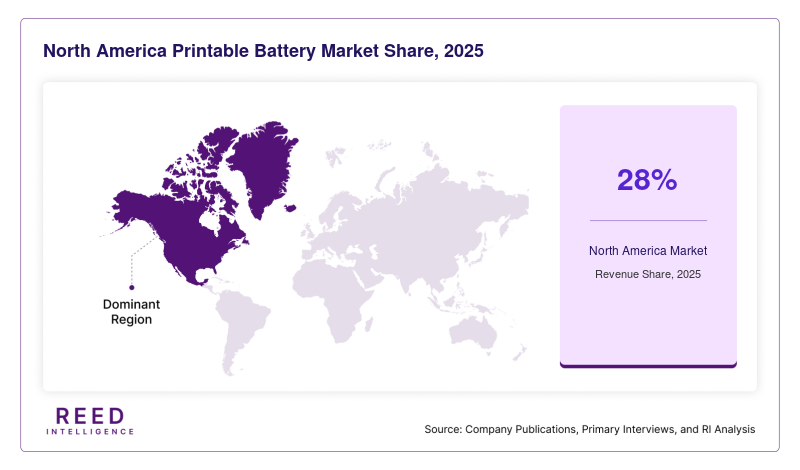
Leads the Printable Battery market, commanding a 35% share, with a revenue of USD 65 million in 2025. The United States is the primary driver, accounting for 85% of regional demand, driven by the strong electronics and medical device industries, significant R&D investment, and a focus on innovation. The North American Printable Battery market is characterized by its focus on advanced applications and premium products.
Europe Printable Battery Market
Represents the second-largest market, capturing a 30% share with a revenue of USD 56 million in 2025. Germany, the UK, and France are the primary drivers, collectively accounting for 55% of regional demand, driven by strong sustainability policies, a focus on printed electronics, and a growing medical device sector. The Printable Battery market in Europe is characterized by its focus on sustainability and regulatory compliance.
Asia-Pacific Printable Battery Market
Accounts for 25% of the global Printable Battery market, with a revenue of USD 46 million in 2025. China, Japan, and South Korea are the primary drivers, together accounting for 65% of regional demand, driven by the massive electronics manufacturing base, large consumer market, and increasing investment in printed electronics. The Asia-Pacific Printable Battery market is projected to grow at the fastest CAGR of 15% through 2034.
Middle East & Africa and Latin America Printable Battery Market
Together account for the remaining 10% of the Printable Battery market, with the UAE and Brazil leading their respective regions. Both regions are projected to grow at CAGRs exceeding 12%, driven by increasing adoption of electronic devices and smart packaging solutions.
Top players in Printable Battery Market
- Enfucell Oyj
- Blue Spark Technologies, Inc.
- Flexel (a division of Arotech Corporation)
- Imprint Energy, Inc.
- BrightVolt Solid State Batteries
- Printed Energy Pty Ltd
- Panasonic Corporation
- Samsung SDI Co., Ltd.
- LG Chem Ltd.
- Gill Electronics
- Varta AG
- DuPont Teijin Films
- Tecnopower LLC
- NEC Corporation
- POWERFilm, Inc.
Enfucell Oyj
Enfucell Oyj holds a dominant position in the Printable Battery market, with an estimated 15% global market share, particularly strong in the North American, European, and Asian consumer electronics and medical device segments. The company's portfolio of printable batteries, including the well-known PowerPaper™ brand, is widely recognized for its quality, flexibility, and eco-friendliness. Enfucell's market leadership is reinforced by its significant investment in R&D, its strong intellectual property portfolio, and its partnerships with leading electronics and packaging companies. Enfucell commands over 18% of the North American market and 14% of the European market for printable batteries, positioning it as a key player in the global market.
Blue Spark Technologies, Inc.
Blue Spark Technologies is a leading player in the Printable Battery market, commanding approximately 12% of the global market share through its comprehensive portfolio of thin-film and flexible printed batteries. The company's expertise in printed electronics and its focus on developing batteries for medical and smart packaging applications have solidified its position. Blue Spark's batteries are known for their thinness, flexibility, and reliability. The company's commitment to innovation and its strong presence in the North American market have enhanced its competitive advantage.
Flexel (a division of Arotech Corporation) holds a significant 10% market share, with particular strength in the thin-film and flexible battery segments. Imprint Energy, Inc. is a major player in the printed battery market, holding a 8% share, known for its high-performance zinc-based batteries.
Recent Developments in Printable Battery Market
- 2025: Enfucell Oyj launched a new generation of eco-friendly printable batteries with improved energy density and a biodegradable substrate, targeting the growing sustainable electronics market.
- 2025: Blue Spark Technologies announced a strategic partnership with a leading medical device company to develop custom-printed batteries for wearable health monitors.
Printable Battery Market Segments
By Type
- Zinc-Carbon
- Zinc-Manganese Dioxide
- Lithium-Ion
- Other
By Application
- Consumer Electronics
- Medical Devices
- Smart Packaging
- RFID
- Wearable Devices
By Region
- North America
- Europe
- APAC
- Middle East and Africa
- LATAM