Prion Disease Treatment Market Size, Share & Demand Report By Treatment Type (Supportive Care, Drug Therapy, Immunotherapy, Gene Therapy), By Disease Type (Sporadic Prion Diseases, Inherited Prion Diseases, Acquired Prion Diseases), By Distribution Channel (Hospital Pharmacies, Retail Pharmacies, Online Pharmacies), By End-User (Hospitals, Specialty Clinics, Research Institutes), By Region & Segment Forecasts, 2025–2034
USD 3950
Market Overview
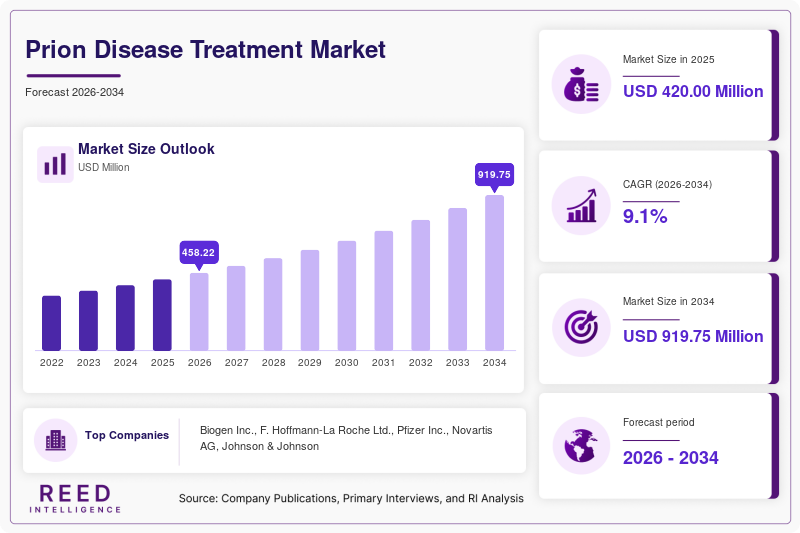
The Prion Disease Treatment Market size was valued at approximately USD 420 million in 2025 and is projected to reach USD 920 million by 2034, expanding at a CAGR of 9.1% during the forecast period (2025–2034). Although prion diseases remain rare, their fatal nature and lack of definitive cures have driven sustained research investments and therapeutic innovation globally.
A key factor supporting market growth has been the increasing global focus on rare neurological disorders and orphan drug development incentives. Regulatory bodies across major economies are providing fast-track approvals, funding support, and exclusivity benefits for rare disease treatments, which has encouraged pharmaceutical and biotechnology firms to accelerate research pipelines targeting prion-related conditions such as Creutzfeldt-Jakob disease (CJD).
Key Highlights
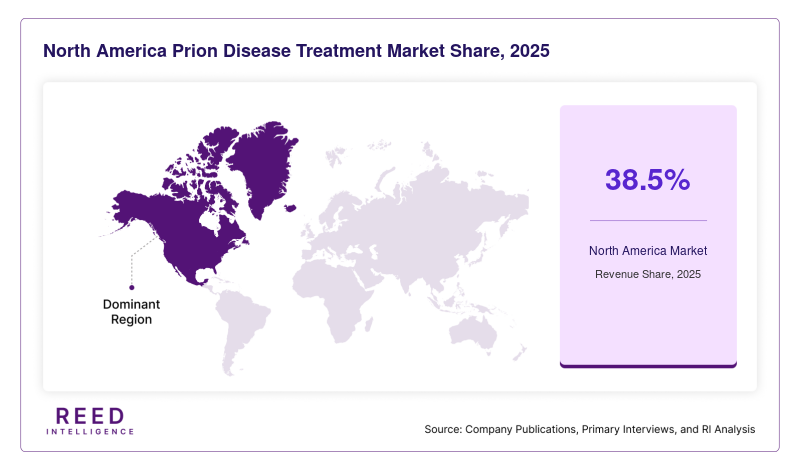
- North America dominated the market with 38.5% share in 2025, while Asia Pacific is projected to register the fastest CAGR of 10.4%
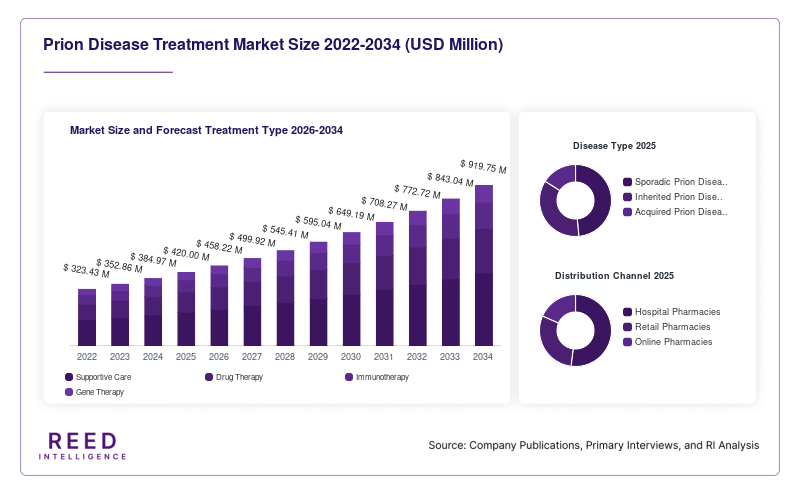
- By treatment type, supportive care therapies held the largest share (44%), while targeted immunotherapy is expected to grow fastest at a CAGR of 11.2%
- By distribution channel, hospital pharmacies dominated (52%), while online pharmacies are projected to grow at 10.8% CAGR
- The United States led the market with USD 150 million in 2025, increasing to USD 162 million in 2026
Market Trends
Increasing Focus on Disease-Modifying Therapies
The Prion Disease Treatment Market is witnessing a shift from symptomatic management to disease-modifying therapies. Traditional approaches have primarily focused on alleviating symptoms, but recent advancements in protein misfolding research are enabling the development of therapies aimed at halting or slowing disease progression. Experimental drugs targeting prion protein aggregation and replication are gaining traction, supported by increased clinical trial activity and funding. This trend reflects a broader transformation in neurodegenerative disease treatment strategies.
Expansion of Precision Medicine Approaches
Another notable trend is the integration of precision medicine in prion disease treatment. Genetic profiling and biomarker-based diagnostics are enabling early detection and personalized therapeutic approaches. This is particularly relevant for inherited prion diseases, where genetic mutations can be identified in advance. Pharmaceutical companies are increasingly investing in targeted therapies tailored to specific genetic variants, improving treatment efficacy and patient outcomes. This trend is expected to reshape the future landscape of the Prion Disease Treatment Market by enhancing treatment specificity and clinical success rates.
Market Drivers
Rising Investment in Rare Disease Research
The increasing allocation of funding toward rare disease research has significantly driven the Prion Disease Treatment Market. Governments, private organizations, and pharmaceutical companies are investing in research initiatives aimed at understanding prion pathophysiology and identifying viable treatment options. Financial incentives such as orphan drug designation and tax benefits are encouraging companies to develop therapies for rare conditions, including prion diseases.
Advancements in Neurodegenerative Disease Diagnostics
Technological advancements in diagnostic tools are also fueling market growth. Innovations in cerebrospinal fluid testing, imaging techniques, and molecular diagnostics have improved the early detection of prion diseases. Early diagnosis allows for better disease management and increases the demand for available therapeutic interventions. As diagnostic accuracy improves, more cases are identified, expanding the treatment pool and contributing to the overall growth of the Prion Disease Treatment Market.
Market Restraint
Limited Availability of Approved Therapies
One of the major challenges in the Prion Disease Treatment Market is the limited availability of approved and effective therapies. Currently, most treatments focus on symptom management rather than curing or significantly altering disease progression. The complexity of prion biology, characterized by misfolded proteins that resist conventional therapeutic approaches, makes drug development particularly challenging.
Additionally, the rarity of prion diseases poses difficulties in conducting large-scale clinical trials, leading to limited clinical data and slower regulatory approvals. High research costs and uncertain outcomes further discourage investment in this niche segment. The absence of standardized treatment protocols also creates variability in patient care, impacting overall market growth. This restraint continues to hinder the widespread adoption of advanced treatment options and limits revenue generation potential within the market.
Market Opportunities
Development of Novel Therapeutic Modalities
The emergence of innovative therapeutic approaches presents a significant opportunity in the Prion Disease Treatment Market. Technologies such as RNA interference, antisense oligonucleotides, and monoclonal antibodies are being explored to target prion protein replication. These advanced modalities offer the potential to address the root cause of the disease rather than merely managing symptoms. As research progresses, these therapies could open new revenue streams and transform the treatment landscape.
Expansion in Emerging Markets
Emerging economies offer untapped growth potential for the Prion Disease Treatment Market. Increasing healthcare expenditure, improving diagnostic infrastructure, and rising awareness about rare diseases are driving demand in regions such as Asia Pacific and Latin America. Governments in these regions are gradually implementing policies to support rare disease treatment, creating favorable conditions for market expansion. Companies that invest in these markets early are likely to benefit from increasing patient populations and evolving healthcare systems.
Segmental Analysis
By Treatment Type
Supportive care therapies dominated the Prion Disease Treatment Market in 2025, accounting for 44% of the total share. These therapies include medications and interventions aimed at managing symptoms such as pain, muscle stiffness, and cognitive decline. The widespread use of supportive care is attributed to the lack of definitive cures and the immediate need to improve patient quality of life.
Targeted immunotherapy is expected to be the fastest-growing subsegment, with a projected CAGR of 11.2% during the forecast period. This growth will be driven by ongoing research into monoclonal antibodies that target misfolded prion proteins. The ability of these therapies to potentially slow disease progression represents a significant advancement, encouraging increased investment and clinical development.
By Disease Type
Sporadic prion diseases held the largest share of 58% in 2025, as they represent the majority of diagnosed cases globally. The unpredictable nature of these diseases and their higher prevalence compared to inherited and acquired forms contribute to their dominance in the market.
Inherited prion diseases are projected to grow at the fastest rate, with a CAGR of 10.6%. Advances in genetic testing and increased awareness of hereditary conditions will drive growth in this segment. Early identification of genetic mutations allows for proactive monitoring and potential intervention, boosting demand for targeted treatments.
By Distribution Channel
Hospital pharmacies accounted for 52% of the market share in 2025, making them the dominant distribution channel. The preference for hospital-based treatment is due to the complexity of prion diseases, which often require specialized care and monitoring.
Online pharmacies are expected to witness the fastest growth, with a CAGR of 10.8%. The increasing adoption of digital healthcare platforms and the convenience of home delivery services are key factors driving this trend. As telemedicine continues to expand, online channels will play a more significant role in treatment distribution.
By End-User
Hospitals dominated the Prion Disease Treatment Market with a 61% share in 2025, owing to their comprehensive facilities and access to specialized healthcare professionals. The need for intensive care and advanced diagnostic tools makes hospitals the primary treatment setting.
Specialty clinics are anticipated to grow at the fastest rate, with a CAGR of 9.9%. These clinics focus on neurological disorders and provide targeted care, attracting patients seeking specialized treatment. The increasing number of such clinics and their expertise in managing rare diseases will drive segment growth.
Regional Analysis
North America
North America accounted for 38.5% of the Prion Disease Treatment Market share in 2025 and will continue to maintain its leadership, expanding at a projected CAGR of 8.7% during 2025–2034. The region’s growth is driven by strong healthcare infrastructure, advanced research facilities, and the presence of leading pharmaceutical companies focusing on rare neurological disorders.
The United States dominated the regional market due to its robust research ecosystem and high healthcare spending. A key growth factor has been the widespread availability of specialized diagnostic centers capable of early detection of prion diseases. Additionally, strong collaboration between academic institutions and biotech firms has accelerated clinical trials and therapeutic innovation, further strengthening the country’s position.
Europe
Europe held a 27.2% share of the Prion Disease Treatment Market in 2025 and is expected to grow at a CAGR of 8.9% over the forecast period. The region benefits from well-established healthcare systems and supportive regulatory frameworks for orphan drugs.
Germany emerged as the dominant country, driven by its strong focus on neurological research and public healthcare funding. The country’s emphasis on early diagnosis and patient care has contributed to the steady adoption of treatment solutions. Furthermore, collaborative research initiatives across European nations are enhancing the development of innovative therapies.
Asia Pacific
Asia Pacific captured 19.6% of the market share in 2025 and is projected to register the fastest growth with a CAGR of 10.4%. Rapid improvements in healthcare infrastructure and increasing awareness about rare diseases are key factors driving growth in this region.
China led the regional market due to its expanding healthcare system and rising investments in biotechnology research. The government’s initiatives to improve access to advanced diagnostics and treatments have played a significant role in market expansion. Additionally, the growing patient population and increasing focus on neurological disorders are expected to drive demand further.
Middle East & Africa
The Middle East & Africa region held 8.1% of the Prion Disease Treatment Market in 2025 and is anticipated to grow at a CAGR of 7.8%. The market is gradually expanding due to improving healthcare infrastructure and increasing government initiatives.
Saudi Arabia dominated the region, supported by its investments in healthcare modernization and specialized medical facilities. The country’s efforts to enhance diagnostic capabilities and provide access to advanced treatments have contributed to market growth. However, limited awareness in certain areas remains a challenge.
Latin America
Latin America accounted for 6.6% of the market share in 2025 and is expected to grow at a CAGR of 8.2%. The region is experiencing steady growth due to increasing healthcare investments and improving access to medical services.
Brazil emerged as the leading country, driven by its expanding healthcare sector and rising focus on rare diseases. Government initiatives aimed at improving diagnostic infrastructure and patient care have supported market development. The growing presence of pharmaceutical companies in the region is also contributing to increased treatment availability.
Competitive Landscape
The Prion Disease Treatment Market is moderately competitive, with a mix of established pharmaceutical companies and emerging biotechnology firms. Key players are focusing on research collaborations, clinical trials, and the development of innovative therapies to strengthen their market position.
Biogen Inc. is a leading player in the market, known for its strong focus on neurological disorders. The company recently advanced a novel therapeutic candidate targeting prion protein aggregation into early-stage clinical trials, reflecting its commitment to innovation.
Other companies are also investing in pipeline development and strategic partnerships to expand their presence. The competitive landscape is expected to evolve as new therapies progress through clinical stages and regulatory approvals increase.
Key Players List
- Biogen Inc.
- F. Hoffmann-La Roche Ltd.
- Pfizer Inc.
- Novartis AG
- Johnson & Johnson
- GlaxoSmithKline plc
- Sanofi S.A.
- Takeda Pharmaceutical Company Limited
- Amgen Inc.
- Eli Lilly and Company
- AbbVie Inc.
- Merck & Co., Inc.
- UCB S.A.
- Ionis Pharmaceuticals, Inc.
- Alnylam Pharmaceuticals, Inc.
Recent Developments
- 2025: A leading biotechnology firm initiated Phase II trials for a monoclonal antibody targeting prion protein misfolding.
- 2024: A collaboration between pharmaceutical companies and academic institutions accelerated research in gene-based therapies for prion diseases.
- 2025: Regulatory authorities granted orphan drug designation to a novel prion disease therapy candidate.
- 2026: Increased funding was allocated to rare disease research programs, supporting clinical advancements in prion treatment.
Prion Disease Treatment Market Segments
Treatment Type
- Supportive Care
- Drug Therapy
- Immunotherapy
- Gene Therapy
Disease Type
- Sporadic Prion Diseases
- Inherited Prion Diseases
- Acquired Prion Diseases
Distribution Channel
- Hospital Pharmacies
- Retail Pharmacies
- Online Pharmacies
End-User
- Hospitals
- Specialty Clinics
- Research Institutes
By Region
- North America
- Europe
- APAC
- Middle East and Africa
- LATAM