Process Air Heater Market Size, Share & Demand Report By Heater Type (Gas-Fired Process Air Heaters, Infrared Air Heaters, Steam-Based Air Heaters), By Application (Chemical Processing, Food Processing, Semiconductor Manufacturing, Pharmaceutical Processing), By End-Use Industry (Food & Beverage Industry, Electronics Industry, Automotive Industry, Chemical Industry) By Region & Segment Forecasts, 2026–2034
USD 3950
Market Overview
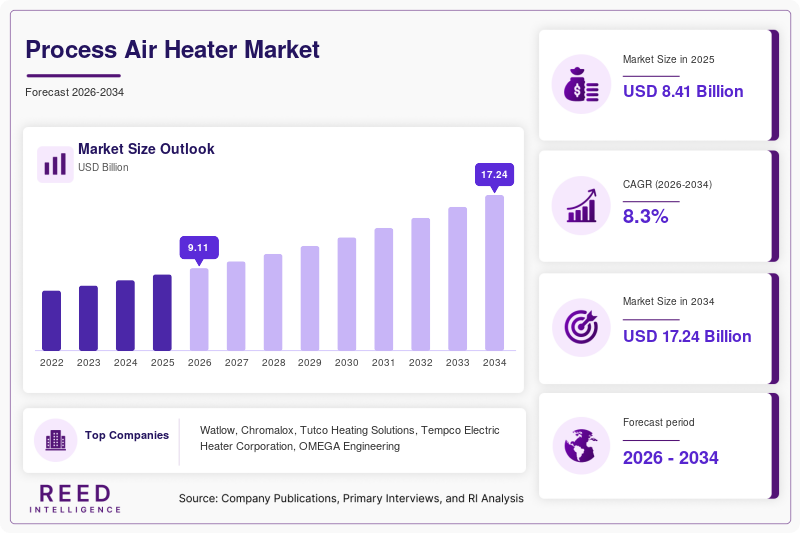
The global Process Air Heater Market size was valued at USD 8.41 billion in 2026 and is projected to reach USD 15.92 billion by 2034, expanding at a CAGR of 8.3% during the forecast period from 2026 to 2034. The market is experiencing steady growth due to rising industrial automation, expanding manufacturing output, and increasing demand for energy-efficient thermal processing systems across multiple industries. Process air heaters are widely used in chemical processing, food manufacturing, pharmaceuticals, electronics, plastics, and automotive industries where controlled heating is essential for drying, curing, sterilization, and material processing applications.
Growing emphasis on industrial energy efficiency has emerged as a major factor supporting market expansion worldwide. Manufacturers are increasingly investing in modern heating systems capable of reducing operational energy losses and improving temperature precision. Governments in several countries are also promoting energy optimization programs for industrial facilities, encouraging the adoption of advanced electric and gas-fired process air heating systems. Additionally, rising investments in semiconductor production facilities and industrial infrastructure development are accelerating product demand in both developed and emerging economies.
Key Highlights
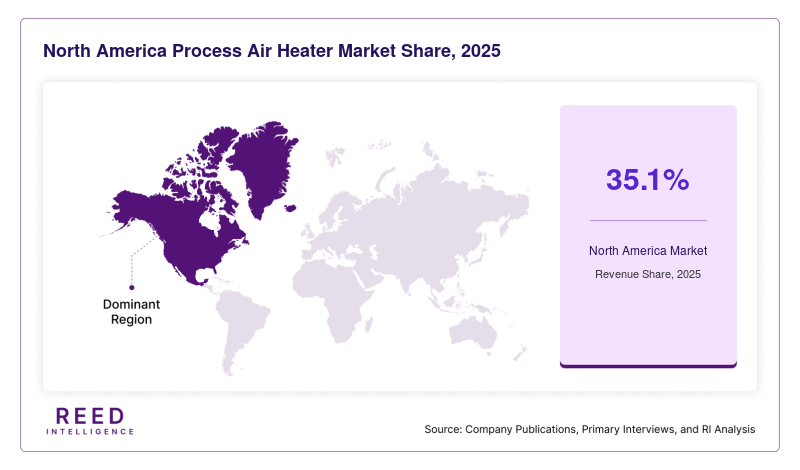
- North America dominated the market with a 35.1% share in 2025.
- Asia Pacific is expected to grow at the fastest CAGR of 10.9% during 2026–2034.
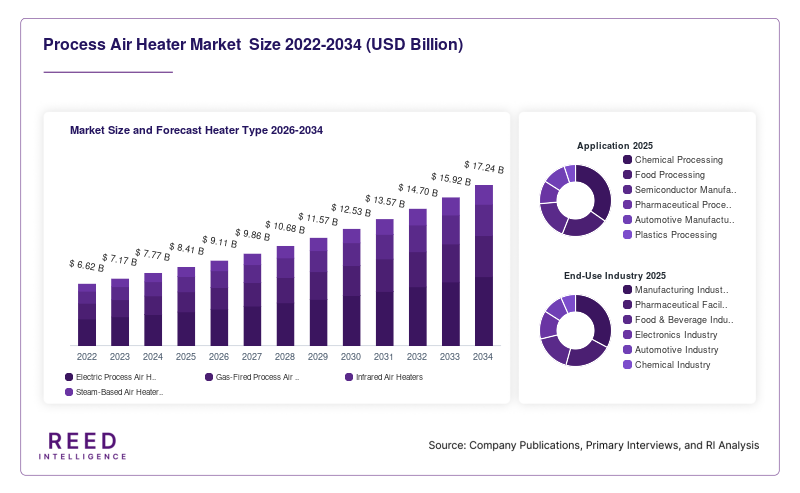
- By heater type, electric process air heaters accounted for the largest share of 42.8%.
- while infrared air heaters are projected to grow at a CAGR of 11.6%.
- By application, chemical processing led with a 31.4% share.
- whereas semiconductor manufacturing is expected to expand at a CAGR of 12.1%.
- By end-use industry, manufacturing industries held the dominant share of 39.6%.
- while pharmaceutical facilities are projected to grow at a CAGR of 11.3%.
- The United States remained the dominant country, with market values of USD 1.42 billion in 2024 and USD 1.53 billion in 2025.
Market Trends
Smart Industrial Heating Systems Transforming Manufacturing Facilities
Industrial facilities are increasingly adopting smart process air heater systems integrated with automated temperature monitoring and remote-control capabilities. Manufacturers are focusing on digitally connected heating equipment that improves operational precision while reducing downtime and maintenance costs. Smart controllers, predictive maintenance tools, and real-time thermal monitoring systems are becoming standard features in modern industrial heating infrastructure. These solutions allow operators to optimize airflow, minimize thermal losses, and maintain process consistency across production lines. The growing adoption of Industry 4.0 practices has further accelerated the integration of intelligent heating technologies across sectors such as electronics, automotive, and pharmaceuticals. Companies are also deploying cloud-based monitoring systems that enable centralized supervision of multiple heating units across industrial plants.
Increasing Preference for Energy-Efficient Electric Heating Technologies
The transition toward energy-efficient and low-emission industrial operations is encouraging industries to replace traditional combustion-based heating systems with electric process air heaters. Electric systems provide better temperature accuracy, reduced emissions, and lower maintenance requirements compared to conventional heating technologies. Growing environmental regulations regarding industrial emissions are supporting this transition across Europe, North America, and parts of Asia Pacific. In addition, rising energy prices are motivating industries to invest in efficient heating systems capable of reducing operational costs over the long term. Compact electric air heaters are also gaining popularity in semiconductor manufacturing and food processing applications where clean and precise heat delivery is required. This trend is expected to strengthen as industries continue prioritizing sustainable manufacturing operations.
Market Drivers
Expansion of Industrial Manufacturing and Processing Activities
The continuous expansion of industrial manufacturing activities worldwide is driving substantial demand for process air heaters. Industries such as chemicals, plastics, food processing, automotive, and electronics rely heavily on controlled heating systems for drying, curing, melting, and sterilization operations. Rapid industrialization in developing economies is creating new production facilities that require efficient thermal processing systems to maintain product quality and operational efficiency. The rise of automated production lines is also increasing the need for precise heating equipment capable of supporting continuous manufacturing processes. Furthermore, investments in advanced manufacturing facilities and industrial modernization projects are contributing to the growing installation of process air heaters across both large-scale and medium-sized industries globally.
Rising Demand for Temperature Precision in High-Performance Industries
Industries that require accurate temperature control are increasingly investing in advanced process air heater technologies. Semiconductor manufacturing, pharmaceutical production, and medical device fabrication demand highly controlled thermal environments to maintain product consistency and safety standards. Modern process air heaters offer uniform heat distribution and precise airflow management, making them suitable for sensitive industrial applications. The increasing production of electronic components and semiconductor devices is creating significant opportunities for compact and high-performance heating systems. In addition, pharmaceutical manufacturers are adopting advanced air heating technologies for sterilization and drying applications where process reliability is critical. The growing importance of product quality assurance and process stability continues to strengthen demand for technologically advanced industrial heating equipment.
Market Restraint
High Initial Investment and Maintenance Complexity Limiting Adoption
The relatively high installation cost associated with advanced process air heater systems remains a significant challenge for market growth, particularly among small and medium-sized industrial enterprises. Industrial heating systems often require specialized installation procedures, upgraded electrical infrastructure, and integrated control systems, which increase overall project costs. In addition, maintenance of high-capacity heating units can be technically complex and may require trained personnel to ensure efficient operation. Industries operating in cost-sensitive environments frequently delay modernization projects due to budget limitations and uncertain returns on investment. Fluctuating energy prices also create concerns regarding long-term operational expenses for industrial users. For example, manufacturers in developing economies may continue using older combustion-based systems despite lower efficiency because replacing existing infrastructure involves substantial capital expenditure and production downtime.
Market Opportunities
Growing Semiconductor Manufacturing Investments Creating New Demand
The expansion of global semiconductor manufacturing facilities presents significant opportunities for process air heater manufacturers. Semiconductor fabrication processes require clean, controlled, and consistent heating environments for wafer processing, drying, and component manufacturing applications. Governments across Asia Pacific, North America, and Europe are investing heavily in domestic semiconductor production capabilities to strengthen supply chain resilience. These investments are increasing demand for compact electric process air heaters with advanced thermal precision capabilities. Manufacturers are also developing specialized heating solutions designed specifically for cleanroom environments and sensitive electronic applications. The increasing production of consumer electronics, electric vehicles, and industrial automation systems is expected to sustain long-term demand for semiconductor-related heating equipment worldwide.
Increasing Adoption of Sustainable Industrial Infrastructure
The global shift toward sustainable industrial infrastructure is creating strong growth opportunities for energy-efficient process air heating technologies. Industrial facilities are actively seeking heating systems that reduce carbon emissions and improve operational efficiency while complying with environmental regulations. Renewable energy integration and electrification of industrial processes are encouraging the replacement of older fossil-fuel-based heating systems. Process air heater manufacturers are responding by introducing high-efficiency electric and hybrid heating technologies with lower environmental impact. Demand for sustainable heating systems is particularly increasing in food processing, pharmaceuticals, and specialty chemicals where environmental compliance is becoming a critical operational requirement. Growing investments in green manufacturing facilities and industrial energy optimization programs are expected to generate substantial market opportunities during the forecast period.
Segmental Analysis
By Heater Type
Electric process air heaters accounted for the largest market share of 42.8% in 2024 due to their high operational efficiency, precise temperature control, and low maintenance requirements. These systems are widely used across pharmaceutical manufacturing, food processing, semiconductor production, and electronics assembly applications where consistent heat delivery is essential. Electric heaters are increasingly preferred because they produce lower emissions and support cleaner industrial operations compared to combustion-based alternatives. The growing implementation of industrial energy-efficiency programs has also accelerated their adoption across developed economies. In addition, technological advancements in compact electric heating systems have improved heat transfer efficiency and enabled integration with automated manufacturing environments. Manufacturers continue introducing advanced electric heaters with intelligent control systems and enhanced durability for demanding industrial operations.
Infrared air heaters are projected to witness the fastest CAGR of 11.6% during the forecast period due to increasing demand for rapid and targeted heating solutions. These systems provide faster heat transfer, reduced energy consumption, and improved processing efficiency in applications such as drying, curing, and surface treatment. Industries are increasingly adopting infrared heating technologies because they minimize heat loss and reduce production cycle times. The automotive and plastics industries are among the major users of infrared heating systems for coating and material processing operations. Rising adoption of lightweight manufacturing materials and high-speed production technologies is further supporting segment growth. Manufacturers are also investing in advanced infrared heating systems capable of delivering precise thermal output while reducing overall energy usage in industrial facilities.
By Application
Chemical processing emerged as the dominant application segment and accounted for 31.4% of the market share in 2024. Process air heaters are extensively utilized in chemical manufacturing facilities for drying, evaporation, sterilization, and temperature-sensitive processing operations. The growing global demand for specialty chemicals, industrial chemicals, and petrochemical products continues to support segment growth. Industrial operators are increasingly adopting advanced heating systems that improve process consistency and reduce energy losses during chemical production. Safety and operational reliability remain important factors influencing purchasing decisions within this segment. Furthermore, increasing automation across chemical plants has strengthened demand for digitally controlled heating equipment capable of maintaining accurate thermal conditions during continuous manufacturing operations.
Semiconductor manufacturing is anticipated to register the fastest CAGR of 12.1% during the forecast period due to rising global demand for electronic devices and advanced computing technologies. Semiconductor fabrication processes require highly controlled thermal environments to ensure product precision and manufacturing efficiency. Process air heaters are widely used in wafer drying, cleanroom operations, and component manufacturing applications where contamination control and temperature stability are essential. Governments across major economies are investing heavily in semiconductor production infrastructure to reduce supply chain dependence and strengthen domestic manufacturing capabilities. These investments are significantly increasing demand for advanced electric air heaters designed for clean manufacturing environments. Growing adoption of artificial intelligence, electric vehicles, and industrial automation systems is also expected to drive long-term expansion of this segment.
By End-Use Industry
Manufacturing industries held the largest market share of 39.6% in 2024 due to widespread use of process air heaters across production and assembly operations. Industrial manufacturing facilities require controlled heating systems for drying, coating, sterilization, and material treatment processes. Rising automation and modernization initiatives across manufacturing sectors are increasing the installation of energy-efficient heating technologies. Process air heaters help improve product quality, operational consistency, and production speed while reducing energy waste. Automotive, electronics, plastics, and packaging industries remain key contributors to segment growth. In addition, manufacturers are increasingly adopting advanced heating systems integrated with automated monitoring tools to improve operational performance and minimize unplanned downtime across industrial facilities.
Pharmaceutical facilities are projected to grow at the fastest CAGR of 11.3% during the forecast period due to rising global healthcare demand and increasing pharmaceutical production capacity. Pharmaceutical manufacturers rely on precise air heating systems for sterilization, drying, and cleanroom applications where temperature consistency is essential for maintaining product quality. Expanding investments in biotechnology and vaccine manufacturing facilities are creating additional opportunities for advanced heating technologies. Regulatory compliance requirements regarding hygiene and process safety are encouraging pharmaceutical companies to replace conventional heating equipment with modern electric systems capable of delivering accurate thermal control. The increasing production of temperature-sensitive medical products and active pharmaceutical ingredients is also expected to support strong demand for process air heaters in this segment.
Regional Analysis
North America
North America accounted for 35.1% of the global Process Air Heater Market share in 2025 and is expected to maintain steady growth at a CAGR of 7.8% during the forecast period. The region benefits from a well-established industrial manufacturing sector and widespread adoption of automated thermal processing systems. Strong demand from chemical processing, food manufacturing, and electronics industries continues to support market expansion. Industrial facilities across the region are increasingly investing in energy-efficient heating infrastructure to improve production efficiency and reduce operating costs. The growing emphasis on industrial modernization is further accelerating equipment replacement activities.
The United States remained the dominant country within North America due to extensive industrial production and strong investments in advanced manufacturing technologies. The country recorded market values of USD 1.42 billion in 2024 and USD 1.53 billion in 2025. One unique growth factor supporting the market is the increasing expansion of semiconductor fabrication facilities across several states. Federal incentives supporting domestic electronics manufacturing are encouraging industries to install advanced thermal processing equipment with higher efficiency and precision capabilities.
Europe
Europe represented a significant portion of the global market in 2025 and is projected to expand at a CAGR of 7.5% through 2034. The regional market is driven by strict environmental regulations and increasing industrial focus on energy conservation. Countries across Europe are adopting sustainable heating technologies to reduce industrial emissions and improve production efficiency. Demand for electric process air heaters is increasing steadily as industries shift away from conventional fuel-based systems. Food processing, pharmaceuticals, and specialty chemicals remain major application sectors contributing to regional market growth.
Germany dominated the European market due to its strong industrial manufacturing base and technological leadership in industrial automation. One important growth factor supporting the German market is the rapid integration of Industry 4.0 technologies across manufacturing facilities. Companies are investing in digitally controlled heating systems capable of improving process precision and reducing energy consumption. The presence of leading industrial equipment manufacturers further strengthens regional demand for advanced process air heating technologies.
Asia Pacific
Asia Pacific is anticipated to register the fastest CAGR of 10.9% during the forecast period due to rapid industrialization and expanding manufacturing capacity across emerging economies. Increasing investments in electronics manufacturing, automotive production, and chemical processing industries are significantly boosting demand for process air heaters. Countries in the region are also witnessing rising adoption of energy-efficient industrial infrastructure as governments focus on sustainable industrial growth. Expanding industrial parks and export-oriented manufacturing facilities are creating substantial opportunities for heating equipment manufacturers across the region.
China remained the dominant country in Asia Pacific due to its extensive manufacturing ecosystem and growing industrial automation investments. A unique factor supporting regional market growth is the rapid expansion of semiconductor and electric vehicle production facilities. Rising domestic production of advanced electronics and batteries requires precise thermal processing systems capable of supporting large-scale manufacturing operations. In addition, increasing foreign investments in industrial infrastructure continue to strengthen demand for advanced heating technologies throughout the country.
Middle East & Africa
The Middle East & Africa market is witnessing gradual expansion and is projected to grow at a CAGR of 6.9% between 2026 and 2034. Growth is supported by increasing industrial diversification initiatives and expanding investments in manufacturing sectors beyond oil and gas. Several countries are establishing industrial zones and processing facilities that require efficient thermal systems for production operations. Rising adoption of industrial automation technologies is also contributing to the demand for modern process air heaters. The food processing and petrochemical sectors remain major consumers of industrial heating equipment within the region.
Saudi Arabia dominated the regional market due to ongoing industrial development projects and strong investments in manufacturing infrastructure. One distinct growth factor is the country’s large-scale industrial diversification strategy aimed at expanding non-oil industries. Industrial modernization programs and development of new manufacturing facilities are increasing demand for efficient heating systems capable of supporting continuous production processes. The growing establishment of chemical and pharmaceutical plants is also contributing to regional market expansion.
Latin America
Latin America is expected to experience moderate growth during the forecast period with increasing industrial production activities across several economies. The region is witnessing rising demand for process air heaters from food processing, packaging, and automotive industries. Companies are gradually modernizing industrial infrastructure to improve operational efficiency and reduce energy consumption. Expanding investments in manufacturing facilities and industrial automation projects are creating opportunities for advanced heating equipment suppliers. Demand for compact and energy-efficient air heaters is particularly increasing among medium-scale manufacturing enterprises.
Brazil remained the dominant country in the Latin American market due to its large industrial sector and growing manufacturing output. A major growth factor supporting the country’s market expansion is the increasing development of food processing and packaging industries. Manufacturers are investing in advanced heating technologies to improve production consistency and comply with evolving quality standards. In addition, rising exports of processed food products are encouraging industries to adopt efficient thermal processing systems that support high-volume manufacturing operations.
Competitive Landscape
The Process Air Heater Market remains moderately fragmented with the presence of established industrial heating equipment manufacturers competing through product innovation, energy efficiency improvements, and geographic expansion strategies. Leading companies are focusing on smart heating technologies, advanced temperature control systems, and compact industrial heating solutions to strengthen their market positions. Strategic partnerships with industrial automation providers are also becoming increasingly common as manufacturers seek to offer integrated thermal processing solutions.
Watlow emerged as one of the leading companies in the market due to its broad industrial heating portfolio and strong global distribution network. The company recently introduced advanced electric process air heaters integrated with digital monitoring capabilities for high-precision industrial applications. Other major players are investing in research and development activities aimed at improving thermal efficiency and reducing energy consumption. Several companies are also expanding manufacturing facilities in Asia Pacific to address rising regional demand from electronics, automotive, and chemical industries. Competitive intensity is expected to increase further as industrial customers continue prioritizing energy-efficient and digitally connected heating technologies.
Key Players
- Watlow
- Chromalox
- Tutco Heating Solutions
- Tempco Electric Heater Corporation
- OMEGA Engineering
- Backer Hotwatt
- Durex Industries
- Leister Technologies
- Heatrod Elements
- Warren Electric Corporation
- Indeeco
- Vulcan Electric
- Elmatic Ltd
- Thermal Corporation
- Rama Corporation
Recent Developments
- Watlow launched a new high-efficiency electric process air heater series in 2025 designed for semiconductor and cleanroom manufacturing environments.
- Chromalox expanded its industrial heating production facility in Asia Pacific to strengthen supply capabilities for electronics and chemical manufacturing industries in 2024.
- Leister Technologies introduced digitally controlled infrared air heaters with enhanced thermal precision for automotive coating applications in 2025.
Process Air Heater Market Segments
Heater Type
- Electric Process Air Heaters
- Gas-Fired Process Air Heaters
- Infrared Air Heaters
- Steam-Based Air Heaters
Application
- Chemical Processing
- Food Processing
- Semiconductor Manufacturing
- Pharmaceutical Processing
- Automotive Manufacturing
- Plastics Processing
End-Use Industry
- Manufacturing Industries
- Pharmaceutical Facilities
- Food & Beverage Industry
- Electronics Industry
- Automotive Industry
- Chemical Industry
By Region
- North America
- Europe
- APAC
- Middle East and Africa
- LATAM