Process Gas Compressors Market Size, Share & Trends Analysis Report By Compressor Type (Centrifugal Compressors, Reciprocating Compressors, Rotary Compressors, Axial Compressors), By Application (Natural Gas Processing, LNG & Gas Liquefaction, Refining, Petrochemical Processing, Hydrogen & Industrial Gases, Carbon Capture), By End Use (Oil & Gas, Chemical & Petrochemical, Power Generation, Industrial Gases) Forecasts, 2026–2034
USD 3950
Process Gas Compressors Market Size
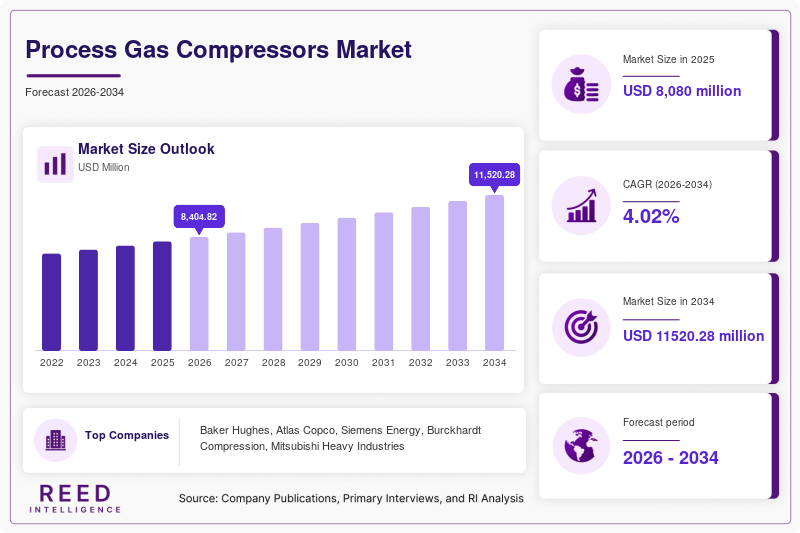
The global process gas compressors market size was valued at USD 8,080 million in 2025 and is projected to grow from USD 8.40 billion in 2026 to USD 11.07 billion by 2034, registering a CAGR of 4.02% during the forecast period from 2026 to 2034.
The process gas compressors market is being shaped by continued investment in natural gas infrastructure, LNG, refining, petrochemicals, industrial gases and emerging hydrogen and carbon-management applications. Compressors are essential process equipment because they raise gas pressure, move gases between process stages and maintain operating conditions in pipelines, LNG plants, refineries and chemical facilities. Atlas Copco identifies natural gas, chemical and petrochemical plants, power generation, hydrogen, carbon capture and LNG among its gas-and-process compressor applications.
Natural gas infrastructure remains a major demand base, although the near-term environment is uneven. The IEA reported that global natural gas demand increased 1% in 2025, while its July 2026 outlook expected global demand to decline 0.5% in 2026 because of tighter supply and higher prices. At the same time, LNG production capacity and new infrastructure continue to generate compressor requirements across liquefaction, transportation and regasification.
Process Gas Compressors Market Drivers
LNG infrastructure is creating equipment demand across the gas value chain
LNG projects require multiple compressor duties, including feed-gas compression, refrigerant compression, boil-off-gas management, fuel-gas supply and end-flash gas handling. Mitsubishi Heavy Industries Compressor Corporation notes that LNG plants use process gas compressors throughout gas treatment and liquefaction, while its LNG equipment portfolio includes off-gas, boil-off-gas and fuel-gas compressors. The IEA's 2026 gas outlook also shows continued additions to global LNG supply, although geopolitical disruptions have introduced substantial volatility. Baker Hughes' July 2026 order for six additional liquefaction blocks at Venture Global's CP2 project included compression trains based on centrifugal compressor technology. The mechanism is direct: every new liquefaction or gas-handling train requires dedicated compression equipment, while existing LNG facilities generate aftermarket requirements for maintenance, upgrades and reliability improvements.
Natural gas processing and pipeline expansion sustain large compression requirements
Gas must be compressed at multiple points between production fields, processing facilities, pipelines and LNG export infrastructure. Baker Hughes' April 2026 order for Argentina's Vaca Muerta gas infrastructure included three gas turbines paired with three centrifugal compressors for a pipeline transporting natural gas toward the Gulf of San Matias and planned LNG export facilities. In September 2026, Baker Hughes also announced gas compression systems for the Cloud Connector Pipeline in Louisiana. These projects illustrate how compressor demand follows upstream production growth and midstream infrastructure rather than gas consumption alone. The constraint is that gas-market volatility can delay final investment decisions, while higher gas prices can reduce utilization of some energy-intensive industrial facilities.
Hydrogen, CO₂ and industrial decarbonization create new compressor specifications
Hydrogen and carbon-management projects require compression equipment capable of handling different molecular properties, pressure ratios and operating conditions than conventional natural-gas systems. The U.S. Department of Energy notes that hydrogen is typically produced at relatively low pressure and must be compressed for transport, with reciprocating and centrifugal compressors among the principal technologies. The IEA reported that global hydrogen demand surpassed 100 million tonnes in 2025, while low-emissions hydrogen production increased 20% to nearly 1 million tonnes. Baker Hughes' 2026 compression portfolio includes applications for hydrogen and CO₂, and Atlas Copco identifies hydrogen and CCUS as new process-compressor applications. These applications expand the addressable equipment base beyond conventional hydrocarbons, although project economics remain sensitive to policy, infrastructure and offtake commitments.
Process Gas Compressors Market Restraints
High capital costs and project-cycle uncertainty
Large process compressors are engineered for specific pressure, flow, temperature and gas-composition requirements and are commonly integrated into large industrial projects. This makes purchasing decisions closely tied to project financing and final investment decisions. The IEA reported that investment decisions for low-emissions hydrogen projects weakened in 2025 and that project delays, cancellations and insufficient offtake commitments continue to constrain development. Similar project-cycle sensitivity affects LNG, petrochemical and refinery investments when commodity prices or financing conditions deteriorate. For compressor manufacturers, this can produce uneven order intake even when long-term equipment requirements remain intact. Customers may also extend the operating life of existing machinery through overhauls and retrofits instead of purchasing new units.
Energy efficiency, emissions and reliability requirements increase technical complexity
Compressors can represent a material share of process-plant energy consumption, making efficiency, leakage control, maintenance and equipment availability important purchasing criteria. Atlas Copco identifies energy efficiency, energy recovery, CO₂ reduction and total life-cycle cost as major market trends in gas and process compression. Gas composition can also create demanding sealing, lubrication and material requirements, particularly for hydrogen, CO₂ and cryogenic LNG applications. Meeting these specifications increases engineering requirements and can lengthen qualification cycles. Customers therefore increasingly evaluate compressors on lifetime operating economics rather than initial purchase price alone.
Process Gas Compressors Market Opportunities
Digital Monitoring and Predictive Maintenance
The installed compressor base provides a growing aftermarket opportunity through remote monitoring, predictive maintenance, upgrades and long-term service agreements. Burckhardt Compression reported that its PROGNOST-NT monitoring system helped a hydrogen compressor customer detect problems earlier and increase mean time between failures beyond 16,000 hours. The company has also expanded cloud-based monitoring capabilities through its digital product portfolio. This changes the commercial model from equipment-only sales toward recurring service revenue. Compressor suppliers can use vibration, temperature, pressure and operating data to identify deterioration before failures interrupt production. For operators, the economic benefit is tied to availability, reduced unplanned shutdowns and longer maintenance intervals.
Hydrogen and CO₂ Compression
Hydrogen and carbon-management infrastructure provides a new application layer for process compressors. The IEA reported nearly USD 7 billion of capital spending on low-emissions hydrogen projects in 2025, almost twice the 2024 level, although project delays and uncertain demand remain constraints. Baker Hughes already markets compression equipment for hydrogen and CO₂, while Atlas Copco includes CCUS and hydrogen among its emerging applications. As hydrogen production, transport and industrial hubs develop, compression requirements will extend across production, storage, transport and utilization. CO₂ transport for CCUS similarly requires specialized compression and conditioning equipment.
Segmental Analysis
By Compressor Type
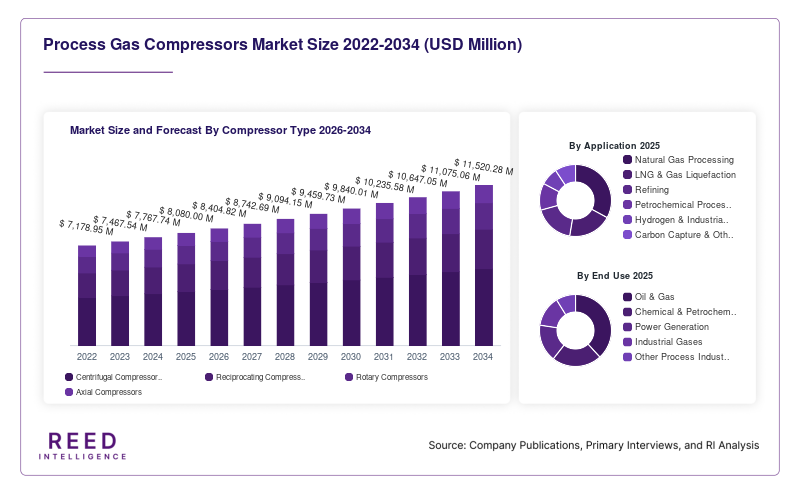
Centrifugal Compressors represent approximately 56% of the global market in 2025, making them the dominant compressor type. Their high-flow capability makes them suitable for LNG, natural-gas processing, pipeline compression, refining and large chemical facilities. Baker Hughes describes centrifugal compressors as part of its compression portfolio for natural gas, LNG and industrial applications, while its 2026 LNG awards demonstrate continued use of centrifugal technology in large liquefaction projects.
Reciprocating Compressors are the fastest-growing compressor type, with a projected CAGR of approximately 5.1%. Their ability to handle high compression ratios and specialized gases makes them relevant to hydrogen, CO₂, LNG boil-off gas and other demanding applications. The DOE identifies reciprocating compressors as particularly suitable for hydrogen applications requiring very high compression ratios. Burckhardt Compression's 2026 LNG and hydrogen projects also demonstrate continued investment in high-pressure reciprocating systems.
By Application
Natural Gas Processing accounts for approximately 34% of the global market in 2025, making it the largest application. Gas-processing facilities require compression to maintain pressure through separation, treatment and transportation stages. Atlas Copco specifically identifies gas processing as a core application for its compressor portfolio, while Baker Hughes continues to secure compression orders tied to new gas infrastructure.
Hydrogen & Industrial Gases is the fastest-growing application, with a projected CAGR of approximately 6.6%. Hydrogen demand exceeded 100 million tonnes in 2025, while low-emissions hydrogen production increased 20%. Compression is required because hydrogen production, transport and storage generally involve pressure increases from production conditions to distribution or utilization requirements.
By End Use
Oil & Gas represents approximately 52% of the global market in 2025, remaining the largest end-use sector because compression is required across upstream gas gathering, processing, transmission, LNG and refining. Recent awards from Baker Hughes in Argentina, the United States, Qatar and Brazil demonstrate continuing investment in gas compression and LNG infrastructure.
Industrial Gases is among the fastest-growing end-use categories, with a projected CAGR of approximately 5.5%. Industrial-gas plants use compression for hydrogen, oxygen, nitrogen, argon and other gases, while emerging hydrogen infrastructure adds new high-pressure requirements. Atlas Copco identifies industrial gases and hydrogen among its gas-and-process applications.
Regional Analysis
North America Process Gas Compressors Market
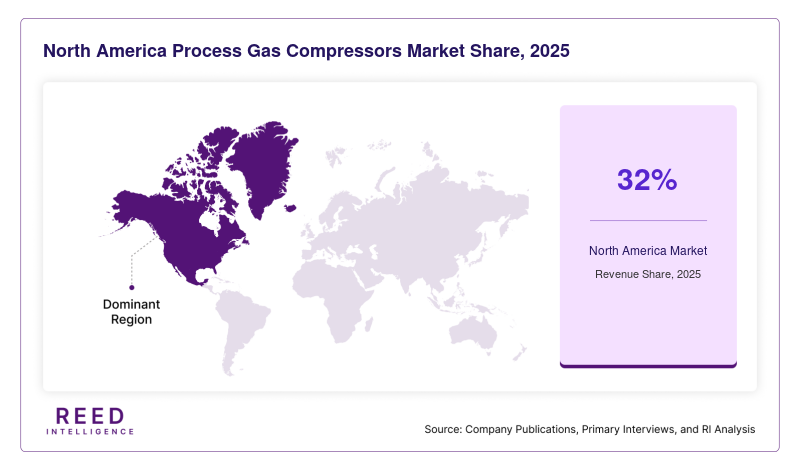
North America represents approximately 32% of the global market in 2025, supported by extensive natural-gas production, pipeline infrastructure, LNG development and large-scale petrochemical activity. The United States remains a major equipment demand center because new gas infrastructure connects domestic production with LNG export facilities.
Baker Hughes announced several 2026 projects that demonstrate this investment pattern. The company received an order for gas compression systems supporting the Cloud Connector Pipeline in Louisiana and additional compression and liquefaction equipment for Venture Global's Plaquemines LNG expansion. It also agreed to supply compression and power-generation technology for the proposed 8.4 MTPA ST LNG offshore export project in Texas.
North America is projected to register a CAGR of approximately 3.8% through 2034. The region benefits from an established compressor manufacturing and service base, but project timing remains exposed to LNG economics, permitting, financing and changes in gas-market conditions.
Europe Process Gas Compressors Market
Europe accounts for approximately 24% of the global market in 2025, supported by refining, chemicals, industrial gases, LNG import infrastructure and a large installed base of process equipment. Compressor demand is increasingly connected to energy security, LNG infrastructure modernization, hydrogen and carbon-management projects.
The IEA notes that European gas markets are undergoing structural changes as countries diversify supply and expand renewable generation. At the same time, hydrogen infrastructure is developing, although the IEA reports that project implementation remains slower than earlier expectations.
Europe is projected to grow at approximately 3.5% CAGR. Demand will increasingly emphasize energy efficiency, equipment modernization and low-emission applications rather than relying solely on new conventional gas demand. This favors suppliers with strong service networks, retrofit capabilities and specialized hydrogen or CO₂ compression technologies.
APAC Process Gas Compressors Market
APAC represents approximately 27% of the global market in 2025 and is the fastest-growing region, with a projected CAGR of approximately 5.1%. China, India, Japan, South Korea and Southeast Asia are important demand centers because of LNG infrastructure, refining, petrochemicals, industrial gases and expanding manufacturing activity.
The IEA expects Asia-Pacific gas demand dynamics to remain important to global gas markets, while LNG infrastructure continues to expand across the region. Burckhardt Compression secured several compressor orders for LNG terminals in Thailand and Taiwan in April 2026, including eight boil-off-gas compressor units and one minimum-send-out compressor.
South Korea is also important for LNG-related compressor demand. Burckhardt's March 2026 order from Hanwha Ocean covers 14 high-pressure boil-off-gas compressors for seven next-generation LNG carriers.
APAC's expansion is supported by LNG imports, industrial production and energy infrastructure investment, while price volatility and project financing can affect the timing of large compressor orders.
Middle East and Africa Process Gas Compressors Market
Middle East and Africa account for approximately 11% of the global market in 2025, supported by natural-gas production, LNG, refining, petrochemicals and large industrial projects. The Middle East remains an important gas-processing and refining center, while Africa is developing additional gas and LNG infrastructure.
The IEA reported that the Middle East conflict disrupted LNG flows and affected gas-intensive industrial activity in 2026. At the same time, new LNG projects in Africa are contributing additional supply to global markets.
The region is projected to register a CAGR of approximately 4.3%. Demand will depend on new gas-processing and LNG projects, refinery expansions and industrial development. Hydrogen and CCUS could provide additional demand over the longer term, although financing, infrastructure and geopolitical risks remain important constraints.
LATAM Process Gas Compressors Market
LATAM represents approximately 6% of the global market in 2025, with Brazil and Argentina acting as important demand centers for gas processing, pipelines, refining and LNG-related infrastructure.
Brazil provides a particularly clear recent demand signal. In August 2026, Burckhardt Compression secured orders for six process gas compressor packages for Petrobras' Boaventura Energy Complex in Rio de Janeiro. The equipment will support natural-gas processing, refining and lubricant production, while the broader complex also includes future green-hydrogen and biorefining initiatives.
Argentina is another important growth market. Baker Hughes' April 2026 order for three centrifugal compressor units supports transportation of Vaca Muerta gas toward LNG export infrastructure.
LATAM is projected to grow at approximately 4.6% CAGR, supported by natural-gas production and infrastructure expansion, although financing conditions and project execution remain key constraints.
Competitive Landscape
The process gas compressors market is characterized by a combination of large engineered-equipment suppliers, specialist compressor manufacturers and integrated energy-technology companies. Competition is based on compressor efficiency, pressure and flow capability, gas compatibility, reliability, project engineering, delivery capability, service coverage and lifecycle economics.
Baker Hughes has a broad compression portfolio spanning centrifugal, reciprocating and turboexpander-compressor technologies. Its 2026 orders show exposure to LNG liquefaction, pipeline compression, carbon capture and offshore gas operations. The company's Cloud Connector Pipeline award and Venture Global LNG projects extend its position across both midstream and LNG infrastructure.
Atlas Copco Gas and Process supplies centrifugal compressors, turboexpanders and oil-free gas screw compressors across natural gas, LNG, chemical and petrochemical, industrial-gas, hydrogen and CCUS applications. Its production footprint includes the United States, India, China and South Korea, supporting regional delivery and service capabilities.
Key Market Players
- Baker Hughes
- Atlas Copco
- Siemens Energy
- Burckhardt Compression
- Mitsubishi Heavy Industries
- Elliott Group
- Howden
- Everllence (formerly MAN Energy Solutions)
- Ingersoll Rand
- Ariel Corporation
- Kobelco Compressors
- Hitachi
- Baker Hughes Gas Technology
- FS-Elliott
- NEUMAN & ESSER
Recent Market Developments
- September 2026 – Baker Hughes: The company announced gas compression systems for the Cloud Connector Pipeline project in Louisiana and additional modular LNG technology for the Plaquemines LNG expansion. The awards strengthen its involvement across U.S. gas transportation and LNG infrastructure.
- August 2026 – Burckhardt Compression: The company secured orders for six process gas compressor packages for Petrobras' Boaventura Energy Complex in Brazil. The equipment will support natural-gas processing, refining, and lubricant production.
Process Gas Compressors Market Segments
By Compressor Type
- Centrifugal Compressors
- Reciprocating Compressors
- Rotary Compressors
- Axial Compressors
By Application
- Natural Gas Processing
- LNG & Gas Liquefaction
- Refining
- Petrochemical Processing
- Hydrogen & Industrial Gases
- Carbon Capture & Other Applications
By End Use
- Oil & Gas
- Chemical & Petrochemical
- Power Generation
- Industrial Gases
- Other Process Industries
By Region
- North America
- Europe
- APAC
- Middle East and Africa
- LATAM