Programmable Logic Device Market Size, Share Demand Report By Type (Field-Programmable Gate Arrays (FPGA), Complex Programmable Logic Devices (CPLD), System-on-Chip (SoC) FPGA), By Architecture (SRAM-based, Flash-based, Antifuse-based), By Application (Telecommunications, Automotive, Consumer Electronics, Industrial), By End-Use Industry (IT & Telecom, Automotive, Industrial, Consumer Electronics), By Sales Channel (Direct Sales, Distributors), By Region & Segment Forecasts, 2025–2034
USD 3950
Market Overview
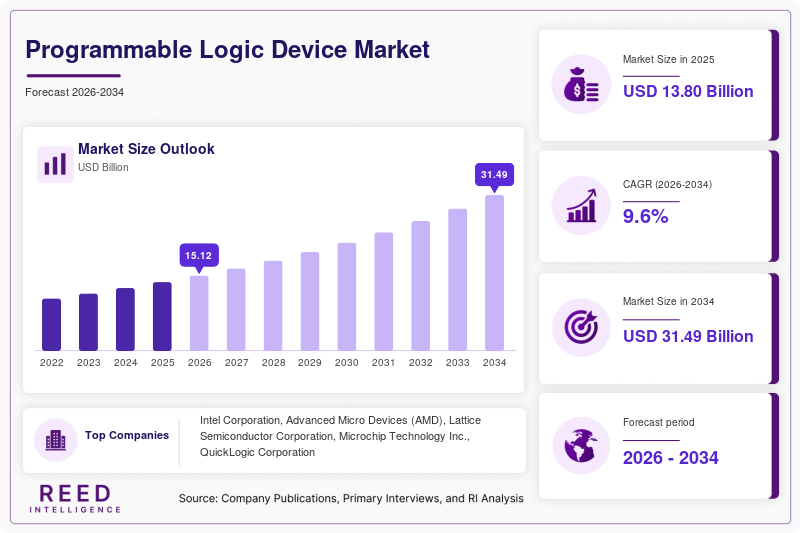
The Programmable Logic Device Market size was valued at approximately USD 13.8 billion in 2025 and is projected to reach USD 31.6 billion by 2034, expanding at a CAGR of 9.6% during 2025–2034. The market growth reflects increasing demand for flexible, reconfigurable hardware solutions across industries such as telecommunications, automotive, consumer electronics, and industrial automation.
A key global factor supporting the growth of the Programmable Logic Device Market is the rapid expansion of data-intensive applications and edge computing infrastructure. As organizations require faster data processing and low-latency performance, programmable logic devices (PLDs), including FPGAs and CPLDs, are becoming essential due to their adaptability and parallel processing capabilities.
Key Highlights:
- North America dominated the market with a 39% share in 2025, while Asia Pacific is projected to grow at the fastest CAGR of 11.2%.
- By type, Field-Programmable Gate Arrays (FPGAs) led with a 52% share, while System-on-Chip (SoC) FPGAs are expected to grow at a CAGR of 10.8%.
- By application, telecommunications accounted for the largest share, whereas automotive electronics are projected to grow at a CAGR of 10.5%.
- The United States remained the dominant country, with market values of USD 4.8 billion in 2025 and USD 5.2 billion in 2026.
Market Trends
Increasing Integration of AI and Machine Learning
The Programmable Logic Device Market is witnessing a significant shift toward AI-enabled hardware solutions. PLDs are increasingly being used to accelerate machine learning workloads due to their parallel processing capabilities and configurability. This trend is particularly evident in data centers and edge computing environments, where real-time analytics and adaptive processing are critical.
Growth of 5G and High-Speed Connectivity
Another notable trend shaping the market is the expansion of 5G infrastructure. PLDs are widely used in base stations, network equipment, and signal processing applications. Their ability to handle high data throughput and support evolving standards makes them a preferred choice in next-generation communication systems.
Market Drivers
Rising Demand for Customizable Hardware Solutions
The increasing need for flexible and application-specific hardware is a major driver for the Programmable Logic Device Market. Unlike fixed-function ASICs, PLDs can be reprogrammed to meet changing requirements, making them suitable for a wide range of applications. This flexibility reduces development time and costs, encouraging adoption across industries.
Expansion of Automotive Electronics
The automotive sector is rapidly adopting advanced electronic systems, including ADAS and in-vehicle infotainment. PLDs play a crucial role in enabling these technologies by providing real-time processing and adaptability. The shift toward electric and autonomous vehicles is further boosting demand for programmable logic devices.
Market Restraint
Complexity in Design and Programming
A major restraint in the Programmable Logic Device Market is the complexity associated with device design and programming. Developing PLD-based systems requires specialized knowledge and expertise, which can limit adoption among smaller companies. Additionally, the need for advanced development tools and skilled engineers increases overall project costs. This complexity can slow down product development cycles and create barriers for new entrants in the market.
Market Opportunities
Growth in Edge Computing Applications
The increasing adoption of edge computing presents a significant opportunity for the Programmable Logic Device Market. PLDs are well-suited for edge environments due to their ability to process data locally with low latency. As industries continue to deploy edge devices for real-time analytics, demand for programmable logic solutions is expected to rise.
Expansion in Industrial Automation
Industrial automation is another key area of opportunity. PLDs are used in control systems, robotics, and machine vision applications. The growing trend toward smart manufacturing and Industry 4.0 is driving the need for flexible and high-performance computing solutions, creating new growth avenues for the market.
Segmental Analysis
By Type
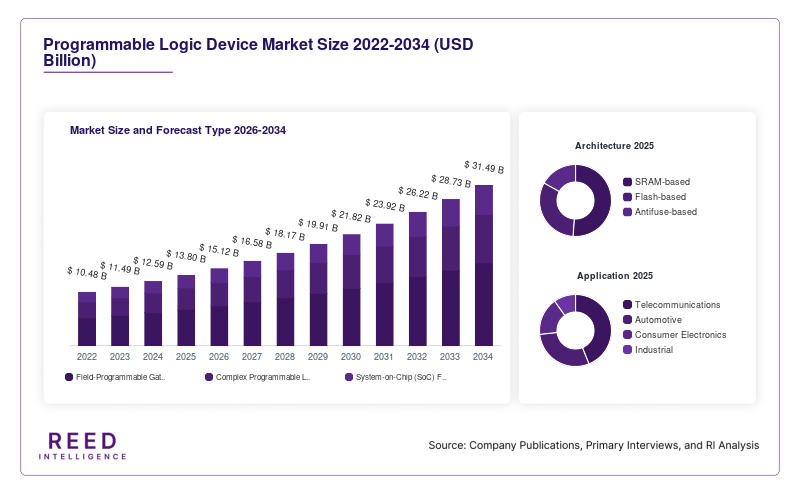
Field-Programmable Gate Arrays (FPGAs) dominated the Programmable Logic Device Market with a 52% share in 2025, due to their high performance and flexibility. They are widely used in applications requiring complex processing and real-time data handling.
System-on-Chip (SoC) FPGAs are expected to grow at the fastest CAGR of 10.8%, driven by their ability to integrate processing systems with programmable logic. This integration enhances efficiency and reduces system complexity.
By Architecture
SRAM-based PLDs held the largest share at 47% in 2025, owing to their reprogrammability and widespread use in various applications.
Flash-based PLDs will grow at a CAGR of 10.1%, supported by their non-volatile nature and lower power consumption, making them suitable for embedded systems.
By Application
Telecommunications accounted for the largest share of 34% in 2025, driven by the increasing deployment of 5G infrastructure and high-speed networks.
Automotive electronics will grow at a CAGR of 10.5%, fueled by the adoption of advanced driver-assistance systems and electric vehicle technologies.
By End-Use Industry
The IT and telecom sector dominated with a 36% share in 2025, as PLDs are widely used in networking and data processing applications.
The automotive industry will grow at a CAGR of 10.6%, supported by the increasing integration of electronic systems in vehicles.
By Sales Channel
Direct sales accounted for the largest share of 55% in 2025, as manufacturers often engage directly with large clients for customized solutions.
Distribution channels are expected to grow at a CAGR of 9.9%, driven by expanding global supply chains and increasing demand from smaller enterprises.
Regional Analysis
North America
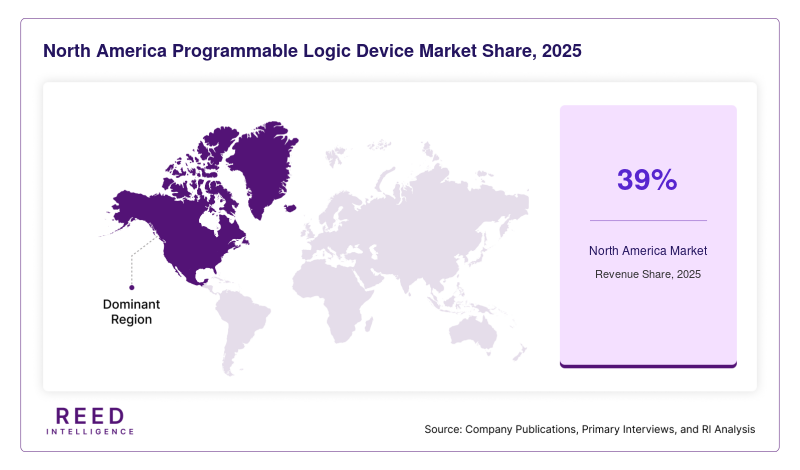
North America accounted for 39% of the Programmable Logic Device Market share in 2025 and will grow at a CAGR of 8.9% through 2034. The region’s dominance was driven by strong technological infrastructure and high adoption of advanced computing solutions.
The United States led the region due to its well-established semiconductor industry. A key growth factor is the presence of leading technology companies investing in AI and data center expansion, which is driving demand for programmable logic devices.
Europe
Europe held approximately 26% market share in 2025 and is expected to grow at a CAGR of 9.1%. The region benefited from increasing investments in automotive electronics and industrial automation.
Germany emerged as the dominant country, driven by its strong manufacturing sector. A key growth factor is the adoption of advanced automation technologies in industrial processes.
Asia Pacific
Asia Pacific captured around 24% of the market share in 2025 and will register the fastest growth at a CAGR of 11.2%. Rapid industrialization and expansion of consumer electronics manufacturing contributed to market growth.
China dominated the region, supported by its large-scale semiconductor production capabilities. A major growth factor is government initiatives promoting domestic chip manufacturing and technological self-reliance.
Middle East & Africa
The Middle East & Africa region held about 6% share in 2025 and is projected to grow at a CAGR of 9.4%. Market growth was influenced by increasing digital transformation initiatives and infrastructure development.
United Arab Emirates led the region due to its focus on smart city projects. A key growth factor is the adoption of advanced technologies in urban development.
Latin America
Latin America accounted for nearly 5% of the Programmable Logic Device Market in 2025 and will grow at a CAGR of 9.2%. The region showed steady growth due to increasing investments in technology infrastructure.
Brazil dominated the market, supported by expanding industrial activities. A significant growth factor is the adoption of automation technologies in manufacturing.
Competitive Landscape
The Programmable Logic Device Market is highly competitive, with key players focusing on innovation, product development, and strategic partnerships. The market is characterized by rapid technological advancements and strong competition among semiconductor companies.
Intel Corporation is a leading player, leveraging its FPGA portfolio to address diverse applications. The company recently introduced advanced FPGA solutions designed for AI and data center workloads, strengthening its market position.
Other major players are investing in research and development to enhance product performance and expand their market presence. Collaborations with technology firms and expansion into emerging markets are common strategies adopted by leading companies.
Key Players List
- Intel Corporation
- Advanced Micro Devices (AMD)
- Lattice Semiconductor Corporation
- Microchip Technology Inc.
- QuickLogic Corporation
- Achronix Semiconductor Corporation
- Efinix Inc.
- Flex Logix Technologies
- Gowin Semiconductor
- Shanghai Anlogic Infotech
- Xilinx Inc.
- Cypress Semiconductor Corporation
- Broadcom Inc.
- NXP Semiconductors
- Renesas Electronics Corporation
Recent Developments
- 2024: Intel Corporation launched new FPGA solutions targeting AI workloads.
- 2024: AMD expanded its programmable logic portfolio with advanced SoC FPGA products.
- 2025: Lattice Semiconductor introduced low-power FPGA solutions for edge applications.
- 2025: Microchip Technology enhanced its PLD offerings for industrial automation.
- 2025: Achronix Semiconductor developed high-performance FPGA architectures for data centers.
Programmable Logic Device Market Segments
Type
- Field-Programmable Gate Arrays (FPGA)
- Complex Programmable Logic Devices (CPLD)
- System-on-Chip (SoC) FPGA
Architecture
- SRAM-based
- Flash-based
- Antifuse-based
Application
- Telecommunications
- Automotive
- Consumer Electronics
- Industrial
End-Use Industry
- IT & Telecom
- Automotive
- Industrial
- Consumer Electronics
Sales Channel
- Direct Sales
- Distributors
By Region
- North America
- Europe
- APAC
- Middle East and Africa
- LATAM