Property Maintenance Market Size, Share & Trends Analysis Report By Service Type (Routine Maintenance, Preventive Maintenance), By Property Type (Residential, Commercial, Industrial, Institutional & Public Properties), By Maintenance Category (HVAC & Mechanical, Electrical & Plumbing, Cleaning & Janitorial), By Service Provider (In-House Maintenance Teams, Property Management Companies), By Property Ownership (Owner-Occupied, Rented & Leased) Forecasts, 2026–2034
USD 3950
Property Maintenance Market Size
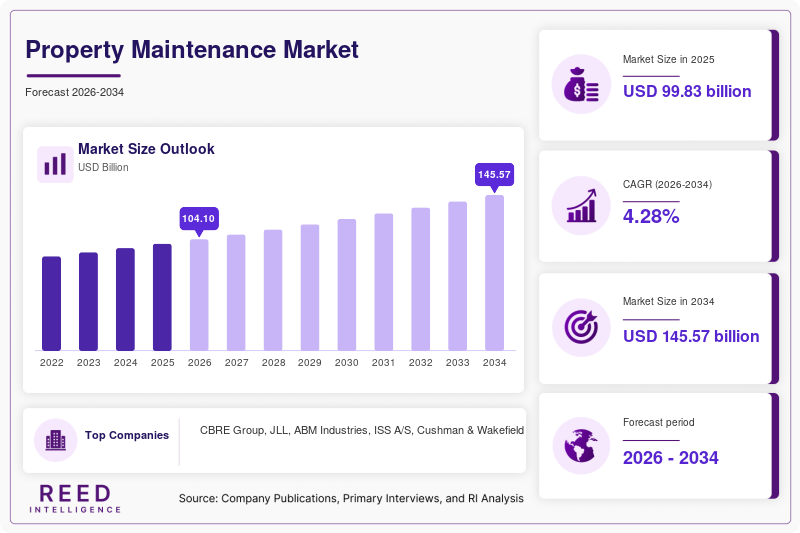
The global Property Maintenance Market size was valued at USD 99.83 billion in 2025 and is projected to grow from USD 104.10 billion in 2026 to USD 145.57 billion by 2034, registering a CAGR of 4.28% during the forecast period from 2026 to 2034.
Property maintenance is becoming a more integrated operating function as owners and occupiers face higher expectations around asset reliability, safety, energy performance, tenant experience and regulatory compliance. The market covers recurring activities such as cleaning, landscaping, HVAC servicing, electrical and plumbing work, building repairs, pest control, exterior maintenance and preventive inspections.
The demand base is broad because maintenance is required across residential buildings, offices, retail properties, industrial sites, healthcare facilities, educational campuses, hotels and public buildings. U.S. Bureau of Labor Statistics data shows that building and grounds cleaning and maintenance remains a large employment category, while janitors and building cleaners alone accounted for about 2.43 million U.S. jobs in 2025.
The commercial model is also moving from reactive repair toward planned and technology-enabled maintenance. JLL's 2025 facilities-management research found that 28% of organizations had already embedded AI into FM operations, rising to 46% among very large organizations, while more than half were applying technology and AI to automate workflows.
Property owners are simultaneously facing pressure to control operating costs. JLL's 2026 real-estate outlook identifies proactive maintenance, capital-expenditure management, operational efficiency and technology adoption as important cost-management tools.
Property Maintenance Market Drivers
Preventive Maintenance Is Replacing Reactive Property Management
Property owners increasingly have a financial reason to identify equipment problems before they become failures. HVAC breakdowns, water leaks, electrical faults and roof deterioration can disrupt tenants and create substantially larger repair bills than scheduled maintenance.
JLL's 2026 asset-management guidance specifically recommends preventive and predictive maintenance supported by computerized maintenance-management systems. These systems can track equipment, automate maintenance schedules and help extend asset life.
The same shift is visible in commercial property contracts. CBRE describes its operations-and-maintenance offering around technical talent, maintenance strategies, smart-enabled delivery and data-driven optimization of building operations.
The commercial mechanism is therefore changing from paying contractors primarily when something fails to paying for recurring inspections, scheduled servicing, condition monitoring and planned repairs. This creates more predictable revenue for maintenance providers and can improve asset availability for property owners.
Energy Efficiency and Building Renovation Are Increasing Maintenance Requirements
Energy performance is increasingly connected to property maintenance because HVAC systems, controls, lighting, insulation, plumbing and building envelopes directly influence operating costs. The EU's revised Energy Performance of Buildings Directive entered into force in 2024 and had a general national-transposition deadline of May 29, 2026. It specifically targets renovation of poorly performing buildings and requires national building-renovation plans.
The directive also creates a connection between maintenance and renovation: properties undergoing upgrades need inspection, equipment replacement, commissioning and continuing maintenance.
In the U.S., DOE continues to maintain federal building energy-efficiency standards covering new construction and major renovations, while federal agencies have ongoing energy and water reporting requirements.
For maintenance companies, this expands the addressable service mix from basic repairs into HVAC optimization, controls, energy monitoring, retrofit support and lifecycle asset management.
Outsourcing Is Expanding the Role of Integrated Property-Service Providers
Property owners increasingly use external providers to combine multiple services under one contract. JLL's 2025 FM research found that strategic partnerships and integrated capabilities are becoming important provider-selection criteria, while 78% of surveyed organizations identified a strategic partnership with deep understanding of their business as the top selection criterion.
Recent contracts illustrate the mechanism. In May 2026, JLL was selected by Airbus to provide facilities-management services across a 4.3-million-square-foot U.S. portfolio, including HVAC, electrical and plumbing maintenance.
Similarly, Siemens Healthineers selected JLL in March 2026 for integrated facilities management across 5.3 million square feet in the U.S. and Canada, covering engineering, HVAC, electrical, elevators, fire and life safety, janitorial, landscaping and grounds maintenance.
This increases the role of large providers that can coordinate multiple specialist contractors and manage service-level agreements across portfolios.
Property Maintenance Market Restraints
Labor Availability and Wage Pressure Limit Service Capacity
Property maintenance remains labor intensive. Building cleaning, landscaping, repair work and specialist maintenance require workers on site, and many tasks cannot be fully automated.
BLS projects about 730,600 annual openings across U.S. building and grounds cleaning occupations through 2035, largely because of employment growth and replacement of workers leaving the occupations.
The maintenance workforce also has substantial training requirements. BLS found that on-the-job training was required for 87.8% of building and grounds cleaning and maintenance workers in 2024.
This creates a cost and scalability constraint. Providers must recruit, train, schedule and retain technicians while maintaining service-level commitments. Digital work-order systems can improve productivity, but they do not remove the need for physical labor in most property-maintenance activities.
Fragmented Property Portfolios Make Standardization Difficult
Property maintenance varies considerably according to building age, construction type, equipment, tenant requirements and local regulations. A single service model rarely works equally well for an apartment complex, hospital, warehouse, shopping center and office campus.
JLL reported in September 2026 that organizations were managing an average of 17 different technology platforms across real-estate operations, including separate systems for maintenance tracking and other workplace functions. The fragmentation can create duplicated data and additional administrative work.
The result is a market where providers must integrate legacy systems, contractor networks and property-level processes. This raises implementation costs and can slow adoption of predictive maintenance and AI-based workflows.
Property Maintenance Market Opportunities
Predictive Maintenance and AI-Enabled Property Operations
Technology is creating an opportunity to shift maintenance from scheduled or reactive work toward condition-based intervention. JLL recommends using AI in areas such as performance tracking, predictive maintenance and work-order management, while ABM's 2026 facilities research identifies predictive maintenance as a mechanism for turning facilities into data-driven assets.
Sensors can monitor temperature, vibration, energy use, water flow and equipment conditions. Maintenance software can then convert those signals into work orders.
The commercial benefit is reduced downtime, better technician scheduling and longer asset life. Providers able to combine physical maintenance with software, sensors and analytics can move toward higher-value recurring contracts.
Energy and Sustainability Maintenance Services
Building owners increasingly need maintenance providers that can improve energy performance without disrupting occupants. The EU building-performance framework is increasing attention on renovation and energy performance, while CBRE emphasizes data-driven optimization of building operations to reduce energy consumption and emissions.
This creates demand for HVAC tuning, building-automation maintenance, lighting controls, energy monitoring, equipment commissioning and water-efficiency services.
The opportunity is especially relevant for large commercial buildings, industrial facilities, hospitals, data centers and institutional campuses where small efficiency improvements can have material operating-cost effects.
Integrated Multi-Service Contracts
Large property owners can reduce administrative complexity by purchasing multiple services from one provider. JLL's Airbus and Siemens Healthineers contracts demonstrate this model, combining engineering, HVAC, electrical, cleaning, landscaping and other services under integrated FM arrangements.
This creates an opportunity for providers to increase contract value through cross-selling. A company initially hired for janitorial work can add landscaping, pest control, HVAC maintenance, energy management and emergency-response services.
The model also increases customer retention because changing suppliers becomes more complicated when multiple property functions are integrated into one contract.
Segmental Analysis
By Service Type
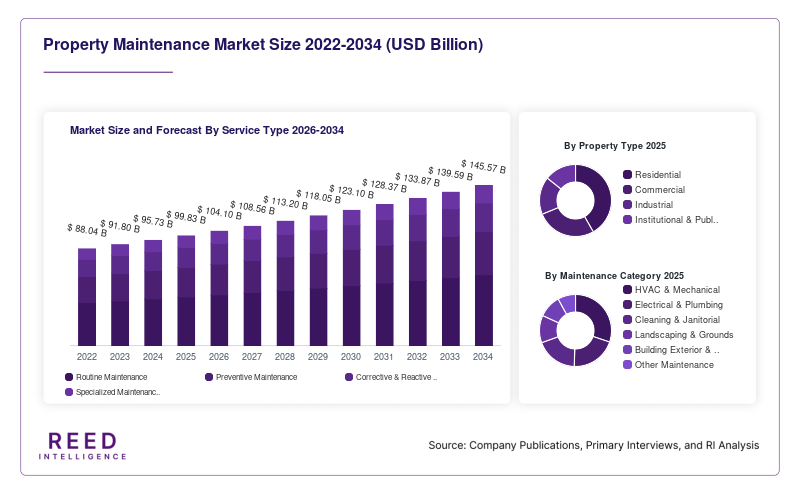
Routine Maintenance represents approximately 31% of the global market in 2025. It includes recurring cleaning, landscaping, inspections, filter replacement, minor repairs and other scheduled property tasks. Its predictable nature makes it a core component of recurring maintenance contracts.
Preventive Maintenance accounts for approximately 29% and is the fastest-growing service type, with a CAGR of approximately 5.6%. The shift toward preventive maintenance is supported by property owners seeking longer equipment life, fewer operational interruptions and greater control over maintenance budgets. JLL specifically identifies preventive and predictive maintenance as core applications for modern computerized maintenance-management systems.
Corrective & Reactive Maintenance represents approximately 25%, while Specialized Maintenance accounts for 15%. Corrective work remains necessary, but its share is constrained as large property portfolios increasingly use planned maintenance programs.
By Property Type
Commercial Properties represent approximately 37% of the market in 2025. Offices, retail centers, hospitality properties and mixed-use assets require continuous maintenance because tenant experience, safety and building availability directly influence asset performance.
Residential Properties account for approximately 32%, supported by apartment buildings, multifamily portfolios, homeowners and rental properties.
Industrial Properties represent approximately 18%, while Institutional & Public Properties account for approximately 13%.
Industrial Properties are the fastest-growing property segment, with approximately 5.3% CAGR, supported by warehouses, manufacturing facilities, logistics infrastructure and technically demanding buildings. CBRE reports increasing facilities-management activity across industrial, logistics, infrastructure and data-center environments.
By Maintenance Category
Cleaning & Janitorial represents approximately 28% of the market in 2025. Cleaning is a high-frequency service and is required across nearly all property categories.
HVAC & Mechanical accounts for approximately 23%, followed by Electrical & Plumbing at 19%, Landscaping & Grounds at 16%, Building Exterior & Structural at 9%, and other maintenance at 5%.
HVAC & Mechanical is the fastest-growing category, with approximately 5.8% CAGR. The segment benefits from energy-efficiency requirements, equipment aging, preventive maintenance and demand for indoor environmental quality. EPA identifies HVAC maintenance as one of the building-system factors affecting indoor air quality.
By Service Provider
Facility Management Companies represent approximately 36% of the market in 2025. Integrated providers can coordinate multiple maintenance functions and increasingly combine physical services with technology and analytics.
Specialized Contractors account for approximately 29%, particularly for HVAC, electrical, plumbing, roofing, elevators and other technical work.
Property Management Companies represent approximately 21%, while In-House Maintenance Teams account for 14%.
Facility Management Companies are the fastest-growing provider segment, with approximately 6.0% CAGR, as property owners increasingly outsource multi-service portfolios. JLL, CBRE and other major providers are expanding integrated FM offerings across commercial, healthcare, industrial and other property categories.
By Property Ownership
Rented & Leased Properties represent approximately 44% of the market in 2025 because landlords and property managers have ongoing responsibility for maintaining common areas, building systems and tenant-facing services.
Institutional & Managed Properties account for approximately 31%, covering healthcare, education, government, hospitality and other managed portfolios.
Owner-Occupied Properties represent approximately 25%.
Institutional & Managed Properties are the fastest-growing ownership segment, with approximately 5.2% CAGR, supported by increasing outsourcing and the operational complexity of large campuses.
Regional Analysis
North America Property Maintenance Market
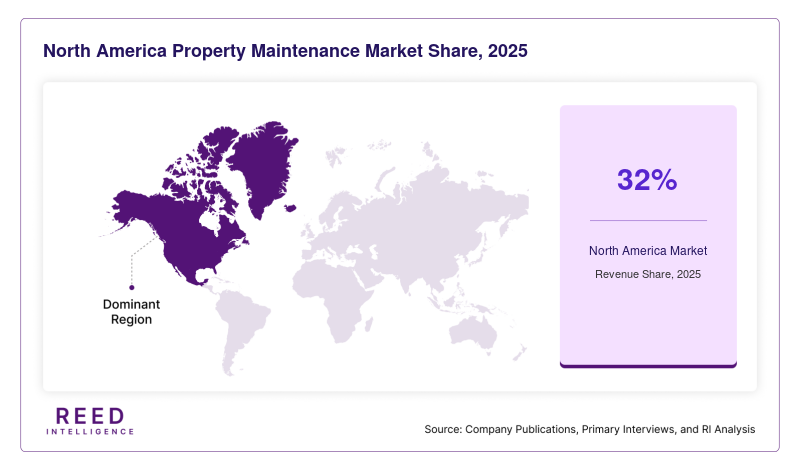
North America represents approximately 32% of the global Property Maintenance Market in 2025. The region benefits from a large commercial property base, mature outsourcing practices, established facility-management companies and substantial demand for technical building services.
CBRE's operations-and-maintenance platform covers building operations, technical maintenance, smart-enabled facilities and sustainability optimization across sectors including data centers, healthcare, industrial and logistics.
The U.S. also has a large maintenance workforce. BLS reported 2.43 million janitors and building cleaners in 2025 and approximately 1.3 million grounds-maintenance workers.
North America is projected to grow at approximately 3.9% CAGR through 2034. Commercial, healthcare, industrial and data-center properties provide strong technical-maintenance demand.
The region's main constraint is labor availability. Replacement demand accounts for a substantial portion of projected building-maintenance job openings, increasing pressure on service providers to automate scheduling and improve technician productivity.
Europe Property Maintenance Market
Europe accounts for approximately 28% of the global market in 2025. Property maintenance demand is increasingly connected with energy performance and building renovation.
The revised EU Energy Performance of Buildings Directive requires member states to develop national building-renovation plans and focuses particularly on poorly performing buildings. The general deadline for national transposition was May 29, 2026.
This creates additional work for maintenance and building-service providers covering HVAC systems, insulation, controls, lighting, ventilation and building envelopes. Public buildings are also included within the EU's renovation framework.
Europe is projected to grow at approximately 4.1% CAGR. The market is supported by energy-efficiency upgrades and mature property-management outsourcing, although labor costs and fragmented national regulations can increase service costs.
APAC Property Maintenance Market
APAC represents approximately 24% of the global market in 2025 and is the fastest-growing region, with a CAGR of approximately 6.1%.
The region combines rapid commercial development with large residential and mixed-use property portfolios. India, China, Japan, Singapore, Australia and Southeast Asia are developing increasingly sophisticated property-management and facilities-management ecosystems.
JLL's India research highlights the use of automation, predictive maintenance, real-time monitoring, smart sensors and building automation to improve property-management efficiency and energy performance.
The outsourcing model is also becoming more structured. CBRE's 2026 India facilities-management roles cover building operations, preventive and breakdown maintenance across civil, electrical, mechanical, HVAC, plumbing and fire/life-safety systems, illustrating the breadth of professional property-maintenance services being managed within commercial portfolios.
APAC's growth mechanism therefore combines new property construction with professionalization of existing-building operations.
The main constraints are fragmented supplier markets, varying regulations, uneven technician skills and differences in maintenance spending between developed and developing markets.
Middle East and Africa Property Maintenance Market
Middle East and Africa represents approximately 7% of the global market in 2025 and is projected to grow at approximately 5.0% CAGR.
Demand is supported by commercial developments, hotels, shopping centers, residential communities, airports, healthcare facilities and large-scale infrastructure projects. The region's climate also increases requirements for HVAC maintenance, cooling systems, landscaping and building-envelope management.
Integrated facility-management models are particularly relevant to large developments because owners can consolidate cleaning, security, technical maintenance, landscaping and specialist services.
The market's growth is constrained by dependence on skilled technical workers, extreme operating environments and differences in property-maintenance standards between countries.
LATAM Property Maintenance Market
LATAM accounts for approximately 9% of the global market in 2025 and is expected to expand at approximately 4.7% CAGR.
Commercial real estate, residential developments, retail properties, industrial facilities and hospitality assets provide the principal demand base. Large cities are also creating opportunities for professional property managers and outsourced maintenance providers.
The region's commercial mechanism is gradual formalization: property owners increasingly use specialized contractors and integrated service providers instead of coordinating multiple small maintenance vendors independently.
Digital work-order systems can help providers manage geographically dispersed properties and improve service-level tracking. The principal constraints remain currency volatility, fragmented supplier networks and uneven adoption of professional facility-management practices.
Competitive Landscape
The Property Maintenance Market is highly fragmented at the local level but increasingly consolidated around large integrated facility-management providers for major commercial portfolios. Competition is based on service breadth, technician availability, geographic coverage, response time, cost, technology, compliance and the ability to manage multiple contractors.
CBRE operates one of the largest global facilities-management workforces, reporting more than 65,000 team members and 2.2 billion square feet of space managed globally. Its operations-and-maintenance offering combines technical services, technology, sustainability and sector-specific solutions.
JLL is expanding integrated FM through large portfolio contracts. Its May 2026 Airbus agreement covers 4.3 million square feet and combines HVAC, electrical and plumbing maintenance with broader facilities services. Its March 2026 Siemens Healthineers agreement covers 5.3 million square feet and combines technical maintenance with janitorial, landscaping and life-safety services.
Key Market Players
- CBRE Group
- JLL
- ABM Industries
- ISS A/S
- Cushman & Wakefield
- Sodexo
- Mitie Group
- EMCOR Group
- Cintas
- ServiceMaster Brands
- Rentokil Initial
- BrightView
- Compass Group
- OCS Group
- Atalian Global Services
Recent Market Developments
- September 2026 – JLL highlighted technology fragmentation in real estate operations. Its research found that organizations were managing an average of 17 technology platforms across real estate operations, reinforcing demand for integrated maintenance and property-management systems.
- September 2026 – ABM highlighted AI-enabled facility operations. ABM reported that 28% of organizations had embedded AI in facility operations and emphasized the need to convert building data into automated corrective actions.
Property Maintenance Market Segments
By Service Type
- Routine Maintenance
- Preventive Maintenance
- Corrective & Reactive Maintenance
- Specialized Maintenance
By Property Type
- Residential
- Commercial
- Industrial
- Institutional & Public Properties
By Maintenance Category
- HVAC & Mechanical
- Electrical & Plumbing
- Cleaning & Janitorial
- Landscaping & Grounds
- Building Exterior & Structural
- Other Maintenance
By Service Provider
- In-House Maintenance Teams
- Property Management Companies
- Facility Management Companies
- Specialized Contractors
By Property Ownership
- Owner-Occupied
- Rented & Leased
- Institutional & Managed Properties
By Region
- North America
- Europe
- APAC
- Middle East and Africa
- LATAM