Propionic Acid Derivative Market Size, Share Demand Report By Type (Calcium Propionate, Sodium Propionate, Other Derivatives), By Application (Food Preservation, Pharmaceuticals, Agriculture, Chemical Intermediates), By End-Use (Food & Beverage Industry, Healthcare Industry, Agriculture & Animal Feed, Industrial Applications) & Segment Forecasts, 2025–2034
USD 3950
Market Overview
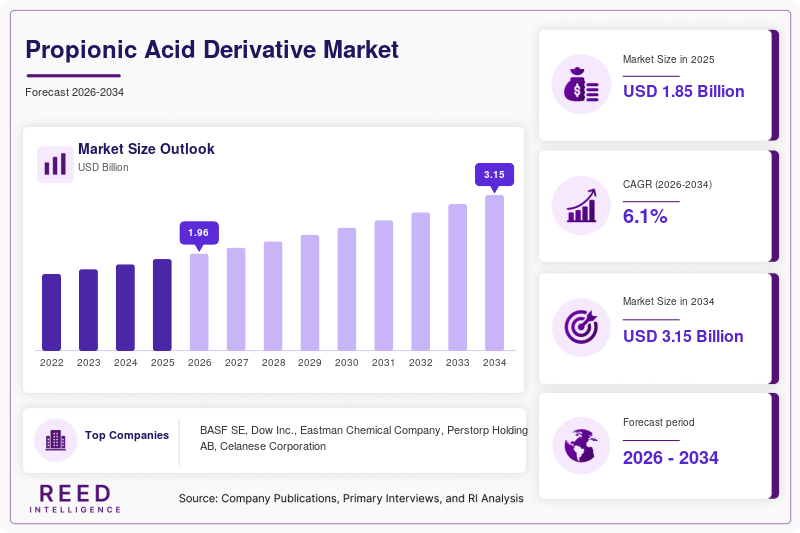
The Propionic Acid Derivative Market size was valued at approximately USD 1.85 billion in 2025 and is estimated to reach USD 1.96 billion in 2026. Over the forecast period from 2025 to 2034, the market is projected to grow at a compound annual growth rate (CAGR) of 6.1%, reaching nearly USD 3.18 billion by 2034. This growth reflects the rising adoption of propionic acid derivatives in various industrial and consumer applications.
One of the primary growth factors is the expanding use of propionates as preservatives in food and feed. These compounds help inhibit mold and bacterial growth, making them essential in extending shelf life and reducing food waste. Another key factor is the growing pharmaceutical sector, where propionic acid derivatives are widely used in drug formulations, particularly in non-steroidal anti-inflammatory drugs (NSAIDs). Additionally, the increasing demand for animal feed additives to enhance livestock productivity is further supporting market growth.
Key Highlights
- Market size reached USD 1.85 billion in 2025 and is projected to hit USD 3.18 billion by 2034, reflecting steady expansion across key end-use industries.
This growth is supported by increasing demand for preservatives and chemical intermediates in both developed and emerging markets. - The market is expected to grow at a CAGR of 6.1% during the forecast period (2025–2034), indicating consistent and sustainable development.
Rising industrial applications and expanding global supply chains are contributing to this stable growth trajectory. - Strong demand from food preservation and pharmaceutical sectors continues to drive market expansion globally.
These industries rely heavily on propionic acid derivatives for product stability, safety, and extended shelf life. - Rising use of propionates in animal feed applications is supporting market growth, particularly in livestock-intensive regions.
These additives help improve feed quality, prevent fungal contamination, and enhance overall animal productivity.
Market Trends
Increasing Adoption of Clean-Label Preservatives
The shift toward clean-label and natural food products is influencing the Propionic Acid Derivative Market significantly. Consumers are becoming more aware of ingredient transparency, leading manufacturers to explore naturally derived preservatives. Propionic acid derivatives, particularly calcium and sodium propionates, are being positioned as safer alternatives due to their established safety profiles and regulatory approvals. Food producers are reformulating products to align with clean-label standards, which is increasing the demand for these derivatives. This trend is especially visible in bakery and dairy segments, where shelf life extension is critical without compromising quality or consumer trust.
Expansion in Pharmaceutical Formulations
The growing pharmaceutical industry is driving increased use of propionic acid derivatives in drug manufacturing. These compounds serve as key intermediates in the production of active pharmaceutical ingredients, especially in anti-inflammatory medications. With the rise in chronic diseases and aging populations, the demand for such drugs is increasing globally. Additionally, advancements in drug delivery systems are encouraging the use of specialized chemical derivatives, including those derived from propionic acid. Pharmaceutical companies are investing in research to improve efficacy and stability, which is further boosting the demand for high-purity derivatives.
Market Drivers
Rising Demand for Food Preservation Solutions
The increasing consumption of processed and packaged foods is a major driver of the Propionic Acid Derivative Market. Urban lifestyles and busy schedules have led to higher reliance on ready-to-eat products, which require effective preservation methods. Propionic acid derivatives are widely used to prevent spoilage caused by mold and bacteria, particularly in baked goods and dairy products. Food manufacturers are prioritizing shelf life extension to reduce waste and improve supply chain efficiency. As global food production and distribution networks expand, the demand for reliable preservatives continues to grow, supporting market expansion.
Growth in Animal Feed Industry
The global livestock industry is expanding rapidly, driven by increasing demand for meat and dairy products. Propionic acid derivatives play a crucial role as feed additives, helping to improve animal health and prevent fungal contamination in stored feed. These compounds enhance feed quality and contribute to better productivity in livestock farming. With rising awareness about food safety and animal nutrition, farmers and feed producers are adopting advanced additives. Government initiatives promoting efficient livestock management are also encouraging the use of such derivatives, thereby driving market growth.
Market Restraint
Fluctuating Raw Material Prices and Regulatory Challenges
One of the key restraints affecting the Propionic Acid Derivative Market is the volatility in raw material prices. The production of propionic acid derivatives depends on petrochemical feedstocks, which are subject to price fluctuations due to changes in crude oil markets. This volatility impacts manufacturing costs and profit margins for producers. In addition, stringent regulatory frameworks governing food additives and chemical usage create compliance challenges for manufacturers. Different regions have varying safety standards, requiring companies to invest in testing and certification processes. For example, regulatory restrictions in certain European countries on chemical preservatives can limit market expansion. These factors collectively pose challenges to consistent growth and operational efficiency.
Market Opportunities
Expansion in Emerging Economies
Emerging economies present significant growth opportunities for the Propionic Acid Derivative Market. Rapid urbanization, rising disposable incomes, and changing dietary habits are increasing the demand for processed foods and pharmaceuticals in regions such as Asia Pacific and Latin America. Governments in these regions are also investing in food safety infrastructure and healthcare systems, which supports the adoption of propionic acid derivatives. Local manufacturers are entering the market, creating competitive dynamics and expanding supply chains. This growth potential is attracting global players to invest in production facilities and distribution networks in emerging markets.
Development of Bio-Based Derivatives
The shift toward sustainability is opening new avenues for the development of bio-based propionic acid derivatives. Manufacturers are exploring renewable feedstocks and green chemistry processes to reduce environmental impact. Bio-based derivatives offer similar functional properties while aligning with regulatory and consumer preferences for eco-friendly products. Research and development efforts are focused on improving production efficiency and cost-effectiveness of these alternatives. As environmental regulations become stricter, the adoption of sustainable solutions is expected to increase, creating long-term growth opportunities for market participants.
Segmental Analysis
By Type
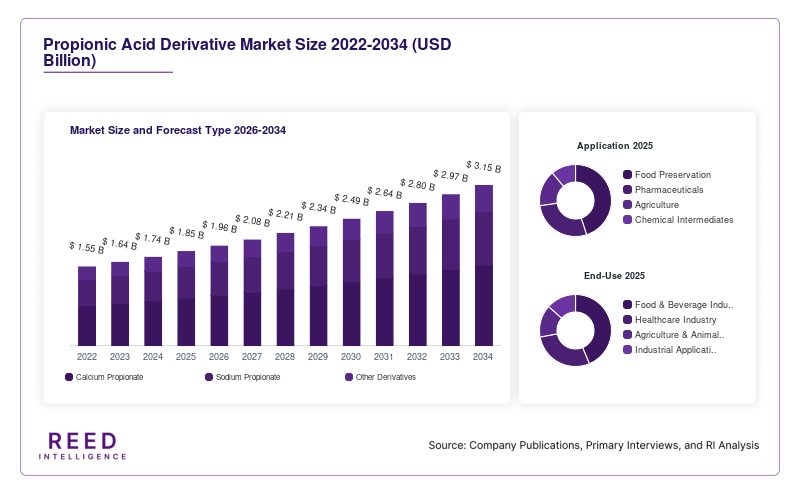
The calcium propionate segment dominated the market in 2024, accounting for approximately 38% of the total share. This dominance is attributed to its widespread use as a food preservative, particularly in bakery products. Calcium propionate is effective in inhibiting mold growth, making it a preferred choice for extending shelf life. Its cost-effectiveness and regulatory approval across multiple regions further support its extensive adoption. Food manufacturers rely on this compound to maintain product quality and reduce spoilage, especially in high-moisture environments.
The sodium propionate segment is expected to be the fastest-growing, with a CAGR of 6.8% during the forecast period. This growth is driven by its increasing use in pharmaceuticals and specialty chemicals. Sodium propionate offers better solubility and stability compared to other derivatives, making it suitable for various industrial applications. The rising demand for advanced chemical formulations and improved processing techniques is contributing to the expansion of this segment.
By Application
The food preservation segment held the largest share of around 45% in 2024, driven by the widespread use of propionic acid derivatives in bakery and dairy products. These compounds play a critical role in preventing microbial growth and ensuring product safety. The growing demand for packaged foods and extended shelf life is supporting the dominance of this segment. Manufacturers are focusing on maintaining quality while reducing waste, which further increases the use of preservatives.
The pharmaceuticals segment is projected to grow at the fastest CAGR of 7.0%. This growth is attributed to the increasing use of propionic acid derivatives in drug formulations and active ingredients. The rising prevalence of chronic diseases and advancements in healthcare infrastructure are driving demand for pharmaceutical products. Research and development activities are also contributing to the adoption of these derivatives in innovative drug formulations.
By End-Use
The food and beverage industry dominated the market in 2024, accounting for approximately 42% of the total share. This dominance is driven by the extensive use of propionic acid derivatives as preservatives in processed foods. The industry relies on these compounds to ensure safety and extend shelf life, particularly in bakery and dairy products. Increasing consumer demand for convenience foods is further supporting the growth of this segment.
The agriculture and animal feed segment is expected to grow at the fastest CAGR of 6.9%. This growth is driven by the rising demand for high-quality feed additives to improve livestock health and productivity. Propionic acid derivatives help prevent fungal contamination and enhance feed efficiency. The expansion of the livestock industry and increasing focus on food safety are key factors contributing to the growth of this segment.
Regional Analysis
North America
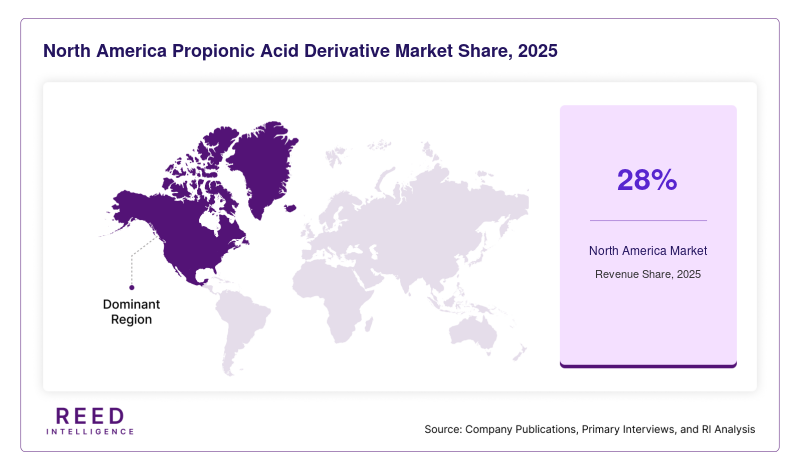
North America accounted for approximately 28% of the Propionic Acid Derivative Market share in 2025 and is expected to grow at a CAGR of 5.8% during the forecast period. The region benefits from a well-established food processing industry and advanced pharmaceutical sector. Strong demand for preservatives and feed additives is driving market growth, supported by technological advancements and high consumer awareness regarding food safety.
The United States dominates the regional market due to its large-scale food production and pharmaceutical manufacturing capabilities. A unique growth factor is the increasing adoption of clean-label products, which is encouraging the use of approved preservatives such as propionates. The presence of leading chemical manufacturers further strengthens the market landscape.
Europe
Europe held around 24% of the market share in 2025 and is projected to grow at a CAGR of 5.5%. The region’s strict regulatory framework ensures high-quality standards for food additives and pharmaceuticals. This has led to consistent demand for reliable and safe propionic acid derivatives across various applications.
Germany is a key contributor to the European market, driven by its strong chemical manufacturing base. A unique growth factor is the region’s emphasis on sustainability, which is encouraging the development of bio-based derivatives. Companies are investing in green technologies to meet regulatory requirements and consumer expectations.
Asia Pacific
Asia Pacific accounted for the largest share of approximately 32% in 2025 and is expected to grow at a CAGR of 7.2%. Rapid industrialization, urbanization, and population growth are driving demand for processed food and pharmaceuticals. The region is emerging as a major production hub for chemical derivatives.
China leads the market in Asia Pacific due to its large-scale manufacturing capabilities and expanding food industry. A unique growth factor is the increasing investment in livestock farming, which is boosting demand for feed additives. Government initiatives supporting industrial growth are also contributing to market expansion.
Middle East & Africa
The Middle East & Africa region held about 8% of the market share in 2025 and is projected to grow at a CAGR of 5.3%. The market is driven by increasing demand for food preservation solutions and gradual development of the pharmaceutical sector.
Saudi Arabia is a dominant country in this region, supported by investments in food processing and chemical industries. A unique growth factor is the growing focus on food security, which is encouraging the use of preservatives to reduce waste and improve storage efficiency.
Latin America
Latin America accounted for approximately 8% of the market share in 2025 and is expected to grow at a CAGR of 5.9%. The region is experiencing steady growth due to rising demand for processed foods and agricultural products.
Brazil dominates the market in Latin America, driven by its large agricultural sector. A unique growth factor is the increasing use of propionic acid derivatives in animal feed to enhance livestock productivity. This trend is supported by expanding meat exports and improving farming practices.
Competitive Landscape
The Propionic Acid Derivative Market is moderately fragmented, with several global and regional players competing based on product quality, pricing, and innovation. Leading companies are focusing on expanding their production capacities and strengthening their distribution networks. Strategic partnerships and acquisitions are common as companies aim to enhance their market presence.
BASF SE is recognized as a leading player in the market, owing to its extensive product portfolio and strong global presence. The company recently announced an expansion of its production facility to meet growing demand for food-grade preservatives. Other major players are also investing in research and development to introduce advanced and sustainable products.
Competition is further intensified by the entry of new players in emerging markets, which is increasing supply and driving innovation. Companies are also adopting digital technologies to optimize production processes and improve efficiency.
Key Players List
- BASF SE
- Dow Inc.
- Eastman Chemical Company
- Perstorp Holding AB
- Celanese Corporation
- Corbion N.V.
- Macco Organiques Inc.
- A.M. Food Chemical Co., Ltd.
- Niacet Corporation
- Krishna Chemicals
- Kemin Industries
- Impextraco NV
- ADDCON GmbH
- Tokyo Chemical Industry Co., Ltd.
- Prathista Industries Limited
Recent Developments
- BASF SE expanded its propionic acid derivative production capacity in 2024 to cater to rising demand in North America and Europe.
- Perstorp Holding AB introduced a new line of sustainable, bio-based propionate products aimed at reducing environmental impact.
- Eastman Chemical Company invested in advanced manufacturing technologies to improve efficiency and reduce production costs in 2025.
Propionic Acid Derivative Market Segments
Type
- Calcium Propionate
- Sodium Propionate
- Other Derivatives
Application
- Food Preservation
- Pharmaceuticals
- Agriculture
- Chemical Intermediates
End-Use
- Food & Beverage Industry
- Healthcare Industry
- Agriculture & Animal Feed
- Industrial Applications
By Region
- North America
- Europe
- APAC
- Middle East and Africa
- LATAM