Propyl Acetate Market Size, Share & Demand Report By Type (Industrial Grade, Pharmaceutical Grade), By Application (Coatings, Adhesives, Printing Inks, Others), By End-Use Industry (Paints and Coatings, Packaging, Pharmaceuticals, Automotive, Others) By Region & Segment Forecasts, 2026–2034
USD 3950
Market Overview
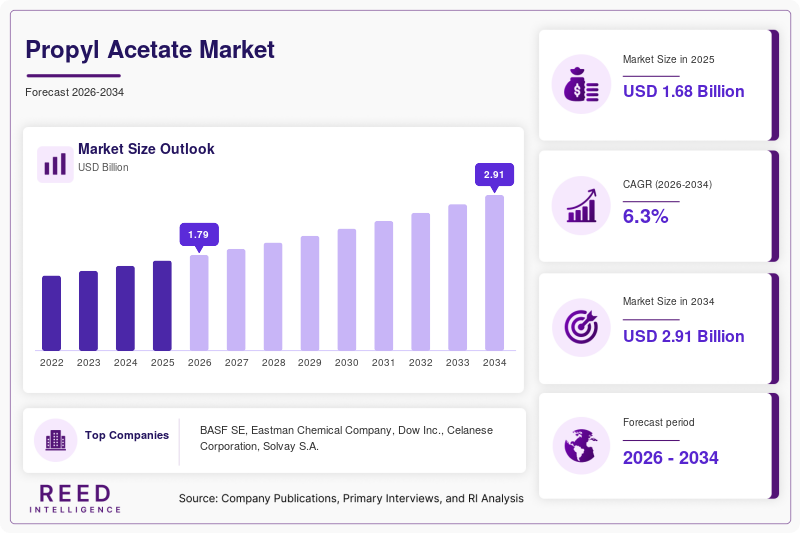
The global Propyl Acetate Market size was valued at approximately USD 1.68 billion in 2026 and is projected to reach around USD 2.74 billion by 2034, expanding at a compound annual growth rate (CAGR) of 6.3% during the forecast period from 2026 to 2034. Propyl acetate, a widely used solvent in coatings, inks, adhesives, and pharmaceuticals, has witnessed stable demand due to its favorable properties such as low toxicity, pleasant odor, and efficient solvency. The market is increasingly benefiting from the rising demand for eco-friendly and low-VOC (volatile organic compound) solvents, particularly in developed regions where environmental regulations are becoming stricter.
One of the key global factors supporting market growth is the ongoing expansion of the paints and coatings industry, driven by rapid urbanization, infrastructure development, and industrial production. As construction activities increase worldwide, the need for high-performance coatings and inks has surged, consequently boosting the consumption of propyl acetate as a solvent. Additionally, advancements in printing technologies and packaging solutions have further strengthened demand across emerging economies.
Key Highlights
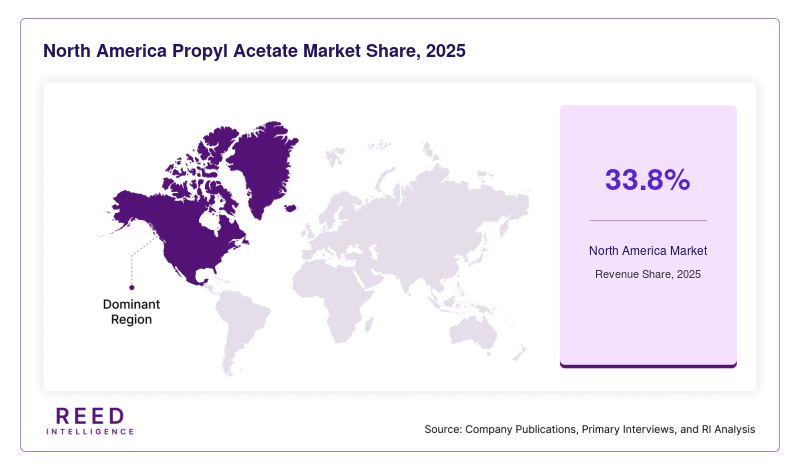
- North America dominated the market with a 33.8% share in 2025.
- Asia Pacific is expected to grow at the fastest CAGR of 7.4% during 2026–2034.
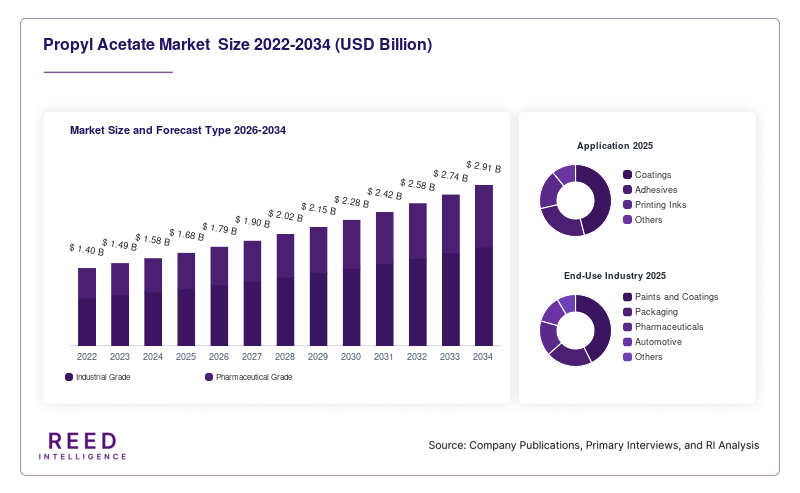
- By type, industrial grade accounted for the largest share of 61.2%, while pharmaceutical grade is projected to grow at a CAGR of 7.1%.
- By application, coatings led with a 42.5% share, whereas adhesives are expected to expand at a CAGR of 6.9%.
- The United States remained the dominant country, with market values of USD 410 million in 2024 and USD 445 million in 2025.
Market Trends
Rising Adoption of Low-VOC Solvents Across Industrial Applications
A notable trend shaping the Propyl Acetate Market is the increasing adoption of low-VOC solvents across industries such as paints, coatings, and adhesives. Regulatory authorities worldwide are implementing stringent environmental standards aimed at reducing air pollution and occupational hazards. As a result, manufacturers are shifting toward solvents like propyl acetate, which offer lower toxicity and reduced environmental impact compared to traditional alternatives. This transition is particularly evident in North America and Europe, where compliance with emission norms is mandatory. Additionally, consumer awareness regarding sustainable products is encouraging companies to reformulate their offerings, further driving the demand for propyl acetate in eco-friendly product formulations.
Growth in Flexible Packaging and Printing Ink Demand
Another significant trend influencing the market is the expansion of the flexible packaging sector and its associated demand for high-performance printing inks. Propyl acetate is widely used in printing ink formulations due to its excellent solvency and quick evaporation properties, which enhance print quality and drying time. The rapid growth of e-commerce, food delivery services, and consumer goods packaging has led to increased consumption of flexible packaging materials, particularly in Asia Pacific and Latin America. This surge is directly contributing to the higher utilization of propyl acetate in ink production, making it a critical component in modern packaging solutions.
Market Drivers
Expansion of the Paints and Coatings Industry
The robust growth of the global paints and coatings industry is a major driver for the Propyl Acetate Market. Increasing construction activities, infrastructure development projects, and automotive production are generating strong demand for coatings that require efficient solvents. Propyl acetate plays a vital role in enhancing the performance and application properties of coatings, including improved flow, leveling, and drying characteristics. In emerging economies, rising disposable incomes and urbanization are further stimulating residential and commercial construction, thereby boosting demand for coatings. This widespread application across industries ensures a consistent consumption pattern for propyl acetate.
Increasing Demand from the Pharmaceutical Sector
The pharmaceutical industry is another key driver contributing to the growth of the Propyl Acetate Market. The compound is used as a solvent and intermediate in the synthesis of various pharmaceutical products due to its favorable chemical properties. With the global healthcare sector expanding rapidly, particularly in developing regions, the demand for pharmaceutical-grade solvents has increased significantly. Moreover, the rising prevalence of chronic diseases and the need for advanced drug formulations are encouraging pharmaceutical manufacturers to invest in high-quality raw materials. This trend is expected to sustain the demand for propyl acetate over the forecast period.
Market Restraint
Volatility in Raw Material Prices and Supply Chain Constraints
One of the primary restraints affecting the Propyl Acetate Market is the volatility in raw material prices, particularly propanol and acetic acid, which are derived from petrochemical sources. Fluctuations in crude oil prices directly impact the cost structure of propyl acetate production, creating uncertainty for manufacturers and end users. Additionally, supply chain disruptions caused by geopolitical tensions, transportation challenges, or regulatory restrictions can further exacerbate pricing instability. For instance, sudden increases in feedstock costs may lead to reduced profit margins for manufacturers or higher product prices for consumers, potentially limiting market growth. Smaller manufacturers are especially vulnerable to these fluctuations, as they may lack the financial flexibility to absorb cost variations.
Market Opportunities
Emerging Demand in Bio-Based Solvent Development
A promising opportunity in the Propyl Acetate Market lies in the development of bio-based solvents. With increasing emphasis on sustainability and environmental responsibility, companies are investing in the production of propyl acetate derived from renewable resources. Bio-based variants offer similar performance characteristics while reducing dependence on fossil fuels and minimizing carbon emissions. This shift is gaining traction among manufacturers aiming to align with green chemistry principles and regulatory requirements. As industries continue to prioritize sustainable solutions, the demand for bio-based propyl acetate is expected to create new growth avenues for market participants.
Expansion in Emerging Economies and Industrial Growth
The rapid industrialization and economic growth in emerging markets present significant opportunities for the Propyl Acetate Market. Countries in Asia Pacific, Latin America, and parts of Africa are experiencing increased investments in manufacturing, construction, and packaging industries. This expansion is driving demand for solvents used in coatings, adhesives, and inks. Additionally, government initiatives supporting industrial development and infrastructure projects are further boosting market growth. As these regions continue to develop, the consumption of propyl acetate is expected to rise, offering lucrative opportunities for both local and international manufacturers.
Segmental Analysis
By Type
The industrial-grade segment dominated the Propyl Acetate Market in 2024, accounting for a share of approximately 61.2%. This dominance can be attributed to its widespread use in applications such as coatings, inks, and adhesives. Industrial-grade propyl acetate offers cost-effective performance and is suitable for large-scale manufacturing processes. Its compatibility with various formulations makes it a preferred choice among manufacturers, particularly in industries where high volumes of solvents are required. Additionally, the growth of construction and packaging industries has further strengthened the demand for industrial-grade propyl acetate.
The pharmaceutical-grade segment is expected to witness the fastest growth, with a projected CAGR of 7.1% during the forecast period. This growth is driven by the increasing demand for high-purity solvents in pharmaceutical applications. Pharmaceutical-grade propyl acetate is used in drug synthesis and formulation processes, where quality and consistency are critical. The expansion of the global pharmaceutical industry, along with rising investments in healthcare, is fueling the demand for this segment. Moreover, stringent quality standards and regulatory requirements are encouraging the adoption of high-grade solvents.
By Application
The coatings segment held the largest share of 42.5% in 2024, driven by the extensive use of propyl acetate as a solvent in paints and coatings formulations. Its ability to improve flow, leveling, and drying properties makes it an essential component in coatings. The growth of construction and automotive industries has significantly increased the demand for coatings, thereby boosting the consumption of propyl acetate. Additionally, the trend toward eco-friendly coatings has further supported the adoption of low-VOC solvents.
The adhesives segment is projected to grow at the fastest CAGR of 6.9% during the forecast period. The increasing demand for adhesives in packaging, construction, and automotive industries is driving this growth. Propyl acetate is used as a solvent in adhesive formulations, enhancing their performance and application efficiency. The rise of flexible packaging and the growing need for durable bonding solutions are key factors contributing to the expansion of this segment.
By End-Use Industry
The paints and coatings industry dominated the Propyl Acetate Market in 2024, accounting for a significant share due to the high consumption of solvents in coating formulations. The industry’s growth is driven by increasing construction activities and infrastructure development worldwide. Propyl acetate plays a crucial role in enhancing the performance of coatings, making it a preferred solvent for manufacturers. The shift toward environmentally friendly coatings has further increased its demand.
The packaging industry is expected to be the fastest-growing end-use segment, with a CAGR of 6.8% during the forecast period. The rapid growth of e-commerce and consumer goods industries has led to increased demand for packaging materials. Propyl acetate is widely used in printing inks and adhesives for packaging applications. Its properties, such as quick drying and strong solvency, make it ideal for high-speed printing processes. This growth is expected to continue as packaging demand rises globally.
Regional Analysis
North America
North America accounted for a significant share of approximately 33.8% of the Propyl Acetate Market in 2025 and is projected to maintain steady growth with a CAGR of 5.6% during the forecast period. The region’s well-established industrial base, coupled with stringent environmental regulations, has encouraged the adoption of low-VOC solvents such as propyl acetate. The presence of major manufacturers and advanced technological capabilities further supports market growth.
The United States dominates the regional market due to its strong paints and coatings and pharmaceutical industries. A unique growth factor in this region is the increasing adoption of sustainable manufacturing practices, which has led to higher demand for environmentally friendly solvents. Additionally, continuous investments in research and development are fostering innovation in solvent applications.
Europe
Europe held a market share of around 27.4% in 2025 and is expected to grow at a CAGR of 5.9% through 2034. The region’s focus on environmental sustainability and strict regulatory framework has driven the adoption of eco-friendly solvents. Industries such as automotive coatings and packaging are key contributors to the demand for propyl acetate in Europe.
Germany leads the European market, supported by its strong industrial and manufacturing sectors. A unique growth factor is the region’s emphasis on circular economy practices, which encourages the use of sustainable and recyclable materials. This approach has increased the demand for propyl acetate in environmentally compliant formulations.
Asia Pacific
Asia Pacific is the fastest-growing region in the Propyl Acetate Market, with a projected CAGR of 7.4% during the forecast period and a market share of 24.6% in 2025. Rapid industrialization, urbanization, and increasing consumer demand are driving market growth. The expanding construction and packaging industries are major contributors to the rising demand for propyl acetate.
China dominates the regional market due to its large manufacturing base and high demand for solvents in coatings and inks. A unique growth factor is the region’s booming e-commerce sector, which has significantly increased the demand for flexible packaging and printing inks, thereby boosting propyl acetate consumption.
Middle East & Africa
The Middle East & Africa region accounted for a smaller share of 7.2% in 2025 but is expected to grow at a CAGR of 6.1% during the forecast period. The region’s growth is supported by increasing investments in construction and industrial projects. The demand for coatings and adhesives is rising, contributing to the growth of the propyl acetate market.
Saudi Arabia is a key market in this region, driven by large-scale infrastructure projects and economic diversification initiatives. A unique growth factor is the increasing focus on industrial development under national vision programs, which is boosting the demand for solvents in various applications.
Latin America
Latin America held a market share of approximately 7.0% in 2025 and is projected to grow at a CAGR of 6.3% through 2034. The region’s growing manufacturing and packaging industries are key drivers of market growth. Increasing consumer demand for packaged goods is also contributing to the rising use of propyl acetate.
Brazil dominates the regional market due to its expanding industrial sector. A unique growth factor is the growth of the food and beverage packaging industry, which has increased the demand for printing inks and adhesives, thereby driving the consumption of propyl acetate.
Competitive Landscape
The Propyl Acetate Market is moderately consolidated, with several key players competing based on product quality, pricing, and innovation. Leading companies are focusing on expanding their production capacities and investing in research and development to enhance product performance and sustainability. Strategic partnerships, mergers, and acquisitions are also common as companies aim to strengthen their market presence.
A leading player in the market is BASF SE, which has maintained a strong position due to its extensive product portfolio and global presence. The company recently invested in expanding its solvent production capacity to meet the growing demand for eco-friendly solutions. Other major players are also adopting similar strategies, including the development of bio-based propyl acetate and the optimization of supply chains to ensure consistent product availability.
Key Players
- BASF SE
- Eastman Chemical Company
- Dow Inc.
- Celanese Corporation
- Solvay S.A.
- INEOS Group
- Sasol Limited
- LyondellBasell Industries
- Arkema S.A.
- KH Chemicals
- Daicel Corporation
- Jiangsu Ruijia Chemistry Co., Ltd.
- Shandong Jinyimeng Group
- Oxea GmbH
- Wacker Chemie AG
Recent Developments
- Several notable developments have taken place in the Propyl Acetate Market in recent years. BASF SE expanded its solvent production facilities to meet rising demand for low-VOC products.
- Eastman Chemical Company introduced a new range of sustainable solvents, including bio-based propyl acetate, to cater to environmentally conscious industries.
- Additionally, Celanese Corporation announced a strategic partnership with regional distributors to strengthen its presence in emerging markets.
- These developments highlight the industry’s focus on sustainability, innovation, and market expansion.
Propyl Acetate Market Segments
Type
- Industrial Grade
- Pharmaceutical Grade
Application
- Coatings
- Adhesives
- Printing Inks
- Others
End-Use Industry
- Paints and Coatings
- Packaging
- Pharmaceuticals
- Automotive
- Others
By Region
- North America
- Europe
- APAC
- Middle East and Africa
- LATAM