Propylene Glycol Methyl Ether Acetate Market Size, Share & Demand Report By Grade (Industrial Grade, Semiconductor Grade), By Application (Coatings, Inks, Cleaning Agents, Semiconductor Processing, Adhesives), By End-Use Industry (Electronics & Semiconductors, Automotive, Chemicals, Construction), By Distribution Channel (Direct Sales, Distributors, Online Chemical Platforms), By Region & Segment Forecasts, 2026–2034
USD 3950
Market Overview
The Propylene Glycol Methyl Ether Acetate Market was valued at USD 3.42 billion in 2026 and is projected to reach USD 6.11 billion by 2034, expanding at a CAGR of 7.5% during the forecast period from 2026 to 2034. The global Propylene Glycol Methyl Ether Acetate Market has demonstrated stable growth due to increasing demand for industrial solvents across paints and coatings, electronics, automotive, printing inks, and semiconductor manufacturing industries. Propylene glycol methyl ether acetate (PGMEA) is widely used as a high-performance solvent because of its favorable evaporation rate, low toxicity profile, and excellent solvency characteristics in industrial applications.
One major global factor supporting the growth of the Propylene Glycol Methyl Ether Acetate Market has been the expansion of electronics manufacturing and semiconductor production activities worldwide. PGMEA plays a critical role in semiconductor fabrication, photoresist formulations, and cleaning applications due to its high purity and effective chemical compatibility. Rising investments in electronics production facilities and growing demand for advanced semiconductor technologies have contributed significantly to market expansion.
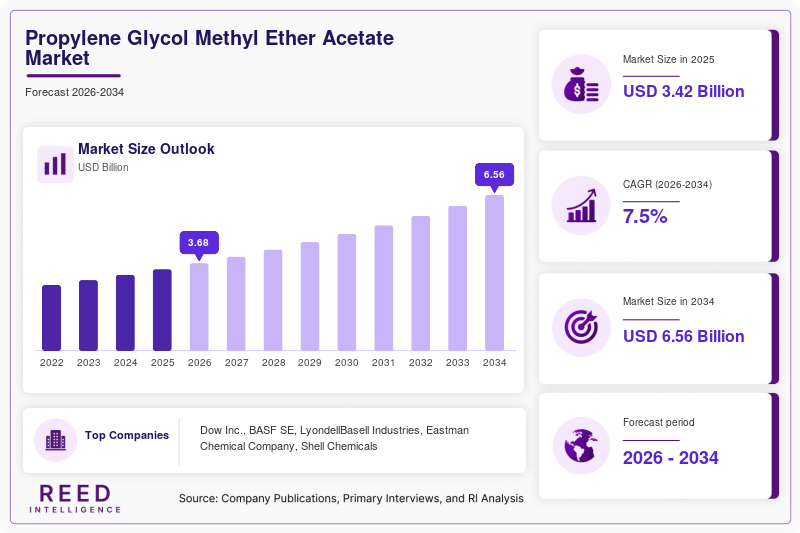
Key Highlights
- Asia Pacific accounted for 44.8% of the global Propylene Glycol Methyl Ether Acetate Market share in 2025, while North America is projected to witness the fastest CAGR of 8.1% during the forecast period.
- By grade, semiconductor grade PGMEA held the dominant market share of 46.2% in 2025, whereas electronic grade PGMEA is anticipated to expand at a CAGR of 8.6% through 2034.
- By application, paints and coatings represented the leading segment with 39.7% market share in 2025, while semiconductor processing applications are projected to grow at a CAGR of 9.2%.
- By end-use industry, electronics and semiconductor manufacturing accounted for 33.5% of the market share in 2025, whereas automotive applications are expected to register a CAGR of 7.9% during the forecast period.
- China remained the dominant country market with values of USD 612 million in 2024 and USD 671 million in 2025 due to expanding electronics manufacturing infrastructure and rising industrial solvent demand.
Market Trends
Rising Demand for High-Purity Semiconductor Solvents
The increasing demand for high-purity solvents in semiconductor fabrication has emerged as a major trend shaping the Propylene Glycol Methyl Ether Acetate Market. Semiconductor manufacturers require ultra-pure solvent solutions for photoresist thinning, wafer cleaning, and advanced lithography applications.
As semiconductor technologies become more complex, the demand for contamination-free and highly stable solvents has increased substantially. Manufacturers are investing in advanced purification technologies and quality control systems to meet the strict performance standards of semiconductor production facilities. This trend is expected to continue supporting market growth during the forecast period.
Growing Shift Toward Environmentally Compliant Solvent Formulations
Another significant trend influencing the Propylene Glycol Methyl Ether Acetate Market is the growing preference for environmentally compliant and low-toxicity solvent systems. Industrial manufacturers are increasingly focusing on solvent formulations that comply with evolving environmental and workplace safety regulations.
PGMEA is gaining wider acceptance because of its favorable solvency properties and comparatively lower environmental impact than certain traditional solvent alternatives. Coating manufacturers and specialty chemical producers are increasingly incorporating compliant solvent solutions into industrial applications, supporting long-term market expansion.
Market Drivers
Expansion of Global Electronics and Semiconductor Manufacturing
The rapid growth of the electronics and semiconductor industries remains one of the primary drivers supporting the Propylene Glycol Methyl Ether Acetate Market. PGMEA is extensively utilized in semiconductor processing because of its compatibility with photoresist materials and high-purity cleaning applications.
Increasing production of consumer electronics, integrated circuits, memory devices, and semiconductor components has strengthened demand for specialty solvents worldwide. Rising investments in semiconductor fabrication plants are expected to continue driving future market growth.
Increasing Demand from Paints and Coatings Industry
The expanding paints and coatings industry has significantly contributed to the growth of the Propylene Glycol Methyl Ether Acetate Market. PGMEA is widely used in industrial coatings, automotive paints, and specialty finishes because it improves flow characteristics, coating performance, and drying efficiency.
Growing infrastructure development activities and increasing automotive production have strengthened the consumption of industrial coatings globally. Manufacturers continue to utilize PGMEA-based solvent systems to improve coating quality and application efficiency.
Market Restraint
Volatility in Raw Material Prices
One of the major restraints affecting the Propylene Glycol Methyl Ether Acetate Market is the volatility in raw material prices associated with petrochemical feedstocks. Fluctuations in propylene and acetate-based raw material costs can significantly influence production expenses and profit margins for manufacturers.
Supply chain disruptions and changing crude oil price trends may create pricing uncertainties within the market. These factors can affect purchasing decisions among industrial consumers and reduce operational predictability for manufacturers.
Market Opportunities
Increasing Adoption in Advanced Printed Electronics
The growing development of printed electronics and flexible electronic devices presents substantial opportunities for the Propylene Glycol Methyl Ether Acetate Market. PGMEA is increasingly used in conductive ink formulations and electronic coating applications because of its efficient solvency and processing characteristics.
Rising investments in wearable electronics, flexible displays, and printed sensors are expected to generate additional demand for specialty solvents across advanced electronics manufacturing applications.
Expansion of Industrial Cleaning Applications
The increasing use of specialty solvents in industrial cleaning processes is creating new opportunities for the Propylene Glycol Methyl Ether Acetate Market. Industries such as aerospace, automotive, electronics, and precision engineering increasingly require high-performance cleaning agents capable of removing contaminants without damaging sensitive surfaces.
PGMEA-based cleaning formulations are gaining popularity due to their effective cleaning efficiency and compatibility with precision manufacturing processes. Growing industrial automation and equipment maintenance activities are expected to support future market demand.
Segmental Analysis
By Grade
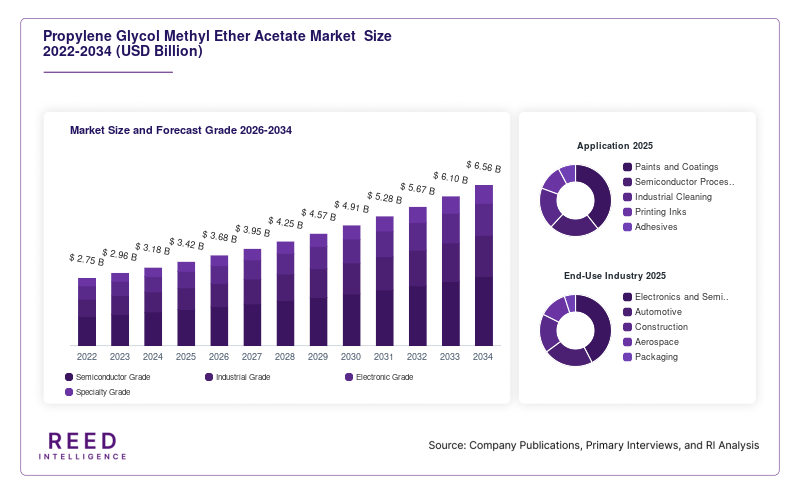
Based on grade, the Propylene Glycol Methyl Ether Acetate Market is segmented into semiconductor grade, industrial grade, electronic grade, and specialty grade.
Semiconductor grade PGMEA dominated the market with a share of 46.2% in 2025. Its extensive use in semiconductor lithography, wafer cleaning, and photoresist applications contributed significantly to segment dominance. Semiconductor manufacturers increasingly demanded ultra-high-purity solvent formulations to improve production efficiency and reduce contamination risks.
Electronic grade PGMEA is anticipated to witness the fastest CAGR of 8.6% during the forecast period. Rising demand for advanced electronic devices and printed electronics manufacturing will support future segment growth. Increasing investments in electronic component manufacturing are expected to strengthen product demand.
By Application
Based on application, the market is categorized into paints and coatings, semiconductor processing, industrial cleaning, printing inks, and adhesives.
Paints and coatings accounted for the leading market share of 39.7% in 2025 due to extensive utilization of PGMEA in industrial coatings and automotive finishing applications. Manufacturers preferred PGMEA-based solvent systems because of their efficient drying performance and improved coating quality.
Semiconductor processing is projected to grow at the fastest CAGR of 9.2% through 2034. Increasing semiconductor production capacity and rising investments in advanced electronics manufacturing will support future segment expansion. High-purity solvent demand is expected to remain strong within semiconductor fabrication facilities.
By End-Use Industry
Based on end-use industry, the Propylene Glycol Methyl Ether Acetate Market is segmented into electronics and semiconductors, automotive, construction, aerospace, and packaging.
Electronics and semiconductors remained the dominant segment with 33.5% market share in 2025. Rising global demand for electronic devices, memory chips, and integrated circuits contributed significantly to segment growth.
Automotive applications are expected to witness the fastest CAGR of 7.9% during the forecast period. Increasing automotive production and rising demand for high-performance industrial coatings will support future segment expansion. Manufacturers are increasingly utilizing specialty solvent systems to improve coating durability and finish quality.
By Distribution Channel
Based on distribution channel, the market is segmented into direct sales, chemical distributors, and online industrial supply platforms.
Chemical distributors accounted for the largest market share of 48.4% in 2025 because industrial buyers frequently relied on established distribution networks for bulk specialty solvent procurement and technical support services.
Online industrial supply platforms are projected to witness the fastest CAGR of 8.8% during the forecast period. Increasing digital procurement activities and growing preference for streamlined industrial purchasing systems will support future segment growth. Expansion of digital chemical distribution networks is expected to contribute to market development.
Regional Analysis
North America
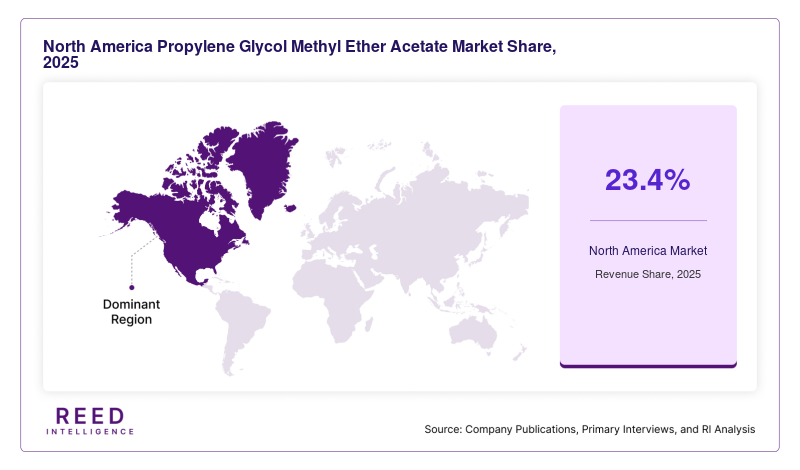
North America held approximately 23.4% of the global Propylene Glycol Methyl Ether Acetate Market share in 2025. The region benefited from advanced semiconductor manufacturing infrastructure and increasing demand for specialty coatings and industrial solvents.
The regional market is projected to expand at a CAGR of 8.1% during the forecast period. The United States remained the dominant country due to strong investments in semiconductor fabrication facilities and growing adoption of advanced electronics manufacturing technologies. Increasing industrial automation activities are expected to support future regional demand.
Europe
Europe accounted for nearly 21.6% of the global Propylene Glycol Methyl Ether Acetate Market share in 2025. The market benefited from rising demand for industrial coatings, automotive finishes, and specialty chemical applications.
The regional market is anticipated to register a CAGR of 7.1% through 2034. Germany emerged as the leading country due to expanding automotive manufacturing activities and increasing specialty chemical production capacity. Growing demand for high-performance coatings is expected to contribute to regional market growth.
Asia Pacific
Asia Pacific represented around 44.8% of the global Propylene Glycol Methyl Ether Acetate Market share in 2025. The region benefited from large-scale electronics manufacturing operations, expanding semiconductor production, and increasing industrialization across emerging economies.
The market is expected to witness a CAGR of 7.8% during the forecast period. China remained the dominant country due to extensive semiconductor manufacturing investments and growing industrial solvent consumption across coatings and electronics industries. Rapid industrial infrastructure expansion is expected to continue supporting regional market growth.
Middle East & Africa
The Middle East & Africa accounted for approximately 5.4% of the global Propylene Glycol Methyl Ether Acetate Market share in 2025. Increasing industrial diversification and expansion of manufacturing activities supported regional market development.
The market is projected to grow at a CAGR of 6.9% during the forecast period. Saudi Arabia remained the dominant country because of growing petrochemical production capacity and increasing industrial coatings demand. Expansion of industrial processing sectors is expected to support future regional growth.
Latin America
Latin America captured nearly 4.8% of the global Propylene Glycol Methyl Ether Acetate Market share in 2025. Rising industrial manufacturing activities and increasing automotive production contributed to market growth across the region.
The market is forecast to register a CAGR of 6.7% through 2034. Brazil remained the leading country due to expanding automotive coating applications and growing specialty chemical demand. Increasing industrial development projects are expected to support regional market expansion.
Competitive Landscape
The global Propylene Glycol Methyl Ether Acetate Market is characterized by the presence of multinational chemical manufacturers and regional specialty solvent producers. Companies compete based on product purity, supply chain integration, production capacity, and pricing strategies. Market participants are also focusing on sustainable solvent technologies and expansion of electronic-grade product portfolios.
Dow remained one of the leading companies in the market due to its integrated chemical manufacturing capabilities and broad industrial solvent portfolio. The company recently expanded specialty solvent production capacity to support rising semiconductor industry demand in Asia Pacific.
Other major players have focused on partnerships, regional distribution expansion, and investments in environmentally compatible solvent technologies to strengthen their market positions.
Key Players List
- Dow Inc.
- LyondellBasell Industries Holdings B.V.
- Shell plc
- BASF SE
- Eastman Chemical Company
- KH Neochem Co., Ltd.
- Chang Chun Group
- Jiangsu Dynamic Chemical Co., Ltd.
- Shinko Organic Chemical Industry Ltd.
- Mitsubishi Chemical Group Corporation
- Solvay S.A.
- Huntsman Corporation
- Monument Chemical
- INEOS Group Holdings S.A.
- Sasol Limited
Propylene Glycol Methyl Ether Acetate Market Segments
Grade
- Semiconductor Grade
- Industrial Grade
- Electronic Grade
- Specialty Grade
Application
- Paints and Coatings
- Semiconductor Processing
- Industrial Cleaning
- Printing Inks
- Adhesives
End-Use Industry
- Electronics and Semiconductors
- Automotive
- Construction
- Aerospace
- Packaging
Distribution Channel
- Direct Sales
- Chemical Distributors
- Online Industrial Supply Platforms
By Region
- North America
- Europe
- APAC
- Middle East and Africa
- LATAM