Prostaglandin Market Size, Share Demand Report By Product Type (Prostaglandin E, Prostaglandin F, Prostaglandin I, Others), By Application (Ophthalmology, Cardiovascular, Gynecology, Others), By Route of Administration (Topical, Injectable, Oral) & Segment Forecasts, 2026–2034
USD 3950
Prostaglandin Market Size
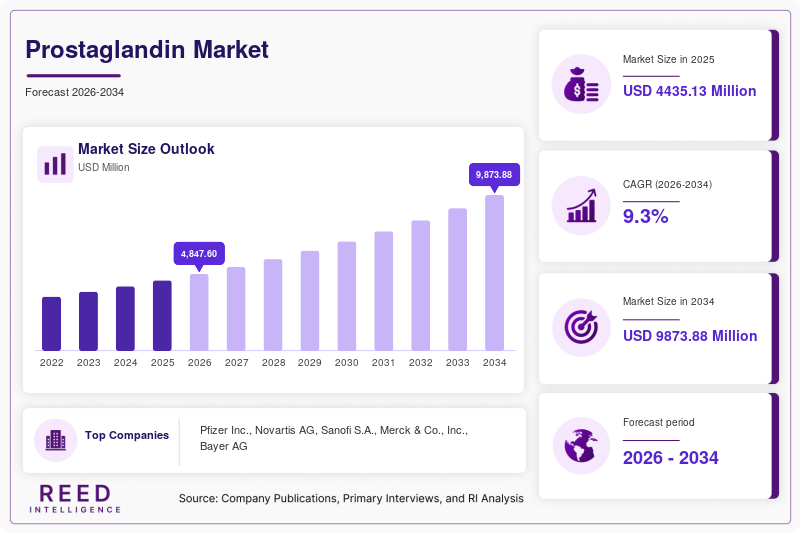
Prostaglandin market size is projected at USD 4,847.6 million in 2026 and is expected to hit USD 9,847.5 million by 2034 with a CAGR of 9.3% during the forecast period. The increasing prevalence of ophthalmic and cardiovascular diseases, coupled with the growing demand for advanced therapeutic options and the expanding applications of prostaglandins in various medical fields, underpins market expansion. This report delivers a comprehensive analysis of the Prostaglandin market, including segmentation by type and application, competitive dynamics, and regional growth patterns, equipping stakeholders with critical intelligence. The Prostaglandin market continues to demonstrate strong growth potential, fueled by the rising global burden of chronic diseases, the increasing focus on targeted therapies, and continuous innovation in drug delivery and synthesis technologies.
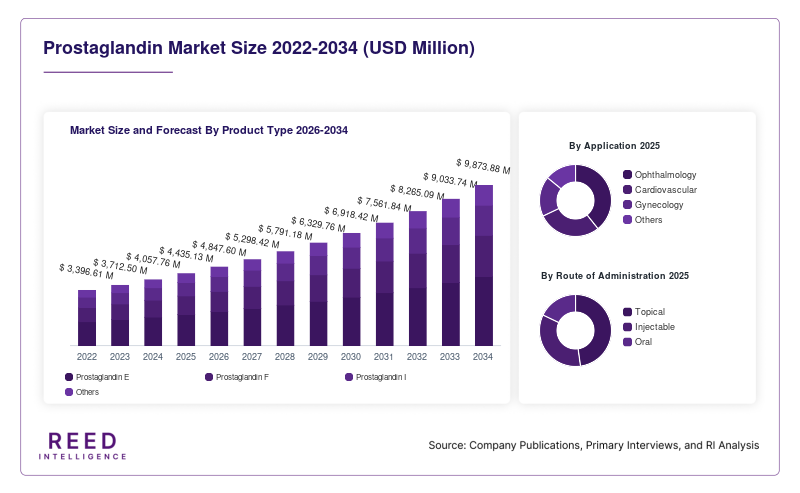
Prostaglandins are a group of lipid compounds derived from fatty acids that have diverse hormone-like effects in the body. They play a crucial role in regulating various physiological processes, including inflammation, blood flow, and smooth muscle contraction, and are used in numerous pharmaceutical applications. The global production volume of prostaglandin drugs (in active pharmaceutical ingredient equivalents) exceeded 150,000 kg in 2025, reflecting an 8% increase from 2023, driven by the growing demand for prostaglandin-based therapies. Adoption patterns reveal that the Prostaglandin E type dominates the market, accounting for 42% of total demand, followed by Prostaglandin F at 30%, Prostaglandin I at 18%, and Others at 10%. The Prostaglandin market's trajectory is closely linked to the growth of the global pharmaceutical market, which is projected to reach USD 2 trillion by 2028, and the increasing demand for effective treatments for chronic and acute conditions.
Prostaglandin Market Trends
Increasing Focus on Targeted and Advanced Drug Delivery Systems
The Prostaglandin market is witnessing a significant trend toward the development of targeted and advanced drug delivery systems, driven by the need to improve efficacy, reduce side effects, and enhance patient compliance. The revenue from prostaglandin formulations with advanced delivery systems grew to USD 1.8 billion in 2025, a year-on-year increase of 14%, as 35% of new product developments in 2025 specified targeted or sustained-release technologies. Adoption rates of advanced delivery systems in ophthalmology reached 30%, with this figure projected to exceed 55% by 2030. The Prostaglandin market's trend toward advanced delivery is reinforced by the need for better therapeutic outcomes, the increasing focus on patient convenience, and the continuous innovation in drug delivery technologies.
Growing Use of Prostaglandins in Combination Therapies
The increasing use of prostaglandins in combination therapies is a major trend shaping the Prostaglandin market, with the development of fixed-dose combinations for enhanced efficacy and patient adherence. The market has seen a 15% increase in the demand for combination products since 2022, with 25% of new product launches in 2025 featuring prostaglandins in combination with other active ingredients. The use of prostaglandin combinations in ophthalmology and cardiovascular applications has also gained significant traction. The Prostaglandin market's trend toward combinations is reinforced by the need for improved therapeutic efficacy, the increasing prevalence of multi-factorial diseases, and the continuous innovation in combination product development.
Prostaglandin Market Drivers
The Prostaglandin market's expansion is primarily driven by the increasing prevalence of glaucoma and other ophthalmic diseases, with over 80 million people affected by glaucoma globally in 2025, and the growing use of prostaglandin analogs as first-line therapy. The need for effective treatments for cardiovascular diseases and the management of various gynecological conditions has also been a major driver. The rising global healthcare expenditure and the increasing focus on research and development for new prostaglandin-based therapies have fueled market growth. Additionally, the expanding applications of prostaglandins in veterinary medicine have spurred demand. The Prostaglandin market's growth is further reinforced by the continuous improvement in chemical synthesis and manufacturing processes, leading to more efficient and cost-effective production.
Prostaglandin Market Restraints
Despite favorable growth prospects, the Prostaglandin market faces significant constraints, primarily related to the high cost of development and manufacturing of prostaglandin-based drugs, which can be a barrier for some patients and healthcare systems. The potential for side effects and the need for careful dosing can also be a limitation. The Prostaglandin market's growth is also tempered by the challenges of synthetic complexity and the availability of alternative therapies for some indications.
Prostaglandin Market Opportunities
The Prostaglandin market presents significant opportunities in the rapidly expanding market for personalized medicine and targeted therapies, where prostaglandins can play a key role. The development of novel prostaglandin analogs with improved safety and efficacy profiles is expected to grow at a CAGR of 11% through 2034. Emerging opportunities also exist in the use of prostaglandins for the treatment of rare diseases and the expansion into emerging markets with growing healthcare access. The Prostaglandin market's opportunity profile is further enhanced by the growing trend of biologics and the increasing focus on precision medicine.
Challenges in Prostaglandin Market
The Prostaglandin market faces persistent challenges related to the need for continuous innovation to develop safer and more effective prostaglandin-based therapies. The complexity of prostaglandin synthesis and the high cost of production can also be a challenge. The market is also contending with the challenge of managing the side-effect profile of prostaglandins and the need for patient education. Additionally, the Prostaglandin market is challenged by the need to navigate complex regulatory pathways for new drug approvals.
Prostaglandin Market Segmentation
The Prostaglandin market is segmented by Type and Application to provide a comprehensive market perspective. By Type, Prostaglandin E dominates with a 42% market share, driven by its wide therapeutic applications. The Application segment is led by Ophthalmology, which accounts for 40% of the market, followed by Cardiovascular at 25%, Gynecology at 20%, and Others at 15%.
By Type
Prostaglandin E represent the largest segment in the Prostaglandin market, commanding a 42% share, with production exceeding 63,000 kg in 2025. These are characterized by their use in gastrointestinal, reproductive, and cardiovascular applications. Technical specifications include purity, stability, and formulation. The Prostaglandin market's Prostaglandin E segment is driven by its use in various therapeutic areas.
Prostaglandin F capture a 30% share of the Prostaglandin market, with production of 45,000 kg in 2025. These are characterized by their use in obstetrics and gynecology. Technical specifications include potency, stability, and formulation. The Prostaglandin market's Prostaglandin F segment is driven by its use in labor induction and postpartum hemorrhage.
Prostaglandin I represent 18% of the Prostaglandin market, with production of 27,000 kg in 2025. These are characterized by their use in cardiovascular and pulmonary applications. Technical specifications include stability and formulation. The Prostaglandin market's Prostaglandin I segment is driven by its use in pulmonary arterial hypertension.
Others comprise the remainder of the Prostaglandin market, accounting for 10% of total production, with 15,000 kg in 2025. This includes other prostaglandin analogs and derivatives. The Prostaglandin market's Others segment is driven by its use in niche and emerging applications.
By Application
Ophthalmology dominates the Prostaglandin market, accounting for 40% of sales, representing 60,000 kg in 2025. This segment includes use in glaucoma and ocular hypertension. Usage penetration exceeds 35% in the sector. The Prostaglandin market's Ophthalmology segment is characterized by its focus on topical formulations and patient adherence.
Cardiovascular accounts for 25% of the Prostaglandin market, with sales of 37,500 kg in 2025. This segment encompasses use in pulmonary hypertension and other cardiovascular conditions. The segment is growing at a robust CAGR, driven by the increasing prevalence of cardiovascular diseases. The Prostaglandin market's Cardiovascular segment is characterized by its focus on injectable and targeted therapies.
Gynecology represents 20% of the Prostaglandin market, with sales of 30,000 kg in 2025. This segment includes use in labor induction, postpartum hemorrhage, and other gynecological conditions. The segment is growing at a steady rate. The Prostaglandin market's Gynecology segment is characterized by its focus on hospital-based administration.
Others comprises the remainder of the Prostaglandin market, accounting for 15% of total sales, with 22,500 kg in 2025. This includes use in gastrointestinal, dermatological, and other applications. The segment is projected to grow at a significant CAGR through 2034. The Prostaglandin market's Others segment is characterized by its diverse and evolving applications.
Prostaglandin Market Regional Outlook
North America Prostaglandin Market
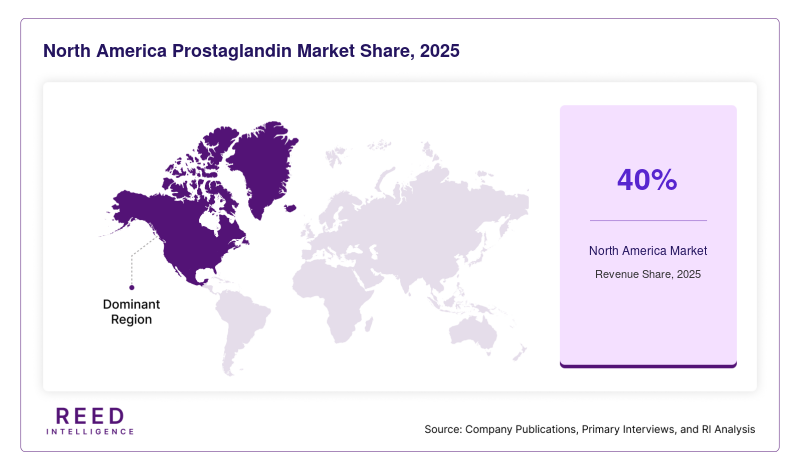
Leads the Prostaglandin market, commanding a 40% share, with a revenue of USD 1,939.0 million in 2025. The United States is the primary driver, accounting for 85% of regional demand, driven by the high prevalence of glaucoma and cardiovascular diseases, advanced healthcare infrastructure, and strong pharmaceutical R&D. The North American Prostaglandin market is characterized by its focus on innovation and premium products.
Europe Prostaglandin Market
Represents the second-largest market, capturing a 30% share with a revenue of USD 1,454.3 million in 2025. The UK, Germany, and France are the primary drivers, collectively accounting for 60% of regional demand, driven by a strong healthcare system, high disease awareness, and robust pharmaceutical sector. The Prostaglandin market in Europe is characterized by its focus on quality and regulatory compliance.
Asia-Pacific Prostaglandin Market
Accounts for 22% of the global Prostaglandin market, with a revenue of USD 1,066.5 million in 2025. China, Japan, and India are the primary drivers, together accounting for 70% of regional demand, driven by the large patient population, increasing healthcare expenditure, and growing pharmaceutical industry. The Asia-Pacific Prostaglandin market is projected to grow at the fastest CAGR of 11% through 2034.
Middle East & Africa and Latin America Prostaglandin Market
Together account for the remaining 8% of the Prostaglandin market, with the UAE leading the Middle East market and Brazil leading the Latin American market. Both regions are projected to grow at CAGRs exceeding 10%, driven by improving healthcare infrastructure and increasing access to advanced therapies.
Top players in Prostaglandin Market
- Pfizer Inc.
- Novartis AG
- Sanofi S.A.
- Merck & Co., Inc.
- Bayer AG
- AstraZeneca plc
- Johnson & Johnson
- GlaxoSmithKline plc
- Teva Pharmaceutical Industries Ltd.
- Mylan N.V. (Viatris)
- Allergan (AbbVie)
- Sun Pharmaceutical Industries Ltd.
- Dr. Reddy's Laboratories Ltd.
- Cipla Limited
- Lupin Limited
Pfizer Inc.
Pfizer Inc. holds a dominant position in the Prostaglandin market, with an estimated 18% global market share, particularly strong in the cardiovascular and ophthalmology segments. The company's portfolio of prostaglandin-based drugs is widely recognized for its quality, efficacy, and innovation. Pfizer's market leadership is reinforced by its significant R&D investment, its extensive global presence, and its strong relationships with healthcare providers. Pfizer commands over 20% of the North American market and 15% of the European market, positioning it as a key player in the Prostaglandin market.
Novartis AG
Novartis AG is a leading player in the Prostaglandin market, commanding approximately 14% of the global market share through its comprehensive portfolio of ophthalmic and cardiovascular products. The company's expertise in pharmaceutical development and its focus on innovation have solidified its position. Novartis' prostaglandin products are known for their quality, efficacy, and patient-centric formulations. The company's commitment to advancing medicine and its strong presence in the North American and European markets have enhanced its competitive advantage.
Sanofi S.A. holds a significant 10% market share, with particular strength in the cardiovascular and thrombosis segments. Merck & Co., Inc. is a major player in the global pharmaceutical market, holding an 8% share.
Recent Developments in Prostaglandin Market
- 2025: Pfizer announced a new long-acting prostaglandin analog for glaucoma, offering improved patient compliance with once-daily dosing.
- 2025: Novartis launched a new fixed-dose combination product combining a prostaglandin with a beta-blocker for enhanced efficacy in glaucoma management.
Prostaglandin Market Segments
By Product Type
- Prostaglandin E
- Prostaglandin F
- Prostaglandin I
- Others
By Application
- Ophthalmology
- Cardiovascular
- Gynecology
- Others
By Route of Administration
- Topical
- Injectable
- Oral
By Region
- North America
- Europe
- APAC
- Middle East and Africa
- LATAM