Prosthetic Liners Market Size, Share & Demand Report By Material (Silicone Liners, Thermoplastic Elastomer (TPE) Liners, Polyurethane Liners, Other Materials), By Application (Lower Extremity Prosthetics, Upper Extremity Prosthetics), By End-Use (Hospitals, Rehabilitation Centers, Prosthetic Clinics), By Distribution Channel (Direct Sales, Distributors, Online Channels), By Region & Segment Forecasts, 2025–2034
USD 3950
Market Overview
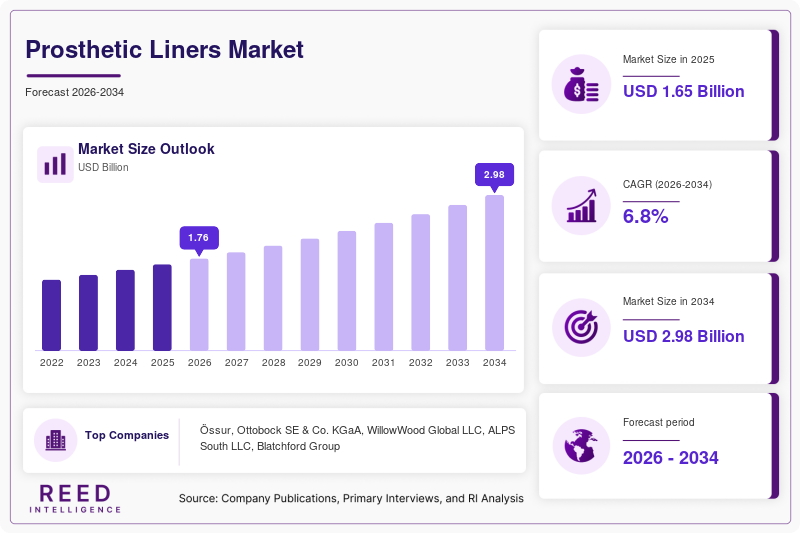
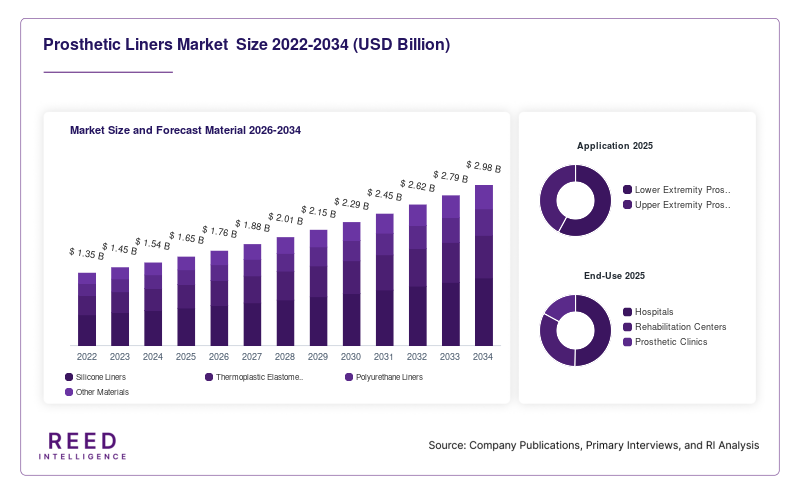
The global Prosthetic Liners Market size was valued at approximately USD 1.65 billion in 2025 and is projected to reach USD 2.98 billion by 2034, expanding at a CAGR of 6.8% during the forecast period (2025–2034). The market growth is primarily supported by the rising incidence of limb amputations due to diabetes, trauma injuries, and vascular diseases across both developed and emerging economies. Increasing awareness regarding mobility solutions and advancements in prosthetic technologies have further contributed to the steady expansion of the market.
A key global factor supporting the Prosthetic Liners Market growth is the increasing integration of advanced materials such as silicone, thermoplastic elastomers (TPE), and polyurethane, which enhance comfort, durability, and performance. These innovations are improving patient compliance and driving adoption rates among amputees.
Key Highlights
- North America dominated with a 38.5% share in 2025, while Asia Pacific is expected to register the fastest CAGR of 8.2%.
- Silicone liners led the material segment with 45.2% share, while TPE liners are projected to grow at a CAGR of 7.6%.
- Lower extremity prosthetics dominated applications with 72.4% share, while upper extremity is expected to grow at 6.9% CAGR.
- The U.S. accounted for USD 620 million in 2025 and is projected to reach USD 655 million in 2026.
Market Trends
Adoption of Smart and Sensor-Integrated Liners
The Prosthetic Liners Market is witnessing a shift toward smart liners embedded with sensors that monitor pressure distribution, temperature, and limb health. These innovations are improving patient outcomes by preventing skin breakdown and enhancing comfort. Integration with mobile applications and digital health platforms is also enabling real-time monitoring, making prosthetic care more personalized and efficient.
Customization and 3D Printing Technologies
Another significant trend is the growing use of 3D scanning and printing technologies to develop customized prosthetic liners. These solutions offer precise fitting and improved comfort, which is crucial for long-term use. Manufacturers are focusing on individualized products that cater to unique anatomical needs, reducing complications such as irritation and poor fit. This trend is particularly gaining traction in developed markets where advanced manufacturing infrastructure supports rapid customization.
Market Drivers
Increasing Prevalence of Diabetes and Vascular Diseases
The rising global prevalence of diabetes and peripheral arterial diseases is a major driver for the Prosthetic Liners Market. These conditions often lead to lower limb amputations, significantly increasing the demand for prosthetic solutions. As healthcare systems focus on rehabilitation and patient mobility, prosthetic liners have become essential components for improving quality of life among amputees.
Advancements in Material Science and Product Innovation
Continuous innovation in liner materials such as silicone, gel-based composites, and thermoplastics is driving market growth. These materials provide enhanced durability, flexibility, and skin compatibility. Manufacturers are investing in R&D to develop liners that minimize friction and improve suspension, thereby boosting user satisfaction and product adoption across both developed and emerging regions.
Market Restraint
High Cost of Advanced Prosthetic Liners
One of the major challenges in the Prosthetic Liners Market is the high cost associated with advanced liner materials and technologies. Premium liners made from silicone or integrated with smart features are often expensive, limiting accessibility in low- and middle-income countries. Additionally, frequent replacement requirements due to wear and tear further increase the overall cost burden for patients.
Limited reimbursement coverage in certain regions also acts as a barrier, discouraging patients from opting for high-quality products. While developed countries offer insurance support, many emerging economies lack structured reimbursement frameworks, restricting market penetration.
Moreover, the availability of low-cost alternatives with inferior quality affects the adoption of advanced products. These cost-related constraints continue to hinder the full potential of the Prosthetic Liners Market, particularly in price-sensitive regions.
Market Opportunities
Expansion in Emerging Markets
Emerging economies in Asia Pacific, Latin America, and Africa present significant growth opportunities for the Prosthetic Liners Market. Increasing healthcare investments, rising awareness about prosthetic care, and improving access to rehabilitation services are driving demand. Governments and non-profit organizations are also supporting initiatives to provide affordable prosthetic solutions, creating a favorable market environment.
Development of Eco-Friendly and Sustainable Materials
The growing focus on sustainability is opening new avenues for innovation in the Prosthetic Liners Market. Manufacturers are exploring biodegradable and recyclable materials to reduce environmental impact. Eco-friendly liners not only address sustainability concerns but also appeal to environmentally conscious consumers and healthcare providers. This trend is expected to create new growth prospects, particularly in developed markets with stringent environmental regulations.
Segmental Analysis
By Material
Silicone liners dominated the Prosthetic Liners Market with a 45.2% share in 2025. Their superior durability, flexibility, and skin-friendly properties made them the preferred choice among users.
Thermoplastic elastomer (TPE) liners will grow at a CAGR of 7.6%, driven by their cost-effectiveness and adaptability. These liners provide a balance between performance and affordability, making them suitable for emerging markets.
By Application
Lower extremity prosthetics accounted for 72.4% of the market share in 2025 due to the higher prevalence of lower limb amputations. These liners are widely used for below-knee and above-knee prostheses.
Upper extremity prosthetics are expected to grow at a CAGR of 6.9%, supported by advancements in prosthetic technologies and increasing demand for functional prosthetic arms.
By End-Use
Hospitals dominated the market with a 40.8% share in 2025, as they serve as primary centers for amputation surgeries and initial prosthetic fittings.
Rehabilitation centers will grow at a CAGR of 7.1%, driven by the increasing focus on post-surgical recovery and long-term patient care. These centers play a critical role in improving mobility outcomes.
By Distribution Channel
Direct sales held the largest share of 48.6% in 2025, as manufacturers prefer direct engagement with healthcare providers for customized solutions.
Online distribution channels are projected to grow at a CAGR of 8.4%, supported by the increasing adoption of digital platforms and convenience in product accessibility.
Regional Analysis
North America
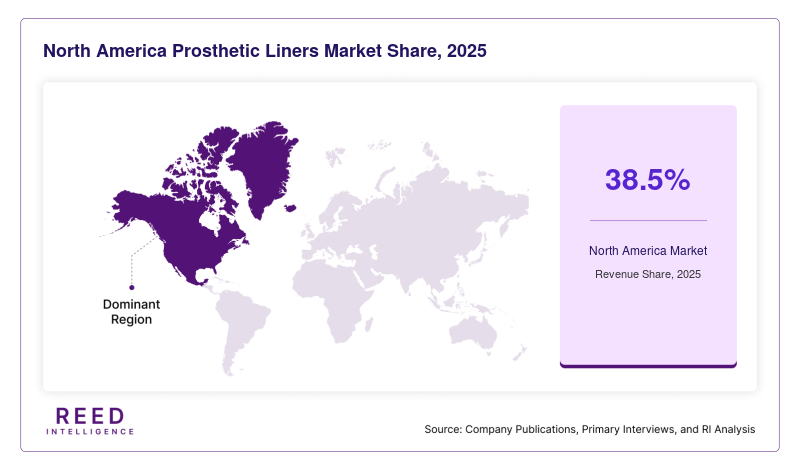
North America accounted for 38.5% of the Prosthetic Liners Market share in 2025 and will grow at a CAGR of 6.2% through 2034. The region benefited from advanced healthcare infrastructure and high adoption of technologically advanced prosthetic products.
The United States dominated the regional market due to strong reimbursement systems and increasing awareness about rehabilitation. The presence of leading manufacturers and continuous innovation in prosthetic technologies further supported growth.
Europe
Europe held 27.3% share in 2025 and is expected to expand at a CAGR of 6.5% during the forecast period. The region experienced steady demand due to well-established healthcare systems and a growing aging population.
Germany emerged as the leading country, driven by its strong medical device industry and emphasis on patient care. Government support for prosthetic solutions and rehabilitation programs contributed significantly to market expansion.
Asia Pacific
Asia Pacific represented 18.6% of the market in 2025 and is projected to grow at the fastest CAGR of 8.2%. The region benefited from increasing healthcare investments and rising awareness about prosthetic solutions.
China dominated the region due to its large population base and increasing number of amputation cases. Expanding healthcare infrastructure and local manufacturing capabilities played a crucial role in market growth.
Middle East & Africa
The Middle East & Africa accounted for 8.1% share in 2025 and is expected to grow at a CAGR of 6.9%. Growth in this region was supported by improving healthcare access and rising demand for rehabilitation services.
Saudi Arabia led the market due to increasing healthcare expenditure and government initiatives to enhance medical services. Investments in healthcare infrastructure are expected to further boost market growth.
Latin America
Latin America held 7.5% share in 2025 and is projected to grow at a CAGR of 6.7%. The region showed moderate growth due to improving healthcare systems and rising awareness.
Brazil dominated the market, driven by its expanding healthcare sector and increasing focus on prosthetic care. Government initiatives to improve accessibility of medical devices supported the market expansion.
Competitive Landscape
The Prosthetic Liners Market is moderately fragmented, with several global and regional players competing based on product quality, innovation, and pricing strategies. Companies are focusing on expanding their product portfolios and investing in advanced materials to gain a competitive edge.
A leading player in the market is Össur, known for its strong product portfolio and continuous innovation. The company recently introduced advanced silicone liners designed to enhance comfort and durability, strengthening its market position.
Other key players are emphasizing partnerships, acquisitions, and regional expansion to increase their market presence. Technological advancements and customization capabilities remain key differentiators in this competitive landscape.
Key Players List
- Össur
- Ottobock SE & Co. KGaA
- WillowWood Global LLC
- ALPS South LLC
- Blatchford Group
- Fillauer LLC
- Streifeneder KG
- Medi GmbH & Co. KG
- College Park Industries
- Freedom Innovations
- Bauerfeind AG
- Trulife
- Steeper Group
- Ohio Willow Wood Company
- Proteor
Recent Developments
- In 2024, Össur launched a new range of advanced silicone liners with improved cushioning technology.
- Ottobock expanded its manufacturing facility to increase production capacity.
- WillowWood introduced eco-friendly liner materials to support sustainability initiatives.
- Blatchford invested in R&D for smart prosthetic liner technologies.
- ALPS South developed cost-effective liners targeting emerging markets.
Prosthetic Liners Market Segments
Material
- Silicone Liners
- Thermoplastic Elastomer (TPE) Liners
- Polyurethane Liners
- Other Materials
Application
- Lower Extremity Prosthetics
- Upper Extremity Prosthetics
End-Use
- Hospitals
- Rehabilitation Centers
- Prosthetic Clinics
Distribution Channel
- Direct Sales
- Distributors
- Online Channels
By Region
- North America
- Europe
- APAC
- Middle East and Africa
- LATAM