Prothrombin Complex Concentrate Market Size, Share & Demand Report By Type (3-Factor Prothrombin Complex Concentrate, 4-Factor Prothrombin Complex Concentrate, Recombinant Prothrombin Complex Concentrate), By Application (Acquired Coagulation Factor Deficiency, Congenital Coagulation Disorders, Trauma and Surgical Bleeding Management, Anticoagulant Reversal Therapy), By End-Use (Hospitals, Specialty Clinics, Ambulatory Surgical Centers), By Distribution Channel (Hospital Pharmacies, Retail Pharm
USD 3950
Market Overview
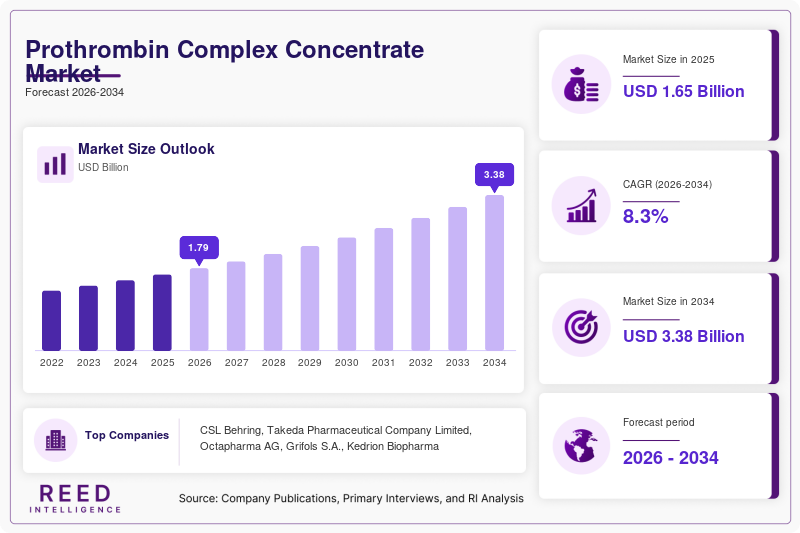
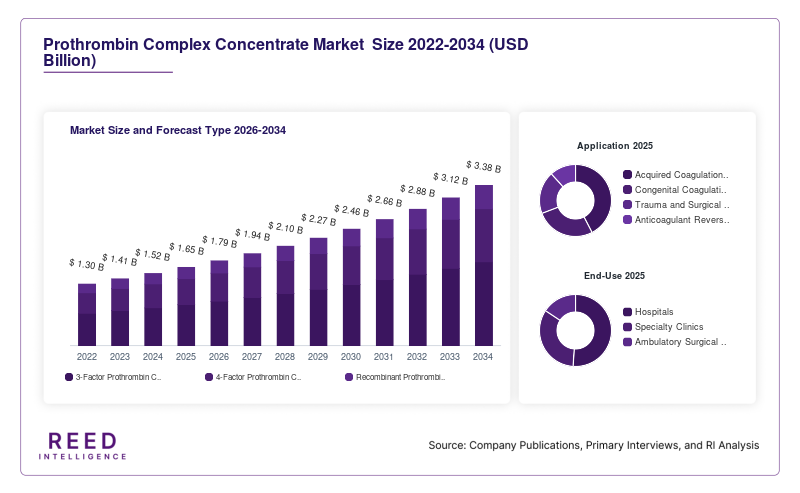
The global Prothrombin Complex Concentrate Market size was valued at approximately USD 1.65 billion in 2026 and is projected to reach around USD 3.12 billion by 2034, expanding at a CAGR of 8.3% during the forecast period (2026–2034). The market has experienced steady expansion due to the increasing clinical reliance on rapid coagulation correction therapies, particularly in emergency care and surgical settings.
A key global factor supporting the growth of the Prothrombin Complex Concentrate Market is the rising incidence of bleeding disorders and anticoagulant-related complications. The growing use of anticoagulants such as vitamin K antagonists has increased the demand for reversal agents, thereby boosting the adoption of prothrombin complex concentrates (PCCs). Additionally, advancements in plasma fractionation technologies and improved safety profiles have strengthened market penetration across developed and emerging healthcare systems.
Key Highlights:
- North America dominated the market with a 38.6% share in 2025, while Asia Pacific is expected to grow at the fastest CAGR of 9.6% during the forecast period
- 4-factor PCC emerged as the leading type segment with a 64.2% share, while recombinant PCC is projected to grow at a CAGR of 10.1%
- Hospitals led the end-use segment with a 59.8% share, whereas specialty clinics are expected to expand at a CAGR of 9.2%
- The U.S. market was valued at USD 520 million in 2024 and USD 565 million in 2025
Market Trends
Increasing Preference for 4-Factor PCC Products
A significant trend shaping the Prothrombin Complex Concentrate Market is the growing preference for 4-factor PCC formulations. These products contain all essential vitamin K-dependent clotting factors (II, VII, IX, and X), making them more effective in rapid anticoagulation reversal. Healthcare professionals are increasingly adopting these products due to their superior efficacy and faster onset of action compared to 3-factor alternatives. The trend is further supported by clinical guidelines recommending 4-factor PCCs for managing life-threatening bleeding events, particularly in patients on warfarin therapy. As hospitals seek standardized treatment protocols, the adoption of these advanced formulations continues to increase.
Expansion of Indications Beyond Hemophilia
Another notable trend is the expanding application of PCCs beyond traditional indications such as hemophilia. The Prothrombin Complex Concentrate Market is witnessing growing use in trauma care, liver disease management, and emergency surgeries. Physicians are leveraging PCCs for off-label uses, including reversal of direct oral anticoagulants (DOACs), which has broadened the market scope. This diversification is supported by ongoing clinical research and real-world evidence demonstrating the versatility of PCCs. As a result, manufacturers are focusing on product innovation and regulatory approvals for broader indications, which is expected to enhance market growth in the coming years.
Market Drivers
Rising Incidence of Coagulation Disorders
The increasing prevalence of coagulation disorders is a major driver of the Prothrombin Complex Concentrate Market. Conditions such as hemophilia, liver disease-related coagulopathy, and vitamin K deficiency are becoming more common globally. This has created a strong demand for effective clotting factor replacement therapies. PCCs offer a rapid and efficient solution, making them a preferred choice in critical care scenarios. The growing patient pool, combined with improved diagnosis rates, continues to support market expansion.
Growing Surgical and Emergency Procedures
The rising number of surgical interventions and trauma cases is another key driver fueling market growth. Emergency situations often require immediate reversal of anticoagulation to prevent excessive bleeding. PCCs provide a quick and reliable solution, making them essential in surgical and trauma care settings. The increasing adoption of minimally invasive procedures, which still carry bleeding risks, has further contributed to demand. As healthcare systems continue to expand surgical capabilities, the utilization of PCCs is expected to rise steadily.
Market Restraint
High Cost and Limited Accessibility
One of the primary challenges in the Prothrombin Complex Concentrate Market is the high cost associated with these therapies. PCCs are derived from human plasma and require complex manufacturing processes, which significantly increases production costs. This makes them less accessible in low- and middle-income regions where healthcare budgets are constrained.
Additionally, the availability of PCCs is often limited due to dependence on plasma donations and stringent regulatory requirements. Supply chain constraints and storage requirements further restrict widespread adoption. Healthcare providers in resource-limited settings may opt for alternative treatments such as fresh frozen plasma, despite its lower efficacy.
The cost barrier also affects reimbursement policies in certain regions, limiting patient access to advanced therapies. While efforts are being made to improve affordability and expand production capacity, these challenges continue to hinder the overall growth potential of the market.
Market Opportunities
Development of Recombinant PCC Products
The development of recombinant PCC products presents a significant growth opportunity in the Prothrombin Complex Concentrate Market. Unlike plasma-derived products, recombinant PCCs eliminate the risk of pathogen transmission and reduce dependence on plasma supply. These advantages make them highly attractive for both healthcare providers and patients. Ongoing research and development efforts are focused on improving the efficacy and safety profiles of these products. As regulatory approvals increase, recombinant PCCs are expected to gain substantial market share.
Expansion in Emerging Markets
Emerging economies offer considerable growth opportunities due to improving healthcare infrastructure and increasing awareness of advanced treatment options. Countries in Asia Pacific, Latin America, and parts of Africa are investing in modern healthcare systems, which is expected to drive demand for PCCs. Government initiatives aimed at improving access to critical care treatments are further supporting market expansion. Additionally, rising healthcare expenditure and growing medical tourism are contributing to increased adoption of PCC therapies in these regions.
Segmental Analysis
By Type
The 4-factor PCC segment dominated the Prothrombin Complex Concentrate Market with a 64.2% share in 2025. Its comprehensive composition and higher efficacy made it the preferred choice in clinical settings.
Recombinant PCC is expected to be the fastest-growing subsegment, with a projected CAGR of 10.1%. Its ability to reduce infection risks and ensure consistent supply is expected to drive future demand.
By Application
The acquired coagulation factor deficiency segment held the largest share of 58.7% in 2025. The high prevalence of anticoagulant-related bleeding contributed to its dominance.
The congenital deficiency segment is anticipated to grow at a CAGR of 8.9%, supported by increasing diagnosis rates and improved access to treatment.
By End-Use
Hospitals accounted for the largest share of 59.8% in 2025 due to the high volume of surgical and emergency procedures performed in these settings.
Specialty clinics are expected to grow at a CAGR of 9.2%, driven by increasing outpatient treatments and specialized care services.
By Distribution Channel
Hospital pharmacies dominated the market with a 61.5% share in 2025, reflecting the primary use of PCCs in inpatient settings.
Online pharmacies are projected to grow at a CAGR of 9.5%, supported by the expansion of digital healthcare platforms and improved accessibility.
Regional Analysis
North America
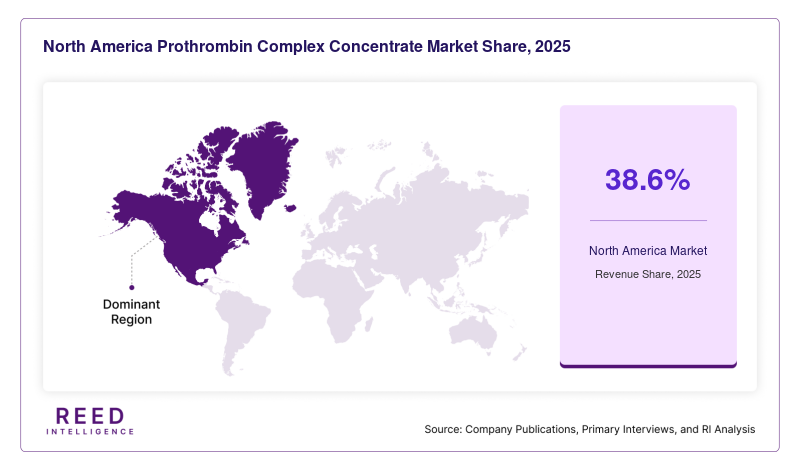
North America accounted for approximately 38.6% of the Prothrombin Complex Concentrate Market share in 2025 and is expected to grow at a CAGR of 7.9% during the forecast period. The region’s mature healthcare infrastructure and high adoption of advanced therapies contributed to its dominant position.
The United States remained the leading country due to strong clinical adoption and well-established reimbursement frameworks. The presence of advanced trauma care systems and high awareness regarding anticoagulation reversal significantly supported market growth in the country.
Europe
Europe held a market share of around 27.4% in 2025 and is projected to grow at a CAGR of 7.6% from 2026 to 2034. The region benefited from strong regulatory support and increasing use of PCCs in surgical and emergency care.
Germany emerged as the dominant country, driven by its advanced healthcare infrastructure and strong focus on patient safety. The country’s emphasis on standardized treatment protocols contributed to widespread adoption of PCC products.
Asia Pacific
Asia Pacific accounted for approximately 19.8% of the market share in 2025 and is expected to grow at the fastest CAGR of 9.6% during the forecast period. Rapid improvements in healthcare infrastructure and increasing awareness are key factors driving growth.
China dominated the regional market due to its large patient population and expanding healthcare investments. The country’s growing focus on modern treatment approaches has significantly boosted demand for PCCs.
Middle East & Africa
The Middle East & Africa region held a 7.2% share in 2025 and is projected to grow at a CAGR of 8.1%. Increasing healthcare investments and improving access to advanced treatments supported market growth.
Saudi Arabia emerged as the leading country, driven by government initiatives to enhance healthcare services. The expansion of hospitals and specialty clinics contributed to increased adoption of PCC therapies.
Latin America
Latin America accounted for approximately 7.0% of the market share in 2025 and is expected to grow at a CAGR of 8.4% during the forecast period. The region is witnessing gradual improvements in healthcare access and infrastructure.
Brazil led the market due to its large healthcare system and growing awareness of advanced coagulation therapies. Increasing investments in healthcare modernization are expected to support continued growth.
Competitive Landscape
The Prothrombin Complex Concentrate Market is moderately consolidated, with key players focusing on product innovation and geographic expansion. Leading companies are investing in research and development to enhance product safety and efficacy.
A major market leader has strengthened its position through the launch of advanced 4-factor PCC products and expanded distribution networks. Companies are also pursuing strategic collaborations and acquisitions to increase their market presence.
Continuous innovation and regulatory approvals are expected to shape the competitive dynamics of the market in the coming years.
Key Players List
- CSL Behring
- Takeda Pharmaceutical Company Limited
- Octapharma AG
- Grifols S.A.
- Kedrion Biopharma
- LFB Group
- Sanquin
- China Biologic Products Holdings, Inc.
- Bio Products Laboratory Ltd.
- Emergent BioSolutions Inc.
- Bayer AG
- Pfizer Inc.
- Novo Nordisk A/S
- Octapharma Plasma
- Shanghai RAAS Blood Products Co., Ltd.
Recent Developments
- Several manufacturers have expanded their production capacities to address increasing global demand.
- New recombinant PCC formulations are undergoing clinical trials to improve safety and efficacy.
- Strategic partnerships have been formed to enhance distribution networks in emerging markets.
- Regulatory approvals for expanded indications have supported broader clinical adoption.
- Companies are investing in advanced plasma fractionation technologies to improve product quality.
Prothrombin Complex Concentrate Market Segments
Type
- 3-Factor Prothrombin Complex Concentrate
- 4-Factor Prothrombin Complex Concentrate
- Recombinant Prothrombin Complex Concentrate
Application
- Acquired Coagulation Factor Deficiency
- Congenital Coagulation Disorders
- Trauma and Surgical Bleeding Management
- Anticoagulant Reversal Therapy
End-Use
- Hospitals
- Specialty Clinics
- Ambulatory Surgical Centers
Distribution Channel
- Hospital Pharmacies
- Retail Pharmacies
- Online Pharmacies
By Region
- North America
- Europe
- APAC
- Middle East and Africa
- LATAM