Prunes Market Size, Share & Demand Report By Product Type (Conventional Prunes, Organic Prunes), By Distribution Channel (Supermarkets and Hypermarkets, Convenience Stores, Specialty Stores, Online Retail, Others), By Application (Food and Beverage Processing, Nutritional Supplements, Household Consumption, Foodservice Industry, Others), By Region & Segment Forecasts, 2026–2034
USD 3950
Market Overview
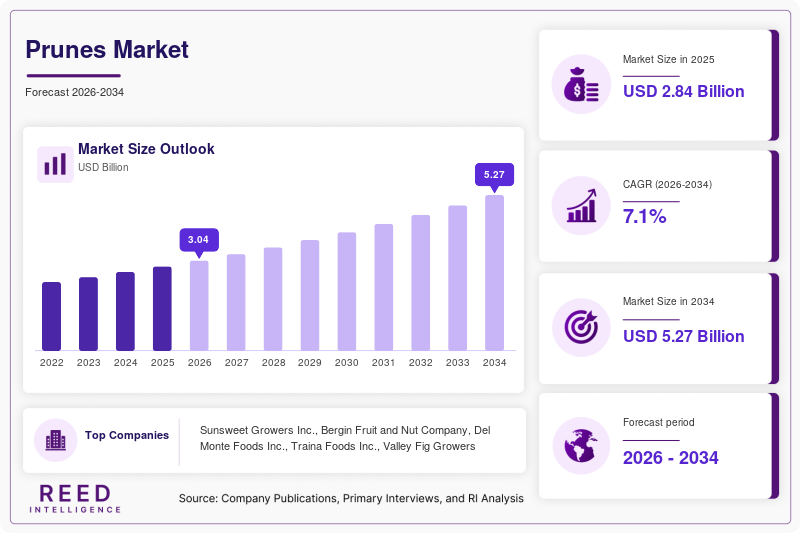
The global Prunes Market size was valued at USD 2.84 billion in 2026 and is projected to reach USD 4.91 billion by 2034, expanding at a CAGR of 7.1% during the forecast period from 2026 to 2034. The market is witnessing steady expansion due to rising consumer demand for functional food products, fiber-rich diets, and natural digestive health solutions. Prunes, which are dried plums processed through controlled dehydration methods, are increasingly used across bakery products, breakfast cereals, snack bars, dairy alternatives, and nutritional supplements. Growing awareness regarding digestive wellness and preventive healthcare has strengthened consumer preference for natural fruit-based ingredients with clean-label positioning.
The increasing adoption of plant-based and nutrient-dense diets has supported long-term market growth across developed and developing economies. Food manufacturers are incorporating prunes into health-focused products because of their high potassium, antioxidant, and dietary fiber content. Demand from aging populations has also increased due to the association between prune consumption and bone health management. In addition, retail expansion through supermarkets, convenience stores, and online grocery platforms has improved product accessibility across urban markets. The growing popularity of healthy snacking and sugar-reduction strategies in processed foods has further supported industry expansion.
Key Highlights
- North America dominated the market with a 36.4% share in 2025.
- Asia Pacific is expected to grow at the fastest CAGR of 9.2% during 2026–2034.
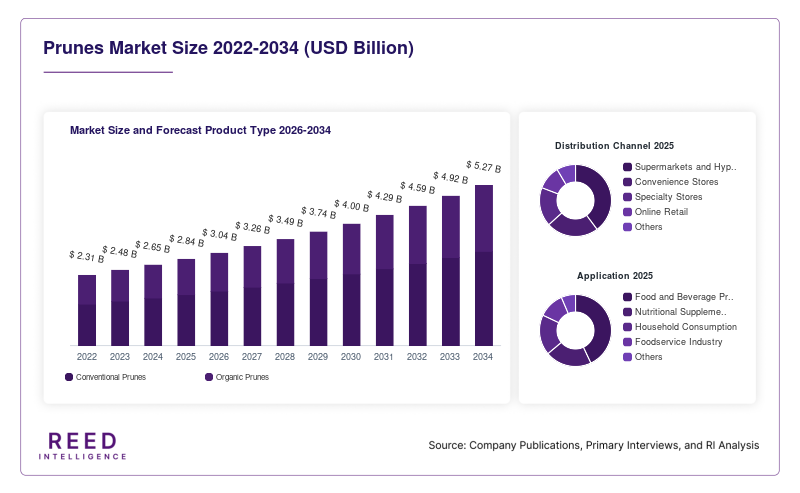
- By product type, conventional prunes accounted for the largest share of 71.8%, while organic prunes are projected to grow at a CAGR of 9.8%. By distribution channel, supermarkets and hypermarkets led with a 43.6% share, whereas online retail is expected to expand at a CAGR of 10.4%.
- By application, food and beverage processing dominated with a 48.1% share, while nutritional supplements are expected to grow at a CAGR of 9.6%. The United States remained the dominant country, with market values of USD 720 million in 2024 and USD 781 million in 2025.
Market Trends
Expansion of Functional Snack Products
The increasing preference for functional snacks is shaping product innovation across the Prunes Market. Consumers are seeking portable food options that combine convenience with nutritional value, encouraging manufacturers to introduce prune-based snack bars, bite-sized dried fruit packs, and mixed fruit blends. Prunes are gaining traction because they provide natural sweetness without artificial additives while supporting digestive wellness and sustained energy release. Food companies are using prunes as sugar alternatives in bakery fillings, smoothies, and breakfast products to align with clean-label trends. Retail shelves across supermarkets and online platforms now feature premium prune products targeted at health-conscious consumers, athletes, and aging populations. This transition toward nutrient-rich snacking is expected to continue supporting product diversification and higher consumer penetration across urban markets.
Growth of Organic and Sustainable Production Practices
Organic farming and sustainable processing methods are becoming important competitive factors within the Prunes Market. Consumers increasingly evaluate food products based on farming transparency, pesticide usage, and environmental impact. As a result, producers are expanding organic prune cultivation and obtaining certifications that improve market acceptance among premium buyers. Sustainable irrigation practices, recyclable packaging, and reduced food waste initiatives are also influencing purchasing decisions, particularly in Europe and North America. Manufacturers are investing in energy-efficient dehydration systems and eco-friendly logistics to strengthen sustainability positioning. Retailers are further promoting organic dried fruit categories through dedicated health-food sections and online subscription models. The combination of sustainability awareness and demand for minimally processed foods is expected to accelerate the adoption of organic prune products during the forecast period.
Market Drivers
Rising Awareness of Digestive Health Benefits
The increasing consumer focus on digestive wellness is a major factor supporting the growth of the Prunes Market. Prunes contain dietary fiber, sorbitol, and antioxidants that are widely associated with improved digestive function and gut health management. Health professionals and nutrition campaigns have promoted dried fruits as healthier alternatives to processed snacks, contributing to stronger consumer acceptance. The aging global population is also driving product demand because digestive health concerns become more common with age. In addition, growing healthcare expenditure and preventive wellness strategies are encouraging consumers to incorporate natural foods into daily diets. Food brands are responding by launching prune-based beverages, cereals, and nutritional blends targeted at digestive support. The expanding popularity of functional foods continues to create stable demand across retail and foodservice sectors.
Increasing Utilization in Food Processing Applications
The broadening application of prunes across food processing industries is contributing significantly to market expansion. Manufacturers are using prunes in bakery products, confectionery fillings, dairy alternatives, sauces, and meat preparations because of their natural sweetness, moisture retention properties, and nutritional profile. Prunes also help reduce refined sugar usage in processed foods, supporting clean-label and low-sugar product development. Demand from industrial food processors has increased as consumers seek healthier packaged foods with recognizable ingredients. The growth of ready-to-eat meals and premium bakery items has further accelerated prune ingredient adoption. Food processing companies are partnering with dried fruit suppliers to ensure consistent product quality and long-term sourcing stability. These industrial applications continue to create new revenue opportunities across global food manufacturing networks.
Market Restraint
Price Volatility and Climatic Dependence in Raw Material Supply
The Prunes Market faces challenges related to fluctuating raw material prices and climate-sensitive agricultural production. Plum cultivation depends heavily on stable weather conditions, water availability, and seasonal harvesting cycles. Droughts, extreme temperatures, and irregular rainfall patterns can significantly reduce crop yields, resulting in supply shortages and price increases. Regions heavily dependent on prune exports are particularly vulnerable to climate-related disruptions that affect international trade and inventory planning. Rising labor costs and transportation expenses also influence overall production economics, making it difficult for smaller processors to maintain competitive pricing.
Price instability can reduce profitability for manufacturers that rely on large-scale procurement of dried fruits for food processing applications. Retailers may also experience challenges in maintaining stable pricing for consumers during periods of supply fluctuation. For example, lower plum harvest volumes in major producing regions have previously led to increased import dependency and higher product costs across packaged food categories. These conditions may slow market penetration in price-sensitive economies where consumers prioritize lower-cost snack alternatives. Despite rising health awareness, inconsistent supply conditions remain a key operational challenge for the industry.
Market Opportunities
Expansion of E-Commerce and Direct-to-Consumer Channels
The rapid development of e-commerce grocery platforms is creating new opportunities within the Prunes Market. Consumers increasingly purchase dried fruit products through digital retail channels because of convenience, product variety, and subscription-based delivery models. Online retail enables manufacturers to market specialty prune products directly to targeted consumer groups, including fitness-focused buyers, vegan consumers, and elderly populations seeking digestive health products. Digital platforms also support faster product launches and personalized marketing strategies through data-driven consumer insights. Small and medium-sized brands are benefiting from online marketplaces that reduce dependence on traditional retail shelf space. As internet penetration and digital payment adoption continue to rise globally, online distribution channels are expected to contribute significantly to long-term market revenue growth.
Product Innovation in Nutritional and Functional Foods
The increasing demand for functional nutrition products is creating opportunities for innovation across the Prunes Market. Manufacturers are developing prune-based powders, concentrates, beverages, and dietary supplements designed for bone health, digestive wellness, and sports nutrition applications. Consumers are showing greater interest in products that provide multiple health benefits through natural ingredients, encouraging companies to expand research and development activities. Functional food manufacturers are also integrating prunes into protein snacks, breakfast blends, and fortified food products to improve nutritional value and natural sweetness. Demand for sugar-reduction solutions in processed foods is further supporting the use of prune ingredients as natural sweetening alternatives. These developments are expected to strengthen market expansion across both mainstream and premium product categories.
Segmental Analysis
By Product Type
Conventional prunes accounted for the largest share of the Prunes Market in 2024, representing 71.8% of global revenue. The dominance of this segment is linked to its wide availability, lower production cost, and strong presence across mainstream retail channels. Conventional prune products are extensively used in household consumption as well as industrial food processing applications. Manufacturers prefer conventional products because they provide stable supply volumes and competitive pricing for bakery, confectionery, and packaged snack production. Supermarkets and hypermarkets continue to stock a broad range of conventional prune products in different packaging sizes to attract mass-market consumers. In developing economies, conventional prunes remain the preferred choice due to affordability and familiarity. The strong integration of conventional prune ingredients into processed food manufacturing has supported long-term segment leadership across global markets.
By Distribution Channel
Supermarkets and hypermarkets dominated the distribution channel segment in 2024, accounting for 43.6% of the global Prunes Market. These retail formats provide consumers with access to extensive product variety, competitive pricing, and convenient shopping experiences. Large retail chains frequently promote dried fruit products through health-food aisles, discount campaigns, and bundled offerings, increasing product visibility and purchase frequency. Consumers prefer supermarkets because they can compare multiple brands and packaging options within a single shopping trip. Strong urban retail infrastructure in developed economies has further strengthened the dominance of this segment. In addition, retailers increasingly collaborate with dried fruit manufacturers to launch private-label prune products targeted at price-sensitive consumers. The combination of organized retail expansion and rising consumer preference for packaged health foods continues to support segment leadership.
By Application
Food and beverage processing held the dominant share of the Prunes Market in 2024, contributing 48.1% of global revenue. Prunes are widely used across bakery products, confectionery fillings, cereals, dairy alternatives, and ready-to-eat snacks because of their natural sweetness and moisture retention properties. Food manufacturers increasingly incorporate prune ingredients to reduce refined sugar usage and improve nutritional value in processed foods. The growth of healthy packaged food categories has further strengthened demand from industrial food processors. Large-scale manufacturers also value prunes for their versatility in flavor enhancement and texture improvement across multiple product applications. Rising consumer demand for convenient yet nutritious foods has encouraged companies to expand prune-based product formulations. This broad industrial adoption continues to support the leading position of the food and beverage processing segment.
Regional Analysis
North America
North America accounted for the largest share of the Prunes Market in 2025, representing 36.4% of global revenue. The region is projected to expand at a CAGR of 6.8% during the forecast period due to strong consumer awareness regarding digestive health and healthy snacking habits. High consumption of dried fruit products across the United States and Canada continues to support regional demand. The presence of large-scale food processing industries and organized retail networks has also strengthened product availability. Increasing demand for natural sweeteners and clean-label food ingredients is encouraging manufacturers to incorporate prunes into packaged food formulations.
The United States remains the dominant country within the North American market due to extensive plum cultivation and advanced dried fruit processing infrastructure. A major growth factor in the country is the rising use of prunes in functional food applications such as nutritional bars, breakfast cereals, and wellness beverages. Health-conscious consumers are increasingly replacing processed sugary snacks with fruit-based alternatives. In addition, strong export activity and established distribution partnerships enable domestic producers to maintain stable international market presence, supporting overall regional industry growth.
Europe
Europe represented a substantial portion of the global Prunes Market in 2025 and is expected to register a CAGR of 6.5% between 2026 and 2034. Consumer preference for organic and minimally processed food products continues to support regional market expansion. Countries across Western Europe have experienced increasing demand for fiber-rich foods and digestive wellness products, contributing to greater prune consumption. The region’s mature retail sector, including specialty health-food stores and supermarket chains, has improved accessibility for premium dried fruit products. Regulatory support for clean-label food production has also strengthened the adoption of natural fruit ingredients.
Germany remains the leading country in the European market due to high consumer spending on organic foods and functional nutrition products. One unique growth factor supporting the country’s market expansion is the increasing demand for sustainable and ethically sourced dried fruits. German consumers actively seek certified organic products with transparent sourcing information, encouraging suppliers to adopt environmentally responsible production practices. In addition, food manufacturers are using prune ingredients in sugar-reduction formulations across bakery and confectionery applications, contributing to stronger domestic demand.
Asia Pacific
Asia Pacific is projected to record the fastest growth rate in the Prunes Market, expanding at a CAGR of 9.2% during the forecast period. Rising disposable income levels, urbanization, and changing dietary preferences are contributing to higher consumption of healthy packaged foods across the region. Consumers in emerging economies are increasingly adopting western-style snacking patterns while also seeking products with nutritional benefits. The growing retail presence of imported dried fruit products and expanding e-commerce grocery platforms are further supporting market penetration. Manufacturers are introducing smaller packaging formats and flavored products tailored to local consumer preferences.
China dominates the Asia Pacific market due to its large consumer base and rapidly expanding health-food industry. A significant growth factor in the country is the rising popularity of preventive healthcare and wellness-focused diets among urban consumers. Middle-income households are increasingly purchasing premium dried fruit products as part of balanced nutrition routines. In addition, strong expansion of online retail and digital marketing channels has enabled international prune brands to reach younger consumers more effectively. Government initiatives supporting healthy dietary practices are also contributing to stronger long-term market demand.
Middle East & Africa
The Middle East & Africa region is witnessing gradual growth in the Prunes Market and is expected to register a CAGR of 5.8% during the forecast period. Demand for imported dried fruit products is increasing across urban centers due to rising health awareness and growing interest in convenient snack products. Expanding supermarket chains and premium grocery stores are improving product visibility across Gulf countries and selected African economies. Consumers are increasingly purchasing nutrient-rich dried fruits during festive seasons and for daily nutritional consumption. The hospitality sector is also contributing to demand through the incorporation of prunes into bakery and dessert applications.
Saudi Arabia remains the dominant country in the regional market because of strong purchasing power and rising demand for premium imported food products. A unique factor supporting growth in the country is the increasing adoption of healthy eating initiatives linked to lifestyle disease prevention. Consumers are showing greater interest in foods that support digestive wellness and balanced nutrition. Retailers are responding by expanding imported dried fruit assortments and premium organic offerings. The growing presence of international food brands and modern retail infrastructure continues to strengthen market accessibility.
Latin America
Latin America accounted for a moderate share of the global Prunes Market in 2025 and is anticipated to grow at a CAGR of 6.1% over the forecast period. The region is benefiting from rising consumer awareness regarding healthy snacking and nutritional food products. Urban populations are increasingly shifting toward packaged foods that offer convenience and longer shelf life. Demand for dried fruits is also increasing among younger consumers seeking healthier alternatives to processed confectionery items. Retail expansion, improved cold chain logistics, and greater product availability in supermarkets are contributing to market development across several Latin American countries.
Brazil leads the Latin American market due to its expanding food processing industry and increasing demand for functional food ingredients. One important growth factor in the country is the growing use of prunes in bakery and dessert manufacturing. Local food producers are incorporating dried fruits into premium cakes, cereal products, and snack bars to align with evolving consumer preferences for healthier ingredients. In addition, the rising popularity of imported wellness products among middle-income consumers is supporting higher retail sales of packaged prune products.

Competitive Landscape
The Prunes Market is characterized by the presence of established dried fruit processors, agricultural cooperatives, and packaged food manufacturers competing through product quality, distribution expansion, and organic product innovation. Companies are focusing on sustainable sourcing practices, advanced dehydration technologies, and premium packaging solutions to strengthen brand positioning. Strategic partnerships with retailers and food processing companies are also supporting broader market penetration. The competitive environment remains moderately fragmented, with regional suppliers competing alongside multinational food ingredient companies.
Sunsweet Growers Inc. continues to maintain a leading position in the market due to its extensive prune cultivation network, diversified product portfolio, and strong global distribution capabilities. The company has expanded its product offerings through functional snack products and prune-based beverages targeted at health-conscious consumers. Other major participants are increasing investments in organic farming and e-commerce distribution to improve long-term competitiveness.
Key Players
- Sunsweet Growers Inc.
- Bergin Fruit and Nut Company
- Del Monte Foods Inc.
- Traina Foods Inc.
- Valley Fig Growers
- Royal Nut Company
- Graceland Fruit Inc.
- Kiantama Oy
- California Prunes
- Arimex Ltd.
- Berrifine A/S
- National Raisin Company
- NutraDried LLP
- Kanegrade Ltd.
- Dole Food Company
Recent Developments
- In February 2025, Sunsweet Growers Inc. introduced a new range of flavored prune snack packs designed for younger consumers seeking healthier portable snacks.
- In July 2025, Traina Foods Inc. expanded its dehydration facility capacity in California to improve export supply capabilities and reduce production lead times.
- In November 2025, several European dried fruit distributors partnered with organic prune suppliers to expand certified organic product availability across supermarket chains.
- In March 2026, multiple online grocery platforms across Asia Pacific launched premium imported prune categories to address rising consumer demand for functional snack products.
Prunes Market Segments
Product Type
- Conventional Prunes
- Organic Prunes
Distribution Channel
- Supermarkets and Hypermarkets
- Convenience Stores
- Specialty Stores
- Online Retail
- Others
Application
- Food and Beverage Processing
- Nutritional Supplements
- Household Consumption
- Foodservice Industry
- Others
By Region
- North America
- Europe
- APAC
- Middle East and Africa
- LATAM