Prussian Blue Market Size, Share & Demand Report By Type (Industrial-Grade Prussian Blue, Pharmaceutical-Grade Prussian Blue), By Application (Paints & Coatings, Printing Inks, Textiles, Medical Applications), By End-Use Industry (Construction, Automotive, Healthcare, Packaging), By Distribution Channel (Direct Sales, Distributors, Online), By Region & Segment Forecasts, 2025–2034
USD 3950
Market Overview
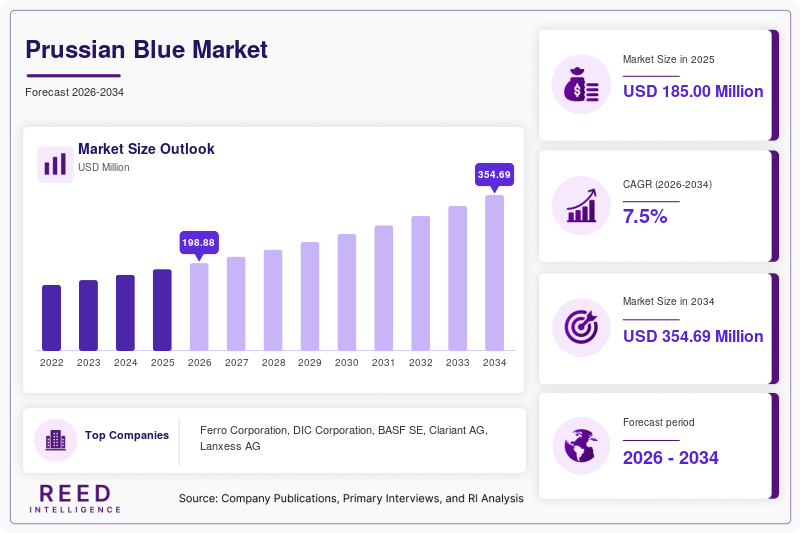
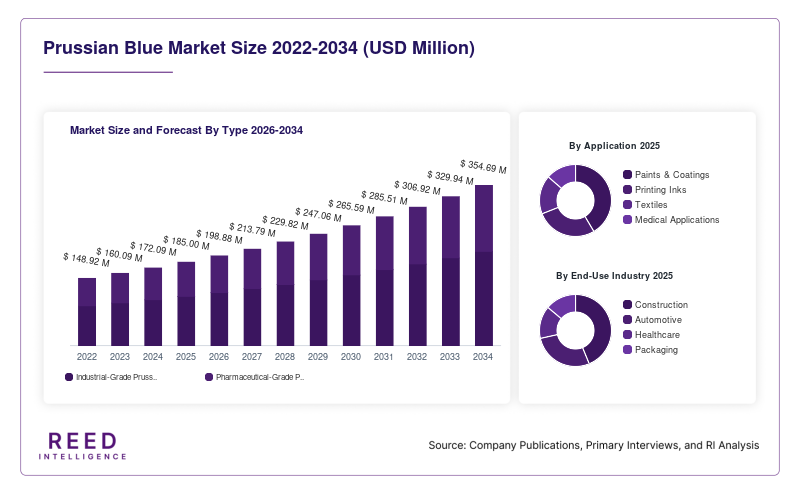
The Prussian Blue Market size was valued at approximately USD 185 million in 2025 and is projected to reach USD 355 million by 2034, expanding at a compound annual growth rate (CAGR) of 7.5% from 2025 to 2034. The market is witnessing consistent growth due to its wide range of applications across industries such as paints and coatings, printing inks, textiles, and medical treatments.
A key global factor supporting the growth of the Prussian Blue Market is the increasing demand for high-performance pigments in industrial and artistic applications. Prussian blue is widely recognized for its deep color intensity, chemical stability, and cost-effectiveness, making it suitable for coatings, inks, and specialty applications. In addition, its role in medical treatments, particularly for treating heavy metal poisoning, has contributed to steady demand across healthcare sectors.
Key Highlights:
- Asia Pacific dominated the market with a 42% share in 2025, while the same region is expected to register the fastest CAGR of 8.4% during the forecast period.
- Industrial-grade Prussian blue led the type segment with a 58% share, while pharmaceutical-grade Prussian blue is projected to grow at a CAGR of 8.9%.
- By application, paints & coatings accounted for 46% share, while medical applications are expected to expand at a CAGR of 8.7%.
- China remained the dominant country, with market values of USD 52 million in 2025 and USD 56 million in 2026.
Market Trends
Increasing Use in Advanced Battery Technologies
A notable trend shaping the Prussian Blue Market is its growing application in advanced battery technologies. Prussian blue analogs are being explored as cathode materials in sodium-ion batteries due to their structural stability and cost efficiency. This trend is gaining attention as industries seek alternatives to lithium-based batteries. The integration of Prussian blue compounds in energy storage solutions is expected to expand its industrial relevance and create new revenue streams.
Rising Demand in Artistic and Specialty Pigments
Another key trend is the increasing demand for Prussian blue in artistic and specialty pigment applications. The pigment’s vibrant color, durability, and resistance to fading make it a preferred choice among artists and manufacturers of premium paints and inks. The growth of the creative industry and rising consumer interest in high-quality art materials are supporting this trend, contributing to steady market expansion.
Market Drivers
Expanding Paints and Coatings Industry
The growth of the global paints and coatings industry is a significant driver of the Prussian Blue Market. Prussian blue is widely used as a pigment in industrial coatings, automotive finishes, and decorative paints. Its strong tinting strength and chemical stability make it suitable for various applications, driving consistent demand across industries.
Increasing Adoption in Medical Treatments
The use of Prussian blue in medical treatments is another key driver of market growth. It is used as an antidote for certain types of heavy metal poisoning, including cesium and thallium exposure. The increasing focus on emergency preparedness and healthcare readiness has supported the demand for pharmaceutical-grade Prussian blue, contributing to market expansion.
Market Restraint
Environmental and Regulatory Concerns
One of the major restraints in the Prussian Blue Market is the growing concern over environmental and regulatory compliance. The production and disposal of chemical pigments are subject to strict environmental regulations, particularly in developed regions. Manufacturers must adhere to guidelines related to emissions, waste management, and chemical handling.
These regulatory requirements can increase production costs and limit market entry for smaller players. Additionally, concerns regarding the environmental impact of synthetic pigments may encourage the adoption of alternative eco-friendly materials. This shift could pose challenges for traditional Prussian blue manufacturers, potentially affecting market growth in the long term.
Market Opportunities
Growth in Energy Storage Applications
The expanding energy storage sector presents a significant opportunity for the Prussian Blue Market. The development of sodium-ion batteries as an alternative to lithium-ion technology is gaining momentum. Prussian blue compounds offer cost advantages and structural benefits, making them suitable for large-scale energy storage applications. This emerging application is expected to create new growth avenues for market participants.
Increasing Demand in Emerging Economies
Emerging economies in Asia Pacific and Latin America are witnessing rapid industrialization and urbanization. This has led to increased demand for paints, coatings, and printing inks, all of which utilize Prussian blue as a key pigment. As infrastructure development and manufacturing activities expand in these regions, the demand for Prussian blue is expected to rise significantly.
Segmental Analysis
By Type
Industrial-grade Prussian blue dominated the Prussian Blue Market with a 58% share in 2025. This segment is widely used in paints, coatings, and printing inks due to its strong pigmentation and cost-effectiveness.
Pharmaceutical-grade Prussian blue is expected to grow at the fastest CAGR of 8.9%. The increasing use of this compound in medical treatments and emergency preparedness will drive growth in this segment.
By Application
Paints & coatings accounted for the largest share of 46% in 2025. The widespread use of Prussian blue in decorative and industrial coatings has supported this segment’s dominance.
Medical applications are projected to grow at a CAGR of 8.7%. The increasing awareness of its use in treating heavy metal poisoning will contribute to segment growth.
By End-Use Industry
Construction and automotive industries held the largest share of 50% in 2025, as they are major consumers of paints and coatings. The demand for durable and high-performance pigments supports this segment.
Healthcare is expected to grow at a CAGR of 8.5%, driven by the increasing use of Prussian blue in pharmaceutical applications and emergency treatments.
By Distribution Channel
Direct sales dominated the market with a 62% share in 2025, as manufacturers often supply large quantities directly to industrial clients.
Online distribution is expected to grow at a CAGR of 8.3%, supported by the increasing adoption of digital platforms for chemical procurement.
Regional Analysis
North America
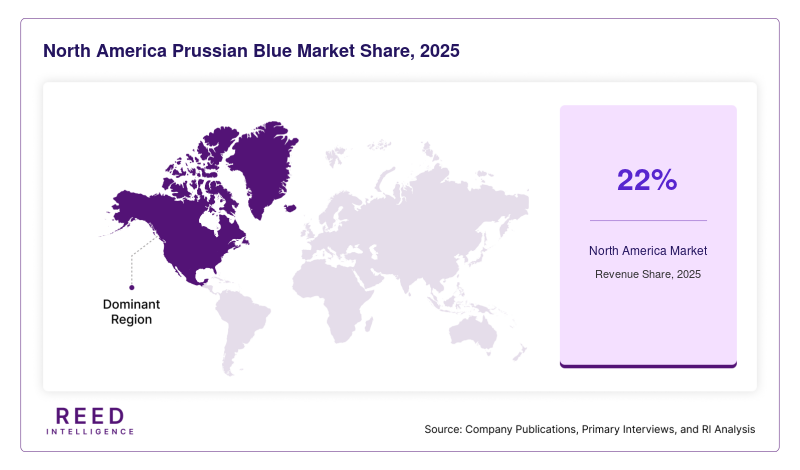
North America accounted for 22% of the Prussian Blue Market share in 2025 and will grow at a CAGR of 6.8% through 2034. The region benefits from a well-established industrial base and demand for specialty pigments.
The United States dominated the regional market due to its strong presence in the paints and coatings industry. The country’s focus on high-quality industrial materials has supported the steady demand for Prussian blue.
Europe
Europe held approximately 24% of the market share in 2025 and is expected to expand at a CAGR of 7.0% during the forecast period. The region has a strong tradition of chemical manufacturing and innovation.
Germany emerged as the leading country, driven by its advanced chemical industry and emphasis on sustainable production practices. The adoption of eco-friendly manufacturing processes is shaping market dynamics in the region.
Asia Pacific
Asia Pacific represented 42% of the market share in 2025 and will register the fastest CAGR of 8.4% through 2034. Rapid industrialization and urbanization are key factors driving growth.
China led the regional market due to its large-scale manufacturing sector and high demand for industrial pigments. The expansion of construction and automotive industries has further boosted demand for Prussian blue.
Middle East & Africa
The Middle East & Africa accounted for 6% of the market share in 2025 and is projected to grow at a CAGR of 7.2%. The region is gradually expanding its industrial capabilities.
Saudi Arabia dominated the market due to its investments in industrial diversification and infrastructure development. The growing demand for coatings and construction materials is supporting market growth.
Latin America
Latin America held around 6% of the market share in 2025 and is expected to grow at a CAGR of 7.1% during the forecast period. The region is experiencing steady industrial growth.
Brazil emerged as the leading country, supported by increasing demand for paints and coatings in construction and automotive sectors. Economic development initiatives are driving market expansion.
Competitive Landscape
The Prussian Blue Market is moderately fragmented, with key players focusing on product quality, innovation, and regulatory compliance. Companies are investing in research and development to enhance pigment performance and explore new applications.
Ferro Corporation is recognized as a leading player in the market, known for its extensive portfolio of high-performance pigments. The company recently introduced improved formulations of Prussian blue pigments with enhanced stability and environmental compliance, strengthening its market position.
Other major players are focusing on expanding their production capacities and entering emerging markets to increase their global footprint. Strategic collaborations and technological advancements remain key approaches for sustaining competitiveness in this market.
Key Players List
- Ferro Corporation
- DIC Corporation
- BASF SE
- Clariant AG
- Lanxess AG
- Merck KGaA
- Huntsman Corporation
- Shepherd Color Company
- Sun Chemical Corporation
- Cathay Industries
- Venator Materials PLC
- Tronox Holdings plc
- Heubach GmbH
- Dominion Colour Corporation
- Kolortek Co., Ltd.
Recent Developments
- In 2025, manufacturers introduced advanced Prussian blue pigments for use in sodium-ion battery applications.
- Several companies expanded their production facilities to meet rising demand in Asia Pacific.
- New environmentally compliant pigment formulations were launched to meet regulatory standards.
- Strategic partnerships were formed to enhance distribution networks in emerging markets.
- Increased investment in research focused on expanding medical applications of Prussian blue.
Prussian Blue Market Segments
By Type
- Industrial-Grade Prussian Blue
- Pharmaceutical-Grade Prussian Blue
By Application
- Paints & Coatings
- Printing Inks
- Textiles
- Medical Applications
By End-Use Industry
- Construction
- Automotive
- Healthcare
- Packaging
By Distribution Channel
- Direct Sales
- Distributors
- Online
By Region
- North America
- Europe
- APAC
- Middle East and Africa
- LATAM