Psoriasis Treatment Market Size, Share & Demand Report By Drug Class (Biologics, Topical Therapies, Systemic Therapies, Oral Small Molecule Therapies), By Disease Type (Plaque Psoriasis, Guttate Psoriasis, Pustular Psoriasis, Inverse Psoriasis, Psoriatic Arthritis-Associated Psoriasis), By Route of Administration (Injectable Therapies, Oral Therapies, Topical Administration), By Distribution Channel (Hospital Pharmacies, Retail Pharmacies, Specialty Pharmacies, Online Pharmacies), By Region & Se
USD 3950
Market Overview
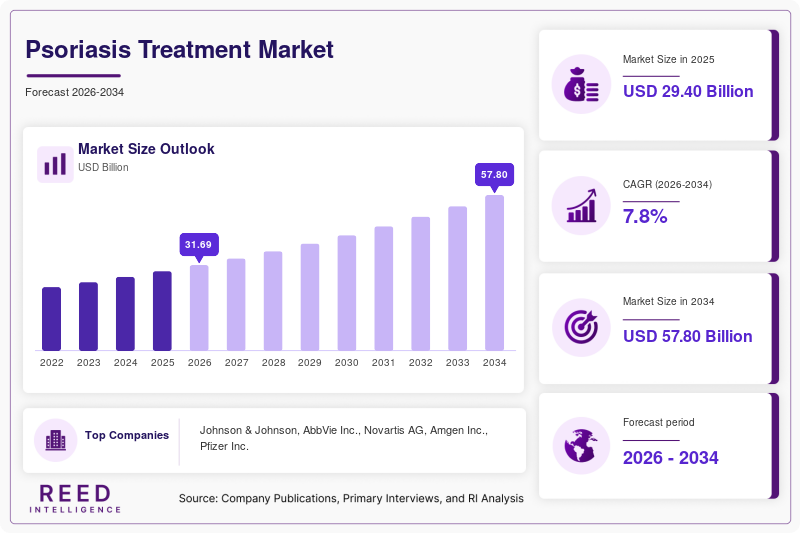
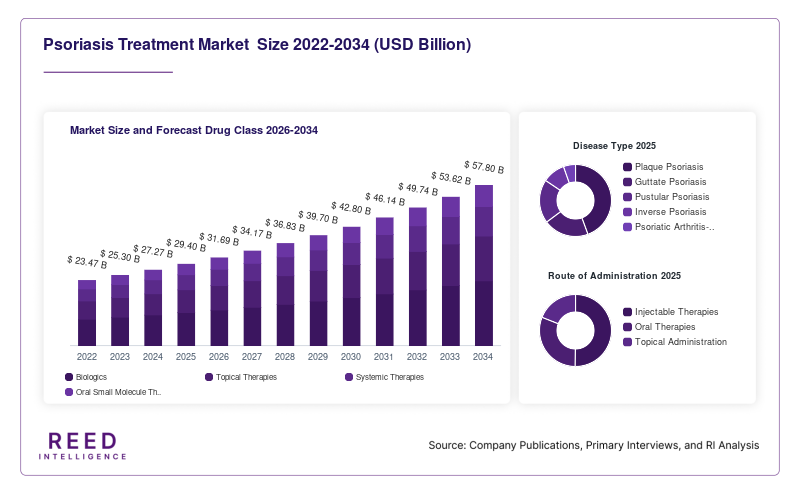
The Psoriasis Treatment Market was valued at USD 29.4 billion in 2026 and is projected to reach USD 53.8 billion by 2034, expanding at a CAGR of 7.8% during the forecast period (2026–2034). Psoriasis is a chronic autoimmune skin disorder characterized by rapid skin cell growth, inflammation, scaling, and recurrent flare-ups. Treatment options include topical therapies, systemic medications, biologics, oral small molecules, and phototherapy, all aimed at controlling symptoms, reducing inflammation, and improving patient quality of life.
A major global factor supporting market growth has been the increasing prevalence of autoimmune and inflammatory disorders worldwide. Improved disease awareness, broader access to dermatological care, enhanced diagnostic capabilities, and the growing availability of advanced biologic therapies have contributed significantly to the expansion of the Psoriasis Treatment Market. Healthcare systems across developed and emerging economies are increasingly prioritizing chronic disease management, creating favorable conditions for treatment adoption.
Key Highlights
- North America accounted for the largest market share of 42.8% in 2025, while Asia Pacific is anticipated to register the fastest CAGR of 9.4% during 2026–2034.
- By Drug Class, Biologics held the dominant share of 48.6% in 2025, while Oral Small Molecule Therapies are projected to expand at a CAGR of 10.1%.
- By Disease Type, Plaque Psoriasis represented the leading share of 71.2% in 2025, whereas Psoriatic Arthritis-Associated Psoriasis is forecast to grow at a CAGR of 8.9%.
- By Route of Administration, Injectable Therapies accounted for 52.4% of the market in 2025, while Oral Therapies are projected to register a CAGR of 8.7%.
- By Distribution Channel, Hospital Pharmacies captured the largest share of 44.5% in 2025, whereas Online Pharmacies are expected to grow at a CAGR of 11.3%.
- The United States, the dominant country market, was valued at USD 10.8 billion in 2024 and increased to USD 11.6 billion in 2025.
Market Trends
Expansion of Targeted Biologic Therapies
Biologic therapies continue to reshape treatment standards within the Psoriasis Treatment Market. Pharmaceutical companies are introducing highly selective therapies targeting interleukin pathways such as IL-17, IL-23, and TNF-alpha. These treatments offer improved disease control, reduced symptom severity, and longer remission periods. Increasing physician preference for targeted therapies is expected to support continued market expansion.
Growing Adoption of Digital Dermatology Platforms
Telemedicine and digital dermatology solutions are becoming increasingly integrated into psoriasis management. Patients can access virtual consultations, treatment monitoring services, medication adherence tools, and disease-tracking applications. These technologies improve patient engagement and facilitate continuous disease management, particularly in regions with limited access to specialist care.
Market Drivers
Rising Prevalence of Chronic Autoimmune Skin Disorders
The increasing incidence of psoriasis and related autoimmune conditions remains a major growth driver. Genetic predisposition, environmental triggers, lifestyle factors, and growing awareness have contributed to higher diagnosis rates globally. The expanding patient population continues to generate sustained demand for effective therapeutic interventions.
Increasing Availability of Advanced Therapeutic Options
The introduction of innovative biologics, biosimilars, and targeted oral therapies has significantly expanded treatment possibilities for psoriasis patients. Enhanced efficacy profiles, improved safety outcomes, and longer treatment durability have encouraged physicians to adopt advanced treatment regimens, supporting market growth across multiple healthcare settings.
Market Restraint
High Cost of Biologic Treatment Regimens
Despite their clinical effectiveness, biologic therapies often involve substantial treatment expenses. High medication costs can create affordability challenges for patients and healthcare systems, particularly in regions with limited reimbursement support. Cost-related barriers may restrict treatment accessibility and influence therapeutic decision-making.
Market Opportunities
Expansion of Biosimilar Product Portfolios
The growing development and commercialization of biosimilar therapies present significant opportunities within the Psoriasis Treatment Market. Biosimilars can improve treatment affordability while expanding patient access to advanced biologic therapies. Pharmaceutical companies are increasingly investing in biosimilar development strategies to address unmet market demand.
Growth Potential in Emerging Healthcare Markets
Developing economies are experiencing improvements in healthcare infrastructure, dermatology services, and pharmaceutical accessibility. Increasing healthcare expenditure and expanding insurance coverage are creating favorable opportunities for psoriasis treatment manufacturers seeking market expansion beyond traditional high-income regions.
Segmental Analysis
By Drug Class
The Psoriasis Treatment Market is segmented into Biologics, Topical Therapies, Systemic Therapies, and Oral Small Molecule Therapies.
Biologics accounted for the largest share of 48.6% in 2025. Their dominance was attributed to superior efficacy in moderate-to-severe psoriasis management and increasing physician preference for targeted immune-modulating treatments. These therapies continue to represent a significant portion of treatment expenditures globally.
Oral Small Molecule Therapies are projected to expand at a CAGR of 10.1% through 2034. Growth will be driven by improved convenience, reduced administration complexity, and ongoing development of targeted oral treatments with favorable safety profiles.
By Disease Type
The market is segmented into Plaque Psoriasis, Guttate Psoriasis, Pustular Psoriasis, Inverse Psoriasis, and Psoriatic Arthritis-Associated Psoriasis.
Plaque Psoriasis held the dominant share of 71.2% in 2025. This segment maintained leadership due to its status as the most frequently diagnosed psoriasis subtype and the broad availability of treatment options specifically targeting plaque manifestations.
Psoriatic Arthritis-Associated Psoriasis is expected to witness a CAGR of 8.9% during the forecast period. Growth will result from increasing recognition of joint involvement among psoriasis patients and greater emphasis on integrated disease management strategies.
By Route of Administration
The Psoriasis Treatment Market is segmented into Injectable Therapies, Oral Therapies, and Topical Administration.
Injectable Therapies accounted for the largest share of 52.4% in 2025. The segment's dominance was supported by widespread utilization of biologics administered through subcutaneous or intravenous delivery methods for moderate-to-severe disease management.
Oral Therapies are anticipated to register a CAGR of 8.7% through 2034. Growth will be supported by patient preference for convenient treatment formats and continued innovation in targeted oral therapeutic development.
By Distribution Channel
The market is segmented into Hospital Pharmacies, Retail Pharmacies, Specialty Pharmacies, and Online Pharmacies.
Hospital Pharmacies captured 44.5% of market revenue in 2025. Their leadership position was supported by the administration requirements associated with advanced biologics and specialist treatment oversight for complex psoriasis cases.
Online Pharmacies are forecast to grow at a CAGR of 11.3% during the forecast period. Growth will stem from increasing digital healthcare adoption, convenient medication access, and expanding e-commerce integration within pharmaceutical distribution networks.
Regional Analysis
North America
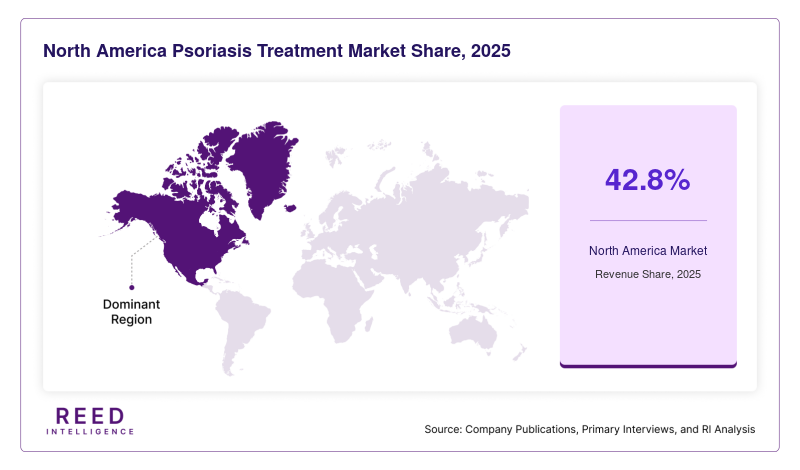
North America accounted for 42.8% of the global Psoriasis Treatment Market share in 2025 and is expected to expand at a CAGR of 7.2% through 2034. The region benefits from advanced healthcare systems, strong biologic adoption rates, and extensive access to specialty dermatology services.
The United States remained the dominant country market. Growth is supported by high treatment awareness, favorable reimbursement frameworks, and significant investment in autoimmune disease research and therapeutic innovation.
Europe
Europe represented 29.1% of the global market share in 2025 and is projected to register a CAGR of 7.4% during the forecast period. The region maintains strong healthcare coverage and increasing adoption of biologics and biosimilar therapies for chronic autoimmune conditions.
Germany emerged as the leading country market. Growth is influenced by broad access to specialist dermatology care and increasing utilization of advanced treatment protocols for moderate-to-severe psoriasis management.
Asia Pacific
Asia Pacific held 18.4% of the global Psoriasis Treatment Market share in 2025 and is anticipated to grow at a CAGR of 9.4% from 2026 to 2034. Rising healthcare expenditure, expanding patient awareness, and improving access to advanced therapies continue to support regional market growth.
China remained the dominant country market. Growth is driven by healthcare infrastructure development, increasing diagnosis rates, and broader availability of innovative dermatology treatments.
Middle East & Africa
The Middle East & Africa accounted for 4.2% of global revenue in 2025 and is projected to expand at a CAGR of 8.0% during the forecast period. The region is witnessing gradual improvements in specialty healthcare services and access to advanced pharmaceutical therapies.
Saudi Arabia represented the dominant country market. Growth is supported by increasing investment in healthcare modernization and expanding availability of specialized dermatological treatment services.
Latin America
Latin America captured 5.5% of the global market share in 2025 and is expected to register a CAGR of 7.8% through 2034. Expanding healthcare access and increasing awareness regarding chronic skin disorders continue to contribute to market development.
Brazil remained the dominant country market. Growth is influenced by rising diagnosis rates and improved access to specialty dermatology care across urban healthcare centers.
Competitive Landscape
The Psoriasis Treatment Market remains highly competitive, characterized by continuous innovation, strong research pipelines, and strategic collaborations. Market participants focus on expanding biologic portfolios, developing next-generation immune-targeting therapies, and strengthening global commercialization strategies.
Johnson & Johnson maintained a leading market position through its established psoriasis treatment portfolio and broad global market presence. The company recently expanded clinical development activities focused on advanced immune-pathway therapies designed to improve long-term disease control and patient outcomes.
Other major participants including AbbVie Inc., Novartis AG, Amgen Inc., and Pfizer Inc. continue to strengthen market positions through biologic innovation, biosimilar development programs, and strategic investments in autoimmune disease therapeutics.
Key Players List
- Johnson & Johnson
- AbbVie Inc.
- Novartis AG
- Amgen Inc.
- Pfizer Inc.
- Eli Lilly and Company
- Bristol Myers Squibb
- UCB S.A.
- Sun Pharmaceutical Industries Ltd.
- Boehringer Ingelheim International GmbH
- Merck & Co., Inc.
- Almirall S.A.
- LEO Pharma A/S
- Biocon Biologics Ltd.
- Viatris Inc.
Recent Developments
- In January 2026, a major pharmaceutical company initiated late-stage clinical trials for a next-generation IL-23 inhibitor targeting moderate-to-severe psoriasis patients.
- In March 2026, several manufacturers expanded biosimilar development programs focused on improving treatment accessibility and affordability.
- In July 2026, new oral small molecule therapies entered regulatory review processes in multiple healthcare markets.
- In October 2026, leading market participants strengthened digital patient support programs designed to improve medication adherence and disease monitoring.
- In February 2027, pharmaceutical companies announced strategic collaborations focused on biomarker-driven treatment personalization initiatives.
- In June 2027, several healthcare providers expanded teledermatology services supporting remote psoriasis management and follow-up care.
- In September 2027, manufacturers increased investments in advanced biologic production facilities to address growing global demand.
- In January 2028, industry participants launched integrated patient engagement platforms combining digital consultations, treatment education, and adherence monitoring tools.
Psoriasis Treatment Market Segments
Drug Class
- Biologics
- Topical Therapies
- Systemic Therapies
- Oral Small Molecule Therapies
Disease Type
- Plaque Psoriasis
- Guttate Psoriasis
- Pustular Psoriasis
- Inverse Psoriasis
- Psoriatic Arthritis-Associated Psoriasis
Route of Administration
- Injectable Therapies
- Oral Therapies
- Topical Administration
Distribution Channel
- Hospital Pharmacies
- Retail Pharmacies
- Specialty Pharmacies
- Online Pharmacies
By Region
- North America
- Europe
- APAC
- Middle East and Africa
- LATAM