PTFE Tube Market Size, Share & Demand Report By Type (Virgin PTFE Tubes, Expanded PTFE Tubes, Modified PTFE Tubes), By Application (Chemical Processing, Semiconductor Manufacturing, Pharmaceuticals, Aerospace, Food & Beverage), By End-Use Industry (Pharmaceuticals, Chemicals & Petrochemicals, Electronics & Semiconductors, Aerospace & Defense, Energy & Power), By Region & Segment Forecasts, 2026–2034
USD 3950
Market Overview
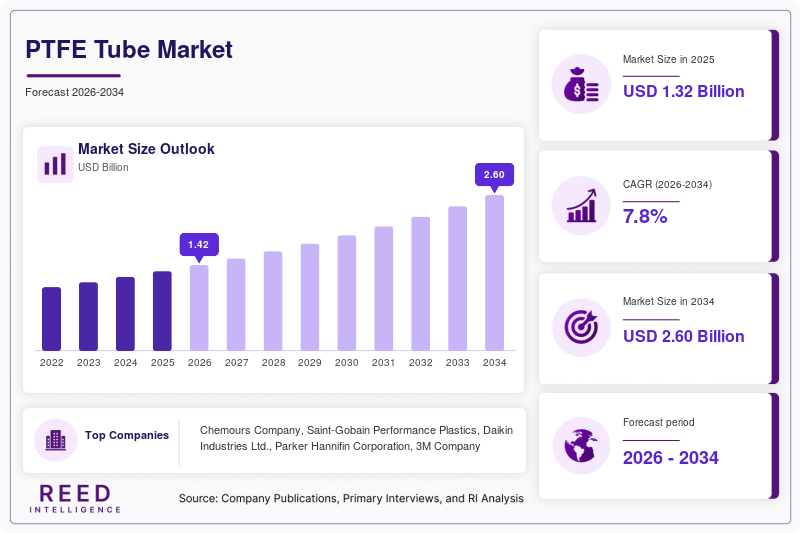
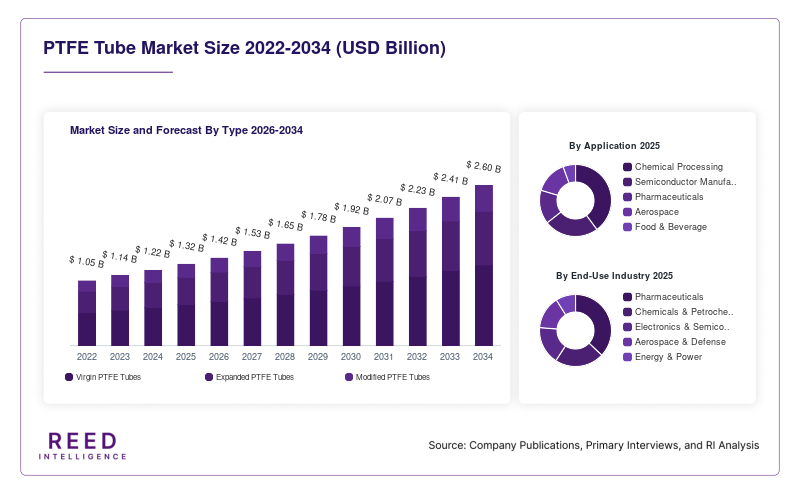
In 2026, the PTFE Tube Market size is estimated to be valued at approximately USD 1.42 billion, and is projected to reach nearly USD 2.58 billion by 2034, expanding at a compound annual growth rate (CAGR) of 7.8% during the forecast period 2026–2034. Growth is primarily driven by increasing adoption of high-performance fluoropolymer tubing in industries requiring chemical resistance, thermal stability, and low friction properties. The expansion of semiconductor manufacturing, pharmaceuticals, and chemical processing industries has further strengthened demand for PTFE tubes across global supply chains. Additionally, rising investment in advanced fluid handling systems has supported steady market penetration across both developed and emerging economies.
A key global factor supporting market growth is the increasing shift toward high-purity and corrosion-resistant materials in critical industrial applications. PTFE tubes, known for their inert chemical properties and wide operating temperature range, are increasingly replacing conventional plastic and metal tubing in sensitive environments such as laboratory systems and semiconductor fabrication units. Furthermore, stricter environmental and safety regulations across manufacturing sectors have accelerated the adoption of fluoropolymer-based solutions.
Key Highlights
- North America dominated the market with a 34.2% share in 2025.
- Asia Pacific is expected to grow at the fastest CAGR of 11.2% during 2026–2034.
- By application, chemical processing accounted for the largest share of 39.6%.
- while semiconductor manufacturing is projected to grow at a CAGR of 12.1%.
- By end-use industry, pharmaceuticals led with a 36.4% share.
- whereas electronics and semiconductors are expected to expand at a CAGR of 12.6%.
- The United States remained the dominant country, with market values of USD 540 million in 2024 and USD 585 million in 2025.
Market Trends
Expansion of High-Purity Applications in Semiconductor and Medical Industries
The PTFE Tube Market is witnessing a strong shift toward high-purity applications, particularly within semiconductor fabrication and medical device manufacturing. In semiconductor production, PTFE tubing is increasingly used for ultra-clean fluid transfer systems due to its resistance to particle contamination and chemical degradation. Similarly, in medical applications, PTFE tubes are utilized in catheter systems, diagnostic equipment, and sterile fluid transfer systems, where biocompatibility and non-reactivity are essential. The growing demand for miniaturized and precision-based components in electronics and healthcare has further strengthened the requirement for reliable tubing materials. Manufacturers are investing in enhanced extrusion technologies to produce ultra-smooth internal surfaces that reduce contamination risks and improve flow efficiency.
Integration of Advanced Manufacturing and Customization Capabilities
Another significant trend shaping the PTFE Tube Market is the adoption of advanced manufacturing technologies, including precision extrusion, laser sintering, and automated quality inspection systems. These innovations enable the production of PTFE tubes with tighter tolerances, improved flexibility, and customized dimensions for specific industrial applications. Demand for application-specific tubing solutions is rising in aerospace, chemical processing, and analytical instrumentation industries. Additionally, customization trends are encouraging manufacturers to develop multi-layered PTFE tubing that combines mechanical strength with enhanced chemical resistance. The integration of digital manufacturing systems has also improved production scalability, enabling suppliers to meet growing global demand while maintaining consistent product quality.
Market Drivers
Rising Demand from Chemical Processing and Industrial Fluid Handling
A major driver of the PTFE Tube Market is the expanding use of fluoropolymer tubing in chemical processing and industrial fluid handling systems. PTFE tubes offer exceptional resistance to aggressive chemicals, acids, and solvents, making them ideal for use in corrosive environments. Industries such as petrochemicals, fertilizers, and specialty chemicals rely heavily on PTFE tubing for safe and efficient material transfer. Increasing industrial automation has also contributed to demand, as automated systems require reliable and long-lasting fluid conveyance components. Furthermore, the replacement of metal and conventional polymer tubes with PTFE alternatives has improved operational efficiency and reduced maintenance downtime across processing facilities.
Growth in Pharmaceutical and Biotechnology Applications
The pharmaceutical and biotechnology sectors represent another strong driver of market growth. PTFE tubes are widely used in drug manufacturing, laboratory equipment, and sterile fluid transfer systems due to their non-reactive and contamination-resistant properties. The expansion of biologics, vaccine production, and personalized medicine has significantly increased demand for high-performance tubing systems. Regulatory requirements for hygiene and material safety have further reinforced the adoption of PTFE-based solutions. Additionally, the growth of single-use systems in bioprocessing has created new opportunities for flexible and disposable PTFE tubing applications, supporting consistent demand across global pharmaceutical manufacturing facilities.
Market Restraint
High Production Costs and Material Processing Challenges
One of the primary restraints in the PTFE Tube Market is the relatively high cost associated with raw material production and processing. PTFE manufacturing involves complex polymerization techniques and high-temperature sintering processes, which increase overall production expenses. Additionally, PTFE is difficult to process due to its non-meltable nature, requiring specialized equipment and skilled labor for extrusion and shaping. These factors contribute to higher product pricing compared to conventional tubing materials such as polyethylene or PVC. In cost-sensitive industries, this pricing gap can limit adoption, particularly in small-scale manufacturing operations and developing markets where budget constraints are significant.
Market Opportunities
Expansion in Renewable Energy and Hydrogen Infrastructure
The increasing global focus on renewable energy systems presents a strong opportunity for the PTFE Tube Market. PTFE tubes are increasingly used in hydrogen fuel systems, solar panel manufacturing equipment, and energy storage technologies due to their chemical stability and resistance to extreme environmental conditions. As hydrogen infrastructure expands, demand for safe and leak-resistant tubing materials is expected to rise significantly. PTFE’s ability to withstand high pressure and corrosive gases makes it suitable for next-generation energy applications. Governments and private investors are accelerating investments in clean energy projects, further opening new growth avenues for PTFE tube manufacturers.
Technological Advancements in Aerospace and Defense Systems
Another key opportunity lies in the aerospace and defense sector, where PTFE tubes are used in hydraulic systems, fuel lines, and thermal insulation applications. The increasing development of advanced aircraft and spacecraft systems has created demand for lightweight, high-performance materials capable of withstanding extreme conditions. PTFE tubing offers excellent dielectric properties and temperature resistance, making it suitable for mission-critical applications. Additionally, defense modernization programs across various countries are increasing procurement of advanced materials for military vehicles and aviation systems. This trend is expected to support long-term market expansion in high-value industrial segments.
Segmental Analysis
By Type
Virgin PTFE tubes accounted for the largest share of the PTFE Tube Market, representing nearly 48.3% of global revenue in 2024. These tubes are widely preferred due to their superior purity, high thermal stability, and exceptional chemical resistance. Industries such as pharmaceuticals, semiconductor manufacturing, and biotechnology rely heavily on virgin PTFE tubing for contamination-sensitive applications. The material’s low friction coefficient and non-reactive properties also make it suitable for laboratory systems, medical equipment, and precision fluid transfer systems. Furthermore, increasing demand for high-purity industrial materials has encouraged manufacturers to expand production capacities for virgin PTFE tubing solutions.
Expanded PTFE tubes are projected to witness the fastest CAGR of 8.6% during the forecast period. Growth is primarily driven by increasing applications in filtration systems, sealing technologies, and advanced biomedical devices. Expanded PTFE offers improved flexibility and porosity compared to conventional tubing materials, making it suitable for specialized industrial applications. The material is increasingly used in aerospace insulation systems and high-performance filtration equipment where durability and lightweight properties are essential. Additionally, technological advancements in extrusion and material processing are enabling manufacturers to develop customized expanded PTFE tubing solutions for complex industrial environments.
By Application
Chemical processing emerged as the dominant application segment, accounting for approximately 41.2% of the PTFE Tube Market share in 2024. PTFE tubes are extensively used in chemical transfer systems, reactors, and fluid handling equipment because they can withstand aggressive acids, solvents, and corrosive materials. Chemical manufacturers increasingly prefer PTFE tubing due to its long operational life and ability to reduce maintenance requirements. The growing adoption of automated chemical processing systems has also contributed to segment growth, as reliable tubing materials are critical for operational efficiency and workplace safety. Furthermore, expanding global specialty chemical production continues to support strong demand for PTFE tubing systems.
Semiconductor manufacturing is anticipated to be the fastest-growing application segment, registering a CAGR of 12.1% through 2034. The increasing production of advanced chips, sensors, and electronic devices has created substantial demand for ultra-clean and chemically stable tubing materials. PTFE tubes are widely used in semiconductor fabrication plants for high-purity fluid transfer and contamination-sensitive processing environments. Rising investments in semiconductor manufacturing facilities across Asia Pacific and North America are expected to accelerate demand further. Additionally, the growing complexity of semiconductor production technologies is increasing the need for precision-engineered PTFE tubing systems with enhanced durability and purity standards.
By End-Use Industry
The pharmaceutical industry dominated the PTFE Tube Market with a revenue share of nearly 37.5% in 2024. PTFE tubes are extensively utilized in sterile processing systems, laboratory equipment, and pharmaceutical manufacturing lines due to their non-reactive and contamination-resistant characteristics. Increasing production of biologics, vaccines, and specialty drugs has significantly boosted demand for high-purity tubing systems. Regulatory requirements for clean manufacturing environments have also encouraged pharmaceutical companies to adopt fluoropolymer-based fluid handling solutions. Furthermore, rising healthcare expenditure and expansion of global pharmaceutical production capacities continue to strengthen segment growth.
Electronics and semiconductors are expected to register the fastest CAGR of 12.6% during the forecast period. The rapid growth of consumer electronics, data centers, and semiconductor fabrication facilities has increased demand for PTFE tubing in cleanroom environments and precision manufacturing systems. PTFE tubes provide excellent dielectric properties and high resistance to harsh chemicals used in electronics manufacturing processes. Expanding investments in next-generation semiconductor technologies and advanced electronic devices are further supporting market growth. In addition, increasing demand for miniaturized electronic components has encouraged manufacturers to develop precision-engineered PTFE tubing products tailored for advanced production environments.
Regional Analysis
North America
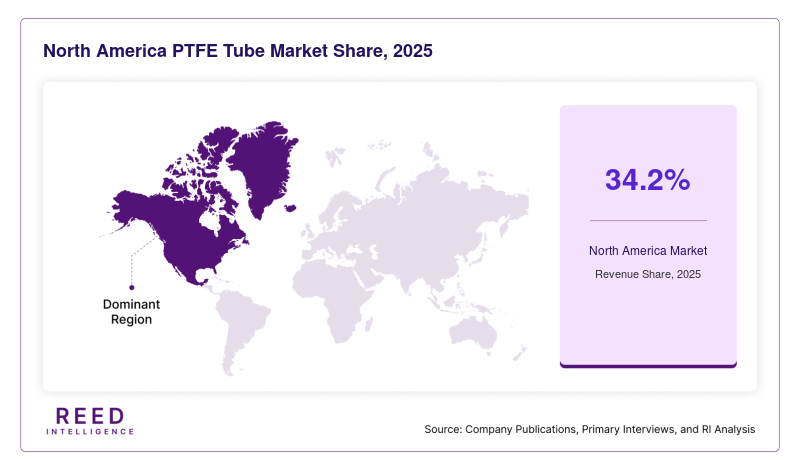
North America accounted for the largest share of the PTFE Tube Market, representing approximately 34.2% of global revenue in 2025. The region is projected to expand at a CAGR of 7.4% during the forecast period due to strong demand from pharmaceutical manufacturing, semiconductor fabrication, and aerospace applications. The presence of advanced industrial infrastructure and strict regulatory standards for chemical handling systems has accelerated the adoption of high-performance PTFE tubing solutions. Additionally, increasing investment in industrial automation and fluid transfer technologies is supporting market expansion across the United States and Canada.
The United States remained the dominant country in North America, with market values reaching nearly USD 585 million in 2025. Growth is largely driven by the rapid expansion of semiconductor production facilities and increasing pharmaceutical manufacturing capacity. Rising demand for ultra-high purity tubing systems in biotechnology laboratories and medical equipment production has further strengthened PTFE tube consumption. Furthermore, government support for domestic electronics manufacturing and aerospace innovation continues to create long-term growth opportunities for regional suppliers.
Europe
Europe held nearly 27.8% of the global PTFE Tube Market share in 2025 and is expected to register a CAGR of 7.1% through 2034. Market growth is supported by increasing adoption of fluoropolymer tubing in automotive systems, industrial processing, and healthcare applications. European manufacturers are increasingly focusing on energy-efficient and corrosion-resistant fluid handling systems, driving demand for PTFE tubes across multiple industrial sectors. The region also benefits from stringent environmental regulations that encourage the use of durable and chemically stable materials in manufacturing operations.
Germany dominated the European market due to its strong industrial base and advanced engineering capabilities. The country has witnessed growing demand for PTFE tubing in chemical plants, precision machinery, and automotive manufacturing systems. Increasing investments in electric vehicle production and advanced industrial automation have created additional opportunities for fluoropolymer tubing suppliers. Moreover, Germany’s emphasis on sustainable manufacturing practices and industrial safety standards continues to support long-term market development across the region.
Asia Pacific
Asia Pacific represented approximately 25.6% of the global PTFE Tube Market in 2025 and is anticipated to grow at the fastest CAGR of 11.2% during the forecast period. Rapid industrialization, expansion of semiconductor manufacturing, and increasing pharmaceutical production are key factors driving regional growth. Countries across the region are investing heavily in electronics manufacturing infrastructure and chemical processing facilities, creating strong demand for high-performance tubing materials. Additionally, the availability of low-cost manufacturing capabilities and expanding export-oriented industries continue to strengthen the regional market landscape.
China remained the dominant country within Asia Pacific, supported by extensive investments in semiconductor fabrication and industrial manufacturing. The country’s growing focus on domestic electronics production and advanced healthcare infrastructure has increased demand for PTFE tubing systems in cleanroom and high-purity applications. Rising production of specialty chemicals and increasing industrial automation across Chinese manufacturing facilities have also contributed to sustained market expansion. Furthermore, government-led industrial modernization initiatives are expected to enhance long-term growth opportunities for PTFE tube manufacturers operating in the region.
Middle East & Africa
The Middle East & Africa accounted for nearly 7.2% of the PTFE Tube Market share in 2025 and is projected to expand at a CAGR of 6.8% through 2034. Growth in the region is mainly driven by increasing investments in oil & gas processing, petrochemical production, and industrial infrastructure development. PTFE tubes are widely utilized in harsh industrial environments where resistance to chemicals and extreme temperatures is critical. In addition, growing awareness regarding industrial safety and operational efficiency is encouraging manufacturers to adopt high-performance fluoropolymer tubing systems.
Saudi Arabia emerged as the leading market within the region due to its expanding petrochemical sector and industrial diversification initiatives. The country is investing heavily in downstream chemical processing projects and advanced manufacturing facilities, which require durable and corrosion-resistant tubing solutions. Increasing focus on reducing maintenance costs and improving operational reliability in industrial plants has further accelerated PTFE tube adoption. Additionally, government-supported economic diversification programs continue to attract investments in non-oil industries, supporting broader market expansion.
Latin America
Latin America held around 5.2% of the global PTFE Tube Market share in 2025 and is expected to witness a CAGR of 6.5% during the forecast period. The region is experiencing growing demand for PTFE tubes in pharmaceutical production, chemical processing, and food manufacturing industries. Industrial modernization efforts and increasing adoption of advanced processing equipment are contributing to market growth. Moreover, regional manufacturers are increasingly investing in durable fluid handling systems to improve productivity and comply with evolving industrial standards.
Brazil dominated the Latin American market due to its expanding industrial manufacturing base and rising healthcare investments. The country has witnessed increasing demand for PTFE tubing in pharmaceutical laboratories, industrial processing plants, and specialty chemical production facilities. Growth is also supported by expanding food processing operations that require contamination-resistant tubing systems. Furthermore, increasing foreign investment in industrial infrastructure and manufacturing modernization projects is expected to strengthen long-term market opportunities for PTFE tube suppliers across Brazil and neighboring economies.
Competitive Landscape
The PTFE Tube Market is moderately competitive, with both multinational fluoropolymer manufacturers and regional specialty tubing suppliers competing through product innovation, strategic partnerships, and expansion of manufacturing capabilities. Companies are increasingly focusing on the development of high-purity and application-specific PTFE tubing solutions to meet the evolving requirements of semiconductor, pharmaceutical, and aerospace industries. Market participants are also investing in automation technologies and precision extrusion systems to improve production efficiency and product consistency.
Chemours Company remains one of the leading players in the market due to its extensive fluoropolymer portfolio and strong global distribution network. The company has expanded its high-performance PTFE product offerings to support rising demand from semiconductor and medical device manufacturers. Saint-Gobain Performance Plastics continues to strengthen its position through customized tubing solutions designed for advanced industrial processing systems. Daikin Industries Ltd. has focused on expanding its fluoropolymer manufacturing capabilities across Asia Pacific to support regional industrial growth. Parker Hannifin Corporation has increased investment in fluid transfer technologies and engineered tubing systems for aerospace and industrial applications. Meanwhile, 3M Company continues to develop advanced fluoropolymer materials with improved durability and chemical resistance for high-performance industrial environments.
Key Players
- Chemours Company
- Saint-Gobain Performance Plastics
- Daikin Industries Ltd.
- Parker Hannifin Corporation
- 3M Company
- Zeus Industrial Products
- Greene Tweed
- NICHIAS Corporation
- Teadit Group
- AMETEK Inc.
- Fluorotherm Polymers Inc.
- Habia Teknofluor AB
- Polyfluor Plastics BV
Recent Developments
- A leading fluoropolymer manufacturer expanded its PTFE tubing production facility in Asia to meet rising semiconductor demand.
- A global industrial supplier introduced a new line of ultra-high purity PTFE tubes for biopharmaceutical applications.
- A major market player announced investment in automated extrusion technology to improve dimensional accuracy and reduce production waste in PTFE tubing manufacturing.
PTFE Tube Market Segments
By Type
- Virgin PTFE Tubes
- Expanded PTFE Tubes
- Modified PTFE Tubes
By Application
- Chemical Processing
- Semiconductor Manufacturing
- Pharmaceuticals
- Aerospace
- Food & Beverage
By End-Use Industry
- Pharmaceuticals
- Chemicals & Petrochemicals
- Electronics & Semiconductors
- Aerospace & Defense
- Energy & Power
By Region
- North America
- Europe
- APAC
- Middle East and Africa
- LATAM