Public Safety in Building Wireless DAS System Market Size, Share & Demand Report By Component (Hardware, Software and Network Management Solutions), By Deployment Type (Active DAS Systems, Passive DAS Systems), By Frequency Type (VHF Systems, UHF Systems, Multi-Band Systems), By End User (Commercial Buildings, Healthcare Facilities, Government Buildings, Industrial Facilities) By Region & Segment Forecasts, 2026–2034
USD 3950
Market Overview
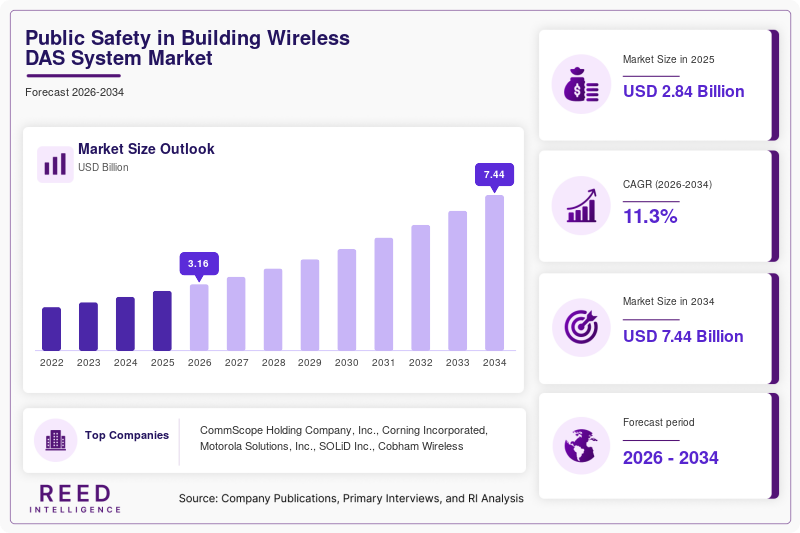
The Public Safety in Building Wireless DAS System Market was valued at approximately USD 2.84 billion in 2026 and is projected to reach nearly USD 6.71 billion by 2034, expanding at a CAGR of 11.3% during the forecast period from 2026 to 2034. The global Public Safety in Building Wireless DAS System Market is witnessing substantial growth due to increasing investments in emergency communication infrastructure, rising adoption of smart building technologies, and growing enforcement of public safety communication regulations across commercial and residential infrastructure projects. Public safety in-building wireless distributed antenna system (DAS) solutions are increasingly being deployed to improve radio signal coverage for first responders, firefighters, law enforcement agencies, and emergency medical teams inside buildings where traditional radio communication signals are weak or unavailable.
A major global factor supporting the growth of the Public Safety in Building Wireless DAS System Market is the rapid expansion of urban infrastructure and high-rise commercial construction activities worldwide. Governments and municipal authorities are increasingly implementing stringent building safety regulations that require uninterrupted emergency communication systems inside airports, hospitals, shopping malls, stadiums, tunnels, educational institutions, and industrial facilities. In addition, increasing concerns regarding disaster preparedness and emergency response efficiency are encouraging property developers and infrastructure operators to invest in advanced wireless communication coverage systems. The growing integration of 5G-ready infrastructure and smart city communication frameworks is also positively influencing long-term market expansion.
Key Highlights
- North America dominated the market with 41% share in 2025, while Asia Pacific is projected to witness the fastest growth at a 12.6% CAGR during 2026–2034.
- By component, hardware solutions accounted for the largest market share of 49% in 2025, while software and network management solutions are projected to expand at a CAGR of 12.9% during the forecast period.
- By deployment type, active DAS systems held the dominant market share of 58% in 2025, whereas hybrid DAS systems are anticipated to grow at a CAGR of 13.1% through 2034.
- By end user, commercial buildings represented the leading segment with 36% share in 2025, while healthcare facilities are expected to witness a CAGR of 12.8% during the forecast timeline.
- The United States remained the dominant country market and was valued at approximately USD 812 million in 2024 and USD 903 million in 2025.
Market Trends
Increasing Integration of Smart Building Communication Infrastructure
One of the major trends shaping the Public Safety in Building Wireless DAS System Market is the increasing integration of smart building communication technologies with emergency wireless infrastructure. Modern commercial buildings are adopting centralized digital communication platforms that support security monitoring, emergency alerts, IoT-based automation, and public safety radio connectivity through a unified network architecture. Building owners are increasingly integrating wireless DAS systems during the early stages of infrastructure planning to ensure seamless communication coverage and regulatory compliance.
Smart building operators are also emphasizing network scalability and interoperability to support future communication technologies. Advanced DAS systems now support multi-frequency public safety communication standards and are designed to integrate with cloud-based monitoring platforms. This trend is expected to strengthen long-term market demand across urban infrastructure projects and intelligent building developments.
Rising Adoption of 5G-Compatible Public Safety DAS Systems
Another important trend in the Public Safety in Building Wireless DAS System Market is the growing deployment of 5G-compatible public safety communication infrastructure. Property developers and network integrators are increasingly investing in advanced DAS systems capable of supporting both public safety frequencies and commercial cellular networks simultaneously. This integration helps reduce infrastructure complexity while improving indoor wireless connectivity for occupants and emergency responders.
Manufacturers are developing next-generation DAS platforms with improved bandwidth capacity, remote network management capabilities, and enhanced signal amplification technologies. These systems are increasingly being deployed across airports, transportation hubs, manufacturing plants, and mixed-use commercial properties. The transition toward digital emergency communication systems and high-speed wireless connectivity is expected to accelerate future market expansion.
Market Drivers
Stringent Public Safety Communication Regulations
The implementation of strict public safety communication standards is a major factor driving the growth of the Public Safety in Building Wireless DAS System Market. Governments and fire safety authorities across multiple countries are introducing regulations requiring uninterrupted emergency responder radio coverage inside large buildings and underground facilities. Compliance with these regulations is becoming mandatory for new construction projects and major building renovations.
Building owners are increasingly deploying DAS infrastructure to comply with fire codes, emergency preparedness standards, and communication reliability requirements. The growing focus on occupant safety and emergency response coordination is expected to continue supporting market demand throughout the forecast period.
Expansion of Commercial and High-Rise Infrastructure Projects
Another significant driver supporting the Public Safety in Building Wireless DAS System Market is the increasing development of commercial infrastructure and high-rise urban buildings. Large commercial complexes, airports, hotels, hospitals, and entertainment venues often experience poor radio signal penetration due to dense construction materials and complex architectural layouts.
Infrastructure developers are increasingly investing in in-building wireless coverage systems to improve communication reliability and emergency response readiness. The rapid pace of urbanization and the growing number of smart infrastructure projects are contributing significantly to the expansion of the market across developed and emerging economies.
Market Restraint
High Installation and System Maintenance Costs
One of the primary restraints affecting the Public Safety in Building Wireless DAS System Market is the high cost associated with system installation, infrastructure integration, and long-term maintenance. Public safety DAS deployment requires specialized engineering, network design, signal testing, and regulatory compliance verification, which can increase project expenses significantly. Small property owners and budget-constrained infrastructure operators may face challenges in adopting advanced DAS solutions due to capital investment limitations.
Market Opportunities
Growth of Smart City Emergency Communication Networks
The increasing development of smart city infrastructure presents strong opportunities for the Public Safety in Building Wireless DAS System Market. Municipal authorities are investing in advanced emergency communication systems to improve public safety coordination, disaster management, and urban connectivity. Public safety DAS systems are expected to play an important role in supporting integrated smart city communication frameworks.
The growing deployment of connected transportation systems, public surveillance networks, and intelligent emergency response platforms is likely to create new revenue opportunities for market participants. Vendors focusing on scalable and cloud-connected DAS platforms are expected to benefit from this transition.
Rising Demand for Wireless Connectivity in Healthcare Facilities
Healthcare facilities are increasingly adopting advanced public safety communication infrastructure, creating additional opportunities for market growth. Hospitals and medical campuses require uninterrupted wireless communication systems to support emergency coordination, patient management, and operational safety. Public safety DAS systems are becoming increasingly important in large healthcare buildings where communication signal reliability is essential.
The growing expansion of healthcare infrastructure and modernization of medical facilities are expected to increase the adoption of in-building wireless communication systems. This trend is likely to create long-term growth opportunities for network integrators and DAS solution providers.
Segmental Analysis
By Component
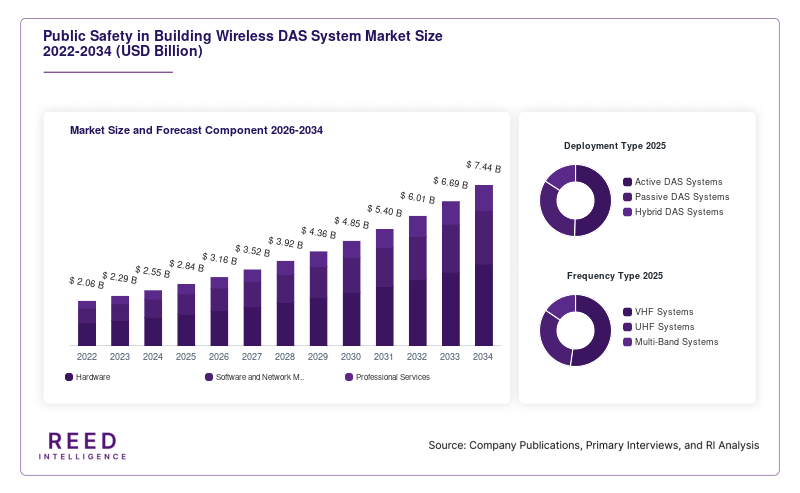
Based on component, the Public Safety in Building Wireless DAS System Market is segmented into hardware, software and network management solutions, and professional services. Hardware solutions dominated the market with approximately 49% share in 2025 due to increasing deployment of antennas, repeaters, signal boosters, cabling systems, and base station equipment across commercial buildings and public facilities. Software and network management solutions are projected to witness the fastest growth at a CAGR of 12.9% during the forecast period because building operators are increasingly adopting centralized monitoring platforms to improve communication reliability and network performance visibility.
By Deployment Type
By deployment type, the market is segmented into active DAS systems, passive DAS systems, and hybrid DAS systems. Active DAS systems accounted for the largest market share of 58% in 2025 because of their superior signal amplification capabilities and ability to support large commercial infrastructure projects. Hybrid DAS systems are expected to grow at a CAGR of 13.1% through 2034 due to increasing demand for cost-efficient solutions that combine the benefits of passive and active communication infrastructure in multi-building environments.
By Frequency Type
Based on frequency type, the market includes VHF systems, UHF systems, and multi-band systems. Multi-band systems held the dominant share of approximately 47% in 2025 due to their capability to support multiple communication frequencies and interoperability requirements across public safety agencies. UHF systems are projected to witness a CAGR of 12.3% during the forecast period owing to increasing adoption in urban emergency communication networks and commercial infrastructure deployments.
By End User
The market is segmented into commercial buildings, healthcare facilities, government buildings, industrial facilities, transportation hubs, and educational institutions. Commercial buildings accounted for the leading market share of approximately 36% in 2025 due to increasing installation of emergency communication infrastructure across shopping malls, hotels, office complexes, and mixed-use developments. Healthcare facilities are expected to grow at a CAGR of 12.8% during the forecast period because hospitals and medical centers are increasingly emphasizing uninterrupted wireless communication coverage for emergency coordination and patient safety management.
Regional Analysis
North America
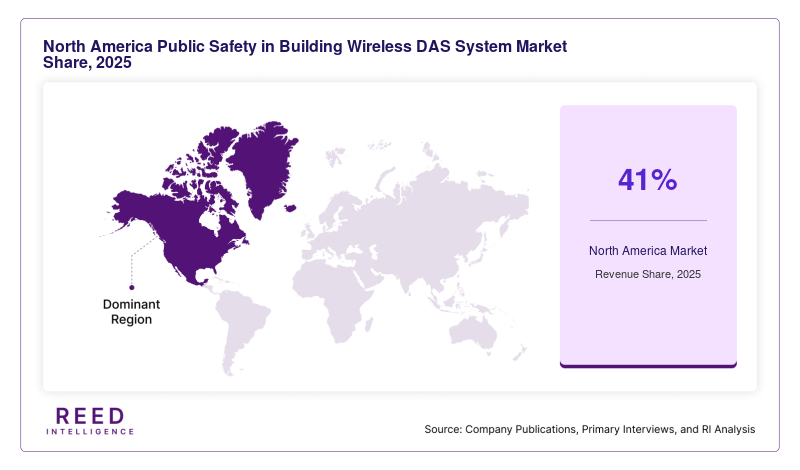
North America accounted for approximately 41% share of the Public Safety in Building Wireless DAS System Market in 2025 and is projected to grow at a CAGR of 10.8% during the forecast period. The region benefits from strong regulatory enforcement related to emergency communication systems and advanced building safety infrastructure. The United States dominated the regional market due to widespread adoption of public safety DAS systems across commercial buildings, airports, stadiums, and healthcare facilities. Increasing modernization of public safety communication networks is further supporting regional market expansion.
Europe
Europe held around 26% market share in 2025 and is expected to expand at a CAGR of 10.5% through 2034. The region is witnessing growing investments in transportation infrastructure modernization and commercial building safety upgrades. Germany remained the dominant country market because of increasing deployment of wireless communication systems across industrial facilities and public infrastructure projects. Expanding adoption of digital emergency response technologies is supporting long-term regional market development.
Asia Pacific
Asia Pacific represented nearly 21% share in 2025 and is projected to witness the fastest growth at a CAGR of 12.6% during the forecast period. Rapid urbanization, expansion of smart city projects, and increasing high-rise construction activities are supporting strong market growth across the region. China remained the leading regional contributor due to extensive investments in urban infrastructure and public transportation development. Growing awareness regarding emergency communication preparedness is further accelerating regional adoption of public safety DAS systems.
Middle East & Africa
The Middle East & Africa accounted for approximately 7% share in 2025 and is expected to grow at a CAGR of 10.1% during the forecast period. Large-scale commercial construction projects, airport modernization initiatives, and hospitality infrastructure development are supporting market expansion across the region. The United Arab Emirates dominated the regional market because of increasing smart infrastructure investments and growing adoption of advanced building safety technologies.
Latin America
Latin America held nearly 5% market share in 2025 and is projected to expand at a CAGR of 9.7% through 2034. Brazil remained the dominant country market due to rising investments in commercial real estate and public infrastructure upgrades. Increasing focus on emergency communication reliability and modernization of urban facilities is contributing to the steady growth of the regional market.
Competitive Landscape
The Public Safety in Building Wireless DAS System Market is moderately competitive with the presence of global communication infrastructure providers, network equipment manufacturers, and specialized DAS integrators focusing on product innovation, regulatory compliance, and advanced wireless connectivity solutions. Market participants are emphasizing strategic partnerships, smart building integration capabilities, and next-generation network technologies to strengthen their market positions.
CommScope Holding Company, Inc. remained one of the leading companies in the market due to its extensive portfolio of in-building wireless communication infrastructure and advanced DAS solutions. The company recently expanded its public safety communication offerings with integrated 5G-compatible DAS platforms designed for commercial and transportation infrastructure projects.
Corning Incorporated continues to strengthen its market presence through fiber-based DAS technologies and scalable communication infrastructure solutions. Motorola Solutions is focusing on emergency communication integration and public safety radio interoperability platforms, while SOLiD Inc. and Cobham Wireless are expanding their product portfolios through advanced network management capabilities and high-capacity wireless coverage systems.
Key Players List
- CommScope Holding Company, Inc.
- Corning Incorporated
- Motorola Solutions, Inc.
- SOLiD Inc.
- Cobham Wireless
- ADRF Technology, Inc.
- Zinwave Limited
- Westell Technologies, Inc.
- HUBER+SUHNER AG
- PBE Group
- Galtronics Corporation Ltd.
- JMA Wireless
- Advanced RF Technologies, Inc.
- Comba Telecom Systems Holdings Ltd.
- TE Connectivity Ltd.
Recent Developments
- In 2024, CommScope Holding Company expanded its public safety DAS portfolio with integrated wireless coverage solutions designed for smart commercial buildings and transportation facilities.
- In 2024, Corning Incorporated introduced advanced fiber-based DAS infrastructure systems focused on improving emergency communication reliability in large indoor environments.
- In 2025, Motorola Solutions launched upgraded public safety communication integration platforms to support next-generation emergency responder connectivity.
- In 2025, SOLiD Inc. enhanced its in-building wireless communication solutions with cloud-based network monitoring and remote management capabilities.
- In 2025, Cobham Wireless expanded its DAS infrastructure offerings with multi-band communication platforms designed for airports, hospitals, and industrial facilities.
Public Safety in Building Wireless DAS System Market Segments
Component
- Hardware
- Software and Network Management Solutions
- Professional Services
Deployment Type
- Active DAS Systems
- Passive DAS Systems
- Hybrid DAS Systems
Frequency Type
- VHF Systems
- UHF Systems
- Multi-Band Systems
End User
- Commercial Buildings
- Healthcare Facilities
- Government Buildings
- Industrial Facilities
- Transportation Hubs
- Educational Institutions
By Region
- North America
- Europe
- APAC
- Middle East and Africa
- LATAM