Public Safety Sensor Market Size, Share & Demand Report By Sensor Type (Environmental Monitoring Sensors, Biometric Sensors, Chemical and Radiation Detection Sensors, Motion and Acoustic Sensors), By Application (Emergency Response and Disaster Management, Smart City Monitoring, Border and Homeland Security), By End Use (Government and Defense Agencies, Transportation Infrastructure, Industrial Facilities, Commercial Buildings), By Region & Segment Forecasts, 2026–2034
USD 3950
Market Overview
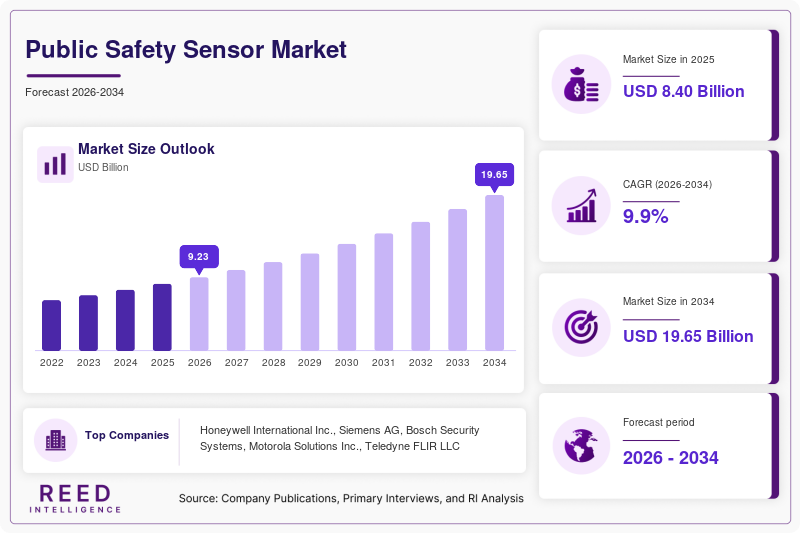
The global Public Safety Sensor Market size was valued at approximately USD 8.4 billion in 2026 and is projected to reach nearly USD 17.9 billion by 2034, expanding at a compound annual growth rate (CAGR) of 9.9% during the forecast period from 2026 to 2034. Public safety sensors are increasingly being deployed across transportation systems, government facilities, industrial zones, smart cities, and emergency response networks to improve surveillance, threat detection, environmental monitoring, and incident management. The growing adoption of intelligent security infrastructure across urban and semi-urban areas continues to strengthen long-term market demand.
One of the major global factors supporting market expansion is the rapid development of smart city infrastructure programs across developed and emerging economies. Governments are investing in connected public safety systems that integrate cameras, thermal detectors, chemical sensors, biometric scanners, and artificial intelligence-based monitoring platforms. These technologies help authorities improve emergency response times, reduce crime rates, and manage large-scale public events more efficiently. Public safety agencies are also prioritizing sensor-based situational awareness systems to strengthen disaster preparedness and border surveillance capabilities.
Key Highlights
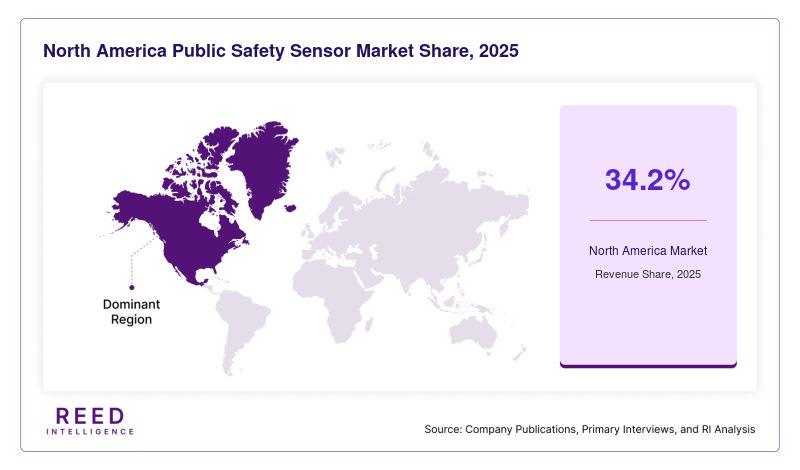
- North America dominated the market with a 34.2% share in 2025.
- Asia Pacific is expected to grow at the fastest CAGR of 11.8% during 2026–2034.
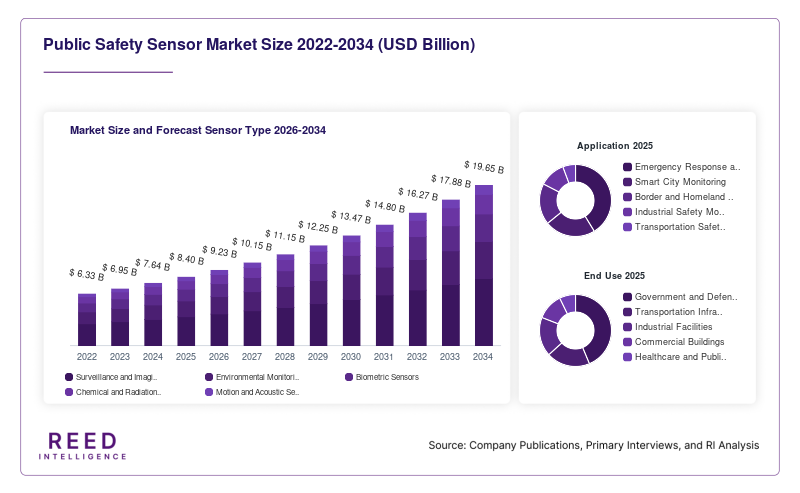
- By sensor type, surveillance and imaging sensors accounted for the largest share of 39.4%.
- while environmental monitoring sensors are projected to grow at a CAGR of 12.6%.
- By application, emergency response and disaster management led with a 36.8% share.
- whereas smart city monitoring is expected to expand at a CAGR of 12.1%.
- By end use, government and defense agencies held the dominant share of 42.5%.
- while transportation infrastructure is projected to register a CAGR of 11.5% during the forecast period.
- The United States remained the dominant country, with market values of USD 1.86 billion in 2024 and USD 2.03 billion in 2025.
Market Trends
Integration of Artificial Intelligence with Sensor Networks
The integration of artificial intelligence with advanced sensor networks is becoming one of the most influential trends in the Public Safety Sensor Market. Public safety authorities are increasingly adopting AI-enabled platforms that can analyze large volumes of sensor-generated data in real time. These systems help detect unusual movement patterns, hazardous environmental changes, crowd density fluctuations, and suspicious activities with improved accuracy. AI-powered analytics also reduce the operational burden on emergency management teams by automating threat identification and incident prioritization. Cities with growing urban populations are investing in intelligent public safety systems capable of predictive monitoring and automated emergency alerts.
Sensor manufacturers are focusing on machine learning algorithms that improve the efficiency of thermal sensors, motion detectors, biometric scanners, and chemical monitoring systems. The use of edge AI processing allows faster decision-making without relying heavily on centralized cloud infrastructure. This capability is becoming increasingly important for critical infrastructure facilities, airports, railway stations, and industrial plants where response time directly affects public safety outcomes. The growing availability of 5G connectivity is further strengthening AI-based sensor communication and real-time situational awareness.
Expansion of Smart Environmental Monitoring Systems
Environmental monitoring systems are emerging as an important trend across the Public Safety Sensor Market due to rising concerns regarding climate-related disasters, industrial accidents, and air quality deterioration. Governments and municipal authorities are deploying sensors that monitor smoke levels, gas leaks, flood conditions, seismic activities, and hazardous chemical emissions. These systems help authorities respond quickly to emergencies while minimizing infrastructure damage and health risks. Public safety agencies are increasingly integrating environmental sensors with centralized command centers to improve disaster preparedness and resource coordination.
The expansion of wildfire detection programs and flood management systems in climate-sensitive regions has significantly increased demand for advanced environmental sensors. Industrial zones are also adopting connected monitoring systems to comply with workplace safety regulations and environmental standards. In addition, the use of low-power wireless sensor networks is helping municipalities deploy cost-efficient monitoring infrastructure across large geographic areas. Continuous improvements in sensor sensitivity and remote monitoring capabilities are expected to support long-term adoption across transportation corridors, coastal regions, and densely populated urban centers.
Market Drivers
Rising Investments in Smart City Security Infrastructure
Growing investments in smart city development projects are significantly driving the Public Safety Sensor Market. Governments across major economies are prioritizing the modernization of urban safety infrastructure to address rising concerns related to public security, traffic management, disaster response, and critical asset protection. Public safety sensors are being integrated into transportation hubs, government buildings, utility networks, and public gathering areas to improve operational visibility and emergency response capabilities. Smart city initiatives increasingly rely on interconnected sensor ecosystems that support centralized monitoring and real-time decision-making.
Many urban administrations are deploying advanced surveillance cameras, acoustic sensors, thermal imaging devices, and biometric systems to improve city-wide security management. The expansion of intelligent traffic control systems and automated emergency communication platforms is further strengthening demand for public safety sensors. In addition, government funding for infrastructure resilience programs is encouraging the adoption of integrated safety monitoring solutions. The ability of sensor networks to provide continuous situational awareness is becoming essential for reducing crime, managing large public events, and improving urban emergency preparedness.
Increasing Demand for Disaster Detection and Emergency Preparedness
The increasing frequency of natural disasters and industrial emergencies is another major factor supporting growth in the Public Safety Sensor Market. Floods, earthquakes, wildfires, hurricanes, and hazardous material incidents are creating greater demand for early warning and emergency monitoring technologies. Public safety agencies are investing in sensor systems capable of detecting environmental changes and transmitting alerts to emergency response teams within seconds. These systems improve evacuation planning, reduce infrastructure damage, and support faster deployment of rescue resources.
Industries such as oil and gas, mining, chemicals, and energy generation are also strengthening their investment in sensor-based emergency detection systems to improve worker safety and regulatory compliance. Governments are expanding disaster management budgets to establish resilient monitoring infrastructure in vulnerable regions. The adoption of wireless communication technologies and cloud-based emergency management platforms is improving the efficiency of sensor-driven safety operations. As climate variability and urban density continue to increase, demand for advanced public safety monitoring solutions is expected to remain strong throughout the forecast period.
Market Restraint
High Deployment and Integration Costs Across Legacy Infrastructure
High deployment and integration costs continue to restrain growth within the Public Safety Sensor Market, particularly in developing regions and municipalities operating with limited infrastructure budgets. Advanced public safety sensor systems often require significant investments in communication networks, software platforms, data storage infrastructure, cybersecurity frameworks, and maintenance services. Integrating modern sensors into older public infrastructure systems can also create operational and compatibility challenges. Many public facilities continue to operate with outdated surveillance networks and fragmented monitoring systems that require substantial upgrades before advanced sensors can be deployed effectively.
The cost burden becomes more significant for small municipalities and public agencies managing large geographic areas with limited financial resources. In addition, sensor calibration, system maintenance, and software updates increase long-term operational expenses. Concerns related to cybersecurity vulnerabilities and data privacy compliance also require additional investments in secure network architecture and monitoring tools. For example, large-scale transportation projects involving smart surveillance and environmental monitoring systems often experience extended implementation timelines due to integration complexity and procurement delays. These financial and technical barriers may slow adoption rates in cost-sensitive markets despite growing demand for public safety modernization.
Market Opportunities
Expansion of Public Safety Applications in Transportation Infrastructure
The growing modernization of transportation infrastructure presents a major opportunity for the Public Safety Sensor Market. Airports, railway stations, highways, seaports, and metro systems are increasingly deploying sensor-based technologies to improve passenger safety, traffic management, and infrastructure monitoring. Transportation authorities are adopting thermal sensors, motion detectors, structural monitoring devices, and environmental hazard sensors to identify operational risks in real time. These technologies help reduce accident rates, improve emergency response coordination, and strengthen public confidence in transportation systems.
The increasing adoption of intelligent transportation systems is creating additional opportunities for sensor manufacturers and software providers. Governments are investing in connected traffic management systems that combine sensor networks with AI-driven analytics platforms. These systems improve congestion monitoring, accident detection, and emergency communication efficiency. The rise of autonomous mobility infrastructure and electric transportation networks is also expected to increase demand for advanced safety sensors. Continuous investments in railway modernization and airport expansion projects across Asia Pacific and the Middle East are likely to support strong market growth during the forecast period.
Growing Adoption of Wireless and Portable Sensor Technologies
Wireless and portable sensor technologies are creating new growth opportunities across the Public Safety Sensor Market due to their flexibility, scalability, and lower deployment complexity. Public safety agencies are increasingly seeking mobile monitoring systems that can be rapidly deployed during emergencies, natural disasters, and large public events. Portable environmental sensors, wearable monitoring devices, and wireless surveillance systems allow authorities to expand operational coverage without depending heavily on fixed infrastructure.
The use of battery-efficient wireless sensors is becoming particularly important in remote locations and temporary emergency response operations. Advances in low-power communication technologies and cloud-based monitoring platforms are improving the performance and accessibility of portable safety systems. Law enforcement agencies and emergency responders are also adopting wearable biometric sensors that monitor physical conditions and improve workforce safety in hazardous environments. In addition, defense organizations are deploying mobile sensor networks for border security and tactical surveillance operations. These evolving use cases are expected to create sustained demand for lightweight, connected, and rapidly deployable public safety sensor solutions.
Segmental Analysis
By Sensor Type
Surveillance and imaging sensors represented the dominant subsegment within the Public Safety Sensor Market in 2024, accounting for approximately 39.4% of total market revenue. These sensors are widely deployed across government buildings, transportation hubs, industrial facilities, and urban infrastructure to improve monitoring and threat detection capabilities. High-resolution imaging systems, thermal cameras, motion sensors, and biometric surveillance technologies are increasingly integrated into centralized security platforms. The growing focus on crime prevention, border protection, and crowd management continues to strengthen demand for advanced surveillance sensors. Public safety agencies are prioritizing integrated visual monitoring systems capable of real-time data analysis and automated threat identification.
Environmental monitoring sensors are expected to witness the fastest growth during the forecast period, expanding at a CAGR of 12.6%. Increasing concerns related to climate change, industrial emissions, hazardous gas leaks, and wildfire incidents are accelerating adoption of these systems across both developed and emerging economies. Governments are deploying connected environmental monitoring networks to improve disaster preparedness and environmental compliance. Advanced sensors capable of detecting smoke, toxic chemicals, radiation, and flood conditions are becoming essential components of public safety infrastructure. Continuous improvements in wireless connectivity and remote monitoring capabilities are further supporting rapid adoption across industrial zones, transportation corridors, and coastal regions.
By Application
Emergency response and disaster management emerged as the dominant application segment in 2024, holding approximately 36.8% of the Public Safety Sensor Market share. Public safety agencies and emergency response teams increasingly rely on advanced sensor systems to improve incident detection, evacuation planning, and rescue coordination. These systems provide real-time situational awareness during natural disasters, industrial accidents, and large-scale emergencies. Thermal imaging sensors, acoustic monitoring devices, and environmental detection systems are widely used to support rapid emergency response operations. Governments are also strengthening investments in disaster management infrastructure due to the rising frequency of climate-related events and urban emergencies.
Smart city monitoring is anticipated to register the fastest growth rate, expanding at a CAGR of 12.1% during the forecast period. Urban administrations are increasingly integrating connected sensor technologies into traffic systems, surveillance networks, public utilities, and emergency communication platforms. Smart city initiatives aim to improve public safety while enhancing operational efficiency across transportation and municipal services. AI-enabled monitoring systems are helping authorities analyze sensor data in real time and automate emergency response coordination. The growing adoption of connected infrastructure, 5G communication networks, and cloud-based analytics platforms is expected to accelerate demand for smart city monitoring applications across major metropolitan regions.
By End Use
Government and defense agencies accounted for the largest share of the Public Safety Sensor Market in 2024, representing approximately 42.5% of global revenue. National security programs, border surveillance initiatives, and critical infrastructure protection projects continue to generate strong demand for advanced sensor technologies. Defense organizations are deploying thermal imaging systems, radar sensors, biometric scanners, and chemical detection devices to improve situational awareness and operational security. Public sector investments in emergency management infrastructure and urban surveillance systems are also supporting segment growth. The increasing focus on counterterrorism operations and disaster preparedness is encouraging governments to modernize public safety monitoring capabilities.
Transportation infrastructure is projected to be the fastest-growing end-use segment, expanding at a CAGR of 11.5% through 2034. Airports, railways, highways, and seaports are increasingly integrating advanced sensor systems to improve passenger safety and operational efficiency. Transportation authorities are adopting intelligent monitoring technologies that detect accidents, structural issues, environmental hazards, and unauthorized access activities. The expansion of high-speed rail projects and smart mobility infrastructure is creating favorable opportunities for sensor manufacturers. In addition, growing investments in autonomous transportation systems and connected traffic management platforms are expected to support long-term adoption of advanced public safety sensors across the transportation sector.
Regional Analysis
North America
North America accounted for the largest share of the Public Safety Sensor Market in 2025, representing approximately 34.2% of global revenue. The region is expected to maintain stable growth at a CAGR of 8.9% during the forecast period due to strong investments in public infrastructure modernization and emergency management technologies. The United States and Canada continue to expand smart city programs that incorporate advanced surveillance systems, environmental monitoring devices, and connected emergency communication platforms. Rising cybersecurity investments and increasing integration of artificial intelligence into public safety operations are also supporting regional market growth.
The United States remains the dominant contributor within the North American market due to extensive deployment of public safety technologies across transportation networks, defense infrastructure, and urban surveillance programs. One major growth factor in the country is the increasing investment in wildfire monitoring and disaster management systems. Federal and state authorities are strengthening sensor-based environmental monitoring capabilities to address climate-related emergencies. The presence of major technology developers and strong public-private partnerships further accelerates innovation and large-scale deployment across the region.
Europe
Europe represented a significant share of the Public Safety Sensor Market in 2025 and is projected to expand at a CAGR of 8.5% through 2034. Regional demand is supported by strict public safety regulations, increasing investments in critical infrastructure protection, and growing adoption of smart transportation systems. European countries are deploying advanced sensor networks for border security, industrial safety monitoring, and urban surveillance applications. The region is also witnessing increased adoption of environmental monitoring sensors to support climate resilience initiatives and disaster preparedness programs.
Germany remains the leading country within the European market due to its strong industrial infrastructure and high adoption of advanced automation technologies. A unique growth factor supporting the German market is the integration of safety sensors into industrial smart manufacturing facilities and public transportation systems. Authorities are investing in connected monitoring systems that improve operational safety and environmental compliance. In addition, the expansion of digital infrastructure projects across major European cities continues to create favorable conditions for sensor deployment.
Asia Pacific
Asia Pacific is expected to record the fastest growth in the Public Safety Sensor Market, registering a CAGR of 11.8% during the forecast period. The region accounted for a substantial revenue share in 2025 due to increasing urbanization, rapid industrialization, and expanding government investments in smart city infrastructure. Countries across the region are adopting advanced sensor technologies to improve disaster management, transportation safety, and public surveillance operations. The growing frequency of environmental hazards and rising population density are accelerating demand for integrated public safety monitoring systems.
China dominates the Asia Pacific market due to its extensive smart city initiatives and large-scale investments in public infrastructure modernization. One significant growth factor driving the Chinese market is the deployment of intelligent surveillance systems integrated with facial recognition and AI-based analytics. The government continues to expand digital monitoring infrastructure across urban transportation corridors, industrial zones, and public facilities. Strong domestic manufacturing capabilities and increasing adoption of connected technologies are also supporting rapid market expansion across the country.
Middle East & Africa
The Middle East & Africa region is witnessing steady growth in the Public Safety Sensor Market and is projected to expand at a CAGR of 9.1% through 2034. Investments in smart infrastructure projects, border security systems, and critical facility protection are supporting regional demand for advanced sensor technologies. Governments across the Gulf region are focusing on improving urban safety management through connected surveillance and emergency response systems. Environmental monitoring sensors are also gaining importance due to rising concerns regarding industrial emissions and extreme climate conditions.
Saudi Arabia remains the leading country in the regional market due to its large-scale infrastructure development programs and smart city investments. A key growth factor in the country is the implementation of digital public safety technologies within newly developed economic zones and urban projects. Authorities are integrating advanced surveillance sensors, traffic monitoring systems, and emergency communication platforms to improve operational efficiency and public security. Increasing investments in transportation modernization and industrial diversification initiatives are further contributing to market expansion.
Latin America
Latin America accounted for a moderate share of the Public Safety Sensor Market in 2025 and is expected to grow at a CAGR of 8.3% during the forecast period. The region is experiencing gradual adoption of advanced safety technologies across transportation, municipal security, and industrial monitoring applications. Governments are investing in smart traffic management systems and urban surveillance infrastructure to address rising public safety concerns in densely populated cities. Environmental monitoring sensors are also being deployed to improve disaster preparedness in regions vulnerable to floods and landslides.
Brazil remains the dominant country within the Latin American market due to ongoing investments in urban infrastructure and public transportation modernization. One unique growth factor supporting the Brazilian market is the increasing use of sensor-based monitoring systems during large public events and sporting activities. Municipal authorities are deploying integrated surveillance and crowd management systems to improve public safety coordination. In addition, the gradual expansion of digital infrastructure and wireless communication networks is encouraging broader adoption of connected sensor technologies.
Competitive Landscape
The Public Safety Sensor Market remains moderately consolidated, with major companies focusing on technology innovation, strategic partnerships, and expansion of integrated safety platforms. Leading market participants are investing in artificial intelligence, wireless communication technologies, and cloud-based analytics to strengthen their competitive positioning. Companies are also expanding their product portfolios to address increasing demand for environmental monitoring, smart surveillance, and emergency response applications.
Honeywell International Inc. continues to maintain a leading position within the market due to its diversified public safety technology portfolio and strong global distribution network. The company has expanded its connected safety solutions by integrating AI-enabled monitoring capabilities into industrial and municipal safety platforms. Other major companies such as Siemens AG, Bosch Security Systems, Teledyne FLIR, and Motorola Solutions are focusing on smart city partnerships and advanced surveillance technologies.
Recent market developments include increased collaboration between sensor manufacturers and municipal authorities for deployment of integrated smart infrastructure projects. Several companies are also investing in portable monitoring devices and cloud-connected safety platforms to improve scalability and operational efficiency. Competitive intensity is expected to increase further as regional players strengthen their capabilities in wireless sensing and AI-based analytics solutions.
Key Players
- Honeywell International Inc.
- Siemens AG
- Bosch Security Systems
- Motorola Solutions Inc.
- Teledyne FLIR LLC
- Johnson Controls International plc
- NEC Corporation
- Thales Group
- Raytheon Technologies Corporation
- Hikvision Digital Technology Co., Ltd.
- Axis Communications AB
- Hexagon AB
- ABB Ltd.
- Huawei Technologies Co., Ltd.
- Schneider Electric SE
Recent Developments
- Honeywell International Inc. introduced an AI-enabled environmental monitoring platform in 2025 designed for smart city emergency response applications and industrial safety management.
- Siemens AG expanded its integrated transportation safety sensor portfolio in 2024 through the deployment of connected railway monitoring systems across several European infrastructure projects.
- Motorola Solutions Inc. partnered with municipal authorities in Asia Pacific during 2025 to deploy cloud-connected public surveillance and emergency communication systems for urban safety modernization.
- Teledyne FLIR LLC launched a next-generation thermal imaging sensor platform in 2025 focused on wildfire detection and critical infrastructure protection applications.
- Bosch Security Systems announced the expansion of its smart surveillance analytics solutions in 2024 to support real-time crowd monitoring and public event security management.
Public Safety Sensor Market Segments
Sensor Type
- Surveillance and Imaging Sensors
- Environmental Monitoring Sensors
- Biometric Sensors
- Chemical and Radiation Detection Sensors
- Motion and Acoustic Sensors
Application
- Emergency Response and Disaster Management
- Smart City Monitoring
- Border and Homeland Security
- Industrial Safety Monitoring
- Transportation Safety and Traffic Management
End Use
- Government and Defense Agencies
- Transportation Infrastructure
- Industrial Facilities
- Commercial Buildings
- Healthcare and Public Institutions
By Region
- North America
- Europe
- APAC
- Middle East and Africa
- LATAM