Pulmonary Alveolar Proteinosis Drug Market Size, Share & Demand Report By Treatment Type (GM-CSF Therapy, Immunosuppressive Therapy, Gene Therapy), By Disease Type (Autoimmune PAP, Congenital PAP, Secondary PAP), By Route of Administration (Parenteral, Inhalation, Oral), By Distribution Channel (Hospital Pharmacies, Retail Pharmacies, Online Pharmacies), By Region & Segment Forecasts, 2025–2034
USD 3950
Market Overview
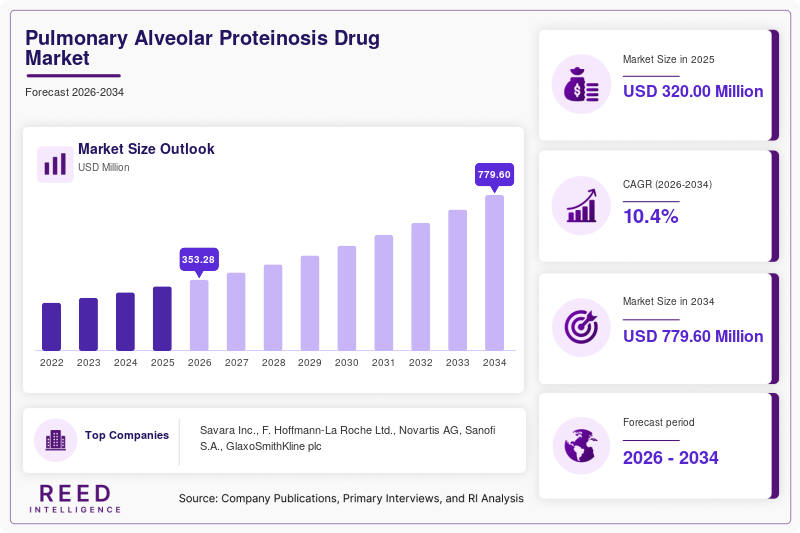
The Pulmonary Alveolar Proteinosis Drug Market was valued at approximately USD 320 million in 2025 and is projected to reach USD 780 million by 2034, expanding at a CAGR of 10.4% during the forecast period (2025–2034). The market growth is being supported by increasing advancements in rare disease therapeutics, particularly in biologics and targeted therapies designed to treat autoimmune and hereditary pulmonary disorders. Rising awareness among healthcare providers and improved diagnostic capabilities have contributed to earlier detection and treatment adoption, positively influencing market expansion.
Pulmonary alveolar proteinosis (PAP) remains a rare lung disorder characterized by the accumulation of surfactant within alveoli, leading to impaired gas exchange. The treatment landscape has evolved from traditional whole lung lavage procedures to pharmacological interventions such as granulocyte-macrophage colony-stimulating factor (GM-CSF) therapies and immunomodulators. The integration of precision medicine and orphan drug incentives has further accelerated clinical research and product development.
Key Highlights
- North America dominated the market with a 42% share in 2025, while Asia Pacific is expected to register the fastest CAGR of 12.8% during the forecast period
- GM-CSF therapy led the treatment segment with a 48% share, whereas gene therapy is projected to grow at a CAGR of 14.5%
- The U.S. market was valued at USD 135 million in 2025 and is estimated to reach USD 150 million in 2026
Market Trends
Rising Adoption of Targeted Biologic Therapies
The Pulmonary Alveolar Proteinosis Drug Market is witnessing a shift toward targeted biologic therapies, particularly GM-CSF-based treatments. These therapies address the underlying autoimmune mechanisms of PAP rather than providing symptomatic relief. The increasing preference for precision medicine has encouraged pharmaceutical companies to invest in monoclonal antibodies and recombinant proteins. This trend is improving treatment outcomes and reducing dependency on invasive procedures such as whole lung lavage.
Expansion of Orphan Drug Development Programs
Another notable trend is the expansion of orphan drug development initiatives. Regulatory bodies across major markets are offering incentives such as fast-track approvals, tax credits, and market exclusivity to encourage innovation in rare diseases. As PAP falls under the rare disease category, this has significantly boosted clinical trial activity and pipeline development. Emerging therapies, including gene-based interventions, are gaining traction, reflecting a shift toward long-term disease modification strategies.
Market Drivers
Increasing Prevalence of Rare Pulmonary Disorders
The growing recognition and diagnosis of rare pulmonary conditions, including PAP, have contributed to the expansion of the Pulmonary Alveolar Proteinosis Drug Market. Improved imaging technologies and diagnostic tools have enabled healthcare providers to identify cases more accurately, increasing the patient pool eligible for treatment. This rise in diagnosed cases has created sustained demand for effective pharmacological interventions.
Advancements in Biotechnology and Drug Development
Rapid progress in biotechnology has enabled the development of innovative therapies tailored to rare diseases. Advances in recombinant DNA technology, biologics manufacturing, and immunotherapy have significantly enhanced the treatment landscape for PAP. These innovations have led to the introduction of safer and more effective drugs, encouraging adoption among clinicians and patients. Additionally, increased R&D investments by pharmaceutical companies are accelerating the availability of novel therapies.
Market Restraint
High Cost of Treatment and Limited Patient Pool
One of the primary challenges in the Pulmonary Alveolar Proteinosis Drug Market is the high cost associated with advanced therapies. Biologic treatments and emerging gene therapies involve complex manufacturing processes, leading to elevated pricing. This can limit accessibility, particularly in low- and middle-income regions. Furthermore, the rarity of the disease results in a relatively small patient population, which restricts large-scale commercialization and discourages investment in some cases. Limited clinical data due to small patient cohorts also poses challenges in regulatory approvals and widespread adoption.
Market Opportunities
Development of Gene and Cell-Based Therapies
Gene therapy represents a promising opportunity in the Pulmonary Alveolar Proteinosis Drug Market. Research efforts are increasingly focused on correcting the underlying genetic and autoimmune causes of PAP. These therapies have the potential to provide long-term or permanent solutions, reducing the need for repeated treatments. As clinical trials progress, successful outcomes could significantly reshape the treatment paradigm.
Expansion in Emerging Markets
Emerging economies present untapped growth potential due to improving healthcare infrastructure and increasing awareness of rare diseases. Governments in these regions are gradually introducing policies to support rare disease treatment and reimbursement. Pharmaceutical companies are also expanding their presence through partnerships and distribution networks, enabling broader access to PAP therapies.
Segmental Analysis
By Treatment Type
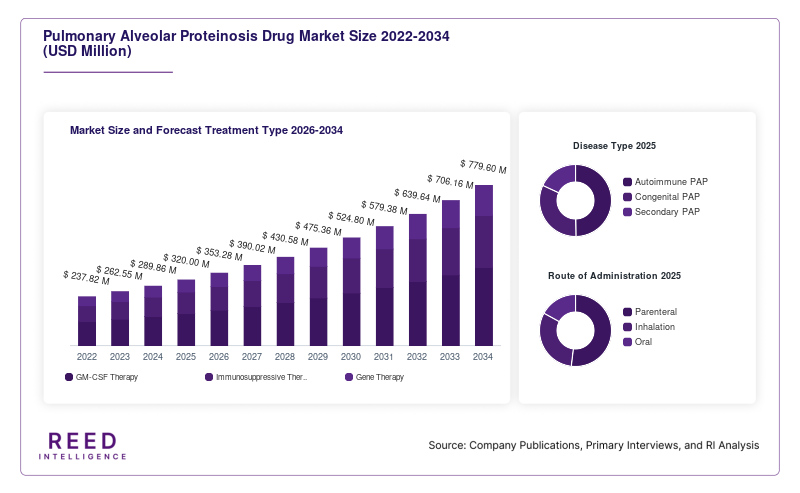
GM-CSF therapy dominated the Pulmonary Alveolar Proteinosis Drug Market in 2025, accounting for approximately 48% of the total share. This dominance was attributed to its effectiveness in treating autoimmune PAP by enhancing macrophage function and improving surfactant clearance. The established clinical efficacy and growing physician preference have contributed to its widespread adoption.
Gene therapy is expected to be the fastest-growing subsegment, with a projected CAGR of 14.5% during the forecast period. The growth will be driven by ongoing clinical trials and the potential for long-term disease correction. Innovations in gene editing technologies are expected to accelerate adoption once regulatory approvals are achieved.
By Disease Type
Autoimmune PAP represented the largest segment in 2025, holding a share of around 70%. This was due to its higher prevalence compared to congenital and secondary forms. The availability of targeted therapies has also supported treatment adoption.
Congenital PAP is projected to grow at the fastest CAGR of 13.2%. The increasing focus on genetic research and early diagnosis will drive growth in this segment. Advancements in neonatal screening and personalized medicine are expected to enhance treatment outcomes.
By Route of Administration
Parenteral administration dominated the market in 2025, accounting for approximately 60% of the share. This was primarily due to the widespread use of injectable biologics, which offer high bioavailability and rapid therapeutic effects.
Inhalation-based therapies are expected to grow at a CAGR of 12.6% during the forecast period. These therapies offer targeted drug delivery to the lungs, improving efficacy while minimizing systemic side effects. Increasing research into aerosolized formulations is supporting this growth.
By Distribution Channel
Hospital pharmacies held the largest share of about 55% in 2025, driven by the need for specialized treatment and monitoring. Most PAP therapies require administration in clinical settings, contributing to the dominance of this segment.
Online pharmacies are anticipated to grow at the fastest CAGR of 13.8%. The increasing adoption of digital healthcare platforms and improved access to specialty drugs are driving this trend. Convenience and home delivery services are further enhancing patient compliance.
Regional Analysis
North America
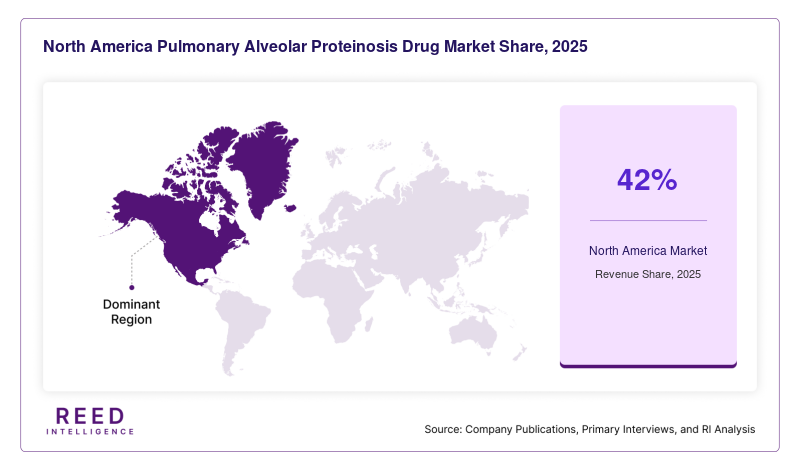
North America accounted for approximately 42% of the Pulmonary Alveolar Proteinosis Drug Market share in 2025 and is expected to grow at a CAGR of 9.8% through 2034. The region benefits from advanced healthcare systems and strong regulatory support for orphan drugs. High awareness levels and access to specialized treatment centers have contributed to market dominance.
The United States remained the leading country due to extensive research funding and the presence of key pharmaceutical companies. A well-established reimbursement framework and early adoption of biologic therapies have driven consistent market growth.
Europe
Europe held around 27% of the market share in 2025 and is projected to expand at a CAGR of 9.5% during the forecast period. The region has a strong focus on rare disease research supported by government initiatives and collaborations between academic institutions and industry players.
Germany emerged as the dominant country due to its robust healthcare infrastructure and increasing investment in clinical research. Favorable regulatory pathways for orphan drugs have also supported market expansion.
Asia Pacific
Asia Pacific captured approximately 18% of the market share in 2025 and is anticipated to register the fastest CAGR of 12.8% through 2034. Rapid improvements in healthcare infrastructure and growing awareness of rare diseases are key growth drivers.
China led the regional market due to its expanding pharmaceutical sector and increasing government focus on rare disease treatment. The growing patient population and rising healthcare expenditure are further supporting market growth.
Middle East & Africa
The Middle East & Africa region accounted for about 7% of the market share in 2025 and is expected to grow at a CAGR of 8.7% during the forecast period. The market is gradually expanding due to improving healthcare facilities and increased awareness.
Saudi Arabia dominated the region, supported by government initiatives to enhance healthcare services and investments in advanced medical technologies. The establishment of specialized treatment centers has also contributed to market growth.
Latin America
Latin America held nearly 6% of the market share in 2025 and is projected to grow at a CAGR of 8.9% through 2034. Increasing healthcare investments and rising awareness of rare diseases are driving market expansion.
Brazil was the leading country in the region due to its large population base and improving access to healthcare services. Government programs aimed at supporting rare disease treatment have further boosted market development.
Competitive Landscape
The Pulmonary Alveolar Proteinosis Drug Market is moderately consolidated, with several key players focusing on innovation and strategic collaborations. The leading companies are actively investing in research and development to expand their product portfolios and strengthen their market positions.
Savara Inc. is a prominent market leader, recognized for its focus on inhaled GM-CSF therapies. The company recently advanced its lead candidate into late-stage clinical trials, demonstrating strong efficacy in treating autoimmune PAP.
Other players are emphasizing partnerships, licensing agreements, and geographic expansion to enhance their presence. Continuous innovation and regulatory approvals are expected to shape the competitive dynamics in the coming years.
Key Players List
- Savara Inc.
- F. Hoffmann-La Roche Ltd.
- Novartis AG
- Sanofi S.A.
- GlaxoSmithKline plc
- AstraZeneca plc
- Pfizer Inc.
- Teva Pharmaceutical Industries Ltd.
- Boehringer Ingelheim International GmbH
- CSL Limited
- Bayer AG
- Takeda Pharmaceutical Company Limited
- Biogen Inc.
- Vertex Pharmaceuticals Incorporated
- Amgen Inc.
Recent Developments
- Savara Inc. announced positive Phase III trial results for its inhaled GM-CSF therapy
- A leading pharmaceutical company initiated clinical trials for a gene therapy targeting congenital PAP
- Strategic collaborations between biotech firms and research institutions increased to accelerate drug development
- Regulatory agencies granted orphan drug designation to multiple PAP treatment candidates
- Expansion of distribution agreements improved drug accessibility in emerging markets
Pulmonary Alveolar Proteinosis Drug Market Segments
Treatment Type
- GM-CSF Therapy
- Immunosuppressive Therapy
- Gene Therapy
Disease Type
- Autoimmune PAP
- Congenital PAP
- Secondary PAP
Route of Administration
- Parenteral
- Inhalation
- Oral
Distribution Channel
- Hospital Pharmacies
- Retail Pharmacies
- Online Pharmacies
By Region
- North America
- Europe
- APAC
- Middle East and Africa
- LATAM