Pulmonary Embolism Therapeutics Market Size, Share Demand Report By Drug Class (Anticoagulants, Thrombolytics, Others), By Route of Administration (Oral, Injectable), By End-Use (Hospitals, Ambulatory Surgical Centers, Specialty Clinics) By Region & Segment Forecasts, 2026–2034
USD 3950
Market Overview
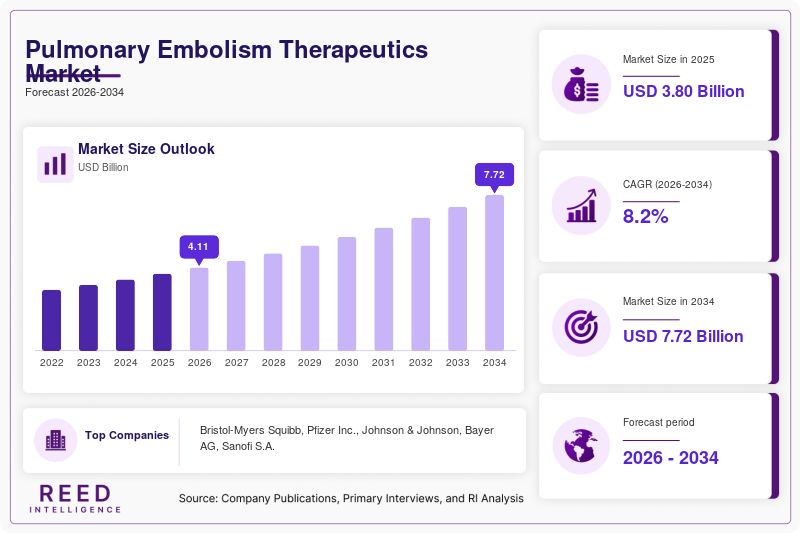
The global Pulmonary Embolism Therapeutics Market was valued at approximately USD 3.8 billion in 2026 and is projected to reach USD 7.1 billion by 2034, expanding at a CAGR of 8.2% during 2026–2034. The market is witnessing steady growth due to the increasing prevalence of venous thromboembolism (VTE), particularly among aging populations and patients with sedentary lifestyles. Rising awareness regarding early diagnosis and advancements in anticoagulant therapies have significantly contributed to the adoption of pulmonary embolism treatment solutions across both developed and emerging economies.
One of the key global factors supporting market growth is the increasing incidence of cardiovascular and thrombotic disorders, driven by lifestyle-related risk factors such as obesity, smoking, and prolonged immobility. Healthcare systems worldwide are emphasizing early detection and rapid intervention, which is boosting demand for innovative therapeutics, including direct oral anticoagulants (DOACs) and catheter-directed thrombolysis therapies.
Key Highlights
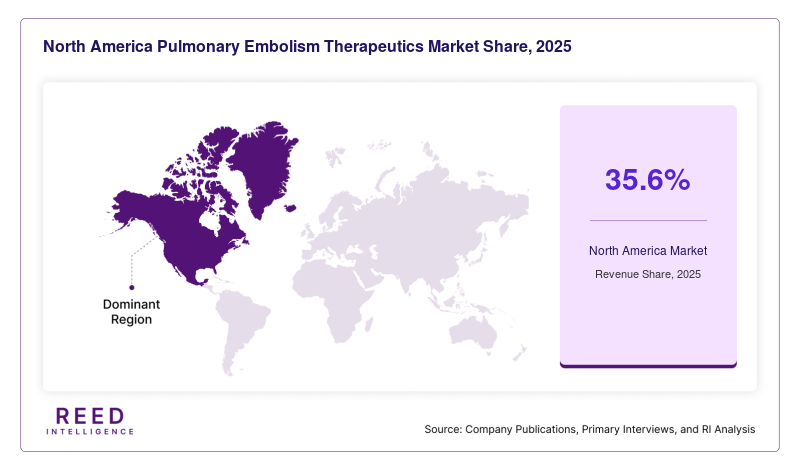
- North America dominated the market with a 35.6% share in 2025.
- Asia Pacific is expected to grow at the fastest CAGR of 9.6% during 2026–2034.
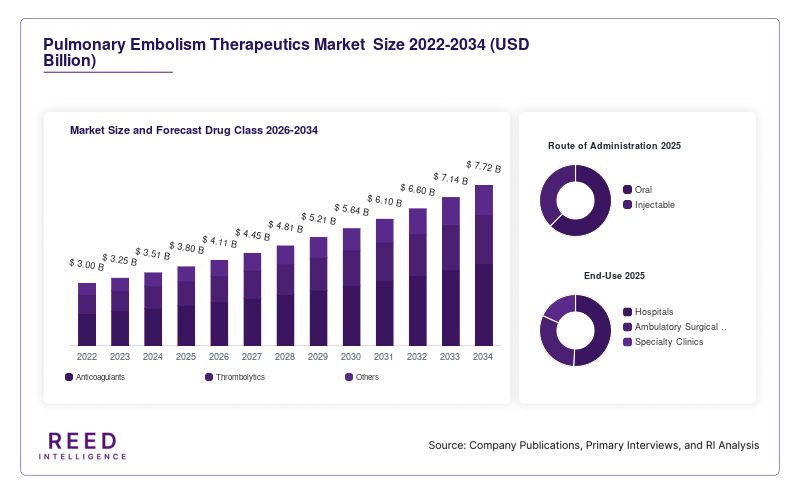
- By drug class, anticoagulants accounted for the largest share of 52.3%, while thrombolytics are projected to grow at a CAGR of 9.1%.
- By route of administration, oral therapeutics led with a 48.7% share, whereas injectable therapies are expected to expand at a CAGR of 8.8%.
- The United States remained the dominant country, with market values of USD 1.1 billion in 2024 and USD 1.2 billion in 2025.
Market Trends
Rising Adoption of Direct Oral Anticoagulants (DOACs)
The Pulmonary Embolism Therapeutics Market is experiencing a strong shift toward direct oral anticoagulants due to their ease of use and improved safety profiles compared to traditional therapies. DOACs eliminate the need for frequent monitoring, making them more convenient for both patients and healthcare providers. Their predictable pharmacokinetics and lower risk of major bleeding events are contributing to their widespread adoption. Additionally, clinical guidelines increasingly recommend DOACs as first-line treatment, further driving their penetration in developed healthcare systems. Pharmaceutical companies are also investing in expanding indications and improving formulations, which is expected to strengthen this trend over the forecast period.
Integration of Minimally Invasive Treatment Approaches
Another notable trend is the growing use of minimally invasive interventions such as catheter-directed thrombolysis and mechanical thrombectomy. These approaches offer targeted treatment, reducing systemic exposure to thrombolytic agents and lowering the risk of complications. Hospitals and specialized cardiac centers are increasingly adopting these technologies, particularly for high-risk pulmonary embolism cases. Technological advancements in imaging and catheter design are improving procedural outcomes and patient recovery times. This trend is expected to gain momentum as healthcare providers focus on precision medicine and improved patient outcomes, especially in acute and emergency care settings.
Market Drivers
Increasing Prevalence of Venous Thromboembolism (VTE)
The rising global burden of venous thromboembolism, including pulmonary embolism, is a major driver for the market. Factors such as aging populations, increasing obesity rates, and a higher number of surgical procedures contribute to the growing incidence of VTE. Hospitalized patients and individuals with chronic illnesses are particularly vulnerable, creating a consistent demand for therapeutic interventions. Governments and healthcare organizations are implementing awareness campaigns and screening programs, which are improving diagnosis rates and driving the adoption of treatment options. This sustained increase in patient pool is expected to support long-term market growth.
Advancements in Drug Development and Clinical Research
Ongoing advancements in pharmaceutical research are leading to the development of more effective and safer therapeutics for pulmonary embolism. Novel anticoagulants with improved efficacy and reduced side effects are entering the market, enhancing treatment outcomes. Clinical trials are focusing on optimizing dosing regimens and expanding the use of existing drugs to broader patient populations. Additionally, the introduction of biosimilars and cost-effective alternatives is improving accessibility in emerging markets. These innovations are encouraging healthcare providers to adopt newer therapies, thereby driving market expansion.
Market Restraint
Risk of Bleeding Complications and High Treatment Costs
Despite advancements in therapeutics, the risk of bleeding complications remains a significant restraint in the Pulmonary Embolism Therapeutics Market. Anticoagulants and thrombolytics, while effective, can lead to severe bleeding events, especially in elderly patients or those with comorbid conditions. This risk often limits the use of certain drugs and requires careful monitoring, which can increase the overall cost of treatment. In addition, advanced therapies such as catheter-directed interventions and newer drug formulations are associated with high costs, making them less accessible in low- and middle-income regions.
The economic burden of treatment, including hospitalization, diagnostic imaging, and long-term medication, further restricts market growth. Healthcare providers must balance efficacy with safety, which sometimes leads to conservative treatment approaches. This restraint is particularly evident in regions with limited healthcare infrastructure, where access to advanced therapies and skilled professionals is constrained. Addressing these challenges will be critical for ensuring broader adoption of pulmonary embolism therapeutics globally.
Market Opportunities
Expansion in Emerging Markets
Emerging economies present significant growth opportunities for the Pulmonary Embolism Therapeutics Market. Rapid urbanization, improving healthcare infrastructure, and increasing healthcare expenditure are driving demand for advanced medical treatments. Governments in countries such as India, China, and Brazil are investing in healthcare modernization and expanding insurance coverage, which is enhancing patient access to therapies. Pharmaceutical companies are also entering these markets through strategic partnerships and localized manufacturing, reducing costs and improving availability. This expansion is expected to create a strong growth trajectory over the forecast period.
Development of Personalized Medicine Approaches
The growing focus on personalized medicine offers promising opportunities for market players. Advances in genomics and biomarker research are enabling the development of tailored treatment strategies based on individual patient profiles. Personalized approaches can improve treatment efficacy and reduce the risk of adverse effects, making them highly attractive in managing pulmonary embolism. Healthcare providers are increasingly adopting data-driven decision-making tools, which support personalized treatment planning. As research continues to evolve, the integration of personalized medicine into clinical practice is expected to drive innovation and create new revenue streams in the market.
Segmental Analysis
By Drug Class
Anticoagulants emerged as the dominant subsegment, accounting for 52.3% of the market share in 2024. These drugs are widely used as first-line treatment for pulmonary embolism due to their effectiveness in preventing clot formation and recurrence. The availability of various anticoagulants, including heparin, warfarin, and direct oral anticoagulants, provides flexibility in treatment options. Healthcare providers prefer anticoagulants for long-term management, especially in patients with chronic conditions. Their widespread use across hospitals and outpatient settings contributes significantly to their market dominance.
Thrombolytics are the fastest-growing subsegment, projected to expand at a CAGR of 9.1% during the forecast period. These drugs are used in severe cases to rapidly dissolve blood clots, making them critical in emergency situations. The growth of this segment is driven by increasing adoption in acute care settings and advancements in drug formulations that improve safety and efficacy. Additionally, the development of targeted delivery methods is enhancing treatment outcomes, further supporting segment growth.
By Route of Administration
Oral administration dominated the market, holding a 48.7% share in 2024. Oral therapeutics offer convenience and ease of use, making them the preferred choice for long-term treatment. Patients can manage their condition without frequent hospital visits, which improves adherence and outcomes. The increasing availability of direct oral anticoagulants has further strengthened this segment, as they eliminate the need for regular monitoring and dose adjustments.
Injectable therapies are expected to be the fastest-growing subsegment, with a CAGR of 8.8%. These therapies are commonly used in hospital settings for immediate treatment of acute pulmonary embolism. The growth is driven by the increasing number of emergency cases and the need for rapid intervention. Advances in injectable formulations and delivery systems are also contributing to improved patient outcomes, supporting the expansion of this segment.
By End-Use
Hospitals accounted for the largest share, contributing 56.4% of the market in 2024. Hospitals are the primary point of care for patients with pulmonary embolism, especially in acute cases requiring immediate intervention. The availability of advanced diagnostic and treatment facilities makes hospitals the preferred setting for managing severe conditions. Additionally, the presence of skilled healthcare professionals ensures effective treatment, contributing to the dominance of this segment.
Ambulatory surgical centers and specialty clinics are the fastest-growing subsegment, expected to grow at a CAGR of 9.0%. These facilities offer cost-effective treatment options and shorter hospital stays, making them increasingly popular among patients. The shift toward outpatient care and minimally invasive procedures is driving the growth of this segment. Improved accessibility and reduced treatment costs are key factors supporting this trend.
Regional Analysis
North America
North America accounted for approximately 35.6% of the global market share in 2025, maintaining its leading position due to advanced healthcare infrastructure and high awareness levels. The region is expected to grow at a CAGR of 7.8% during the forecast period, supported by continuous advancements in treatment technologies and widespread adoption of innovative therapeutics. Strong reimbursement frameworks and the presence of leading pharmaceutical companies further contribute to market stability and growth.
The United States dominates the regional market, driven by a high prevalence of cardiovascular diseases and well-established healthcare systems. A unique growth factor in this region is the rapid adoption of novel anticoagulants supported by favorable clinical guidelines. Additionally, strong research and development activities and early access to new therapies are accelerating market expansion.
Europe
Europe held a significant market share of 27.4% in 2025 and is projected to grow at a CAGR of 7.5% through 2034. The region benefits from a well-developed healthcare system and strong regulatory frameworks that ensure the availability of effective therapies. Increasing geriatric populations and rising awareness of thromboembolic conditions are contributing to steady market growth.
Germany leads the European market, supported by advanced healthcare infrastructure and high healthcare spending. A key growth factor in this region is the integration of standardized treatment protocols across healthcare systems. This ensures consistent patient care and drives the adoption of evidence-based therapies, thereby supporting market growth.
Asia Pacific
Asia Pacific is emerging as the fastest-growing region, with a CAGR of 9.6% during 2026–2034, and held a market share of 21.3% in 2025. The region’s growth is driven by increasing healthcare investments, rising disease awareness, and a growing patient population. Governments are actively working to improve healthcare access, which is boosting the demand for pulmonary embolism therapeutics.
China dominates the regional market due to its large population and expanding healthcare infrastructure. A unique growth factor is the rapid expansion of hospital networks and diagnostic capabilities, which is improving early detection rates. This, in turn, is driving the demand for effective treatment options.
Middle East & Africa
The Middle East & Africa region accounted for 8.2% of the market share in 2025 and is expected to grow at a CAGR of 8.0%. Growth in this region is supported by increasing healthcare investments and the development of medical facilities. However, limited access to advanced treatments remains a challenge.
Saudi Arabia is the leading country in this region, driven by government initiatives to modernize healthcare systems. A unique growth factor is the increasing adoption of private healthcare services, which is improving access to advanced therapeutics and driving market growth.
Latin America
Latin America held a market share of 7.5% in 2025 and is projected to grow at a CAGR of 8.3%. The region is witnessing gradual improvements in healthcare infrastructure and increasing awareness of thromboembolic disorders. Economic development and healthcare reforms are supporting market expansion.
Brazil dominates the Latin American market due to its large population and improving healthcare system. A unique growth factor is the expansion of public healthcare programs, which is increasing access to essential medications and driving demand for pulmonary embolism therapeutics.
Competitive Landscape
The Pulmonary Embolism Therapeutics Market is moderately competitive, with several global and regional players focusing on innovation and strategic collaborations. Leading companies are investing heavily in research and development to introduce advanced therapeutics with improved safety and efficacy profiles. Partnerships with healthcare providers and expansion into emerging markets are common strategies adopted by market participants.
One of the leading players in the market is Bristol-Myers Squibb, known for its strong portfolio of anticoagulant therapies. The company has recently focused on expanding the clinical applications of its products and enhancing patient accessibility through strategic partnerships. Other companies are also investing in pipeline development and regulatory approvals to strengthen their market positions. Continuous innovation and competitive pricing are expected to shape the market dynamics over the forecast period.
Key Players
- Bristol-Myers Squibb
- Pfizer Inc.
- Johnson & Johnson
- Bayer AG
- Sanofi S.A.
- Boehringer Ingelheim
- Daiichi Sankyo Company
- Aspen Pharmacare
- GlaxoSmithKline plc
- Novartis AG
- Merck & Co., Inc.
- Abbott Laboratories
- Teva Pharmaceutical Industries Ltd.
- Mylan N.V.
- Lupin Limited
Recent Developments
- In 2025, a major pharmaceutical company launched an advanced direct oral anticoagulant with improved safety features for long-term use.
- In 2024, a leading healthcare provider introduced a catheter-based therapy system for targeted pulmonary embolism treatment.
- In 2025, several companies expanded their presence in Asia Pacific through partnerships and local manufacturing initiatives.
Pulmonary Embolism Therapeutics Market Segments
Drug Class
- Anticoagulants
- Thrombolytics
- Others
Route of Administration
- Oral
- Injectable
End-Use
- Hospitals
- Ambulatory Surgical Centers
- Specialty Clinics
By Region
- North America
- Europe
- APAC
- Middle East and Africa
- LATAM