Size, Share & Demand Report By Product Type (Bladder Pulsation Dampeners, Diaphragm Pulsation Dampeners, Membrane Pulsation Dampeners, Inline Pulsation Dampeners), By Pressure Range (Low-Pressure Dampeners, Medium-Pressure Dampeners, High-Pressure Dampeners), By End-Use Industry (Oil and Gas, Chemical Processing, Water and Wastewater Treatment, Food and Beverage, Pharmaceuticals, Power Generation, Other Industrial Applications) By Region & Segment Forecasts, 2026–2034
USD 3950
Market Overview
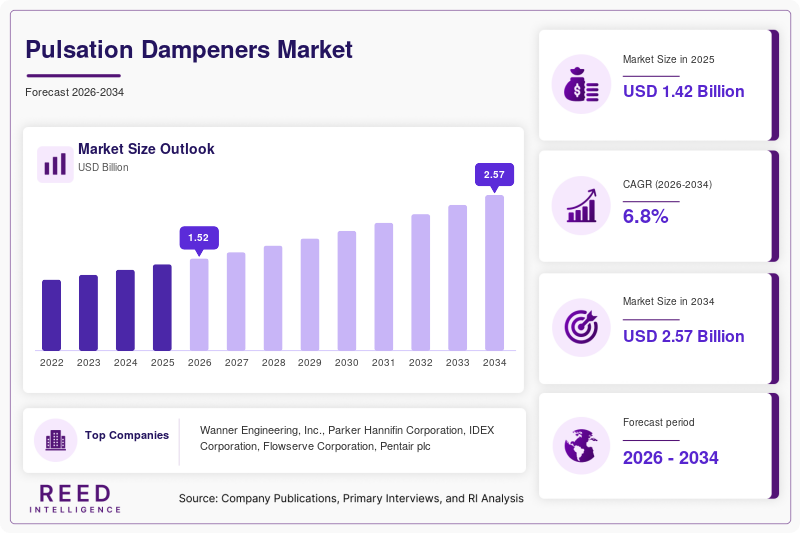
The global Pulsation Dampeners Market size was valued at USD 1.42 billion in 2026 and is projected to reach USD 2.41 billion by 2034, expanding at a CAGR of 6.8% during the forecast period from 2026 to 2034. Pulsation dampeners are widely used in fluid handling systems to reduce pressure fluctuations, improve flow stability, and extend the operating life of pumps and connected equipment. These systems are increasingly adopted across industries such as oil and gas, chemicals, pharmaceuticals, food processing, water treatment, and power generation due to rising demand for process efficiency and operational safety. Manufacturers are focusing on advanced elastomer materials, compact designs, and corrosion-resistant technologies to meet evolving industrial requirements.
A major factor supporting market growth is the increasing global investment in industrial automation and process optimization. Industries operating under continuous production environments are deploying pulsation dampeners to minimize vibration, prevent pipeline damage, and improve equipment reliability. In addition, strict regulations regarding workplace safety and energy efficiency are encouraging industrial facilities to upgrade pumping systems with pressure-control technologies. Expanding chemical processing activities in Asia Pacific and modernization of aging industrial infrastructure in North America and Europe are also creating stable demand for pulsation dampening equipment.
Key Highlights
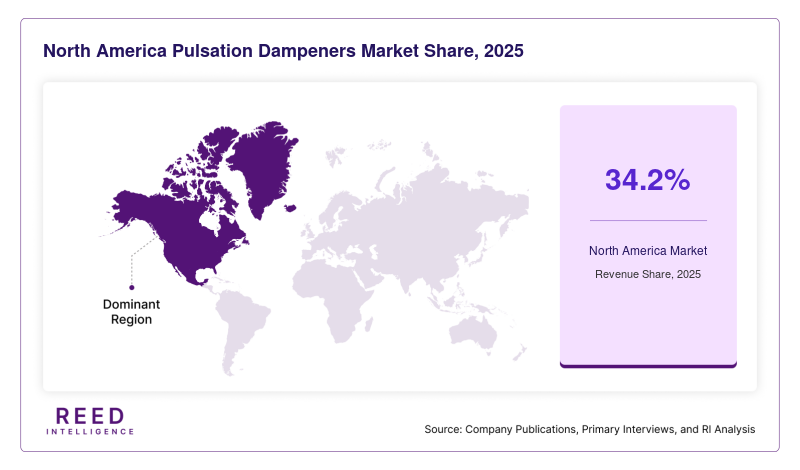
- North America dominated the market with a 34.2% share in 2025, while Asia Pacific is expected to grow at the fastest CAGR of 8.1% during 2026–2034.
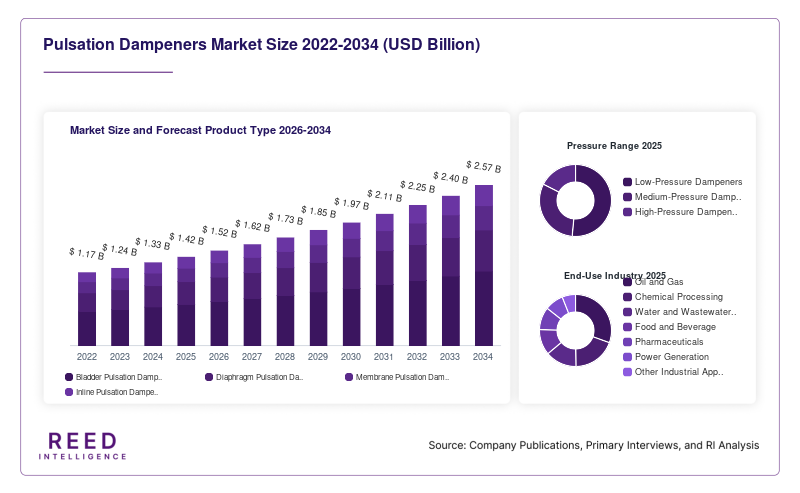
- By product type, bladder pulsation dampeners accounted for the largest share of 39.6%, while diaphragm pulsation dampeners are projected to grow at a CAGR of 8.4%.
- By pressure range, medium-pressure dampeners led with a 44.1% share, whereas high-pressure dampeners are expected to expand at a CAGR of 8.7%.
- By end-use industry, oil and gas held a 31.4% share, while water and wastewater treatment is anticipated to grow at a CAGR of 8.9%.
- The United States remained the dominant country, with market values of USD 382 million in 2024 and USD 408 million in 2025.
Market Trends
Integration of Smart Monitoring Technologies in Industrial Fluid Systems
Industrial facilities are increasingly integrating smart monitoring technologies with pulsation dampeners to improve operational efficiency and predictive maintenance capabilities. Modern dampeners are being equipped with pressure sensors, remote diagnostics, and automated monitoring systems that help operators track pressure fluctuations in real time. These technologies reduce unexpected equipment failure and minimize downtime in critical applications such as oil refining, chemical processing, and pharmaceutical manufacturing. Industrial operators are also using cloud-based monitoring platforms to analyze pump performance and optimize energy usage across fluid handling systems. The growing adoption of Industry 4.0 practices has accelerated the demand for connected dampening systems capable of supporting automated process environments. Manufacturers are responding by developing compact digital dampeners compatible with intelligent industrial control systems.
Growing Demand for Corrosion-Resistant and Hygienic Dampeners
The demand for corrosion-resistant and hygienic pulsation dampeners is increasing across food processing, pharmaceutical, biotechnology, and chemical industries. These industries require equipment capable of handling aggressive chemicals, sterile fluids, and high-purity materials without contamination risks. Stainless steel dampeners and specialized elastomer-lined systems are gaining popularity due to their ability to withstand harsh operating conditions and meet regulatory standards. Manufacturers are investing in advanced coating technologies and sanitary designs to address increasing demand from clean-process industries. In addition, expanding global investments in wastewater treatment and desalination facilities are encouraging the use of corrosion-resistant pulsation control equipment. The trend toward environmentally sustainable production processes is further supporting the adoption of durable and long-lasting dampeners that reduce maintenance frequency and operational costs.
Market Drivers
Expansion of Oil and Gas Infrastructure Projects Worldwide
The expansion of oil and gas infrastructure projects across North America, the Middle East, and Asia Pacific is significantly driving the Pulsation Dampeners Market. Pulsation dampeners are essential in upstream, midstream, and downstream operations where high-pressure pumps and fluid transfer systems are widely used. Increasing investments in offshore drilling platforms, pipeline transportation systems, and refinery modernization projects are generating substantial demand for reliable pressure control equipment. Oil and gas operators are prioritizing equipment that improves flow consistency and reduces mechanical stress in pipelines. Additionally, rising energy consumption and growing exploration activities in deepwater and shale reserves are supporting the installation of advanced pumping systems integrated with pulsation dampeners. The market is also benefiting from the replacement of aging fluid handling infrastructure in mature energy-producing regions.
Rising Investments in Water and Wastewater Treatment Facilities
Growing investments in water treatment and wastewater management infrastructure are accelerating demand for pulsation dampeners globally. Municipal utilities and industrial treatment plants require stable pumping operations to ensure efficient water transfer and chemical dosing processes. Pulsation dampeners help maintain smooth flow rates while reducing vibration and pressure spikes in treatment pipelines. Governments across developing and developed economies are increasing spending on sustainable water infrastructure to address water scarcity and environmental concerns. Rapid urbanization and industrialization are further increasing wastewater generation, leading to the expansion of treatment facilities. In addition, desalination projects in water-stressed regions are creating additional opportunities for dampener manufacturers. The growing focus on energy-efficient fluid management systems is expected to sustain long-term market growth.
Market Restraint
High Installation and Maintenance Costs in Specialized Industrial Applications
High installation and maintenance costs associated with advanced pulsation dampening systems remain a key challenge for market growth. Industrial facilities operating in high-pressure or corrosive environments often require customized dampeners manufactured using specialized alloys, reinforced elastomers, and advanced pressure-control mechanisms. These systems involve higher procurement and installation expenses compared to conventional fluid control equipment. Small and medium-sized industrial operators may hesitate to invest in premium dampening technologies due to budget limitations and uncertain short-term returns. Maintenance requirements, including bladder replacement, pressure calibration, and periodic inspection, also contribute to operational costs. In industries such as chemicals and pharmaceuticals, strict compliance standards further increase maintenance complexity and service expenses. Additionally, fluctuating raw material prices for stainless steel and engineered polymers can affect manufacturing costs and pricing stability across the global Pulsation Dampeners Market.
Market Opportunities
Increasing Adoption of Renewable Energy and Hydrogen Processing Facilities
The global transition toward renewable energy and hydrogen production is creating new growth opportunities for pulsation dampener manufacturers. Hydrogen processing plants, biofuel facilities, and renewable chemical production units rely heavily on high-pressure pumping systems that require efficient pressure stabilization technologies. Pulsation dampeners are increasingly being used to improve operational safety and reduce vibration in these advanced energy systems. Governments across Europe, Asia Pacific, and North America are introducing investment incentives for green hydrogen projects and low-carbon industrial infrastructure. This is encouraging equipment suppliers to develop dampeners compatible with aggressive gases and specialized renewable processing applications. As renewable energy investments continue to expand, demand for durable and high-performance pulsation control systems is expected to increase steadily throughout the forecast period.
Expansion of Pharmaceutical and Biotechnology Manufacturing Capacity
Rapid expansion of pharmaceutical and biotechnology manufacturing facilities is generating significant opportunities for the Pulsation Dampeners Market. Pharmaceutical production processes require accurate fluid dosing, contamination-free operations, and consistent pressure management across sterile manufacturing environments. Pulsation dampeners help maintain process stability and protect sensitive equipment used in vaccine production, injectable drugs, and biotechnology applications. Increasing healthcare expenditure, rising biologics production, and growing demand for advanced drug manufacturing technologies are supporting industrial investments in hygienic fluid handling systems. In addition, pharmaceutical companies are expanding production facilities in Asia Pacific and Latin America to strengthen regional supply chains. This trend is encouraging manufacturers to introduce sanitary-grade dampeners designed specifically for high-purity and cleanroom applications.
Segmental Analysis
By Product Type
Bladder pulsation dampeners accounted for the largest share of the Pulsation Dampeners Market in 2024, representing approximately 39.6% of global revenue. These dampeners are widely used across oil and gas, chemical processing, and industrial manufacturing applications due to their ability to effectively absorb pressure fluctuations and reduce vibration. Bladder-based systems are preferred because of their flexible design, operational efficiency, and compatibility with a broad range of fluids. Industrial operators favor these systems for moderate and high-pressure pumping environments where consistent flow control is required. Manufacturers are also introducing advanced elastomer materials with improved chemical resistance and extended operational life. Increasing use of automated pumping systems in industrial facilities continues to support demand for bladder pulsation dampeners globally.
Diaphragm pulsation dampeners are expected to register the fastest CAGR of 8.4% during the forecast period due to rising demand from hygienic and corrosive fluid applications. These dampeners are increasingly adopted in pharmaceutical manufacturing, food processing, and biotechnology industries because they offer contamination-free operation and superior corrosion resistance. Diaphragm-based systems are suitable for handling aggressive chemicals and sterile fluids in highly regulated environments. Manufacturers are developing compact diaphragm dampeners with enhanced durability and lower maintenance requirements to address evolving industrial needs. The expansion of high-purity processing facilities and increasing investments in pharmaceutical production infrastructure are expected to accelerate adoption of diaphragm pulsation dampeners over the coming years.
By Pressure Range
Medium-pressure pulsation dampeners held the dominant market share of 44.1% in 2024 due to their extensive use in general industrial processing applications. These dampeners are commonly deployed in chemical plants, food processing facilities, water treatment systems, and manufacturing operations where stable pressure management is essential for efficient fluid transfer. Medium-pressure systems offer a balance between operational performance and cost efficiency, making them suitable for a broad range of industrial applications. Growing industrial automation and increasing demand for energy-efficient pumping systems are supporting adoption of medium-pressure dampeners. Manufacturers are also enhancing product reliability through improved sealing technologies and corrosion-resistant materials designed for continuous industrial operation.
High-pressure pulsation dampeners are projected to witness the fastest CAGR of 8.7% throughout the forecast period. Rising investments in offshore drilling, petrochemical production, and hydraulic systems are increasing demand for high-pressure fluid management equipment. These dampeners are specifically designed to withstand extreme operating conditions while maintaining consistent pressure control in critical industrial processes. Advancements in reinforced composite materials and stainless-steel construction are improving the durability and safety performance of high-pressure systems. Furthermore, increasing exploration of deepwater oil reserves and expansion of hydrogen processing facilities are expected to generate substantial opportunities for manufacturers specializing in high-pressure pulsation dampening solutions.
By End-Use Industry
The oil and gas segment dominated the Pulsation Dampeners Market in 2024 and accounted for approximately 31.4% of total revenue. The industry relies heavily on pulsation dampeners to reduce vibration, stabilize fluid flow, and protect high-pressure pumping systems used in drilling, refining, and pipeline transportation operations. Increasing investments in offshore exploration projects and refinery modernization initiatives are supporting continued demand for advanced pressure management systems. Oil and gas operators are also focusing on improving operational efficiency and minimizing equipment downtime, which increases the adoption of durable dampening technologies. The use of corrosion-resistant dampeners in harsh operating environments is further contributing to market expansion across upstream and downstream energy applications.
Water and wastewater treatment is anticipated to emerge as the fastest-growing end-use segment, registering a CAGR of 8.9% during the forecast period. Governments and municipal authorities are increasing investments in sustainable water management infrastructure to address urbanization, industrial wastewater generation, and water scarcity concerns. Pulsation dampeners play an important role in chemical dosing systems, filtration units, and water transfer operations by maintaining stable pressure and reducing mechanical stress on pipelines. Growing deployment of desalination plants and industrial recycling facilities is also creating additional demand for efficient fluid control equipment. Manufacturers are responding with compact and maintenance-efficient dampeners specifically designed for long-term use in municipal and industrial water treatment environments.
Regional Analysis
North America
North America accounted for 34.2% of the global Pulsation Dampeners Market share in 2025 and is expected to maintain a stable growth trajectory with a projected CAGR of 6.3% through 2034. The region benefits from strong industrial automation adoption and extensive use of advanced fluid handling systems across oil and gas, chemicals, and water treatment industries. Industrial operators in the United States and Canada continue investing in pipeline modernization and refinery upgrades, which support demand for high-performance pulsation dampeners. The presence of established equipment manufacturers and strong aftermarket service networks also contributes to regional market expansion.
The United States remains the dominant country within North America due to large-scale investments in shale gas production, industrial manufacturing, and municipal water infrastructure. Growing adoption of predictive maintenance technologies in industrial facilities is supporting demand for smart dampening systems integrated with digital monitoring capabilities. Additionally, aging industrial infrastructure across the country is encouraging replacement of outdated pressure-control systems with advanced corrosion-resistant dampeners. Expansion of pharmaceutical manufacturing and chemical processing operations further strengthens long-term market growth across the United States.
Europe
Europe represented 27.1% of the global Pulsation Dampeners Market in 2025 and is forecast to grow at a CAGR of 5.9% during the forecast period. The regional market is supported by strong environmental regulations and increasing investments in energy-efficient industrial operations. European manufacturers are focusing on reducing operational emissions and improving process safety through advanced fluid management systems. Countries across the region are modernizing industrial facilities to comply with sustainability targets, which is accelerating adoption of pulsation dampeners in chemical processing, wastewater treatment, and food manufacturing applications.
Germany remains the leading market in Europe due to its strong industrial manufacturing base and high adoption of automation technologies. The country’s engineering sector continues investing in precision fluid handling systems to support advanced production processes. In addition, the growth of renewable energy infrastructure and hydrogen processing projects is creating demand for high-pressure dampening equipment. Pharmaceutical production expansion and modernization of municipal wastewater facilities are also contributing to increased installation of corrosion-resistant pulsation dampeners across Germany.
Asia Pacific
Asia Pacific held 24.6% of the global Pulsation Dampeners Market share in 2025 and is expected to register the fastest CAGR of 8.1% between 2026 and 2034. Rapid industrialization, expanding manufacturing output, and rising investments in infrastructure projects are driving regional demand for fluid handling technologies. Countries such as China, India, Japan, and South Korea are increasing spending on chemical processing, energy production, and wastewater management systems. The growing need for operational efficiency and equipment protection in industrial facilities is supporting higher adoption of pulsation dampeners throughout the region.
China dominates the Asia Pacific market due to large-scale industrial expansion and strong investments in chemical and energy infrastructure. The country is also witnessing increased demand for advanced pumping systems in pharmaceutical manufacturing and water treatment applications. Government initiatives supporting industrial modernization and sustainable production practices are encouraging adoption of high-performance dampeners. Furthermore, rising investments in semiconductor manufacturing and industrial automation technologies are creating additional opportunities for manufacturers operating within the Chinese market.
Middle East & Africa
The Middle East & Africa accounted for 8.2% of the global Pulsation Dampeners Market in 2025 and is projected to expand at a CAGR of 6.7% over the forecast period. The region is heavily influenced by oil and gas exploration activities and large-scale investments in petrochemical processing infrastructure. Pulsation dampeners are widely used in drilling operations, pipeline systems, and refinery facilities to reduce pressure fluctuations and improve operational safety. Growing desalination projects and industrial water treatment investments are also supporting regional demand for advanced fluid control equipment.
Saudi Arabia remains the dominant country in the Middle East & Africa market due to extensive investments in refinery modernization and petrochemical production capacity. The country’s industrial diversification initiatives are driving expansion of manufacturing and water infrastructure projects that require reliable pressure management systems. In addition, increasing focus on reducing operational downtime in oil and gas operations is encouraging adoption of maintenance-efficient dampening technologies. Large-scale hydrogen and renewable energy projects are also creating new opportunities for equipment suppliers across Saudi Arabia.
Latin America
Latin America captured 5.9% of the global Pulsation Dampeners Market share in 2025 and is expected to grow at a CAGR of 6.1% through 2034. The market is supported by rising industrialization and increasing investments in mining, oil production, and water management projects. Several countries in the region are upgrading aging industrial infrastructure to improve process reliability and energy efficiency. Demand for pulsation dampeners is also increasing in food processing and beverage manufacturing industries where stable fluid transfer systems are essential for operational consistency.
Brazil leads the Latin American market due to its expanding oil production sector and growing industrial processing activities. Investments in offshore exploration projects and refinery upgrades are supporting demand for advanced pumping and pressure-control systems. The country is also investing in wastewater treatment and sanitation infrastructure to address urban population growth and environmental concerns. Expansion of agricultural processing industries and chemical manufacturing operations further contributes to increased deployment of pulsation dampeners across Brazil.
Competitive Landscape
The Pulsation Dampeners Market is moderately fragmented, with several international and regional manufacturers competing on the basis of product quality, pressure handling capability, customization, and aftermarket service support. Leading companies are investing in advanced materials, digital monitoring technologies, and energy-efficient designs to strengthen their market position. Strategic partnerships with industrial automation providers and expansion into emerging markets are becoming common growth strategies among major manufacturers.
Wanner Engineering remains one of the leading participants in the market due to its extensive portfolio of industrial fluid handling and pulsation control products. The company continues focusing on product innovation and customized dampening solutions for high-pressure industrial applications. In 2025, the company introduced an upgraded series of corrosion-resistant pulsation dampeners designed for aggressive chemical environments and offshore energy applications. Other major players are emphasizing acquisitions, production capacity expansion, and development of smart dampening systems integrated with industrial IoT capabilities to improve operational efficiency and predictive maintenance performance.
Key Players
- Wanner Engineering, Inc.
- Parker Hannifin Corporation
- IDEX Corporation
- Flowserve Corporation
- Pentair plc
- Graco Inc.
- PSG Dover
- Hydracell
- ARO Ingersoll Rand
- Alfa Laval AB
- SPX FLOW, Inc.
- LEWA GmbH
- Tsurumi Manufacturing Co., Ltd.
- Verder Group
- ProMinent GmbH
Recent Developments
- In February 2025, Parker Hannifin Corporation expanded its industrial fluid handling portfolio with a new line of high-pressure pulsation dampeners designed for hydrogen and renewable fuel applications.
- In August 2025, Flowserve Corporation announced the expansion of its aftermarket service network in Asia Pacific to support rising demand for industrial pump and dampening system maintenance.
- In November 2024, Alfa Laval AB introduced sanitary-grade pulsation dampeners developed specifically for pharmaceutical and biotechnology processing facilities requiring contamination-free fluid management.
- In March 2025, ProMinent GmbH launched compact diaphragm pulsation dampeners optimized for chemical dosing and water treatment applications in municipal infrastructure projects.
Pulsation Dampeners Market Segments
Product Type
- Bladder Pulsation Dampeners
- Diaphragm Pulsation Dampeners
- Membrane Pulsation Dampeners
- Inline Pulsation Dampeners
Pressure Range
- Low-Pressure Dampeners
- Medium-Pressure Dampeners
- High-Pressure Dampeners
End-Use Industry
- Oil and Gas
- Chemical Processing
- Water and Wastewater Treatment
- Food and Beverage
- Pharmaceuticals
- Power Generation
- Other Industrial Applications
By Region
- North America
- Europe
- APAC
- Middle East and Africa
- LATAM