Punnet Packaging Market Size, Share & Demand Report By Material Type (Plastic, Paperboard, Molded Fiber, Biodegradable Materials), By Product Type (Hinged Punnets, Ventilated Punnets, Sealed Punnets, Stackable Punnets), By End Use (Fresh Fruits and Vegetables, Ready-to-Eat Packaged Produce, Mushrooms, Grapes and Berries, Others) By Region & Segment Forecasts, 2026–2034
USD 3950
Market Overview
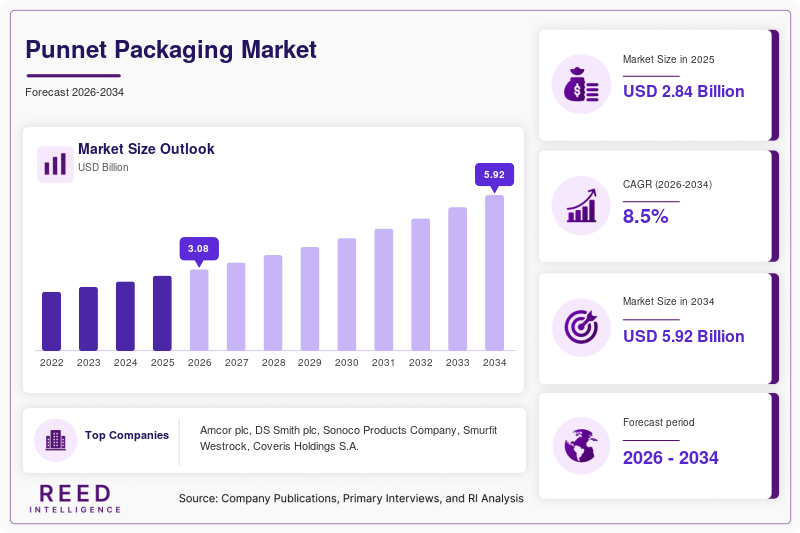
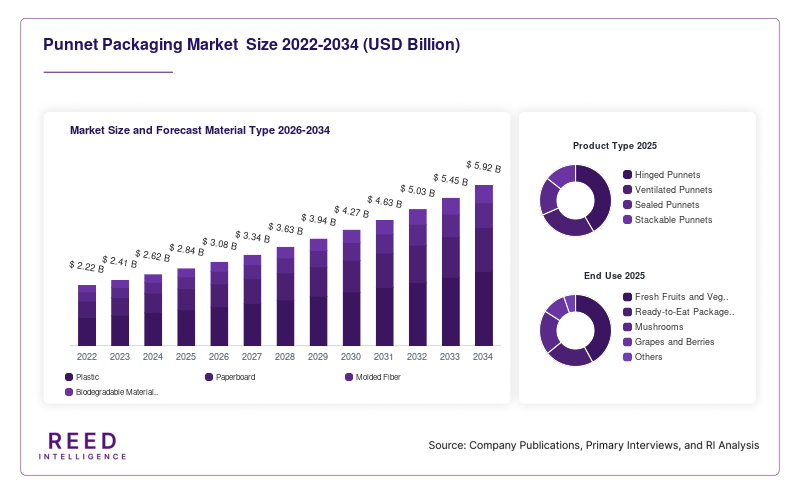
The global Punnet Packaging Market size was valued at USD 2.84 billion in 2026 and is projected to reach USD 5.47 billion by 2034, expanding at a CAGR of 8.5% during the forecast period from 2026 to 2034. The market is witnessing steady expansion due to rising demand for lightweight, recyclable, and retail-friendly packaging formats across the fresh produce industry. Punnet packaging solutions are widely used for berries, tomatoes, mushrooms, grapes, and ready-to-eat fruits because they improve shelf visibility, product protection, and transportation efficiency. Retail chains and food exporters are increasingly adopting sustainable punnet formats made from paperboard, molded fiber, and recycled PET materials to align with changing consumer preferences and environmental regulations.
One major global factor supporting market growth is the rapid expansion of organized retail and e-commerce grocery distribution. Supermarkets and online grocery platforms require packaging that can preserve freshness, reduce damage during transit, and improve product presentation. Punnet packaging fulfills these requirements while also supporting traceability and labeling needs. In addition, governments across Europe and North America are encouraging the replacement of single-use plastic packaging with recyclable and biodegradable alternatives, which is accelerating innovation in fiber-based and compostable punnet solutions.
Key Highlights
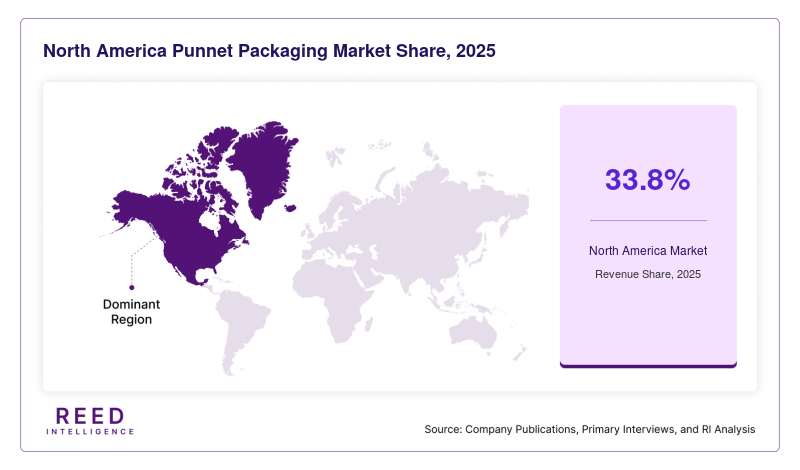
- North America dominated the market with a 33.8% share in 2025.
- Asia Pacific is expected to grow at the fastest CAGR of 10.9% during 2026–2034.
- By material type, plastic punnets accounted for the largest share of 46.4%.
- while molded fiber punnets are projected to grow at a CAGR of 11.8%.
- By product type, hinged punnets led with a 39.7% share.
- whereas ventilated punnets are expected to expand at a CAGR of 10.7%.
- By end use, fresh fruits and vegetables dominated with a 52.6% share.
- while ready-to-eat packaged produce is forecast to grow at a CAGR of 12.1%.
- The United States remained the dominant country, with market values of USD 620 million in 2024 and USD 675 million in 2025.
Market Trends
Rising Adoption of Sustainable and Fiber-Based Packaging
The Punnet Packaging Market is experiencing a notable shift toward sustainable and fiber-based packaging formats as food retailers and agricultural exporters prioritize environmentally responsible packaging solutions. Retail chains are introducing procurement policies that favor recyclable, compostable, and biodegradable packaging materials, encouraging manufacturers to reduce dependence on virgin plastics. Molded fiber punnets, paperboard trays, and hybrid packaging designs are gaining attention due to their lower environmental footprint and improved consumer perception. Food producers are also adopting eco-friendly punnets to meet sustainability commitments and comply with regional packaging waste regulations.
Consumer awareness regarding plastic pollution continues to influence packaging purchasing decisions, particularly in Europe and North America. As a result, packaging suppliers are investing in water-resistant coatings, lightweight fiber structures, and recyclable multilayer materials to improve product durability while maintaining sustainability targets. The expansion of organic produce sales and premium fruit exports is also contributing to higher demand for visually appealing and sustainable punnet packaging solutions. These developments are expected to support long-term market growth and accelerate innovation in renewable packaging materials.
Integration of Smart Packaging and Shelf-Life Enhancement Features
Manufacturers operating in the Punnet Packaging Market are increasingly integrating advanced packaging technologies to improve food preservation and supply chain efficiency. Smart packaging features such as QR codes, freshness indicators, RFID labels, and tamper-evident sealing systems are becoming more common in premium produce packaging. These technologies help retailers improve traceability, inventory management, and consumer engagement while supporting food safety compliance. Packaging companies are also introducing advanced ventilation systems and moisture-control designs that extend product freshness and reduce spoilage during storage and transportation.
The growing popularity of online grocery delivery is further increasing the need for durable and protective punnet packaging formats. E-commerce retailers require packaging that can maintain product quality throughout longer distribution cycles while reducing product damage. In response, suppliers are developing reinforced punnets with improved stacking strength and shock resistance. Automated packing lines in large agricultural facilities are also driving demand for standardized punnet dimensions and machine-compatible designs. These technological developments are strengthening the role of punnet packaging within modern food distribution systems.
Market Drivers
Expansion of Fresh Produce Consumption and Export Activities
The increasing consumption of fresh fruits, vegetables, and ready-to-eat produce is a major factor driving the Punnet Packaging Market. Consumers are shifting toward healthier diets that include fresh berries, grapes, cherry tomatoes, and cut fruits, leading to greater demand for convenient and hygienic packaging solutions. Punnet packaging offers improved visibility, ventilation, and product protection, making it highly suitable for fresh produce retailing. Large supermarket chains and food distributors are also standardizing packaging specifications to improve logistics efficiency and maintain product consistency across domestic and international markets.
Export-oriented agricultural economies are contributing significantly to market growth as international buyers demand high-quality protective packaging for perishable products. Countries involved in berry cultivation and premium fruit exports are increasingly using vented and tamper-resistant punnets to minimize transit damage and extend shelf life. In addition, rising urbanization and changing lifestyles are encouraging consumers to purchase packaged produce instead of loose products, creating stable demand for modern punnet packaging solutions.
Growth of Organized Retail and Food Distribution Networks
The rapid growth of supermarkets, hypermarkets, and online grocery platforms is accelerating the adoption of punnet packaging across global food supply chains. Organized retail channels prefer standardized packaging formats that improve shelf presentation, simplify labeling, and support automated inventory management. Punnet packaging allows retailers to display products attractively while reducing contamination risks and minimizing food wastage. The rise of private-label produce brands is also encouraging retailers to invest in customized punnet packaging designs that enhance product differentiation.
Food distribution companies are increasingly focusing on packaging solutions that can improve operational efficiency and reduce transportation losses. Lightweight punnets with optimized stacking performance help reduce shipping costs while maintaining product quality. Retailers are also adopting resealable and tamper-evident punnet formats to improve customer convenience and food safety assurance. Emerging economies in Asia Pacific and Latin America are witnessing rapid expansion of organized retail infrastructure, further increasing the demand for cost-effective and durable punnet packaging solutions.
Market Restraint
Volatility in Raw Material Prices and Recycling Infrastructure Limitations
Fluctuations in raw material prices remain a significant challenge for companies operating in the Punnet Packaging Market. Plastic resin prices are influenced by changes in crude oil costs, while paperboard and molded fiber materials are affected by pulp supply conditions and transportation expenses. These price variations create uncertainty for manufacturers and can reduce profit margins, particularly for small and medium-sized packaging suppliers. In addition, many sustainable punnet materials require specialized production technologies and higher initial investment costs, which can limit adoption among price-sensitive businesses.
The lack of adequate recycling and waste management infrastructure in several developing economies also restricts market expansion. Although recyclable and compostable punnet solutions are gaining popularity, many regions still lack efficient collection and processing systems. As a result, end users may hesitate to invest in premium sustainable packaging formats without clear recycling pathways. Food producers exporting to multiple international markets also face challenges related to differing packaging regulations and recycling standards. These operational and regulatory complexities may slow the transition toward advanced and sustainable punnet packaging solutions.
Market Opportunities
Increasing Demand for Compostable Packaging in Premium Produce Segments
The growing demand for compostable and biodegradable packaging presents a major opportunity for companies operating in the Punnet Packaging Market. Premium fruit brands, organic food producers, and specialty retailers are increasingly promoting environmentally responsible packaging to strengthen brand positioning and attract sustainability-focused consumers. Compostable punnets made from sugarcane fiber, bamboo pulp, and agricultural waste materials are gaining traction as viable alternatives to traditional plastic formats. These materials offer acceptable durability while supporting circular economy objectives and reducing landfill waste.
Government regulations restricting single-use plastics are also creating favorable conditions for investment in compostable punnet technologies. Packaging manufacturers that develop cost-efficient and moisture-resistant compostable solutions are expected to gain competitive advantages. Several food exporters are partnering with packaging suppliers to create customized eco-friendly punnets that comply with international sustainability standards. As organic and premium produce sales continue to increase worldwide, demand for innovative biodegradable punnet packaging is expected to expand steadily during the forecast period.
Expansion of Automated Packaging and Smart Labeling Solutions
The adoption of automated packaging systems across food processing and agricultural facilities is generating new opportunities for punnet packaging manufacturers. High-speed packaging lines require consistent packaging dimensions, improved stacking stability, and compatibility with automated filling equipment. Manufacturers are therefore designing lightweight punnets that can improve operational efficiency and reduce labor costs. Automation is particularly important in large-scale berry and grape packaging facilities where production volumes are increasing rapidly.
Smart labeling and digital traceability solutions are also creating additional market opportunities. Retailers and exporters are integrating QR codes, freshness tracking systems, and product authentication features into punnet packaging to improve consumer transparency and supply chain management. These technologies help reduce counterfeiting risks and enhance food safety compliance. Companies investing in digitally enabled punnet packaging solutions are expected to benefit from rising demand among organized retailers and export-focused food producers seeking improved visibility and inventory control.
Segmental Analysis
By Material Type
Plastic punnets dominated the Punnet Packaging Market in 2024 with a market share of 46.4% due to their lightweight structure, cost efficiency, and strong protective performance. PET and recycled PET materials remain widely used because they offer high transparency, moisture resistance, and durability during transportation. Food retailers and produce exporters continue to prefer plastic punnets for berries, grapes, and cherry tomatoes because these products require secure packaging with excellent visibility. Plastic punnets are also compatible with automated filling and sealing systems, making them suitable for high-volume packaging operations. Manufacturers are increasingly incorporating recycled content into plastic punnets to improve sustainability performance and comply with environmental regulations. In addition, advancements in vented packaging designs and stackable structures are helping maintain product freshness and reduce transportation damage across global supply chains.
Molded fiber punnets are projected to register the fastest CAGR of 11.8% during the forecast period due to rising environmental concerns and stricter packaging waste regulations. Consumers and retailers are increasingly favoring biodegradable packaging materials that can reduce plastic consumption and support circular economy goals. Molded fiber packaging is gaining popularity for premium fruits and organic produce because it offers an eco-friendly image while maintaining acceptable product protection. Manufacturers are investing in advanced coating technologies that improve moisture resistance and durability, making molded fiber punnets more suitable for refrigerated food applications. Food companies are also using fiber-based punnets to strengthen sustainability branding and comply with retailer packaging standards. The growing adoption of compostable packaging in Europe and North America is expected to accelerate demand for molded fiber punnet solutions over the coming years.
By Product Type
Hinged punnets accounted for the largest share of the Punnet Packaging Market in 2024, representing 39.7% of global revenue. These packaging formats are widely used because they provide convenient opening and closing mechanisms while ensuring secure product protection during transportation and retail display. Hinged punnets are commonly utilized for berries, grapes, mushrooms, and ready-to-eat fruit products due to their strong stacking performance and compatibility with automated packaging lines. Retailers prefer hinged designs because they improve shelf presentation and reduce the risk of accidental spillage in stores. Packaging manufacturers are also introducing tamper-evident closures and enhanced ventilation features to improve food safety and extend shelf life. The growing expansion of organized retail and e-commerce grocery distribution is further supporting demand for hinged punnet packaging across domestic and export markets.
Ventilated punnets are anticipated to witness the fastest CAGR of 10.7% during the forecast period because of increasing demand for improved freshness preservation and moisture control. These punnets contain specially designed airflow openings that help regulate humidity and reduce condensation, which is essential for delicate produce such as strawberries, blueberries, and cherry tomatoes. Agricultural exporters are increasingly adopting ventilated packaging solutions to minimize spoilage during long-distance transportation and improve shelf life in international markets. Packaging companies are also developing customizable ventilation patterns tailored to different produce categories and storage conditions. The rise of online grocery delivery services is further encouraging the adoption of ventilated punnets, as retailers seek packaging formats capable of maintaining product quality throughout extended logistics operations and home delivery cycles.
By End Use
Fresh fruits and vegetables represented the dominant end-use segment in the Punnet Packaging Market in 2024, accounting for 52.6% of total market revenue. The segment benefits from growing consumer demand for hygienically packaged produce that offers convenience, freshness, and easy handling. Supermarkets and grocery retailers increasingly prefer punnet packaging because it protects delicate produce from physical damage while improving product presentation on store shelves. Berry producers and grape exporters rely heavily on punnets to maintain product quality during transportation and cold storage. Retail-ready packaging formats are also becoming more important as retailers seek to improve operational efficiency and reduce repackaging requirements. In addition, governments and food safety organizations are encouraging improved produce packaging standards to reduce contamination risks and food wastage throughout the supply chain.
Ready-to-eat packaged produce is expected to expand at the fastest CAGR of 12.1% during the forecast period due to changing consumer lifestyles and increasing demand for convenient food products. Urban consumers are purchasing more pre-cut fruits, salad mixes, and snack-sized produce portions because of busy schedules and rising health awareness. Punnet packaging provides an effective solution for maintaining freshness, visibility, and portion control in ready-to-eat food applications. Manufacturers are introducing resealable and tamper-evident punnet designs to improve convenience and food safety for consumers. The expansion of convenience stores, online grocery platforms, and premium food retail channels is also contributing to segment growth. As demand for fresh convenience foods continues to increase globally, ready-to-eat produce packaging is expected to remain a key growth area for punnet manufacturers.
Regional Analysis
North America
North America accounted for 33.8% of the global Punnet Packaging Market in 2025 and is expected to maintain a stable growth trajectory with a CAGR of 7.8% during the forecast period. The region benefits from a well-established fresh produce distribution network and strong demand for packaged berries, salads, and ready-to-eat fruits. Large retail chains are encouraging the use of recyclable and lightweight packaging solutions to reduce environmental impact while improving product visibility and shelf appeal. The growing preference for convenient food packaging among urban consumers is further supporting regional market expansion.
The United States remains the dominant country within the North American market due to its extensive supermarket infrastructure and high fresh produce consumption levels. One unique growth factor supporting the country is the rapid expansion of online grocery delivery services, which require durable and protective packaging solutions for transportation. Packaging manufacturers in the country are also investing in advanced PET recycling systems and fiber-based punnet technologies to comply with sustainability goals established by retailers and regulatory authorities.
Europe
Europe represented 28.6% of the global Punnet Packaging Market in 2025 and is projected to expand at a CAGR of 8.1% between 2026 and 2034. The region is characterized by strict packaging waste regulations and strong consumer awareness regarding sustainable packaging materials. Food retailers across Europe are increasingly replacing conventional plastic punnets with recyclable paperboard and molded fiber alternatives. Demand for premium produce packaging is also rising due to the increasing popularity of organic fruits, berries, and specialty vegetables across regional markets.
Germany emerged as the leading country in the European market because of its advanced packaging manufacturing industry and strong emphasis on recycling systems. A unique growth factor in the country is the widespread implementation of circular economy initiatives that encourage recyclable packaging adoption across food supply chains. Major supermarket groups are collaborating with packaging companies to introduce lightweight and reusable punnet solutions that reduce plastic waste while maintaining food safety standards.
Asia Pacific
Asia Pacific held a 23.4% share of the global Punnet Packaging Market in 2025 and is anticipated to register the fastest CAGR of 10.9% during the forecast period. Rising urbanization, increasing disposable incomes, and the expansion of organized retail are driving demand for packaged fresh produce throughout the region. Countries across Asia Pacific are witnessing rapid growth in supermarket chains and e-commerce grocery platforms, which are increasing the need for durable and visually appealing packaging solutions. The region is also benefiting from expanding agricultural exports and rising adoption of standardized packaging formats.
China remains the dominant country in the Asia Pacific market due to its large-scale fruit production industry and rapidly growing retail infrastructure. One unique growth factor supporting market expansion in the country is the increasing export of berries, grapes, and mushrooms to international markets requiring high-quality protective packaging. Domestic packaging manufacturers are investing in automated production lines and recyclable material technologies to improve product quality and meet export compliance requirements.
Middle East & Africa
The Middle East & Africa region accounted for 7.1% of the global Punnet Packaging Market in 2025 and is forecast to grow at a CAGR of 7.4% through 2034. Increasing demand for imported fruits and vegetables is supporting the adoption of modern packaging formats across supermarkets and retail chains in the region. Governments are investing in food security and cold chain infrastructure, creating opportunities for improved produce packaging solutions. Retailers are also introducing packaged fresh produce formats to improve hygiene standards and reduce product handling.
The United Arab Emirates is the dominant country within the regional market because of its advanced retail infrastructure and strong reliance on imported produce. A unique growth factor in the country is the expansion of premium grocery retailing and luxury food distribution channels, which require visually attractive and durable punnet packaging. Packaging suppliers are increasingly offering customized transparent punnets and tamper-evident designs for imported berries and premium fruits sold through high-end retail stores.
Latin America
Latin America captured 7.1% of the global Punnet Packaging Market in 2025 and is expected to grow at a CAGR of 8.3% during the forecast period. The region is benefiting from increasing agricultural exports, particularly berries, grapes, and tropical fruits. Exporters are adopting advanced punnet packaging solutions to minimize transportation damage and improve product presentation in international markets. Growth in supermarket penetration and consumer preference for hygienically packed produce are also supporting regional market development.
Brazil remains the leading country in the Latin American market due to its strong agricultural production capacity and growing food retail industry. One unique growth factor driving demand in the country is the increasing investment in cold chain logistics for fruit exports. Export-oriented growers are partnering with packaging manufacturers to develop lightweight and ventilated punnet formats that improve shelf life and reduce moisture-related spoilage during long-distance transportation.
Competitive Landscape
The Punnet Packaging Market is moderately fragmented, with global and regional manufacturers competing on sustainability, material innovation, pricing, and customization capabilities. Companies are focusing on recyclable packaging materials, lightweight product designs, and automation-compatible formats to strengthen their market positions. Strategic partnerships with food retailers, agricultural exporters, and fresh produce suppliers are becoming increasingly important for long-term business expansion.
Amcor plc remains one of the leading companies in the market due to its extensive global packaging portfolio and strong investments in sustainable packaging technologies. The company recently expanded its recyclable PET punnet product line for fresh produce applications to support retailer sustainability initiatives. Other major participants are also investing in molded fiber packaging, compostable materials, and digital labeling technologies to address evolving customer requirements.
Competition is intensifying as retailers demand lower packaging weights, improved shelf presentation, and compliance with environmental regulations. Companies are introducing advanced ventilation systems, tamper-evident closures, and customized branding options to differentiate their products. Mergers, production facility expansions, and regional partnerships are expected to remain key competitive strategies throughout the forecast period.
Key Players
- Amcor plc
- DS Smith plc
- Sonoco Products Company
- Smurfit Westrock
- Coveris Holdings S.A.
- Pactiv Evergreen Inc.
- INFIA S.r.l.
- Quinn Packaging Ltd.
- Sirap Group
- Faerch Group
- Mondi Group
- Huhtamaki Oyj
- Genpak LLC
- IPL Packaging
- Sabert Corporation
Recent Developments
- In February 2026, Amcor plc introduced a recyclable lightweight PET punnet range designed for berry packaging applications in North America.
- In July 2025, DS Smith plc launched a molded fiber punnet solution with moisture-resistant coating technology for fresh produce exporters in Europe.
- In October 2025, Coveris Holdings S.A. expanded its automated punnet packaging production capacity in Germany to address rising demand from supermarket chains.
- In March 2026, Faerch Group announced the development of recycled-content food-grade punnets aimed at reducing virgin plastic usage across retail packaging operations.
Punnet Packaging Market Segments
Material Type
- Plastic
- Paperboard
- Molded Fiber
- Biodegradable Materials
Product Type
- Hinged Punnets
- Ventilated Punnets
- Sealed Punnets
- Stackable Punnets
End Use
- Fresh Fruits and Vegetables
- Ready-to-Eat Packaged Produce
- Mushrooms
- Grapes and Berries
- Others
By Region
- North America
- Europe
- APAC
- Middle East and Africa
- LATAM