PUR Hot Melt Adhesive Market Size, Share & Demand Report By Product Type (Reactive PUR Adhesives, Thermoplastic PUR Adhesives), By Application (Woodworking and Furniture Manufacturing, Automotive Assembly, Packaging, Textiles, Electronics Assembly, Construction), By End-Use Industry (Packaging Industry, Automotive Industry, Furniture Industry, Electronics Industry), By Region & Segment Forecasts, 2026–2034
USD 3950
Market Overview
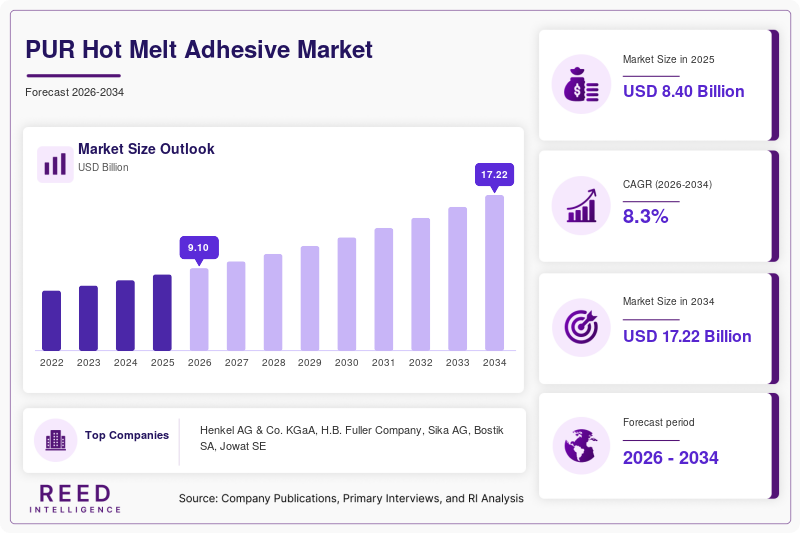
The global PUR Hot Melt Adhesive Market size was valued at USD 8.4 billion in 2026 and is projected to reach USD 15.9 billion by 2034, expanding at a CAGR of 8.3% during the forecast period from 2026 to 2034. PUR hot melt adhesives are increasingly used across woodworking, automotive, packaging, textiles, electronics, and construction industries due to their strong bonding performance, moisture resistance, flexibility, and rapid curing characteristics. These adhesives combine the processing advantages of hot melt technology with the durability of reactive polyurethane chemistry, making them suitable for advanced industrial manufacturing environments.
The rising demand for lightweight and durable bonding materials across manufacturing industries has supported the expansion of the PUR Hot Melt Adhesive Market. Manufacturers are shifting toward adhesive bonding solutions that improve production efficiency while reducing material waste and assembly time. In addition, increasing investments in automated production lines and high-speed packaging systems have accelerated the use of PUR hot melt adhesives because of their fast setting capability and long-term structural performance. Growing demand for sustainable furniture production and flexible packaging applications has also contributed to wider market penetration in developed and emerging economies.
Key Highlights
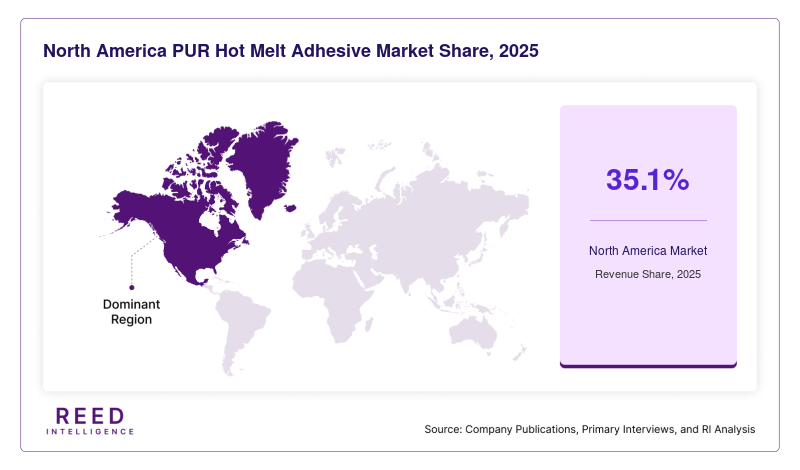
- North America dominated the market with a 35.1% share in 2025.
- Asia Pacific is expected to grow at the fastest CAGR of 10.9% during 2026–2034.
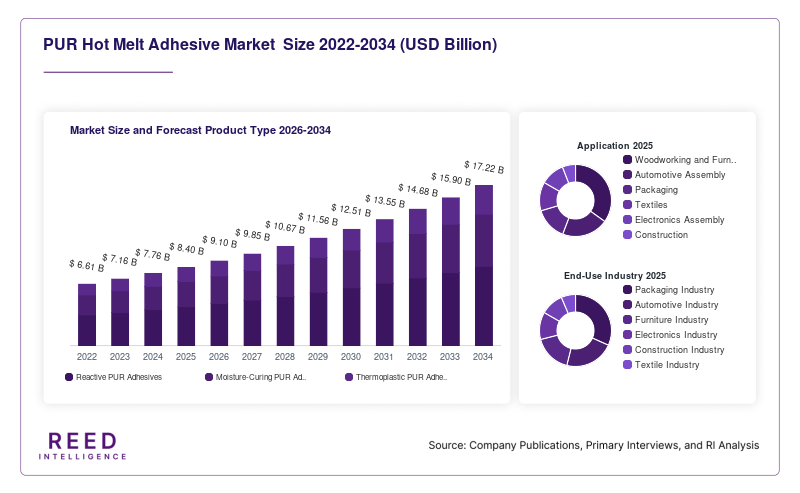
- By product type, reactive PUR adhesives accounted for the largest share of 61.4%.
- while moisture-curing PUR adhesives are projected to grow at a CAGR of 10.7%.
- By application, woodworking and furniture manufacturing led with a 39.6% share.
- whereas automotive assembly is expected to expand at a CAGR of 11.1%.
- The United States remained the dominant country, with market values of USD 1.82 billion in 2024 and USD 1.97 billion in 2025.
Market Trends
Increasing Adoption of Sustainable and Low-Emission Adhesive Solutions
The PUR Hot Melt Adhesive Market is experiencing a growing shift toward sustainable and low-emission adhesive technologies. Manufacturers across furniture, packaging, and automotive sectors are adopting environmentally compliant bonding materials to reduce volatile organic compound emissions and improve workplace safety. PUR hot melt adhesives provide solvent-free processing, lower material consumption, and improved durability compared to traditional solvent-based adhesives. These advantages are encouraging companies to replace conventional bonding technologies with advanced polyurethane-based systems. Regulatory policies related to industrial emissions and recyclable packaging materials are also influencing product development strategies.
Industrial producers are investing in bio-based polyurethane formulations and recyclable packaging-compatible adhesive technologies to align with sustainability goals. Demand for energy-efficient manufacturing processes is further supporting this trend, as PUR hot melt systems require shorter curing times and improve production throughput. Furniture manufacturers are increasingly using these adhesives for laminated panels, edge banding, and decorative surfaces because of their long-lasting bonding strength and resistance to temperature fluctuations. The combination of environmental compliance and operational efficiency continues to strengthen market demand across multiple industries.
Expansion of Automated Manufacturing and High-Speed Production Lines
The rapid expansion of automated manufacturing systems has become a major trend influencing the PUR Hot Melt Adhesive Market. Industries such as automotive, electronics, packaging, and textiles are implementing automated assembly lines that require fast-curing and highly reliable bonding solutions. PUR hot melt adhesives support high-speed industrial operations by delivering strong initial tack, quick setting performance, and long-term structural integrity. Their compatibility with robotic dispensing systems and precision application equipment has increased adoption among large-scale manufacturers.
The packaging sector is witnessing rising demand for automated labeling, carton sealing, and flexible packaging applications where production efficiency is critical. Automotive manufacturers are also integrating PUR hot melt adhesives into lightweight vehicle assembly processes to reduce the use of mechanical fasteners and improve fuel efficiency. In electronics manufacturing, these adhesives are used for compact device assembly because they provide excellent adhesion to plastics, metals, and composite materials. The growing preference for automated production systems across industrial sectors is expected to sustain demand for advanced PUR adhesive technologies throughout the forecast period.
Market Drivers
Rising Demand from Woodworking and Furniture Manufacturing Industries
The expanding global furniture and woodworking industry is a major factor supporting the growth of the PUR Hot Melt Adhesive Market. Furniture manufacturers increasingly require durable adhesives that can bond multiple substrates while maintaining long-term structural performance. PUR hot melt adhesives provide strong adhesion to wood, laminates, plastics, and engineered boards, making them suitable for modular furniture, kitchen cabinets, flooring panels, and decorative interiors. Their resistance to moisture and heat also improves product durability in residential and commercial applications.
Urbanization, residential construction growth, and increasing consumer spending on interior products are creating higher demand for advanced furniture manufacturing materials. Modern furniture production facilities rely on automated edge banding and lamination systems where PUR adhesives improve production speed and reduce downtime. In addition, the expansion of ready-to-assemble furniture and online furniture retailing has increased the need for lightweight and durable bonding solutions. The combination of efficient processing and long-lasting bonding strength continues to accelerate adoption across woodworking applications worldwide.
Growing Use of Lightweight Materials in Automotive Manufacturing
The increasing use of lightweight materials in automotive production is driving demand for advanced adhesive technologies, including PUR hot melt adhesives. Vehicle manufacturers are replacing metal components with lightweight plastics, composites, and engineered materials to improve fuel efficiency and support electric vehicle performance. PUR hot melt adhesives enable strong bonding between dissimilar materials without adding significant weight to vehicle structures. These adhesives also improve vibration resistance, durability, and noise reduction in automotive interiors and assemblies.
Electric vehicle production is further supporting market growth because battery systems and lightweight body structures require high-performance bonding solutions. PUR adhesives are increasingly used in headliners, door panels, seating systems, insulation materials, and electronic components. Automotive manufacturers prefer these adhesives because they support flexible design processes and reduce assembly complexity compared to traditional fastening methods. The global transition toward electric mobility and energy-efficient transportation systems is expected to sustain long-term growth opportunities for PUR hot melt adhesive manufacturers.
Market Restraint
Volatility in Raw Material Prices and Processing Challenges
Fluctuations in raw material prices remain a significant restraint for the PUR Hot Melt Adhesive Market. Polyurethane adhesives are primarily produced using petrochemical derivatives, including isocyanates and polyols, which are sensitive to changes in crude oil prices and global supply chain disruptions. Variations in raw material costs directly impact production expenses and profit margins for adhesive manufacturers. Smaller companies often face difficulties in maintaining stable pricing structures, particularly during periods of supply shortages or transportation disruptions.
Processing challenges associated with moisture-sensitive PUR formulations also affect market expansion in certain industries. PUR hot melt adhesives require controlled storage conditions and specialized dispensing equipment to maintain performance consistency. Small and medium-sized manufacturers may hesitate to adopt these systems because of higher equipment investments and operational complexity. In developing regions, limited technical expertise and infrastructure constraints can slow the transition from traditional adhesives to advanced PUR technologies. Additionally, strict handling requirements related to reactive polyurethane materials increase compliance costs for manufacturers and end users. These factors may restrict rapid market penetration in cost-sensitive industrial sectors despite the strong performance benefits of PUR hot melt adhesive products.
Market Opportunities
Expanding Demand for Flexible Packaging Applications
The increasing use of flexible packaging across food, beverage, pharmaceutical, and consumer goods industries presents significant growth opportunities for the PUR Hot Melt Adhesive Market. Flexible packaging manufacturers require advanced adhesives that provide strong bonding performance while supporting lightweight and durable packaging structures. PUR hot melt adhesives offer high heat resistance, fast curing capability, and compatibility with multilayer packaging materials, making them suitable for modern packaging systems.
The growth of e-commerce and online retailing has accelerated demand for secure packaging solutions that can withstand transportation and handling conditions. Food packaging companies are also adopting PUR adhesives to improve package durability and extend product shelf life. In addition, rising consumer preference for recyclable and sustainable packaging materials is encouraging innovation in adhesive technologies that support environmentally friendly packaging formats. Manufacturers that develop low-migration and food-safe PUR formulations are expected to gain competitive advantages in high-growth packaging markets.
Emerging Applications in Consumer Electronics and Smart Devices
Rapid expansion in consumer electronics production is creating new opportunities for the PUR Hot Melt Adhesive Market. Smartphones, wearable devices, tablets, and smart home products require compact assembly processes and durable bonding materials capable of handling thermal and mechanical stress. PUR hot melt adhesives provide excellent adhesion to plastics, metals, glass, and composite substrates commonly used in electronic devices.
The growing popularity of smart devices and miniaturized electronics is increasing the need for precise adhesive dispensing technologies that improve manufacturing efficiency. PUR adhesives are also used for cable management, display assembly, insulation components, and vibration control applications. As electronics manufacturers focus on thinner and lighter device designs, demand for high-performance adhesives is expected to increase further. Asia Pacific remains a key manufacturing hub for electronics production, and continued investments in semiconductor and smart device manufacturing facilities are likely to support long-term market expansion.
Segmental Analysis
By Product Type
Reactive PUR adhesives accounted for the largest share of the PUR Hot Melt Adhesive Market in 2024, representing approximately 61.4% of total revenue. These adhesives are widely preferred because they combine fast initial bonding with long-term chemical crosslinking performance. Industries such as woodworking, automotive, and electronics rely on reactive PUR formulations for applications that require high mechanical strength, flexibility, and moisture resistance. Furniture manufacturers extensively use reactive PUR adhesives for edge banding, panel lamination, and decorative surface bonding because of their durability under changing environmental conditions. In automotive production, these adhesives support lightweight assembly processes and improve component reliability. The strong compatibility of reactive PUR adhesives with multiple substrates, including plastics, metals, composites, and engineered wood products, continues to support their dominant market position across industrial manufacturing applications.
By Application
Woodworking and furniture manufacturing represented the dominant application segment in the PUR Hot Melt Adhesive Market in 2024, accounting for nearly 39.6% of overall market revenue. The segment benefits from increasing global demand for modular furniture, decorative interiors, and engineered wood products. PUR hot melt adhesives provide strong bonding performance for laminates, veneers, edge banding, and cabinet assembly applications. Their resistance to moisture and temperature changes improves furniture durability and extends product life cycles. Manufacturers also prefer PUR adhesives because they support high-speed automated production processes and reduce material wastage. Growth in residential construction and commercial infrastructure development has contributed to rising furniture consumption worldwide. In addition, expanding online furniture retailing has encouraged manufacturers to use lightweight and durable bonding technologies that improve shipping reliability and assembly efficiency.
By End-Use Industry
The packaging industry held the largest share of the PUR Hot Melt Adhesive Market in 2024, contributing approximately 34.8% of total market revenue. Rising demand for flexible packaging solutions across food, beverage, pharmaceutical, and consumer goods industries continues to support segment growth. PUR hot melt adhesives provide strong sealing performance, rapid curing capability, and compatibility with multilayer packaging materials. Packaging manufacturers increasingly prefer these adhesives because they improve production efficiency while maintaining package integrity during transportation and storage. The expansion of e-commerce activities has also created additional demand for durable packaging systems that can withstand long-distance logistics operations. In addition, sustainability initiatives encouraging the use of recyclable and lightweight packaging materials are promoting adoption of advanced PUR adhesive technologies. The packaging industry remains a major revenue contributor because of continuous innovation in consumer packaging formats and industrial processing systems.
Regional Analysis
North America
North America accounted for 35.1% of the global PUR Hot Melt Adhesive Market in 2025 and is expected to maintain steady growth during the forecast period with a CAGR of 7.6%. The region benefits from strong demand across automotive manufacturing, furniture production, and advanced packaging industries. Industrial automation and early adoption of high-performance bonding technologies have contributed to widespread use of PUR adhesives in manufacturing facilities. The presence of established adhesive manufacturers and advanced research capabilities also supports regional market growth.
Europe
Europe represented 27.4% of the global PUR Hot Melt Adhesive Market in 2025 and is projected to expand at a CAGR of 7.9% through 2034. Demand for sustainable adhesive technologies and recyclable packaging materials continues to influence regional market growth. European manufacturers are focusing on environmentally compliant production processes and low-emission industrial materials, which has increased adoption of solvent-free PUR hot melt adhesives. Strong automotive production and advanced woodworking industries also support market expansion.
Asia Pacific
Asia Pacific held 24.8% of the global PUR Hot Melt Adhesive Market in 2025 and is expected to register the fastest CAGR of 10.9% during the forecast period. Rapid industrialization, expanding manufacturing activities, and rising construction investments are contributing to strong regional demand. Countries across the region are witnessing increased adoption of automated production systems in packaging, electronics, and furniture industries. Growth in disposable income and urbanization is also supporting higher demand for consumer products that utilize PUR adhesive technologies.
Middle East & Africa
The Middle East & Africa region accounted for 6.5% of the global PUR Hot Melt Adhesive Market in 2025 and is projected to grow at a CAGR of 6.8% through 2034. Construction activities, infrastructure modernization, and growth in packaging industries are supporting regional demand for advanced adhesive technologies. The market is also benefiting from rising investments in local manufacturing operations aimed at reducing import dependency. PUR adhesives are increasingly used in insulation materials, furniture applications, and industrial assembly operations.
Latin America
Latin America captured 6.2% of the global PUR Hot Melt Adhesive Market in 2025 and is expected to grow at a CAGR of 7.1% during the forecast period. Expanding packaging industries, increasing furniture production, and growth in automotive component manufacturing are supporting regional market development. Manufacturers across the region are gradually shifting toward high-performance adhesives that improve production efficiency and product durability. Demand for flexible packaging materials in food and beverage industries is also contributing to market expansion.
Competitive Landscape
The PUR Hot Melt Adhesive Market is characterized by the presence of global chemical manufacturers and specialized adhesive producers competing through product innovation, strategic partnerships, and regional expansion. Companies are focusing on sustainable adhesive formulations, improved thermal resistance, and compatibility with automated manufacturing systems to strengthen market positioning. Investment in research and development remains a key strategy as manufacturers seek to introduce low-emission and high-performance adhesive technologies suitable for furniture, automotive, electronics, and packaging applications.
Henkel AG & Co. KGaA remained a leading participant in the market due to its broad industrial adhesive portfolio and strong global distribution network. The company continues to expand its polyurethane adhesive offerings for packaging and automotive applications. H.B. Fuller Company has focused on expanding production capacity and enhancing sustainable adhesive solutions for flexible packaging markets. Sika AG is strengthening its industrial bonding technologies through acquisitions and product innovation initiatives. Jowat SE and Bostik are also increasing investments in high-performance PUR hot melt systems designed for automated woodworking and electronics assembly operations.
Key Players
- Henkel AG & Co. KGaA
- H.B. Fuller Company
- Sika AG
- Bostik SA
- Jowat SE
- 3M Company
- Dow Inc.
- Arkema Group
- Avery Dennison Corporation
- Beardow Adams
- Tex Year Industries Inc.
- Kleiberit Adhesives USA
- Ashland Inc.
- Franklin International
- Nan Pao Resins Chemical Group
Recent Developments
- Henkel AG & Co. KGaA introduced a new low-emission PUR hot melt adhesive range in 2025 designed for automated packaging and furniture manufacturing applications.
- H.B. Fuller Company expanded its production facility in Asia Pacific to increase supply capacity for reactive polyurethane hot melt adhesives used in electronics and flexible packaging industries.
- Sika AG launched an advanced PUR adhesive solution for lightweight automotive interiors aimed at improving thermal resistance and assembly efficiency in electric vehicles.
- Jowat SE developed a high-performance moisture-curing PUR formulation optimized for high-speed edge banding systems in modular furniture production.
PUR Hot Melt Adhesive Market Segments
Product Type
- Reactive PUR Adhesives
- Moisture-Curing PUR Adhesives
- Thermoplastic PUR Adhesives
Application
- Woodworking and Furniture Manufacturing
- Automotive Assembly
- Packaging
- Textiles
- Electronics Assembly
- Construction
End-Use Industry
- Packaging Industry
- Automotive Industry
- Furniture Industry
- Electronics Industry
- Construction Industry
- Textile Industry
By Region
- North America
- Europe
- APAC
- Middle East and Africa
- LATAM