PVC Ball Valves Market Size, Share & Demand Report By Valve Type (Standard PVC Ball Valves, True Union PVC Ball Valves, Multi-Port PVC Ball Valves, Actuated PVC Ball Valves), By Application (Water Treatment, Chemical Processing, Irrigation Systems, Swimming Pools, Industrial Fluid Handling, Residential Plumbing), By End-Use Industry (Municipal Utilities, Agriculture, Industrial Manufacturing, Commercial Facilities, Residential Sector) & Segment Forecasts, 2026–2034
USD 3950
Market Overview
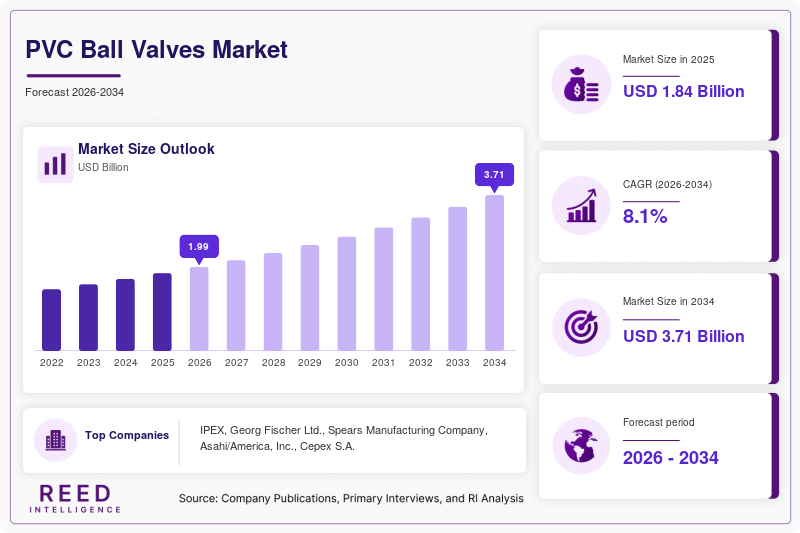
The PVC Ball Valves Market size was valued at approximately USD 1.84 billion in 2026 and is projected to reach USD 3.42 billion by 2034, expanding at a CAGR of 8.1% during the forecast period from 2026 to 2034. PVC ball valves have become an important component in fluid handling systems due to their corrosion resistance, lightweight structure, cost efficiency, and compatibility with a broad range of industrial and commercial applications. These valves are extensively used in water treatment facilities, chemical processing plants, irrigation systems, swimming pools, residential plumbing networks, and industrial fluid transportation systems.
The growing emphasis on water conservation and efficient fluid management has created favorable conditions for market expansion. Governments and industries worldwide continue to invest in water infrastructure modernization, wastewater treatment facilities, and agricultural irrigation projects. PVC ball valves offer operational reliability and lower maintenance costs compared to many traditional metal valve alternatives, making them a preferred choice for several end users.
Key Highlights
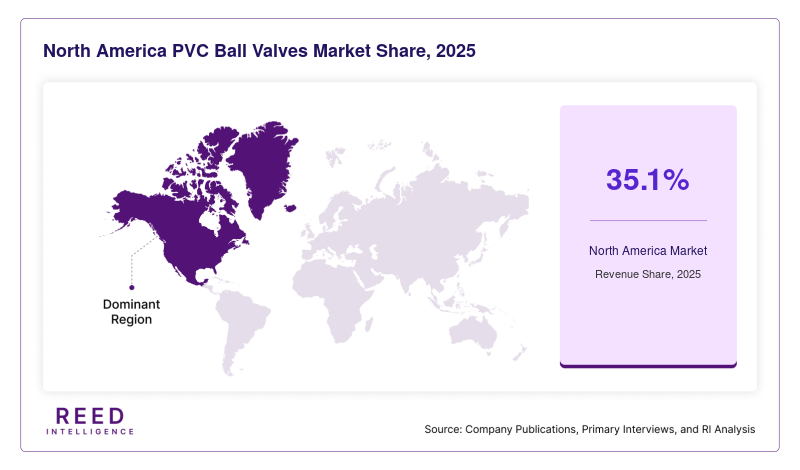
- North America dominated the market with a 35.1% share in 2025, while Asia Pacific is expected to grow at the fastest CAGR of 9.8% during 2026–2034.
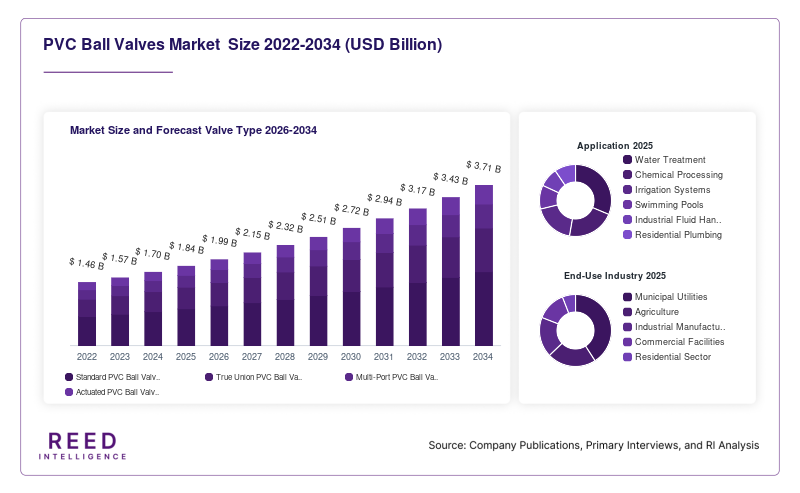
- By valve type, standard PVC ball valves accounted for the largest share of 46.3%, while true union PVC ball valves are projected to grow at a CAGR of 9.5%.
- By application, water treatment led with a 39.4% share, whereas chemical processing is expected to expand at a CAGR of 9.7%.
- By end-use industry, municipal utilities held the largest share of 33.8%, while agriculture is projected to grow at a CAGR of 10.1%.
- The United States remained the dominant country, with market values of USD 412 million in 2024 and USD 448 million in 2025.
Market Trends
Expansion of Smart Water Infrastructure Projects
A significant trend shaping the PVC Ball Valves Market is the increasing deployment of smart water infrastructure projects worldwide. Municipal authorities and utility operators are upgrading aging water distribution networks to reduce leakage, improve efficiency, and ensure sustainable water management. PVC ball valves are being incorporated into these systems because of their durability, corrosion resistance, and ease of installation. The adoption of digital monitoring systems has also encouraged the use of reliable valve components that can operate efficiently over extended periods. As urban populations continue to rise, investments in advanced water infrastructure are expected to generate sustained demand for PVC ball valves across both developed and developing economies.
Rising Adoption of Corrosion-Resistant Piping Systems
Industrial operators are increasingly replacing traditional metal-based fluid control components with corrosion-resistant alternatives. PVC ball valves have emerged as a preferred solution in chemical processing, wastewater treatment, and industrial fluid transport applications where exposure to aggressive chemicals can accelerate equipment degradation. The growing focus on reducing maintenance expenses and extending equipment life cycles is driving this trend. Manufacturers are introducing enhanced valve designs with improved sealing technologies and pressure handling capabilities, further supporting adoption. As industries seek cost-effective and durable fluid management systems, the demand for PVC-based valve solutions is expected to continue expanding throughout the forecast period.
Market Drivers
Increasing Investments in Water and Wastewater Treatment Facilities
Global investments in water treatment and wastewater management infrastructure continue to create substantial demand for PVC ball valves. Governments are prioritizing projects that improve water quality, increase treatment capacity, and strengthen distribution networks. PVC ball valves are widely utilized in filtration systems, pumping stations, and water distribution pipelines because they offer excellent corrosion resistance and low maintenance requirements. Their lightweight design also simplifies transportation and installation processes. As concerns regarding water scarcity and environmental sustainability intensify, investments in modern treatment facilities are expected to rise steadily, providing strong growth momentum for the PVC Ball Valves Market over the coming years.
Growing Demand from Agricultural Irrigation Systems
The agricultural sector represents another major growth driver for the market. Modern irrigation systems require dependable fluid control solutions capable of operating efficiently under varying environmental conditions. PVC ball valves are commonly used in drip irrigation, sprinkler systems, and agricultural water distribution networks due to their affordability and resistance to moisture-related corrosion. Increasing food production requirements, expanding cultivated land areas, and the adoption of precision agriculture technologies are driving investments in irrigation infrastructure globally. As farmers seek efficient water management solutions to improve productivity and conserve resources, demand for PVC ball valves is expected to experience sustained growth during the forecast period.
Market Restraint
Performance Limitations in High-Temperature and High-Pressure Applications
Despite their widespread adoption, PVC ball valves face limitations in applications involving extreme temperatures and elevated pressure conditions. Unlike metal valves, standard PVC valves may experience structural degradation when exposed to high thermal environments for extended periods. This restricts their use in certain industrial processes, including high-temperature chemical manufacturing and heavy industrial operations. Some end users continue to prefer metal or specialty composite valves for critical applications where enhanced mechanical strength is required.
The restraint becomes more significant in industries requiring continuous operation under demanding conditions. Although manufacturers have introduced advanced formulations and reinforced designs to improve performance, PVC valves still encounter challenges in competing with premium alternatives in specific applications. Furthermore, concerns regarding long-term durability in harsh operating environments may influence purchasing decisions among industrial customers. These limitations can slow adoption rates in selected market segments and create competitive pressure from alternative valve technologies.
Market Opportunities
Expansion of Industrial Manufacturing Activities in Emerging Economies
Rapid industrialization across emerging economies presents a substantial opportunity for the PVC Ball Valves Market. Countries throughout Asia Pacific, Latin America, and parts of the Middle East are investing heavily in manufacturing facilities, industrial parks, and infrastructure development projects. These investments require extensive fluid handling systems for water supply, chemical transportation, and wastewater management. PVC ball valves provide an attractive combination of affordability, durability, and ease of maintenance, making them suitable for large-scale industrial projects. As industrial output continues to increase across emerging regions, manufacturers are expected to benefit from expanding demand and new project opportunities.
Growing Adoption in Sustainable Water Management Programs
The global focus on sustainable water management is creating favorable opportunities for market participants. Governments, municipalities, and private organizations are implementing initiatives aimed at reducing water losses, improving treatment efficiency, and enhancing resource conservation. PVC ball valves play an important role in these efforts by providing reliable flow control while minimizing maintenance requirements. Their corrosion-resistant properties contribute to longer service life and reduced replacement frequency, supporting sustainability objectives. Increasing investments in rainwater harvesting systems, recycled water distribution networks, and smart irrigation programs are expected to generate additional growth avenues for manufacturers operating in the PVC Ball Valves Market.
Segmental Analysis
By Valve Type
Standard PVC ball valves dominated the PVC Ball Valves Market and accounted for approximately 46.3% of total revenue share in 2024. Their widespread adoption can be attributed to affordability, ease of installation, and suitability for a broad range of applications. These valves are commonly used in residential plumbing systems, irrigation networks, swimming pools, and basic industrial fluid handling operations. The availability of multiple sizes and pressure ratings further enhances their appeal among end users. Manufacturers continue to focus on improving sealing performance and durability, helping maintain strong demand. Their versatility and cost-effectiveness make standard PVC ball valves the preferred choice across numerous industries requiring reliable flow control solutions.
True union PVC ball valves are expected to register the fastest CAGR of 9.5% during the forecast period. These valves offer advantages such as easy maintenance, simplified replacement, and enhanced operational flexibility. Industries increasingly prefer true union designs because they allow valve removal without disturbing adjacent piping systems. This feature reduces maintenance downtime and lowers operational costs. Growing adoption within chemical processing facilities, water treatment plants, and industrial manufacturing operations is expected to drive segment growth. As end users prioritize efficiency and long-term maintenance benefits, demand for advanced true union PVC ball valves is projected to increase steadily across global markets.
By Application
Water treatment emerged as the dominant application segment, accounting for approximately 39.4% of the global market share in 2024. PVC ball valves are extensively utilized in filtration systems, pumping stations, treatment plants, and water distribution networks. Their resistance to corrosion and chemical exposure makes them particularly suitable for water management environments. Increasing investments in municipal water infrastructure and wastewater treatment facilities continue to support demand. Governments worldwide are allocating substantial resources toward improving water quality and treatment capacity. As aging infrastructure requires replacement and modernization, the water treatment segment is expected to maintain its leading position throughout the forecast period.
Chemical processing is projected to witness the fastest growth, registering a CAGR of 9.7% between 2026 and 2034. Chemical manufacturing facilities require valves capable of handling corrosive substances while maintaining reliable performance. PVC ball valves provide an effective solution due to their resistance to many acids, alkalis, and industrial chemicals. Expanding chemical production capacities across emerging economies are creating new opportunities for valve manufacturers. Furthermore, increasing emphasis on operational safety and maintenance efficiency encourages the adoption of corrosion-resistant fluid control components. These factors are expected to drive strong growth within the chemical processing application segment.
By End-Use Industry
Municipal utilities accounted for the largest share of the PVC Ball Valves Market in 2024, representing approximately 33.8% of total revenue. Municipal water supply networks, wastewater treatment plants, and public infrastructure systems rely heavily on dependable valve solutions to manage fluid flow effectively. PVC ball valves offer several advantages, including low maintenance requirements, corrosion resistance, and cost efficiency. Growing urban populations are increasing pressure on municipal infrastructure, prompting investments in system upgrades and expansion projects. Governments continue to prioritize water management and sanitation initiatives, further supporting demand. These factors collectively strengthen the position of municipal utilities as the dominant end-use segment.
Agriculture is anticipated to record the fastest CAGR of 10.1% during the forecast period. The increasing adoption of advanced irrigation technologies and precision farming practices is driving demand for reliable fluid control components. PVC ball valves are widely used in drip irrigation systems, sprinkler networks, and agricultural water distribution infrastructure. Their affordability and durability make them particularly attractive for large-scale agricultural applications. Rising concerns regarding water conservation and efficient resource utilization are encouraging farmers to invest in modern irrigation solutions. As global food production requirements continue to increase, agricultural demand for PVC ball valves is expected to expand significantly.
Regional Analysis
North America
North America accounted for approximately 35.1% of the PVC Ball Valves Market share in 2025, making it the largest regional market. The region is expected to maintain steady growth with a forecast CAGR of 7.4% through 2034. Demand is primarily supported by extensive investments in water infrastructure modernization, industrial maintenance projects, and wastewater treatment upgrades. Aging pipeline networks across the region continue to create replacement demand for durable and corrosion-resistant valve solutions.
The United States remains the dominant country within North America. A major growth factor is the ongoing rehabilitation of municipal water systems aimed at reducing leakage and improving operational efficiency. Utility operators are increasingly replacing outdated components with PVC-based alternatives due to their cost-effectiveness and long service life. Strong industrial activity and regulatory emphasis on water quality further contribute to market expansion.
Europe
Europe represented approximately 27.6% of the global market in 2025 and is projected to grow at a CAGR of 7.2% during the forecast period. The region benefits from established water treatment infrastructure and stringent environmental regulations governing wastewater management. Demand for PVC ball valves is supported by modernization initiatives focused on improving energy efficiency and reducing operational costs across industrial and municipal facilities.
Germany continues to lead the European market due to its extensive industrial base and advanced manufacturing sector. A unique growth factor is the increasing implementation of sustainable industrial fluid management systems. Industries are investing in corrosion-resistant equipment that supports long-term operational efficiency while meeting environmental compliance requirements. This trend is expected to sustain market demand throughout the forecast period.
Asia Pacific
Asia Pacific captured approximately 24.3% of the market share in 2025 and is expected to register the fastest CAGR of 9.8% between 2026 and 2034. Rapid urbanization, industrial expansion, and infrastructure development projects are creating strong demand for fluid control systems. Government investments in water treatment facilities and agricultural irrigation programs further contribute to regional market growth.
China remains the dominant country in Asia Pacific. One distinctive growth factor is the large-scale expansion of industrial manufacturing facilities across multiple provinces. New production plants require reliable piping and valve systems for water supply and chemical processing operations. Combined with ongoing urban infrastructure development, these investments are expected to support robust demand for PVC ball valves throughout the forecast period.
Middle East & Africa
The Middle East & Africa region accounted for approximately 7.1% of the global market in 2025 and is anticipated to grow at a CAGR of 8.4% through 2034. Increasing investments in water desalination facilities, municipal water distribution systems, and industrial development projects are driving demand. The need for corrosion-resistant components is particularly significant due to challenging environmental conditions in many parts of the region.
Saudi Arabia leads the regional market due to its extensive infrastructure development initiatives. A key growth factor is the expansion of desalination and water reuse projects designed to address water scarcity challenges. PVC ball valves are widely utilized within these systems because they offer durability and resistance to corrosive environments. Continued investment in water security projects is expected to support market growth.
Latin America
Latin America held approximately 5.9% of the market share in 2025 and is projected to expand at a CAGR of 8.1% during the forecast period. Demand is supported by growing investments in municipal infrastructure, agricultural irrigation systems, and industrial processing facilities. Governments across the region are increasingly focusing on improving access to clean water and strengthening wastewater management capabilities.
Brazil represents the largest country market in Latin America. A distinctive growth factor is the expansion of agricultural irrigation networks aimed at improving crop productivity and water utilization efficiency. Farmers and agricultural operators are increasingly adopting PVC-based fluid control solutions due to their affordability and reliability. This trend is expected to contribute significantly to regional market development over the coming years.
Competitive Landscape
The PVC Ball Valves Market remains moderately fragmented, with several global and regional manufacturers competing through product innovation, distribution network expansion, and strategic partnerships. Companies are increasingly focusing on developing advanced valve solutions that offer improved durability, pressure resistance, and maintenance efficiency. Investments in manufacturing capacity expansion and product portfolio diversification continue to shape the competitive environment.
IPEX is recognized as a leading participant in the market due to its extensive product portfolio and strong presence across water management applications. The company recently expanded its industrial valve offerings to address growing demand from water treatment and chemical processing industries.
Key Players
- IPEX
- Georg Fischer
- Spears Manufacturing
- Asahi/America
- Cepex
- Hayward Flow Control
- FIP Valves
- Plast-O-Matic Valves
- VDL Group
- DAB Pumps
- System'O
- Aliaxis Group
- Nibco Inc.
- Comer S.p.A.
- Praher Plastics
Recent Developments
- In 2025, a leading thermoplastic valve manufacturer expanded its PVC ball valve production facility to meet rising demand from water treatment and industrial infrastructure projects across North America and Asia Pacific.
- In 2025, a major flow control solutions provider launched an upgraded true union PVC ball valve series featuring enhanced sealing performance and simplified maintenance capabilities for industrial applications.
- In 2024, several valve manufacturers introduced high-pressure PVC ball valve models designed for chemical processing and wastewater treatment facilities requiring improved operational reliability.
- In 2024, a global piping systems company expanded its distribution network across Latin America and the Middle East to strengthen the availability of PVC ball valves for municipal water and irrigation projects.
- In 2025, a prominent industrial components supplier invested in automated valve manufacturing and quality inspection technologies to improve production efficiency and product consistency in its PVC ball valve portfolio.
PVC Ball Valves Market Segments
Valve Type
- Standard PVC Ball Valves
- True Union PVC Ball Valves
- Multi-Port PVC Ball Valves
- Actuated PVC Ball Valves
Application
- Water Treatment
- Chemical Processing
- Irrigation Systems
- Swimming Pools
- Industrial Fluid Handling
- Residential Plumbing
End-Use Industry
- Municipal Utilities
- Agriculture
- Industrial Manufacturing
- Commercial Facilities
- Residential Sector
By Region
- North America
- Europe
- APAC
- Middle East and Africa
- LATAM