Pvdc Food Packaging Market Size, Share & Demand Report By Type (PVDC Coated Films, PVDC Dispersion Coatings), By Application (Meat & Poultry, Dairy Products, Bakery & Confectionery, Ready-to-Eat Meals, Others), By Material Structure (Multilayer Films, Mono-layer Structures), By End-Use Industry (Food Processing, Retail Packaging, Foodservice) & Segment Forecasts, 2026–2034
USD 3950
Market Overview
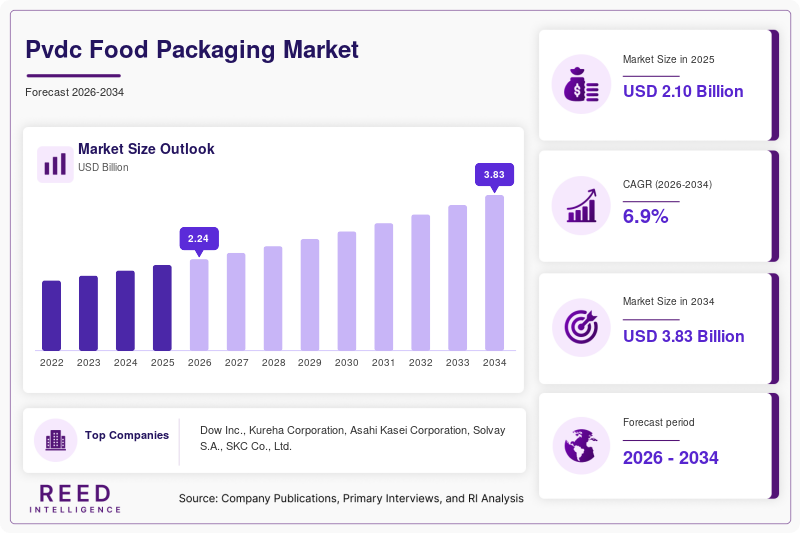
The Pvdc Food Packaging Market was valued at approximately USD 2.1 billion in 2026 and is projected to reach USD 3.6 billion by 2034, expanding at a CAGR of 6.9% during 2026–2034. The market growth is primarily supported by the increasing global demand for high-barrier packaging materials that extend shelf life and maintain food quality. Polyvinylidene chloride (PVDC) coatings and films offer superior oxygen and moisture barrier properties, making them widely suitable for perishable food products such as meat, cheese, and ready-to-eat meals.
A key global factor contributing to market expansion is the rising consumption of packaged and processed food driven by urbanization, changing lifestyles, and expanding retail infrastructure. Food manufacturers are increasingly adopting PVDC-based packaging solutions to minimize food waste and enhance product safety during transportation and storage.
Key Highlights:
- North America dominated the market with a 34% share in 2025, while Asia Pacific is projected to register the fastest growth at a CAGR of 8.1%.
- Among segments, PVDC-coated films led with a 52% share, while PVDC dispersion coatings are expected to grow fastest at a CAGR of 7.8%.
- The meat & poultry application segment accounted for the largest share at 39%, whereas ready-to-eat meals are anticipated to grow fastest at 8.4% CAGR.
- The United States remained the dominant country, with market values of USD 620 million in 2024 and USD 655 million in 2025.
Market Trends
Rising Adoption of High-Barrier Sustainable Packaging Solutions
The Pvdc Food Packaging Market is witnessing a shift toward advanced high-barrier materials that balance performance with sustainability. Manufacturers are developing thinner PVDC coatings and hybrid multilayer films that reduce overall material usage while maintaining barrier efficiency. This trend is driven by regulatory pressure and consumer demand for reduced plastic waste. Companies are also focusing on recyclable and downgauged structures, where PVDC is used selectively to enhance functionality without compromising environmental compliance.
Growth in Modified Atmosphere Packaging (MAP) Applications
The increasing use of modified atmosphere packaging is shaping the Pvdc Food Packaging Market significantly. PVDC films play a critical role in MAP systems by controlling gas permeability, thereby extending shelf life and preserving freshness. This trend is particularly strong in fresh meat, seafood, and dairy segments. The expansion of organized retail and cold chain logistics has further accelerated the adoption of MAP technologies, reinforcing the demand for PVDC-based solutions. As food safety standards tighten globally, the reliance on advanced barrier materials is expected to intensify, positioning PVDC as a key component in next-generation packaging systems.
Market Drivers
Increasing Demand for Extended Shelf Life Packaging
The need to extend the shelf life of food products remains a primary driver of the Pvdc Food Packaging Market. PVDC offers excellent resistance to oxygen, moisture, and aroma transmission, making it highly effective in preserving food quality. As global food supply chains become more complex, manufacturers require reliable packaging solutions that minimize spoilage and reduce product losses. This demand is particularly evident in export-oriented food industries, where maintaining product integrity over long transit periods is critical.
Expansion of Processed and Convenience Food Industry
The rapid growth of processed and convenience foods is another key factor driving market expansion. Urban populations are increasingly relying on packaged meals due to busy lifestyles and changing dietary habits. PVDC packaging ensures that these products retain their taste, texture, and nutritional value over extended periods. Additionally, the rise of e-commerce grocery platforms has increased the need for durable packaging materials that can withstand handling and delivery conditions, further boosting demand for PVDC-based solutions.
Market Restraint
Environmental Concerns and Regulatory Pressure on PVDC Usage
Despite its functional advantages, the Pvdc Food Packaging Market faces challenges due to environmental concerns associated with PVDC. The material contains chlorine, which can pose disposal and recycling issues. Increasing regulatory scrutiny on single-use plastics and non-recyclable materials has led to restrictions in certain regions, particularly in Europe.
These regulatory pressures are encouraging manufacturers to explore alternative barrier materials such as EVOH and biodegradable films. Additionally, consumer awareness regarding sustainable packaging is influencing purchasing decisions, prompting brands to shift toward eco-friendly solutions. The cost associated with developing and adopting alternative materials further adds to the complexity for market participants.
While PVDC remains indispensable for specific high-barrier applications, its long-term growth may be moderated by evolving environmental regulations and the ongoing transition toward circular packaging systems.
Market Opportunities
Development of Recyclable PVDC-Based Structures
Innovation in recyclable packaging solutions presents a significant opportunity for the Pvdc Food Packaging Market. Companies are investing in research to develop PVDC formulations that are compatible with existing recycling streams. The introduction of mono-material structures incorporating thin PVDC layers is gaining traction. These advancements enable manufacturers to retain barrier performance while meeting sustainability requirements, opening new growth avenues in environmentally conscious markets.
Emerging Demand in Developing Economies
Rapid economic development in emerging markets offers substantial growth potential. Rising disposable incomes, urbanization, and expanding retail networks are driving demand for packaged food products in regions such as Asia Pacific, Latin America, and parts of Africa. Local food manufacturers are increasingly adopting advanced packaging technologies to enhance product appeal and shelf life. The relatively low penetration of high-barrier materials in these regions provides a favorable environment for market expansion. As infrastructure improves, the adoption of PVDC-based packaging is expected to accelerate significantly.
Regional Analysis
North America
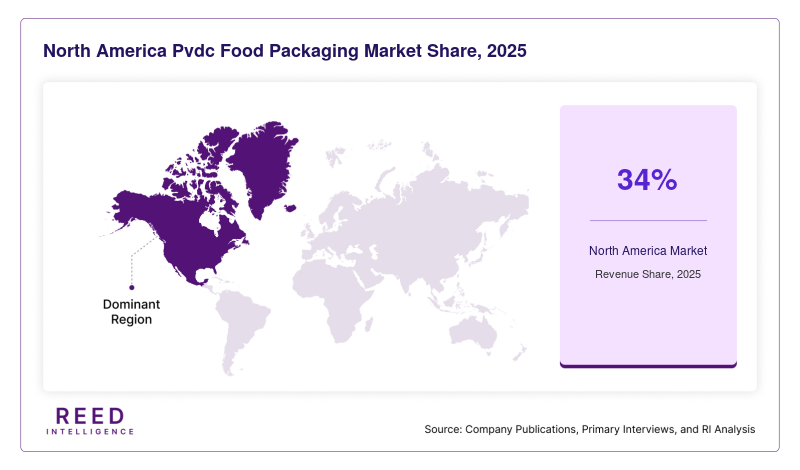
North America accounted for 34% of the Pvdc Food Packaging Market share in 2025 and is expected to grow at a CAGR of 6.2% during 2026–2034. The region’s established food processing industry and high consumption of packaged foods contributed to its dominant position. Strong demand for convenience foods and advanced packaging solutions supported market growth.
The United States remained the leading country, driven by its robust food manufacturing sector. The widespread adoption of high-performance packaging technologies and continuous product innovation contributed to sustained demand. The presence of large-scale retail chains and advanced logistics systems further strengthened market growth.
Europe
Europe held a 28% market share in 2025 and is projected to grow at a CAGR of 5.8% over the forecast period. The region’s growth was influenced by stringent food safety regulations and high consumer awareness regarding food quality.
Germany emerged as the dominant country, supported by its strong packaging industry and technological advancements. The focus on maintaining food freshness and compliance with regulatory standards drove the adoption of PVDC packaging solutions.
Asia Pacific
Asia Pacific captured 22% of the market share in 2025 and is anticipated to expand at the fastest CAGR of 8.1%. Rapid urbanization, increasing disposable incomes, and expanding food retail sectors contributed to regional growth.
China led the region due to its large population and growing demand for packaged food products. The expansion of domestic food processing industries and investments in packaging technologies supported market development.
Middle East & Africa
The Middle East & Africa region accounted for 9% of the market share in 2025 and is expected to grow at a CAGR of 6.5%. Increasing urbanization and the expansion of modern retail infrastructure supported market growth.
Saudi Arabia emerged as the dominant country, driven by rising demand for packaged food and improved distribution networks. The adoption of advanced packaging solutions is expected to increase as the food industry continues to evolve.
Latin America
Latin America held a 7% share in 2025 and is projected to grow at a CAGR of 6.7%. The region’s growth was supported by increasing consumption of processed foods and expanding retail sectors.
Brazil dominated the regional market due to its large food processing industry. The demand for effective packaging solutions to maintain product quality during transportation contributed to market expansion.
Segmental Analysis
By Type
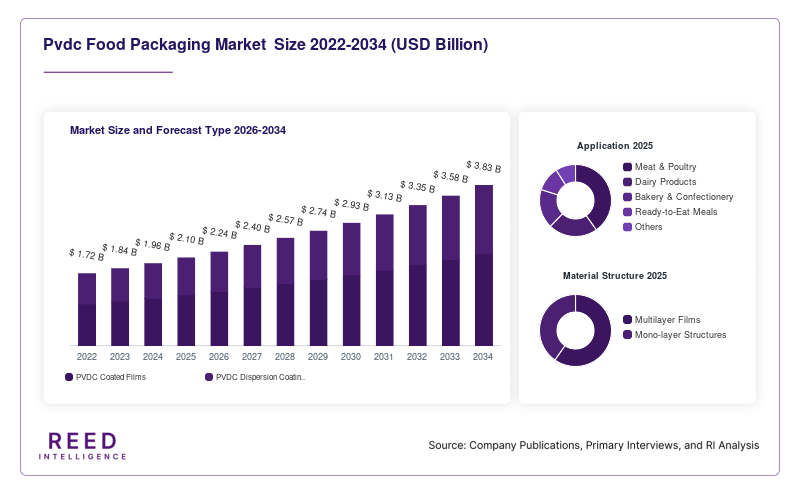
PVDC-coated films dominated the Pvdc Food Packaging Market, accounting for 52% of the share in 2025. These films are widely used due to their excellent barrier properties and versatility in various food packaging applications.
PVDC dispersion coatings are expected to grow at the fastest CAGR of 7.8%. Their ability to be applied on different substrates and compatibility with flexible packaging solutions will drive their adoption in the coming years.
By Application
The meat & poultry segment held the largest share at 39% in 2025, driven by the need to maintain freshness and prevent contamination. PVDC packaging plays a crucial role in extending the shelf life of these products.
The ready-to-eat meals segment is projected to grow at a CAGR of 8.4%, supported by increasing consumer preference for convenience foods. The demand for packaging that preserves taste and texture will drive this segment.
By Material Structure
Multilayer films dominated with a 61% share in 2025, as they provide enhanced barrier properties and durability. These structures are widely used in high-performance packaging applications.
Mono-layer PVDC structures are expected to grow at a CAGR of 7.1%, driven by the push toward simplified and recyclable packaging solutions.
By End-Use Industry
Food processing companies accounted for the largest share at 47% in 2025, due to their extensive use of PVDC packaging for preserving product quality.
The retail packaging segment is expected to grow at a CAGR of 7.5%, supported by increasing demand for packaged food products in supermarkets and online platforms.
Competitive Landscape
The Pvdc Food Packaging Market is moderately competitive, with key players focusing on product innovation and strategic collaborations. Leading companies are investing in sustainable packaging solutions and expanding their product portfolios.
A prominent market leader is Dow Inc., which continues to strengthen its position through advanced PVDC formulations and partnerships with food manufacturers. The company recently introduced a new recyclable PVDC-coated film designed to meet sustainability standards.
Other major players are emphasizing research and development to enhance barrier properties and reduce environmental impact. The competitive landscape is characterized by continuous innovation and efforts to align with regulatory requirements.
Key Players List
- Dow Inc.
- Kureha Corporation
- Asahi Kasei Corporation
- Solvay S.A.
- SKC Co., Ltd.
- Mitsubishi Chemical Group
- Innovia Films Ltd.
- Cosmo Films Ltd.
- Berry Global Inc.
- Sealed Air Corporation
- Amcor plc
- Mondi Group
- Coveris Holdings S.A.
- Uflex Ltd.
- Jindal Poly Films Ltd.
Recent Developments
- 2025: Dow Inc. launched a recyclable PVDC film for food packaging applications.
- 2024: Kureha Corporation expanded its PVDC production capacity in Asia.
- 2025: Amcor plc introduced high-barrier flexible packaging solutions incorporating PVDC layers.
- 2024: Berry Global Inc. developed downgauged PVDC films to reduce material usage.
- 2025: Mondi Group partnered with food manufacturers to enhance sustainable packaging solutions.
Pvdc Food Packaging Market Segments
Type
- PVDC Coated Films
- PVDC Dispersion Coatings
Application
- Meat & Poultry
- Dairy Products
- Bakery & Confectionery
- Ready-to-Eat Meals
- Others
Material Structure
- Multilayer Films
- Mono-layer Structures
End-Use Industry
- Food Processing
- Retail Packaging
- Foodservice
By Region
- North America
- Europe
- APAC
- Middle East and Africa
- LATAM