PXI SMU Market Size, Share & Demand Report By Type (Modular PXI SMU, High-Power SMU, Precision SMU), By Application (Semiconductor Testing, Electric Vehicle Testing, Consumer Electronics Testing, Industrial Equipment Testing), By End-Use (Electronics & Semiconductor, Automotive, Aerospace & Defense, Energy & Utilities, Research & Academia), By Region & Segment Forecasts, 2026–2034
USD 3950
Market Overview
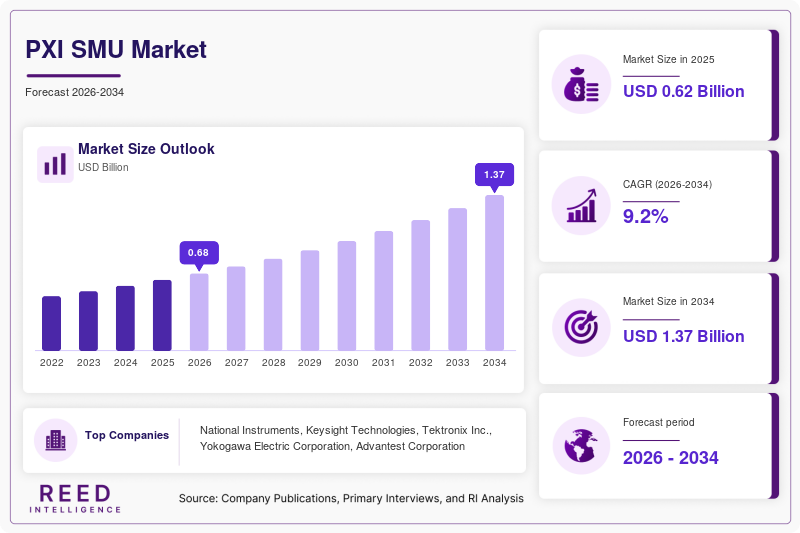
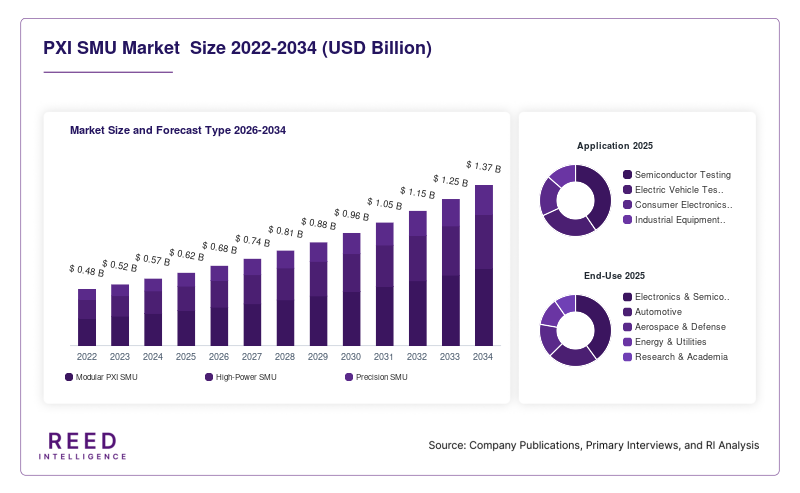
The Pxi Smu Market size was valued at approximately USD 0.62 billion in 2026 and is projected to reach around USD 1.25 billion by 2034, expanding at a CAGR of 9.2% during the forecast period. The growth trajectory reflects the increasing demand for precision electronic testing solutions across semiconductor manufacturing, automotive electronics, and telecommunications industries. PXI-based Source Measure Units (SMUs) are gaining traction due to their compact modular architecture, high-speed measurement capabilities, and cost-efficiency compared to traditional benchtop instruments.
A key global factor supporting market growth is the rapid expansion of the semiconductor ecosystem, particularly driven by advanced nodes, electric vehicles, and AI-enabled devices. As chip complexity increases, manufacturers require highly accurate testing systems capable of handling multiple parameters simultaneously. PXI SMUs provide scalable and synchronized testing environments, making them suitable for high-throughput production lines and research applications.
Key Highlights
- North America dominated the market with a 35.6% share in 2025.
- Asia Pacific is expected to grow at the fastest CAGR of 10.8% during 2026–2034.
- By type, modular PXI SMUs accounted for the largest share of 42.3%, while high-power SMUs are projected to grow at a CAGR of 10.5%.
- By application, semiconductor testing led with a 45.1% share, whereas electric vehicle testing is expected to expand at a CAGR of 11.3%.
- The United States remained the dominant country, with market values of USD 190 million in 2024 and USD 210 million in 2025.
Market Trends
Increasing adoption of modular test architectures
One of the most notable trends shaping the Pxi Smu Market is the increasing shift toward modular test architectures. Unlike traditional standalone instruments, PXI-based systems allow users to integrate multiple functionalities within a single chassis, improving efficiency and scalability. This modularity enables engineers to customize test setups based on specific requirements, reducing both initial investment and long-term operational costs. The growing preference for flexible testing platforms in industries such as aerospace and automotive electronics has accelerated this transition.
Furthermore, modular PXI SMUs offer high channel density and faster data acquisition rates, which are critical for modern semiconductor testing. As device miniaturization continues, testing requirements become more complex, necessitating solutions that can handle parallel testing scenarios. The ability to upgrade individual modules without replacing entire systems also enhances their appeal, making them a preferred choice among manufacturers seeking long-term value and adaptability.
Integration of advanced software and automation tools
Another significant trend is the integration of advanced software platforms and automation tools with PXI SMUs. The adoption of intelligent software solutions enables real-time data analysis, predictive maintenance, and automated test sequences. This reduces human error and enhances measurement accuracy, which is crucial in high-precision industries. Companies are increasingly leveraging software-defined instrumentation to streamline testing workflows and improve productivity.
Additionally, cloud connectivity and data analytics capabilities are being incorporated into PXI systems, allowing remote monitoring and centralized control of testing operations. This trend aligns with the broader movement toward digital transformation across industries. As organizations seek to optimize operational efficiency and reduce downtime, the demand for automated and software-integrated PXI SMUs is expected to grow steadily over the forecast period.
Market Drivers
Rising demand for semiconductor testing solutions
The growing demand for semiconductor devices is a major driver of the Pxi Smu Market. With the proliferation of technologies such as artificial intelligence, 5G, and consumer electronics, semiconductor manufacturers are under increasing pressure to ensure high performance and reliability. PXI SMUs play a critical role in testing voltage, current, and resistance characteristics of semiconductor components, making them indispensable in production and R&D environments.
As semiconductor devices become more complex, traditional testing methods are no longer sufficient. PXI SMUs offer high precision and flexibility, enabling manufacturers to conduct detailed characterization and validation processes. The increasing adoption of advanced packaging technologies and smaller node sizes further amplifies the need for accurate and efficient testing solutions. This trend is expected to continue driving market growth throughout the forecast period.
Expansion of electric vehicle and battery testing applications
The rapid expansion of the electric vehicle (EV) market is another key driver for the Pxi Smu Market. EVs rely heavily on advanced battery systems and power electronics, which require rigorous testing to ensure safety and performance. PXI SMUs are widely used in battery testing applications to measure charge-discharge cycles, leakage currents, and efficiency parameters.
In addition, the shift toward renewable energy and energy storage systems has increased the demand for precise measurement instruments. PXI SMUs provide high accuracy and reliability, making them suitable for testing complex energy systems. As governments worldwide promote sustainable transportation and energy solutions, the adoption of PXI SMUs in EV and battery testing is expected to rise significantly, contributing to overall market growth.
Market Restraint
High initial investment and system complexity
A major restraint affecting the Pxi Smu Market is the high initial investment associated with PXI-based systems. While these systems offer long-term cost benefits, the upfront cost of acquiring chassis, modules, and software can be substantial, particularly for small and medium-sized enterprises. This financial barrier limits adoption among organizations with constrained budgets, slowing market penetration in certain regions.
In addition to cost concerns, system complexity poses a challenge for end-users. PXI SMUs require specialized knowledge for installation, configuration, and maintenance. Organizations often need skilled personnel to operate these systems effectively, which increases operational expenses. For example, smaller testing facilities may struggle to integrate PXI solutions into their existing workflows due to limited technical expertise. These factors collectively hinder market growth, especially in emerging economies where resource constraints are more pronounced.
Market Opportunities
Growth in 5G and IoT device testing
The rapid expansion of 5G networks and IoT devices presents a significant opportunity for the Pxi Smu Market. These technologies require extensive testing to ensure reliability, connectivity, and performance. PXI SMUs are well-suited for testing RF components, sensors, and communication modules, making them essential tools in the development and deployment of 5G and IoT systems.
As the number of connected devices continues to increase, the demand for efficient and scalable testing solutions is expected to grow. PXI SMUs enable high-throughput testing and real-time data analysis, which are critical for meeting the requirements of modern communication technologies. This trend is likely to create new growth avenues for market players, particularly in regions with strong telecommunications infrastructure.
Increasing adoption in research and academic institutions
Another promising opportunity lies in the growing adoption of PXI SMUs in research and academic institutions. Universities and research laboratories are increasingly investing in advanced testing equipment to support innovation in electronics, materials science, and energy systems. PXI SMUs offer the flexibility and precision required for experimental research, making them valuable tools for academic applications.
Furthermore, government funding and collaborative research initiatives are driving the adoption of sophisticated testing technologies. As educational institutions focus on developing next-generation technologies, the demand for PXI SMUs is expected to rise. This trend not only expands the customer base but also fosters innovation, contributing to the long-term growth of the market.
Segmental Analysis
By Type
The modular PXI SMU segment dominated the Pxi Smu Market in 2024, accounting for approximately 42.3% of the total share. This dominance is attributed to the flexibility and scalability offered by modular systems, which allow users to customize their testing configurations. Industries such as semiconductor manufacturing and aerospace prefer modular PXI SMUs due to their ability to handle complex testing requirements efficiently. Additionally, the compact design and high channel density of these systems make them suitable for high-volume production environments.
The high-power SMU segment is expected to grow at the fastest CAGR of 10.5% during the forecast period. This growth is driven by the increasing demand for testing high-power devices such as batteries and power electronics. High-power SMUs provide accurate measurements for applications requiring high voltage and current levels. The expansion of electric vehicles and renewable energy systems further supports the growth of this segment.
By Application
Semiconductor testing emerged as the dominant application segment in 2024, holding a share of 45.1%. The increasing complexity of semiconductor devices and the need for precise testing solutions drive the demand for PXI SMUs in this segment. Manufacturers rely on these systems to ensure product quality and performance, particularly in advanced node technologies. The growing adoption of AI and IoT devices further contributes to segment growth.
Electric vehicle testing is projected to be the fastest-growing application segment, with a CAGR of 11.3%. This growth is fueled by the rising adoption of EVs and the need for efficient battery testing solutions. PXI SMUs enable accurate measurement of battery performance, making them essential tools in EV development. Government initiatives promoting sustainable transportation further support this segment’s expansion.
By End-Use
The electronics and semiconductor industry dominated the Pxi Smu Market in 2024, accounting for a significant share. This dominance is driven by the increasing demand for advanced electronic devices and the need for reliable testing solutions. PXI SMUs are widely used in production and R&D environments to ensure product quality and performance. The continuous advancement of semiconductor technologies further supports this segment’s growth.
The automotive industry is expected to grow at the fastest CAGR during the forecast period. The increasing adoption of electric vehicles and advanced driver-assistance systems drives the demand for precise testing solutions. PXI SMUs play a crucial role in testing automotive electronics, ensuring safety and reliability. This trend is expected to contribute significantly to market growth.
Regional Analysis
North America
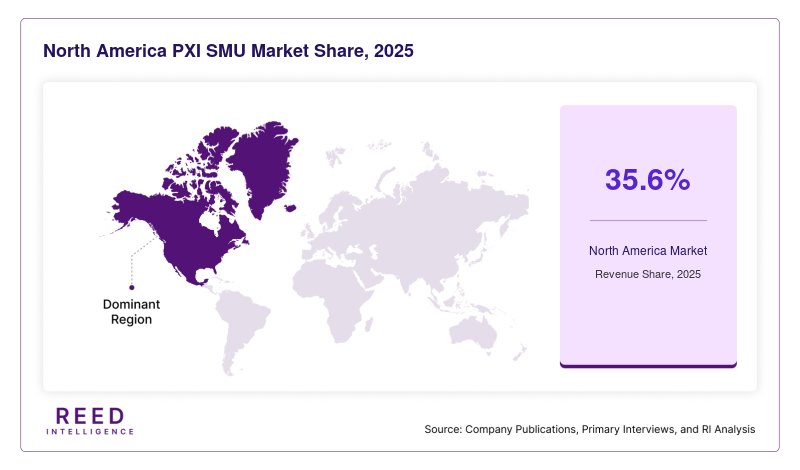
North America held the largest share of the Pxi Smu Market in 2025, accounting for approximately 35.6% of the global revenue. The region is expected to maintain steady growth with a CAGR of 8.7% during the forecast period. The presence of advanced semiconductor manufacturing facilities and strong investment in R&D activities contribute significantly to market dominance. Additionally, the adoption of automation and digital testing solutions across industries supports sustained demand.
The United States dominates the regional market due to its well-established electronics and semiconductor industries. A unique growth factor is the strong focus on innovation and technological advancement, supported by government funding and private investments. The increasing adoption of EVs and renewable energy systems further drives the demand for PXI SMUs in the country.
Europe
Europe accounted for a significant share of the Pxi Smu Market in 2025 and is projected to grow at a CAGR of 8.5% during the forecast period. The region benefits from a strong automotive sector and increasing adoption of electric vehicles. Additionally, stringent regulations related to product quality and safety drive the demand for advanced testing solutions.
Germany leads the European market, supported by its robust automotive manufacturing industry. A key growth factor is the region’s emphasis on sustainability and energy efficiency, which has accelerated the adoption of advanced testing technologies. This focus creates consistent demand for PXI SMUs in automotive and energy applications.
Asia Pacific
Asia Pacific is expected to witness the fastest growth in the Pxi Smu Market, with a CAGR of 10.8% during 2026–2034. The region’s rapid industrialization and expanding semiconductor manufacturing base contribute significantly to market growth. Countries such as China, Japan, and South Korea are major contributors to regional demand.
China dominates the Asia Pacific market due to its large-scale electronics manufacturing industry. A unique growth factor is the government’s support for domestic semiconductor production, which has increased investments in testing equipment. This trend is expected to drive significant demand for PXI SMUs in the region.
Middle East & Africa
The Middle East & Africa region is experiencing moderate growth in the Pxi Smu Market, with a projected CAGR of 7.6%. The increasing adoption of digital technologies and investments in infrastructure development support market expansion. However, limited industrialization in certain areas poses challenges.
The United Arab Emirates leads the regional market due to its focus on technological advancement. A key growth factor is the increasing adoption of smart city initiatives, which require advanced electronic testing solutions. This trend is expected to drive demand for PXI SMUs in the region.
Latin America
Latin America is expected to grow steadily in the Pxi Smu Market, with a CAGR of 7.9% during the forecast period. The region’s growth is driven by increasing investments in electronics manufacturing and telecommunications infrastructure. However, economic fluctuations may impact market expansion.
Brazil dominates the regional market due to its growing industrial base. A unique growth factor is the expansion of the telecommunications sector, which has increased the demand for testing equipment. This trend is expected to support the adoption of PXI SMUs in the region.
Competitive Landscape
The Pxi Smu Market is characterized by the presence of several established players focusing on innovation and product development. Companies are investing in advanced technologies to enhance measurement accuracy and system performance. Strategic partnerships and acquisitions are also common strategies adopted by market participants to expand their market presence.
One of the leading players in the market is National Instruments, which has a strong portfolio of PXI-based testing solutions. The company recently introduced enhanced software integration features to improve automation capabilities. Other key players are also focusing on developing high-performance SMUs to meet the evolving needs of end-users. The competitive landscape remains dynamic, with continuous advancements in technology shaping market trends.
Key Players
- National Instruments
- Keysight Technologies
- Tektronix Inc.
- Yokogawa Electric Corporation
- Advantest Corporation
- Chroma ATE Inc.
- Rohde & Schwarz
- Teradyne Inc.
- AMETEK Inc.
- B&K Precision Corporation
- GW Instek
- Aim-TTi
- Keithley Instruments
- Pickering Interfaces
- VX Instruments
Recent Developments
- National Instruments launched a new PXI SMU platform with enhanced automation capabilities in 2025.
- Keysight Technologies introduced high-power SMUs designed for EV battery testing applications.
- Rohde & Schwarz expanded its PXI portfolio with improved software integration features to support advanced testing requirements.
PXI SMU Market Segments
Type
- Modular PXI SMU
- High-Power SMU
- Precision SMU
Application
- Semiconductor Testing
- Electric Vehicle Testing
- Consumer Electronics Testing
- Industrial Equipment Testing
End-Use
- Electronics & Semiconductor
- Automotive
- Aerospace & Defense
- Energy & Utilities
- Research & Academia
By Region
- North America
- Europe
- APAC
- Middle East and Africa
- LATAM