Pyrolysis Oil Market Size, Share & Demand Report By Feedstock (Plastic Waste, Biomass, Rubber/Tires, Municipal Solid Waste), By Application (Fuel, Chemical Feedstock, Power Generation) By Region & Segment Forecasts, 2026–2034
USD 3950
Pyrolysis Oil Market Size
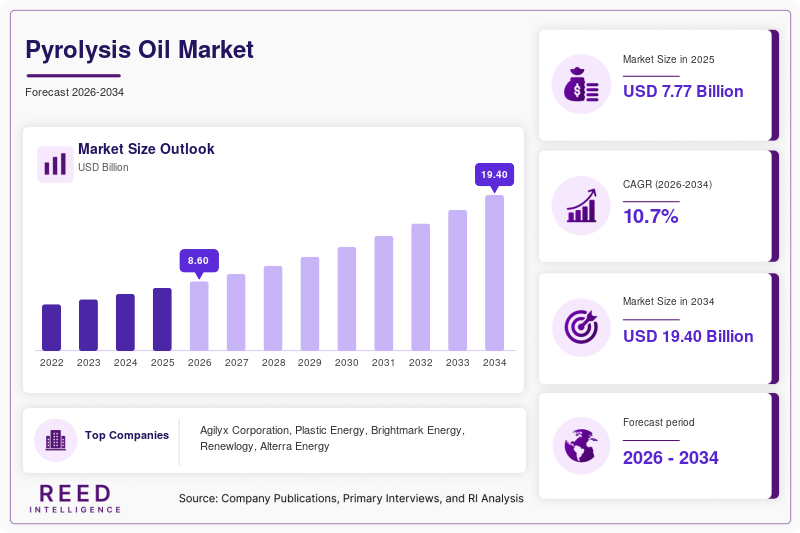
The Pyrolysis Oil market size is projected at USD 465.0 million in 2026 and is expected to hit USD 1,180.0 million by 2034 with a CAGR of 12.3% during the forecast period. The increasing focus on waste-to-energy solutions, the growing concern over plastic waste management, and the rising demand for alternative fuel sources underpin market expansion. This report delivers a comprehensive analysis of the Pyrolysis Oil market, including segmentation by feedstock and application, competitive dynamics, and regional growth patterns, equipping stakeholders with critical intelligence to navigate this rapidly evolving renewable energy landscape.
Key Takeaways
- Dominant Region: Europe leads the Pyrolysis Oil market with a 36% share, while Asia-Pacific is the fastest-growing region with a projected CAGR of 14.5% through 2034.
- Dominant Segment: The Plastic Waste feedstock segment dominates the market with a 42% share, while the Fuel application is the leading segment with a 48% share.
- Emerging Country: China is projected to reach USD 185.0 million by 2034, expanding at a CAGR of 15.2%.
- Key Drivers: The increasing plastic waste generation, stringent environmental regulations, and the growing demand for renewable and alternative fuels are driving market growth.
Pyrolysis Oil Market Trends
Advancements in Catalytic Pyrolysis and Upgrading Technologies
The Pyrolysis Oil market is witnessing a significant trend toward the adoption of advanced catalytic pyrolysis and oil upgrading technologies that enhance product quality and yield. This shift is driven by the need to produce higher-quality pyrolysis oil with improved fuel properties, reduced oxygen content, and enhanced stability. Manufacturers are developing novel catalysts and reactor designs that optimize the pyrolysis process and enable selective production of desired hydrocarbon fractions. The integration of hydrotreating and hydrocracking upgrading processes is gaining momentum, enabling the production of drop-in fuels and high-value chemicals. These technological advancements are improving the economic viability of pyrolysis oil production and expanding its application potential.
Increasing Focus on Circular Economy and Waste Valorization
The increasing focus on circular economy principles and waste valorization is a major trend shaping the Pyrolysis Oil market. The development of integrated waste-to-energy systems that combine pyrolysis with other recovery technologies is gaining traction, driven by the need to maximize resource recovery and minimize landfill disposal. The emergence of chemical recycling technologies that convert plastic waste into valuable pyrolysis oil is particularly prominent. This trend is supported by growing regulatory pressure to reduce plastic waste and increasing corporate sustainability commitments. The development of pyrolysis facilities co-located with waste management infrastructure is enabling efficient feedstock sourcing and product distribution.
Pyrolysis Oil Market Drivers
The Pyrolysis Oil market's expansion is primarily driven by the escalating global plastic waste crisis, with approximately 380 million tons of plastic waste generated annually and only 9% recycled globally. The increasing implementation of stringent environmental regulations and plastic waste reduction targets has been a major driver, with pyrolysis technology offering a viable solution for converting non-recyclable plastics into valuable products. The growing demand for renewable and alternative fuel sources, driven by energy security concerns and climate change mitigation efforts, has further fueled market demand. The rising cost of conventional fossil fuels and the increasing availability of waste feedstocks have also supported market growth. Additionally, the development of supportive government policies and incentives for waste-to-energy projects has spurred investment in pyrolysis facilities.
Pyrolysis Oil Market Restraints
Despite favorable growth prospects, the Pyrolysis Oil market faces significant constraints, primarily related to the high capital investment required for establishing commercial-scale pyrolysis facilities and the ongoing operational costs associated with feedstock handling and product upgrading. The market's growth is further tempered by the variable quality of pyrolysis oil derived from different feedstocks, which can limit its direct application in certain end-use sectors. The competition from other waste-to-energy technologies, such as gasification and anaerobic digestion, also presents challenges. Additionally, the limited market acceptance of pyrolysis oil as a fuel due to concerns about product consistency and compatibility with existing infrastructure can hinder widespread adoption.
Pyrolysis Oil Market Opportunities
The Pyrolysis Oil market presents significant opportunities in the rapidly expanding segment of chemical recycling, where pyrolysis oil serves as a valuable feedstock for producing virgin-quality plastics and chemicals. The development of advanced upgrading technologies that enable the production of drop-in fuels compatible with existing refinery infrastructure is another promising avenue. Emerging opportunities also exist in the application of pyrolysis oil for power generation in decentralized energy systems and remote areas. Furthermore, the untapped potential in developing economies, driven by increasing waste generation and improving waste management infrastructure, offers a fertile ground for market expansion.
Challenges in Pyrolysis Oil Market
The Pyrolysis Oil market grapples with persistent challenges related to the need for continuous innovation to improve process efficiency, reduce production costs, and enhance product quality. The complexity of feedstock composition and the variability in pyrolysis oil properties present ongoing technical hurdles. The market is also contending with the challenge of establishing consistent product quality standards and securing market acceptance for pyrolysis oil in various applications. Moreover, the competition from low-cost conventional fuels and the need for favorable policy frameworks to support market development pose significant challenges for industry growth.
Pyrolysis Oil Market Segmentation Analysis
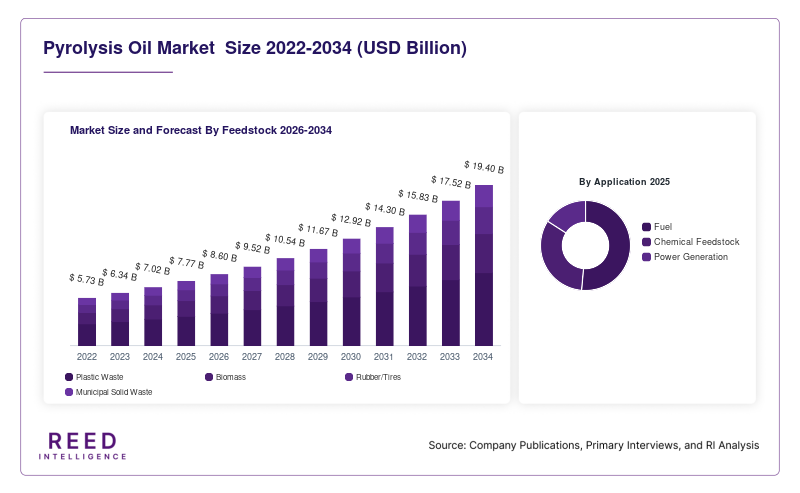
The Pyrolysis Oil market is segmented by Feedstock and Application to provide a comprehensive market perspective. By Feedstock, Plastic Waste dominates with a 42% market share, driven by the abundant supply of non-recyclable plastic waste. The Application segment is led by Fuel, which accounts for 48% of the market, followed by Chemical Feedstock at 32% and Power Generation at 20%.
By Feedstock
Plastic Waste represents the largest segment in the Pyrolysis Oil market, commanding a 42% share, with revenue exceeding USD 195 million in 2025. This feedstock includes mixed plastics, packaging waste, and non-recyclable plastic fractions. Technical specifications include plastic composition, moisture content, and calorific value. The market's Plastic Waste segment is driven by the increasing plastic waste volumes and the growing focus on chemical recycling as a complementary solution to mechanical recycling.
Biomass captures a 32% share of the Pyrolysis Oil market, with revenue of USD 149 million in 2025. This feedstock encompasses agricultural residues, forestry waste, and dedicated energy crops. Technical specifications include moisture content, ash content, and energy density. The market's Biomass segment is driven by its use in regions with abundant agricultural and forestry resources and its sustainability credentials as a renewable feedstock.
Rubber/Tires represent 16% of the market, with revenue of USD 74 million in 2025, characterized by the use of end-of-life tires and rubber waste as pyrolysis feedstock. Technical specifications include rubber composition, steel content, and sulfur content. The market's Rubber/Tires segment is driven by the need to manage the global scrap tire problem and the high energy content of tire-derived oil.
Municipal Solid Waste accounts for 10% of the market, with revenue of USD 47 million in 2025, involving the use of mixed municipal waste as pyrolysis feedstock. Technical specifications include waste composition, moisture content, and contamination levels. The market's MSW segment is driven by its use in integrated waste management systems and the need to reduce landfill disposal.
By Application
Fuel dominates the Pyrolysis Oil market, accounting for 48% of sales, representing USD 223 million in 2025. This segment includes the use of pyrolysis oil as a direct fuel for industrial boilers, furnaces, and marine applications, as well as blending with conventional fuels. Usage penetration exceeds 50% in European industrial heating applications. The market's Fuel segment is characterized by its focus on cost-effectiveness and energy recovery.
Chemical Feedstock accounts for 32% of the Pyrolysis Oil market, with revenue of USD 149 million in 2025. This segment encompasses the use of pyrolysis oil as a feedstock for producing chemicals, including aromatic hydrocarbons, olefins, and specialty chemicals. The segment is growing at a significant CAGR, driven by the increasing demand for sustainable chemical feedstocks. The market's Chemical Feedstock segment is characterized by its focus on product purity and refining capabilities.
Power Generation represents 20% of the market, with revenue of USD 93 million in 2025, involving the use of pyrolysis oil for electricity generation in engines, turbines, and combined heat and power systems. The segment's growth is fueled by the increasing interest in decentralized energy solutions and waste-to-energy projects. The market's Power Generation segment is characterized by its focus on efficiency and emissions compliance.
Pyrolysis Oil Market Outlook
Europe Pyrolysis Oil Market
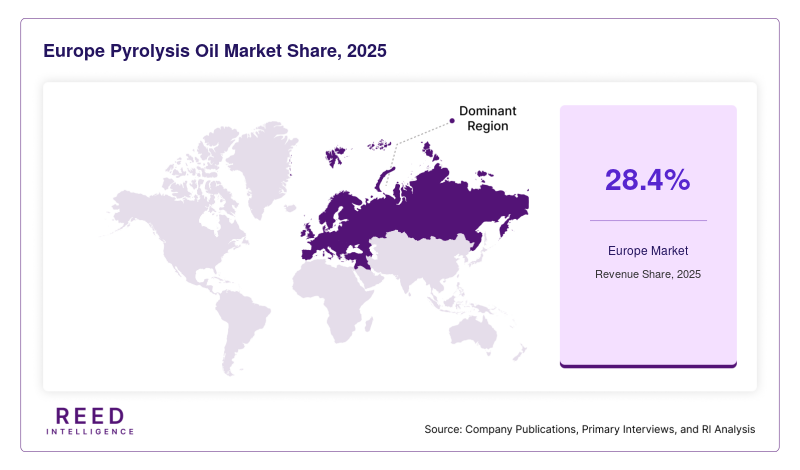
Leads the Pyrolysis Oil market, commanding a 36% share, with revenue of USD 167 million in 2025. Germany, the United Kingdom, and the Netherlands are the primary drivers, together accounting for 55% of regional demand, driven by stringent waste management regulations, advanced recycling infrastructure, and strong environmental awareness. The European market is characterized by its focus on innovation and sustainability, with significant investment in chemical recycling technologies and a strong policy framework supporting waste-to-energy initiatives.
Asia-Pacific Pyrolysis Oil Market
Represents the second-largest market, capturing a 32% share with revenue of USD 149 million in 2025. China, India, and Japan are the primary drivers, together accounting for 60% of regional demand, driven by rapidly increasing waste generation, growing environmental concerns, and supportive government policies. The Asia-Pacific market is projected to grow at the fastest CAGR of 14.5% through 2034, driven by increasing investment in waste management infrastructure and the adoption of advanced recycling technologies.
North America Pyrolysis Oil Market
Accounts for 22% of the global Pyrolysis Oil market, with revenue of USD 102 million in 2025. The United States is the primary driver, accounting for 85% of regional demand, fueled by increasing plastic waste concerns, growing interest in chemical recycling, and favorable state-level policies. The North American market is characterized by its focus on technological innovation and the development of large-scale commercial facilities.
Latin America and Middle East & Africa Pyrolysis Oil Market
Together account for the remaining 10% of the Pyrolysis Oil market, with Brazil, South Africa, and the UAE leading their respective regions. Both regions are projected to grow at CAGRs exceeding 13%, driven by improving waste management infrastructure, increasing environmental awareness, and growing energy demand.
Top players in Pyrolysis Oil Market
- Agilyx Corporation
- Plastic Energy
- Brightmark Energy
- Renewlogy
- Alterra Energy
- Recovery Solutions
- Pyrolyx AG
- Klean Industries
- Mura Technology
- Enrestec
- Green Frontier
- Biofuel Solutions
- EcoGreen Energy
- Waste2Tricity
- Positions Energy
Pyrolysis Oil Market Segments
By Feedstock
- Plastic Waste
- Biomass
- Rubber/Tires
- Municipal Solid Waste
By Application
- Fuel
- Chemical Feedstock
- Power Generation
By Region
- North America
- Europe
- APAC
- Middle East and Africa
- LATAM