Pyrometer Market Size, Share Demand Report By Type (Infrared Pyrometers, Optical Pyrometers, Multi-Wavelength Pyrometers, Fiber Optic Pyrometers), By Application (Metal Processing, Glass Manufacturing, Semiconductor Manufacturing, Ceramics Processing, Power Generation, Food and Packaging), By End Use (Industrial Manufacturing, Automotive, Aerospace and Defense, Electronics and Semiconductor, Energy and Utilities, Chemical and Petrochemical), By Region & Segment Forecasts, 2026–2034
USD 3950
Market Overview
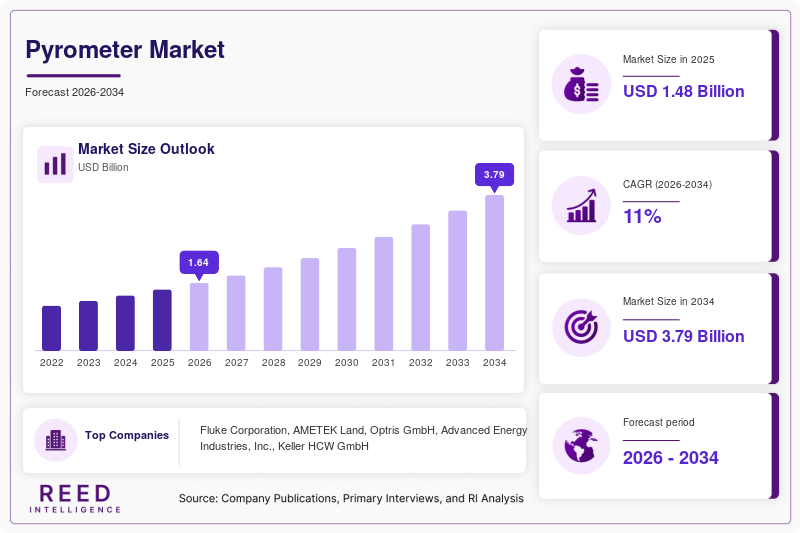
The global Pyrometer Market size was valued at USD 1.48 billion in 2026 and is projected to reach USD 3.41 billion by 2034, expanding at a CAGR of 11.0% during the forecast period from 2026 to 2034. Pyrometers are widely used for non-contact temperature measurement in industrial environments where conventional sensors are less effective. Industries such as metals, glass, ceramics, power generation, automotive manufacturing, and semiconductor fabrication continue to adopt advanced pyrometers to improve process control and product quality. Increasing demand for industrial automation and real-time monitoring systems has created favorable conditions for market expansion across developed and emerging economies.
A major global factor supporting market growth is the rapid transition toward smart manufacturing and Industry 4.0 infrastructure. Manufacturers are increasingly integrating infrared temperature monitoring solutions with connected industrial systems to reduce operational downtime and improve production accuracy. Pyrometers support predictive maintenance programs by delivering reliable thermal data in harsh operating environments. In addition, stricter energy efficiency standards and workplace safety regulations have encouraged companies to replace contact-based temperature devices with advanced optical and infrared pyrometers.
Key Highlights
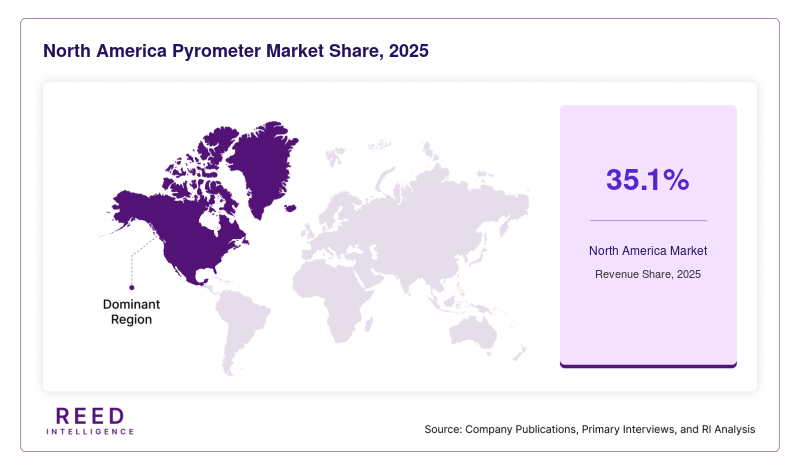
- North America dominated the market with a 35.1% share in 2025, while Asia Pacific is expected to grow at the fastest CAGR of 12.3% during 2026–2034.
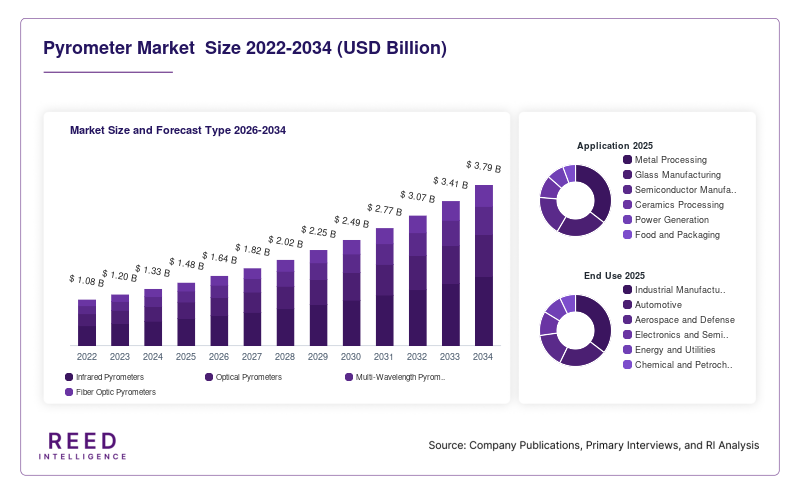
- By type, infrared pyrometers accounted for the largest share of 44.8%, while multi-wavelength pyrometers are projected to grow at a CAGR of 13.1%.
- By application, metal processing led with a 39.5% share, whereas semiconductor manufacturing is expected to expand at a CAGR of 13.6%.
- The United States remained the dominant country, with market values of USD 462 million in 2024 and USD 518 million in 2025.
Market Trends
Integration of Smart Manufacturing Platforms
Industrial facilities are increasingly integrating pyrometers with connected manufacturing systems to improve operational visibility and process efficiency. Smart factories require continuous thermal monitoring to reduce production defects and maintain stable operating conditions. Modern pyrometers equipped with wireless communication modules and cloud-enabled analytics platforms are helping manufacturers monitor temperature fluctuations in real time. This trend is particularly visible in automotive assembly plants, steel manufacturing facilities, and electronics production centers where thermal consistency directly affects product quality. Companies are also investing in centralized monitoring dashboards that combine pyrometer data with machine performance metrics. The adoption of artificial intelligence and machine learning tools for predictive maintenance is further strengthening the role of pyrometers in industrial automation environments.
Rising Adoption Across Semiconductor and EV Manufacturing
The growing expansion of semiconductor fabrication facilities and electric vehicle battery production plants has increased demand for precision temperature monitoring equipment. Pyrometers are becoming essential in semiconductor wafer processing, lithium-ion battery manufacturing, and thermal coating applications due to their ability to deliver accurate non-contact measurements. Manufacturers in these industries require highly responsive instruments capable of operating under extreme temperatures and cleanroom conditions. Demand for compact and portable pyrometers is also rising as production lines become more automated and space optimized. In addition, government investments in semiconductor self-sufficiency and electric mobility infrastructure across Asia Pacific, Europe, and North America are encouraging industrial facilities to adopt advanced infrared monitoring technologies for quality assurance and process optimization.
Market Drivers
Expansion of Industrial Automation and Process Monitoring
The growing adoption of industrial automation systems is a major factor driving the Pyrometer Market. Manufacturing companies are investing in automated production lines that require continuous and accurate temperature monitoring to maintain product consistency and reduce waste. Pyrometers provide reliable non-contact measurement capabilities that help industries monitor high-temperature processes without interrupting operations. Sectors such as steel production, cement manufacturing, and glass processing increasingly depend on infrared monitoring technologies to improve operational efficiency. Industrial facilities are also implementing predictive maintenance programs that use thermal data to identify equipment faults before failures occur. As factories continue to modernize and deploy connected industrial infrastructure, demand for advanced pyrometers with digital integration capabilities is expected to increase steadily.
Growing Demand for Workplace Safety and Energy Efficiency
Rising emphasis on industrial safety and energy efficiency standards is supporting the adoption of pyrometers across multiple industries. Contact-based temperature measurement systems are often unsuitable for hazardous environments involving molten metals, rotating machinery, or chemically sensitive processes. Pyrometers help operators measure temperature from a safe distance, reducing exposure to dangerous operating conditions. Governments and regulatory agencies are encouraging industries to implement safer and more energy-efficient manufacturing processes, which has accelerated the replacement of conventional temperature sensors. In power generation and petrochemical facilities, pyrometers are used to monitor combustion efficiency and reduce unnecessary energy consumption. The ability of modern infrared pyrometers to deliver rapid and accurate readings supports improved operational control and lower production costs.
Market Restraint
High Initial Investment and Calibration Complexity
The high cost associated with advanced pyrometer systems remains a significant challenge for market expansion, particularly among small and medium-sized manufacturing companies. Multi-wavelength and high-precision infrared pyrometers often require substantial investment in equipment, software integration, and periodic calibration services. Industries operating with limited capital budgets may delay the adoption of advanced temperature monitoring technologies despite their long-term operational advantages. Calibration complexity also creates challenges because inaccurate configuration can affect measurement precision and process outcomes. In industries such as semiconductor manufacturing and aerospace production, even minor thermal deviations may result in product defects or production delays. Additionally, the need for trained personnel to manage installation and maintenance increases operational expenses. These factors may limit adoption rates in price-sensitive markets and reduce penetration among smaller industrial facilities.
Market Opportunities
Growth of Renewable Energy and Advanced Power Infrastructure
The rapid expansion of renewable energy projects and modern power infrastructure is creating favorable opportunities for pyrometer manufacturers. Solar panel production, wind turbine component manufacturing, and energy storage system assembly all require accurate temperature monitoring during production and maintenance operations. Pyrometers are increasingly used in thermal inspection applications within battery energy storage facilities and high-voltage power systems. Governments across Asia Pacific, Europe, and the Middle East are investing heavily in clean energy infrastructure, which is increasing demand for advanced industrial instrumentation. Manufacturers are developing rugged pyrometer solutions capable of operating in outdoor and high-temperature environments to support renewable energy applications. The transition toward sustainable energy systems is expected to create long-term growth opportunities for temperature monitoring technology providers.
Rising Demand from Emerging Industrial Economies
Emerging economies are witnessing strong industrial development, creating new opportunities for pyrometer adoption across manufacturing sectors. Countries in Southeast Asia, Latin America, and parts of Africa are investing in steel production, automotive assembly, electronics manufacturing, and infrastructure development. These industries require efficient thermal monitoring systems to improve product quality and maintain compliance with international manufacturing standards. Increasing foreign direct investment in industrial projects is also supporting the adoption of advanced process monitoring technologies. Local manufacturers are gradually shifting toward automation to improve competitiveness and reduce production inefficiencies. As industrial output expands in emerging economies, demand for cost-effective and digitally connected pyrometers is expected to rise significantly during the forecast period.
Segmental Analysis
By Type
Infrared pyrometers accounted for the largest share of the Pyrometer Market in 2024, contributing 44.8% of total revenue. These devices are widely adopted across industrial applications because they provide accurate non-contact temperature measurement in harsh operating environments. Industries such as steel manufacturing, glass production, and ceramics processing rely heavily on infrared pyrometers to monitor extreme temperatures without disrupting production activities. The segment also benefits from strong adoption in food processing and packaging operations where hygiene standards require contact-free measurement methods. Manufacturers are introducing compact and digitally integrated infrared pyrometers with wireless connectivity and advanced display interfaces. Their ability to deliver rapid response times, lower maintenance requirements, and compatibility with automated industrial systems has strengthened their market position across developed and emerging economies.
Multi-wavelength pyrometers are projected to register the fastest CAGR of 13.1% during the forecast period due to increasing demand for high-precision temperature monitoring solutions. These pyrometers are designed to minimize measurement errors caused by dust, smoke, and varying surface emissivity, making them suitable for complex industrial environments. Semiconductor fabrication, aerospace manufacturing, and advanced metallurgy applications are driving demand for multi-wavelength technologies because production accuracy is critical in these industries. Manufacturers are increasingly integrating artificial intelligence and digital analytics capabilities into these systems to improve operational reliability and predictive maintenance efficiency. The rising adoption of automated manufacturing lines and advanced process control systems is expected to accelerate deployment of multi-wavelength pyrometers in industrial facilities worldwide.
By Application
Metal processing represented the dominant application segment in 2024, accounting for 39.5% of the total market share. Pyrometers are extensively used in steel mills, foundries, and aluminum production facilities to monitor furnace temperatures and ensure consistent material quality. High-temperature industrial operations require accurate thermal measurement systems capable of functioning in extreme conditions, which has increased reliance on infrared and optical pyrometers. The metal processing industry also benefits from growing automation adoption as manufacturers seek to improve operational efficiency and reduce production waste. Pyrometers support real-time process monitoring, allowing operators to maintain precise thermal conditions during melting, forging, and heat treatment activities. Increasing investments in infrastructure and industrial manufacturing projects across developing economies continue to sustain strong demand from this application segment.
Semiconductor manufacturing is anticipated to witness the fastest CAGR of 13.6% during the forecast period due to rising global demand for advanced electronic components and integrated circuits. Semiconductor fabrication requires highly accurate temperature control throughout wafer processing, deposition, and thermal treatment operations. Pyrometers provide non-contact measurement capabilities that support cleanroom standards and minimize contamination risks in sensitive production environments. Governments in the United States, China, South Korea, and Europe are investing heavily in domestic semiconductor manufacturing capacity, creating favorable conditions for market expansion. Another important growth factor is the increasing demand for artificial intelligence hardware, electric vehicle electronics, and high-performance computing systems, all of which require advanced semiconductor manufacturing processes supported by precision thermal monitoring equipment.
By End Use
The industrial manufacturing segment held the largest share of the market in 2024, contributing 47.3% of total revenue. Industrial manufacturing facilities use pyrometers for temperature monitoring in production lines involving welding, coating, molding, and heat treatment applications. The segment benefits from the ongoing transition toward Industry 4.0 technologies, where connected monitoring systems and predictive maintenance tools play a critical role in operational management. Pyrometers help manufacturers reduce equipment downtime, optimize energy usage, and improve product consistency across high-volume production environments. Industries including automotive, heavy machinery, chemicals, and glass manufacturing continue to invest in advanced non-contact temperature measurement systems to support productivity improvements and workplace safety initiatives. Growing implementation of digital process control systems is expected to sustain demand across industrial manufacturing facilities.
The electronics and semiconductor segment is forecast to expand at the fastest CAGR of 13.4% during the forecast period owing to rapid growth in advanced electronics production and chip fabrication activities. Manufacturers in this sector require highly precise thermal monitoring equipment capable of operating in contamination-sensitive environments. Pyrometers support quality control in microelectronics assembly, semiconductor wafer processing, and printed circuit board manufacturing operations. Rising investments in consumer electronics, data center infrastructure, and electric vehicle technologies are driving expansion within the electronics industry. Another significant growth factor is the increasing adoption of miniaturized electronic devices that require advanced thermal management during production. As semiconductor manufacturers continue to expand fabrication capacity worldwide, demand for sophisticated pyrometer systems is expected to rise substantially.
Regional Analysis
North America
North America accounted for 35.1% of the global Pyrometer Market share in 2025 and is expected to maintain steady growth during the forecast period at a CAGR of 9.8%. The region benefits from strong industrial automation adoption and advanced manufacturing infrastructure across sectors such as aerospace, automotive, electronics, and energy production. Companies in the United States and Canada continue to invest in predictive maintenance systems and smart factory technologies, increasing demand for infrared temperature monitoring equipment. The presence of established industrial instrumentation manufacturers also contributes to technological innovation and stable regional demand.
The United States remained the dominant country within North America due to extensive investments in semiconductor manufacturing, electric vehicle production, and industrial modernization programs. Federal initiatives supporting domestic semiconductor fabrication facilities have encouraged manufacturers to deploy high-precision pyrometers for wafer processing and thermal control applications. Another major growth factor is the increasing adoption of advanced automation systems in metal processing facilities. Industrial companies are integrating thermal analytics software with pyrometers to improve production efficiency and reduce energy consumption across manufacturing plants.
Europe
Europe represented 27.4% of the global market share in 2025 and is projected to expand at a CAGR of 10.1% between 2026 and 2034. Demand for pyrometers in the region is supported by strict industrial safety regulations and strong focus on energy efficiency. Industries across Germany, France, Italy, and the United Kingdom are adopting advanced non-contact temperature monitoring systems to improve production quality and comply with environmental standards. The region also benefits from a strong automotive manufacturing base where pyrometers are widely used in metal treatment, coating, and component assembly operations.
Germany dominated the European market due to its advanced industrial engineering sector and strong investment in smart manufacturing technologies. The country’s automotive and machinery manufacturing industries rely heavily on accurate thermal monitoring to maintain operational consistency and product reliability. A unique growth factor in Germany is the rapid implementation of energy-efficient production systems within industrial facilities. Manufacturers are upgrading legacy equipment with digital pyrometers connected to centralized industrial monitoring platforms, supporting higher demand for intelligent thermal measurement solutions.
Asia Pacific
Asia Pacific held 23.6% of the global market share in 2025 and is expected to register the fastest CAGR of 12.3% during the forecast period. Rapid industrialization, growing electronics manufacturing activity, and expanding automotive production are supporting market growth across the region. Countries such as China, Japan, South Korea, and India are increasing investments in factory automation and industrial process optimization. Semiconductor fabrication facilities and electric vehicle battery plants are emerging as major end users of advanced pyrometers due to the need for highly accurate thermal control systems.
China remained the leading country within Asia Pacific because of its extensive manufacturing sector and large-scale investments in industrial automation infrastructure. The country has witnessed substantial growth in electric vehicle production and semiconductor manufacturing capacity, creating strong demand for non-contact temperature monitoring equipment. Another important growth factor is the expansion of steel and metal processing facilities that require durable pyrometers for continuous high-temperature operations. Domestic manufacturers are also developing cost-efficient infrared monitoring systems to meet rising regional demand.
Middle East & Africa
The Middle East & Africa accounted for 7.2% of the global market share in 2025 and is forecast to grow at a CAGR of 9.4% through 2034. Increasing investments in oil refining, petrochemical facilities, and power generation infrastructure are supporting the demand for pyrometers across the region. Industrial operators are implementing non-contact temperature monitoring technologies to improve safety standards and operational efficiency in high-temperature environments. Growing infrastructure development and industrial diversification programs in Gulf countries are further contributing to market expansion.
Saudi Arabia dominated the regional market due to its strong oil and gas sector and continued investment in industrial modernization projects. The country is focusing on diversifying its economy by expanding manufacturing and renewable energy infrastructure, which is increasing demand for advanced thermal monitoring systems. A unique growth factor is the development of large-scale industrial cities and smart manufacturing zones under national economic transformation initiatives. These projects are creating new opportunities for pyrometer suppliers serving industrial automation and process monitoring applications.
Latin America
Latin America captured 6.7% of the global market share in 2025 and is expected to grow at a CAGR of 8.9% during the forecast period. Expansion of mining operations, automotive production, and metal processing industries is supporting the adoption of pyrometers across the region. Manufacturers are increasingly using infrared temperature measurement devices to improve process stability and reduce operational downtime. Countries such as Brazil and Mexico are also witnessing gradual growth in factory automation investments, creating additional opportunities for industrial instrumentation providers.
Brazil emerged as the dominant country within Latin America due to its strong industrial manufacturing sector and growing investments in steel production and energy infrastructure. Industrial operators are adopting pyrometers to improve efficiency in metal processing and heavy manufacturing applications. A key growth factor in Brazil is the increasing modernization of mining operations that require continuous thermal monitoring for safety and equipment maintenance. Government initiatives aimed at improving industrial productivity are also supporting broader adoption of automated temperature measurement technologies.
Competitive Landscape
The Pyrometer Market is characterized by the presence of global industrial instrumentation companies focused on product innovation, automation integration, and strategic partnerships. Leading manufacturers are investing in digital pyrometer technologies with wireless communication, cloud connectivity, and advanced analytics capabilities to strengthen their competitive position. Market participants are also expanding distribution networks across emerging economies to capitalize on growing industrial automation demand.
Fluke Corporation remains one of the leading companies in the market due to its extensive product portfolio and strong presence across industrial maintenance and process monitoring applications. The company recently introduced upgraded infrared pyrometer systems with enhanced data logging and wireless monitoring features for manufacturing facilities. Other major players are emphasizing acquisitions and collaborative agreements to expand technological expertise and regional market presence. Competitive intensity is expected to increase as companies focus on developing compact, energy-efficient, and high-accuracy pyrometer solutions for semiconductor, renewable energy, and electric vehicle manufacturing applications.
Key Players
- Fluke Corporation
- AMETEK Land
- Optris GmbH
- Advanced Energy Industries, Inc.
- Keller HCW GmbH
- Calex Electronics Limited
- Sensortherm GmbH
- CHINO Corporation
- PCE Instruments
- Williamson Corporation
- Process Sensors Corporation
- Omega Engineering
- Testo SE & Co. KGaA
- Micro-Epsilon
- Raytek Direct
Recent Developments
- In February 2026, AMETEK Land launched a new series of digital infrared pyrometers designed for continuous monitoring in steel and glass manufacturing applications.
- In August 2025, Fluke Corporation expanded its industrial monitoring portfolio by introducing wireless-enabled pyrometers integrated with predictive maintenance software platforms.
- In November 2025, Optris GmbH announced a strategic partnership with an automation technology provider to develop smart thermal monitoring systems for semiconductor manufacturing facilities.
- In March 2026, Advanced Energy Industries, Inc. introduced compact multi-wavelength pyrometers targeting electric vehicle battery production and advanced electronics manufacturing applications.
Pyrometer Market Segments
Type
- Infrared Pyrometers
- Optical Pyrometers
- Multi-Wavelength Pyrometers
- Fiber Optic Pyrometers
Application
- Metal Processing
- Glass Manufacturing
- Semiconductor Manufacturing
- Ceramics Processing
- Power Generation
- Food and Packaging
End Use
- Industrial Manufacturing
- Automotive
- Aerospace and Defense
- Electronics and Semiconductor
- Energy and Utilities
- Chemical and Petrochemical
By Region
- North America
- Europe
- APAC
- Middle East and Africa
- LATAM