Pyrophyllite Market Size, Share & Demand Report By Type (Natural Pyrophyllite, Processed Pyrophyllite), By Application (Ceramics, Refractories, Paints & Coatings, Rubber, Others), By End-Use Industry (Construction, Automotive, Industrial Manufacturing, Paints & Coatings, Others), By Region & Segment Forecasts, 2026–2034
USD 3950
Market Overview
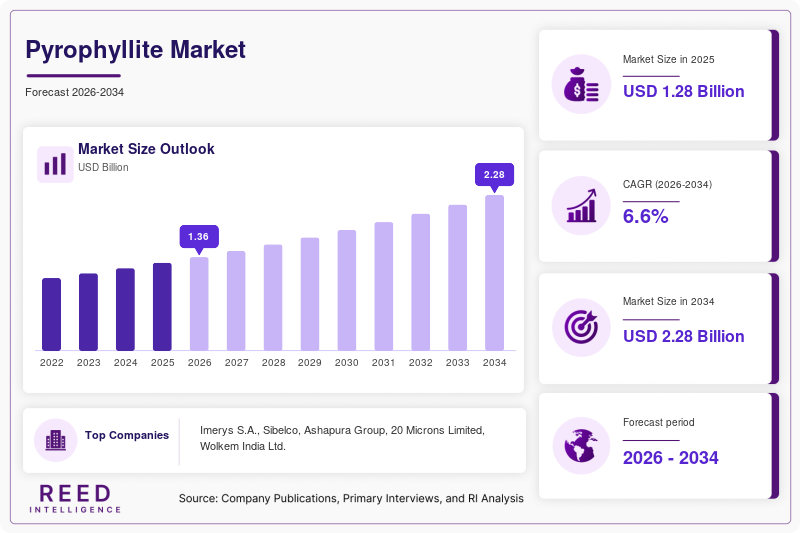
The global Pyrophyllite Market size was valued at USD 1.28 billion in 2026 and is projected to reach USD 2.14 billion by 2034, expanding at a compound annual growth rate (CAGR) of 6.6% during the forecast period (2026–2034). Pyrophyllite, a naturally occurring hydrous aluminum silicate mineral, is widely utilized in ceramics, refractories, paints, rubber, and construction applications due to its thermal stability, chemical inertness, and excellent workability. The market is experiencing steady expansion driven by growing industrialization, particularly in developing economies where demand for advanced materials is rising.
A key global factor supporting market growth is the increasing demand from the ceramics and refractories industries. As construction and infrastructure development accelerate worldwide, the need for high-performance materials that can withstand high temperatures and mechanical stress is increasing. Pyrophyllite’s unique mineralogical properties make it a preferred raw material in these applications, thus contributing to sustained market growth.
Key Highlights
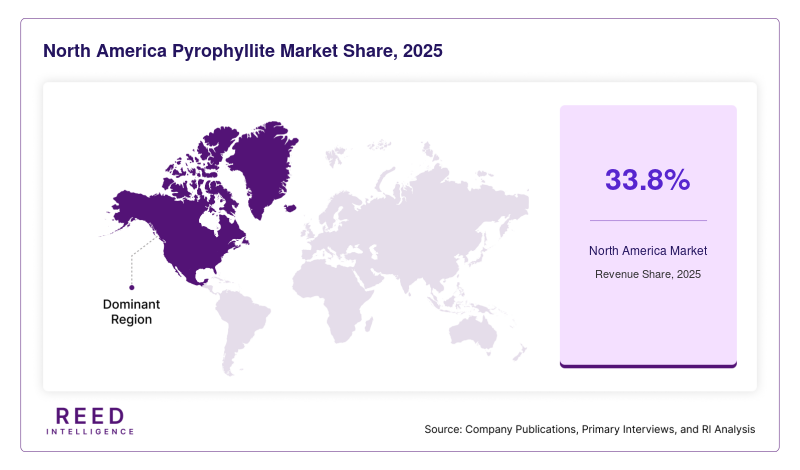
- North America dominated the market with a 33.8% share in 2025.
- Asia Pacific is expected to grow at the fastest CAGR of 7.4% during 2026–2034.
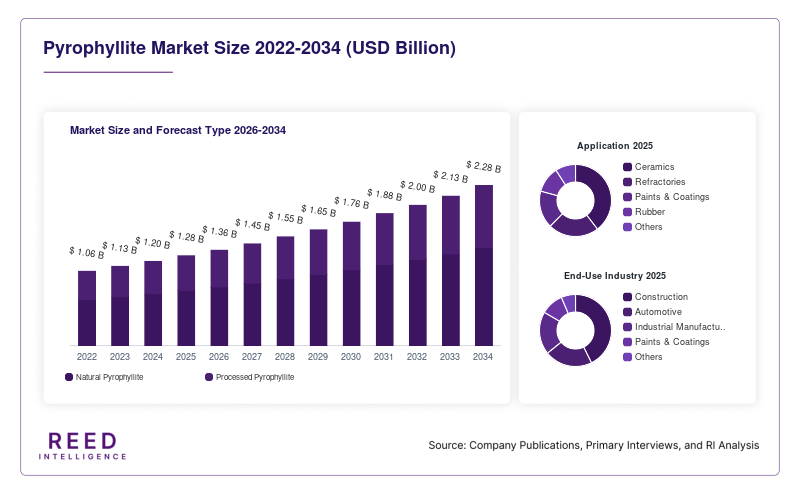
- By type, natural pyrophyllite accounted for the largest share of 62.1%, while processed pyrophyllite is projected to grow at a CAGR of 7.1%.
- By application, ceramics led with a 39.6% share, whereas refractories are expected to expand at a CAGR of 6.9%.
- The United States remained the dominant country, with market values of USD 420 million in 2024 and USD 455 million in 2025.
Market Trends
Increasing Use of Pyrophyllite in Advanced Ceramics
The growing use of pyrophyllite in advanced ceramics is a notable trend shaping the market. Manufacturers are increasingly adopting this mineral in the production of technical ceramics due to its excellent thermal resistance and low shrinkage properties. These characteristics are particularly valuable in electronics, aerospace, and automotive industries where precision and durability are essential. The rising demand for electronic components and heat-resistant materials is further accelerating the adoption of pyrophyllite. Additionally, advancements in ceramic processing technologies have enabled improved utilization of pyrophyllite, enhancing product performance and consistency across applications.
Expansion of Eco-Friendly and Sustainable Materials
Another significant trend is the shift toward environmentally sustainable raw materials. Pyrophyllite is gaining attention as an eco-friendly alternative to synthetic fillers due to its natural origin and low environmental impact during processing. Industries such as paints, coatings, and plastics are increasingly incorporating pyrophyllite to reduce their carbon footprint while maintaining product performance. Regulatory pressures and sustainability goals are encouraging manufacturers to adopt minerals that align with environmental standards. This trend is expected to strengthen over the forecast period as companies prioritize sustainable sourcing and production practices.
Market Drivers
Growth in Construction and Infrastructure Development
The rapid expansion of construction activities worldwide is a major driver of the Pyrophyllite Market. Pyrophyllite is widely used in ceramics, tiles, and refractory materials, all of which are essential components in building and infrastructure projects. Emerging economies are witnessing increased investments in urban development, transportation networks, and industrial facilities, leading to higher demand for construction materials. The mineral’s ability to improve product strength and thermal resistance makes it an attractive choice for manufacturers. This consistent demand from the construction sector is expected to sustain market growth over the coming years.
Rising Demand from the Refractories Industry
The refractories industry plays a critical role in driving the demand for pyrophyllite. The mineral is used extensively in the production of refractory bricks and linings due to its high melting point and resistance to chemical corrosion. Industries such as steel, cement, and glass manufacturing rely heavily on refractory materials to maintain efficient operations under high-temperature conditions. As industrial output increases globally, the demand for durable and cost-effective refractory materials is also rising. This trend is significantly contributing to the expansion of the Pyrophyllite Market.
Market Restraint
Availability of Substitute Materials
The availability of substitute materials such as talc, kaolin, and other industrial minerals poses a challenge to the Pyrophyllite Market. These alternatives often offer similar functional properties and are sometimes available at lower costs, making them attractive to manufacturers seeking cost optimization. For example, talc is widely used in ceramics and plastics due to its softness and chemical stability, which can reduce the reliance on pyrophyllite in certain applications. This competition can limit the growth potential of the market, especially in price-sensitive regions.
Additionally, fluctuations in raw material quality and limited availability of high-grade pyrophyllite deposits can further impact market expansion. Mining and extraction processes can also pose environmental challenges, leading to regulatory restrictions in some regions. These factors collectively create barriers for market participants, requiring them to invest in efficient extraction techniques and product differentiation strategies to maintain competitiveness.
Market Opportunities
Increasing Applications in Paints and Coatings
The expanding use of pyrophyllite in paints and coatings presents a significant growth opportunity. The mineral acts as an effective filler that enhances durability, improves surface finish, and provides resistance to moisture and chemicals. As demand for high-performance coatings rises in construction and automotive industries, the adoption of pyrophyllite is expected to increase. Furthermore, the shift toward eco-friendly formulations is encouraging manufacturers to use natural minerals, creating additional opportunities for market growth.
Growth in Emerging Markets
Emerging economies offer substantial growth opportunities for the Pyrophyllite Market. Countries in Asia Pacific, Latin America, and Africa are experiencing rapid industrialization and urbanization, leading to increased demand for ceramics, refractories, and construction materials. Government initiatives focused on infrastructure development and manufacturing expansion are further driving demand. Additionally, the availability of untapped mineral resources in these regions presents opportunities for new market entrants and investments in mining activities.
Segmental Analysis
By Type
Natural pyrophyllite dominated the market in 2024, accounting for a share of 62.1%. This dominance is attributed to its widespread availability and cost-effectiveness compared to processed variants. Industries such as ceramics and refractories prefer natural pyrophyllite due to its inherent properties, including thermal resistance and chemical stability. Additionally, the minimal processing required for natural pyrophyllite reduces production costs, making it a preferred choice for manufacturers. The growing demand for raw materials in construction and industrial applications further supports the dominance of this segment.
Processed pyrophyllite is expected to be the fastest-growing subsegment, with a CAGR of 7.1%. The growth is driven by increasing demand for high-purity materials in specialized applications such as advanced ceramics and coatings. Processing enhances the mineral’s properties, making it suitable for high-performance applications. Additionally, advancements in processing technologies are improving product quality and consistency, further driving demand.
By Application
The ceramics segment held the largest share of 39.6% in 2024, driven by the extensive use of pyrophyllite in ceramic products such as tiles and sanitary ware. The mineral improves the strength and durability of ceramic products, making it an essential raw material. The growth of the construction industry and increasing demand for aesthetically appealing building materials are further supporting this segment.
The refractories segment is projected to grow at a CAGR of 6.9%. The increasing demand for high-temperature resistant materials in industries such as steel and cement is driving this growth. Pyrophyllite’s ability to withstand extreme temperatures and chemical exposure makes it a preferred choice for refractory applications.
By End-Use Industry
The construction industry dominated the market in 2024, accounting for a significant share due to the widespread use of pyrophyllite in building materials. The rapid growth of infrastructure projects and urban development is driving demand in this segment. Additionally, the increasing use of ceramics and coatings in construction applications is further supporting market growth.
The paints and coatings industry is expected to grow at the fastest CAGR of 6.8%. The rising demand for high-performance coatings with enhanced durability and environmental compatibility is driving this growth. Pyrophyllite’s properties as a filler material make it an ideal choice for improving coating performance.
Regional Analysis
North America
North America held a significant share of 33.8% in 2025 and is expected to grow at a CAGR of 5.8% during the forecast period. The region’s mature industrial base and strong demand from the ceramics and refractories sectors contribute to its dominance. The presence of established manufacturers and advanced production technologies supports consistent market growth. Additionally, the increasing focus on sustainable materials is encouraging the adoption of natural minerals like pyrophyllite.
The United States remains the dominant country in this region, driven by robust construction activities and industrial production. A unique growth factor is the increasing investment in infrastructure modernization projects, which require high-performance materials. This trend is expected to sustain demand for pyrophyllite in the coming years.
Europe
Europe accounted for a notable share of the Pyrophyllite Market in 2025 and is projected to grow at a CAGR of 5.5%. The region’s well-established ceramics industry and strong focus on quality standards contribute to steady demand. Additionally, the increasing adoption of eco-friendly materials is supporting market growth.
Germany is the leading country in Europe, driven by its advanced manufacturing sector. A key growth factor is the rising demand for high-quality ceramics used in automotive and industrial applications. This demand is expected to drive the market forward.
Asia Pacific
Asia Pacific is the fastest-growing region, with a projected CAGR of 7.4%. The region’s rapid industrialization and urbanization are key drivers of market growth. Increasing investments in construction and infrastructure projects are further boosting demand for pyrophyllite-based materials.
China dominates the market in this region due to its large manufacturing base. A unique growth factor is the expansion of the ceramics industry, supported by strong domestic demand and export activities. This trend is expected to continue driving market growth.
Middle East & Africa
The Middle East & Africa region is expected to grow at a CAGR of 6.1%. The market is supported by increasing construction activities and investments in industrial development. The demand for refractory materials in oil and gas industries also contributes to growth.
Saudi Arabia is the dominant country in this region, driven by infrastructure development projects. A key growth factor is the government’s focus on economic diversification, which is encouraging investments in manufacturing and construction sectors.
Latin America
Latin America is projected to grow at a CAGR of 5.9% during the forecast period. The region’s growing construction industry and increasing demand for ceramics are supporting market expansion. Economic recovery in key countries is also contributing to growth.
Brazil leads the market in Latin America, driven by its expanding industrial sector. A unique growth factor is the rising demand for construction materials in residential and commercial projects, which is boosting the use of pyrophyllite.
Competitive Landscape
The Pyrophyllite Market is moderately fragmented, with several regional and global players competing for market share. Leading companies focus on expanding their production capacities and improving product quality to maintain competitiveness. One of the leading players in the market is Imerys S.A., which has a strong presence in industrial minerals and a diverse product portfolio.
Companies are also investing in research and development to explore new applications of pyrophyllite in advanced materials. Recent developments include capacity expansions and strategic partnerships aimed at strengthening market positions. Additionally, market participants are focusing on sustainable mining practices to meet environmental regulations and consumer expectations.
Key Players
- Imerys S.A.
- Sibelco
- Ashapura Group
- 20 Microns Limited
- Jindal Minerals
- Kamlesh Minerals
- Kanhaiya Minerals
- Mahaveer Mineral Industries
- Rajasthan Minerals
- Shree B.S. Mining Company
- Wolkem India Ltd.
- Golcha Minerals
- Trimex Industries
- Dev International
- Anand Talc
Recent Developments
- In 2025, a leading mineral company expanded its pyrophyllite processing facility to meet rising demand from the ceramics industry.
- In 2024, a major player introduced a high-purity pyrophyllite product for advanced coating applications.
- In 2025, several companies formed partnerships to improve supply chain efficiency and expand their global presence.
Pyrophyllite Market Segments
Type
- Natural Pyrophyllite
- Processed Pyrophyllite
Application
- Ceramics
- Refractories
- Paints & Coatings
- Rubber
- Others
End-Use Industry
- Construction
- Automotive
- Industrial Manufacturing
- Paints & Coatings
- Others
By Region
- North America
- Europe
- APAC
- Middle East and Africa
- LATAM