Pyruvate Kinase Deficiency Market Size, Share & Demand Report By Treatment Type (Enzyme Activators, Blood Transfusion, Splenectomy, Gene Therapy), By Diagnosis Type (Genetic Testing, Biochemical Assays), By End-Use (Hospitals, Specialty Clinics, Diagnostic Centers), By Distribution Channel (Hospital Pharmacies, Retail Pharmacies, Online Pharmacies), By Region & Segment Forecasts, 2025–2034
USD 3950
Market Overview
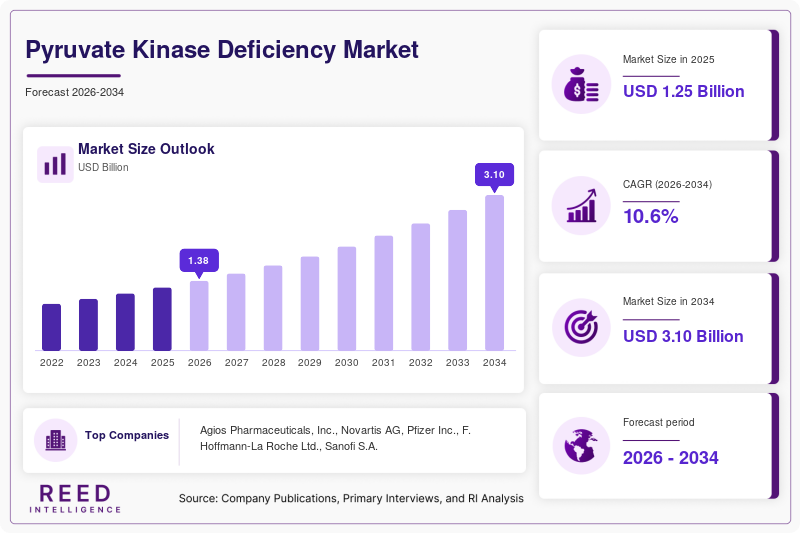
The global Pyruvate Kinase Deficiency Market size was valued at approximately USD 1.25 billion in 2025 and is projected to reach around USD 3.10 billion by 2034, expanding at a CAGR of 10.6% during the forecast period (2025–2034). The market reflects steady growth driven by advancements in rare disease diagnostics, improved genetic screening programs, and the growing availability of targeted therapies. Increasing awareness among healthcare providers and patients regarding inherited hemolytic anemias has also contributed to higher diagnosis rates, thereby supporting overall market expansion.
A key global factor supporting market growth is the increasing adoption of precision medicine approaches in hematology. As healthcare systems transition toward personalized treatment frameworks, therapies tailored to genetic mutations associated with pyruvate kinase deficiency are gaining traction. Additionally, favorable regulatory incentives for orphan drugs and expanding research pipelines are further accelerating the development of innovative treatments.
Key Highlights
- North America dominated the market with a 42% share in 2025, while Asia Pacific is projected to grow at the fastest CAGR of 12.8% through 2034.
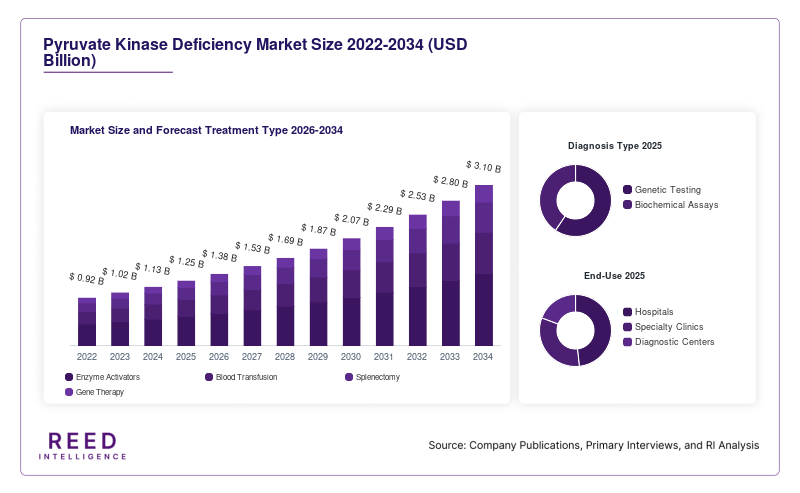
- By treatment type, enzyme activators accounted for the largest share at 38%, while gene therapy is expected to be the fastest-growing segment with a CAGR of 14.2%.
- By end-use, hospitals led with a 55% share, whereas specialty clinics are anticipated to grow at a CAGR of 11.9%.
- The U.S. remained the dominant country with market values of USD 420 million in 2025 and USD 465 million in 2026.
Market Trends
Rising Adoption of Gene-Based Therapies
Gene therapy is emerging as a transformative trend in the Pyruvate Kinase Deficiency Market. With advancements in CRISPR and viral vector technologies, companies are focusing on curative approaches rather than symptomatic management. This shift is reshaping treatment paradigms by targeting the root genetic cause of the disease. Clinical trials and regulatory approvals in gene therapy are expected to redefine long-term treatment outcomes and reduce dependence on lifelong supportive therapies such as transfusions.
Expansion of Rare Disease Screening Programs
Governments and healthcare organizations are increasingly investing in neonatal and genetic screening programs. This trend has led to earlier diagnosis of pyruvate kinase deficiency, improving treatment outcomes and expanding the patient pool. Digital health tools and AI-based diagnostic platforms are also supporting faster identification of rare blood disorders. As a result, early intervention strategies are becoming more common, contributing to sustained market growth.
Market Drivers
Increasing Prevalence of Rare Genetic Disorders
The rising incidence of rare inherited conditions, including pyruvate kinase deficiency, is a major driver of the market. Improved diagnostic technologies and genetic awareness campaigns have led to higher reported cases globally. As more patients are diagnosed, the demand for targeted therapies and supportive treatments continues to grow, thereby driving market expansion.
Strong Pipeline of Targeted Therapies
Pharmaceutical companies are actively investing in research and development for novel therapies, particularly enzyme activators and gene-based treatments. The presence of a robust pipeline, supported by orphan drug incentives and accelerated approval pathways, is fostering innovation. These developments are improving treatment efficacy and expanding therapeutic options, which in turn is fueling the growth of the Pyruvate Kinase Deficiency Market.
Market Restraint
High Cost of Treatment and Limited Accessibility
One of the key challenges in the Pyruvate Kinase Deficiency Market is the high cost associated with advanced therapies, particularly gene therapy and novel enzyme activators. These treatments often require significant investment in research, clinical trials, and manufacturing, which translates into high pricing. As a result, access to these therapies remains limited in low- and middle-income regions.
Additionally, reimbursement frameworks for rare diseases are still evolving in many countries. Patients may face financial barriers due to insufficient insurance coverage or lack of government support. The limited number of specialized treatment centers further restricts access, particularly in developing regions. These factors collectively hinder widespread adoption and slow down market penetration despite technological advancements.
Market Opportunities
Expansion in Emerging Markets
Emerging economies present significant growth opportunities for the Pyruvate Kinase Deficiency Market. Improvements in healthcare infrastructure, rising healthcare expenditure, and increasing awareness about rare diseases are contributing to market expansion. Governments in these regions are also introducing policies to support orphan drug development and improve patient access, creating favorable conditions for market growth.
Development of Curative Therapies
The shift toward curative treatment approaches offers a promising opportunity for market players. Gene therapy and advanced biologics have the potential to provide long-term or permanent solutions for patients. As clinical research progresses and regulatory approvals increase, these therapies are expected to gain wider acceptance. This evolution toward curative solutions could significantly transform the market landscape and create new revenue streams.
Segmental Analysis
By Treatment Type
Enzyme activators dominated the Pyruvate Kinase Deficiency Market in 2025, accounting for 38% of the total share. These therapies gained prominence due to their ability to improve red blood cell function and reduce hemolysis. Their relatively lower cost compared to gene therapies and ease of administration contributed to their widespread adoption.
Gene therapy is expected to be the fastest-growing segment, with a projected CAGR of 14.2% during the forecast period. The growth is driven by its potential to offer long-term or curative outcomes. Advances in gene-editing technologies and increasing investment in clinical trials are expected to support segment expansion. As regulatory approvals increase, gene therapy is likely to become a key component of treatment strategies.
By Diagnosis Type
Genetic testing held the largest share of 45% in 2025, driven by its accuracy in identifying specific mutations associated with the condition. The increasing adoption of advanced diagnostic tools and the growing emphasis on early detection have supported this segment’s dominance.
Biochemical assays are projected to grow at the fastest CAGR of 11.5% during the forecast period. These tests are gaining popularity due to their cost-effectiveness and ability to provide quick results. Improvements in laboratory technologies and increased availability of diagnostic services are expected to drive growth.
By End-Use
Hospitals accounted for 55% of the market share in 2025, as they serve as primary centers for diagnosis and treatment. The availability of specialized equipment and skilled healthcare professionals has supported the dominance of this segment.
Specialty clinics are anticipated to grow at a CAGR of 11.9% during the forecast period. These clinics offer focused care for rare diseases and provide personalized treatment options. The increasing number of such facilities and rising patient preference for specialized care are expected to drive segment growth.
By Distribution Channel
Hospital pharmacies dominated the market with a 48% share in 2025 due to their direct association with treatment centers. They ensure the availability of medications and facilitate efficient patient management.
Online pharmacies are expected to grow at the fastest CAGR of 13.1% during the forecast period. The increasing adoption of digital platforms and the convenience of home delivery are driving this segment. Additionally, improvements in logistics and regulatory frameworks are supporting growth.
Regional Analysis
North America
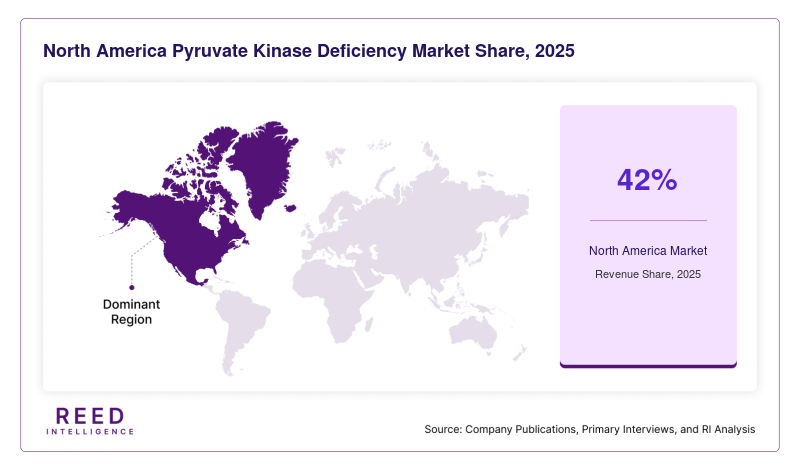
North America accounted for 42% of the Pyruvate Kinase Deficiency Market share in 2025 and will expand at a CAGR of 10.2% during the forecast period. The region has benefited from advanced healthcare infrastructure, high awareness levels, and strong support for rare disease research. The presence of leading pharmaceutical companies and access to cutting-edge diagnostic technologies have further strengthened market growth.
The United States dominated the regional market due to its well-established regulatory framework and high adoption of innovative therapies. The availability of orphan drug incentives and strong reimbursement systems has encouraged companies to invest in research and development. Additionally, the growing number of clinical trials focused on gene therapy has positioned the country as a key hub for innovation.
Europe
Europe held a 28% market share in 2025 and is expected to grow at a CAGR of 9.8% through 2034. The region has witnessed steady growth due to increasing government initiatives aimed at improving rare disease management. Collaborative research programs and funding support from regional organizations have also contributed to market expansion.
Germany emerged as the dominant country in the region, supported by its robust healthcare system and strong focus on biotechnology research. The country’s emphasis on early diagnosis and patient registries has improved disease management. Additionally, partnerships between academic institutions and pharmaceutical companies have accelerated the development of new therapies.
Asia Pacific
Asia Pacific captured 18% of the market share in 2025 and is projected to grow at the fastest CAGR of 12.8% during the forecast period. The region is experiencing rapid growth due to increasing healthcare investments, expanding diagnostic capabilities, and rising awareness of rare diseases.
China dominated the regional market, driven by its large population base and improving healthcare infrastructure. The government’s focus on expanding access to advanced treatments and promoting domestic pharmaceutical innovation has supported market growth. Additionally, increasing collaborations with global companies are facilitating the introduction of new therapies.
Middle East & Africa
The Middle East & Africa accounted for 7% of the market share in 2025 and will grow at a CAGR of 9.1% through 2034. The region is gradually developing its healthcare infrastructure, with increasing investments in specialized treatment facilities and diagnostic services.
Saudi Arabia led the regional market due to its growing focus on healthcare modernization and rare disease management. Government initiatives aimed at improving patient access to advanced treatments and increasing awareness are driving growth. The establishment of specialized centers for genetic disorders has further supported market expansion.
Latin America
Latin America held a 5% share of the Pyruvate Kinase Deficiency Market in 2025 and is expected to grow at a CAGR of 9.5% during the forecast period. The region is witnessing gradual growth due to improving healthcare systems and increasing awareness of rare diseases.
Brazil dominated the regional market, supported by its expanding healthcare infrastructure and government initiatives to improve access to treatment. The country’s focus on public health programs and partnerships with international organizations has enhanced diagnostic capabilities. As awareness continues to grow, the market is expected to expand steadily.
Competitive Landscape
The Pyruvate Kinase Deficiency Market is characterized by the presence of several pharmaceutical and biotechnology companies focusing on rare disease therapies. The market remains moderately consolidated, with a few key players holding significant shares. Companies are investing in research and development, strategic collaborations, and product launches to strengthen their market position.
Agios Pharmaceuticals, Inc. is a leading player in the market, known for its focus on enzyme activators. The company has recently advanced its pipeline by expanding clinical trials for next-generation therapies. Other players are also actively pursuing innovation through partnerships and acquisitions to enhance their portfolios and expand their global presence.
Key Players
- Agios Pharmaceuticals, Inc.
- Novartis AG
- Pfizer Inc.
- F. Hoffmann-La Roche Ltd.
- Sanofi S.A.
- Bristol-Myers Squibb Company
- Bluebird Bio, Inc.
- CRISPR Therapeutics AG
- Vertex Pharmaceuticals Incorporated
- BioMarin Pharmaceutical Inc.
- Takeda Pharmaceutical Company Limited
- Amgen Inc.
- Regeneron Pharmaceuticals, Inc.
- Editas Medicine, Inc.
- Sangamo Therapeutics, Inc.
Recent Developments
- In 2025, a leading biotechnology company initiated Phase III clinical trials for a novel gene therapy targeting pyruvate kinase deficiency.
- A major pharmaceutical firm expanded its enzyme activator portfolio with improved efficacy formulations.
- Strategic collaborations between biotech firms and research institutions increased to accelerate drug development.
- Regulatory agencies granted orphan drug designation to multiple pipeline candidates, supporting faster approvals.
- Companies increased investment in digital diagnostic platforms to enhance early detection and patient monitoring.
Pyruvate Kinase Deficiency Market Segments
Treatment Type
- Enzyme Activators
- Blood Transfusion
- Splenectomy
- Gene Therapy
Diagnosis Type
- Genetic Testing
- Biochemical Assays
End-Use
- Hospitals
- Specialty Clinics
- Diagnostic Centers
Distribution Channel
- Hospital Pharmacies
- Retail Pharmacies
- Online Pharmacies
By Region
- North America
- Europe
- APAC
- Middle East and Africa
- LATAM